WHAT IS URBANResilience, 1-2 August 2012
National Colloquium on Urban
                             RESILIENCE?
                                     from the view of
                                     Irma Wilson
 FutureSharp Resilient Village Blueprint Development
Question 1 – What is Urban Resilience?
THE ABILITY TO ADAPT ~ to sudden or more gradual changing circumstances
Structurally, Systemically & Culturally

Food security
Water management
Energy generation &use
Transportation
Communication
Production
Education
Social habits & constructs
Law & order


                                                                          Irma Wilson 2
Question 2 – Should we promote urban resilience?
YES  we MUST!

Beyond urban, we should develop rural & semi-urban with resilience as a mantra
         Beyond promote, we should build transition spaces for visceral experience
         Beyond resilience, we should redesign for a THRIVING world (ignite imagination)

There is a misconception that it is the ‘strongest most successful’ individuals inside a species
that will survive. It is the most adaptive to change that survives
(evolutionary biology)

Design & construct for resilience
Will result in a more graceful transition


                                                                                    Irma Wilson 3
Question 3 – Can we predict/ determine it?
We can most certainly imagine desirable futures and reverse engineer it.
What outcome to we want ~ if we want this outcome, what must we do just before this? Before
that can happen what must the systems look like and how must culture change to inhabit these
space? To instigate this, what scaffolding is required? before that can happen, who must speak
to each other? And before that what will it take to get them interested in talking? And so on and
so forth…

We can create transition spaces for the mainstream to
interact with abstract concepts brought to life

We are at the precipice.
The only thing we can not predict is when.
It is important to look with clarity at what is.
Ask the questions:
What do we want to become?
Where do we head to next?

                                                                                   Irma Wilson 4
Question 4 – How do we apply it to cities?
                              - retro-fit for resilience
Working with what is          - re-define use
                              - re-connect local to local

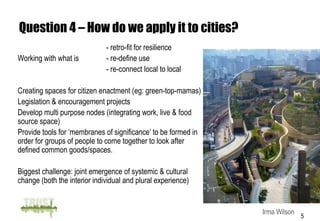
Creating spaces for citizen enactment (eg: green-top-mamas)
Legislation & encouragement projects
Develop multi purpose nodes (integrating work, live & food
source space)
Provide tools for ‘membranes of significance’ to be formed in
order for groups of people to come together to look after
defined common goods/spaces.

Biggest challenge: joint emergence of systemic & cultural
change (both the interior individual and plural experience)


                                                                Irma Wilson
                                                                              5
Question 5 – Will urban resilience look different
             in a developing world context?
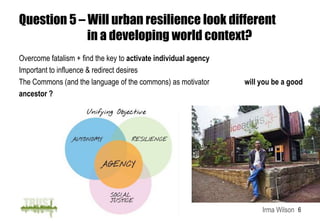
Overcome fatalism + find the key to activate individual agency
Important to influence & redirect desires
The Commons (and the language of the commons) as motivator       will you be a good
ancestor ?


                                                                      Irma Wilson 6

What is urban resilience af

  • 1.
    WHAT IS URBANResilience,1-2 August 2012 National Colloquium on Urban RESILIENCE? from the view of Irma Wilson FutureSharp Resilient Village Blueprint Development
  • 2.
    Question 1 –What is Urban Resilience? THE ABILITY TO ADAPT ~ to sudden or more gradual changing circumstances Structurally, Systemically & Culturally Food security Water management Energy generation &use Transportation Communication Production Education Social habits & constructs Law & order Irma Wilson 2
  • 3.
    Question 2 –Should we promote urban resilience? YES  we MUST! Beyond urban, we should develop rural & semi-urban with resilience as a mantra Beyond promote, we should build transition spaces for visceral experience Beyond resilience, we should redesign for a THRIVING world (ignite imagination) There is a misconception that it is the ‘strongest most successful’ individuals inside a species that will survive. It is the most adaptive to change that survives (evolutionary biology) Design & construct for resilience Will result in a more graceful transition Irma Wilson 3
  • 4.
    Question 3 –Can we predict/ determine it? We can most certainly imagine desirable futures and reverse engineer it. What outcome to we want ~ if we want this outcome, what must we do just before this? Before that can happen what must the systems look like and how must culture change to inhabit these space? To instigate this, what scaffolding is required? before that can happen, who must speak to each other? And before that what will it take to get them interested in talking? And so on and so forth… We can create transition spaces for the mainstream to interact with abstract concepts brought to life We are at the precipice. The only thing we can not predict is when. It is important to look with clarity at what is. Ask the questions: What do we want to become? Where do we head to next? Irma Wilson 4
  • 5.
    Question 4 –How do we apply it to cities? - retro-fit for resilience Working with what is - re-define use - re-connect local to local Creating spaces for citizen enactment (eg: green-top-mamas) Legislation & encouragement projects Develop multi purpose nodes (integrating work, live & food source space) Provide tools for ‘membranes of significance’ to be formed in order for groups of people to come together to look after defined common goods/spaces. Biggest challenge: joint emergence of systemic & cultural change (both the interior individual and plural experience) Irma Wilson 5
  • 6.
    Question 5 –Will urban resilience look different in a developing world context? Overcome fatalism + find the key to activate individual agency Important to influence & redirect desires The Commons (and the language of the commons) as motivator will you be a good ancestor ? Irma Wilson 6