Comprehensive Planning :
An Essential Framework for
Housing and Urban Development
Atty. FRANCISCO L. DAGNALAN, En. P.
Commissioner , Housing and Land Use Regulatory Board
President, Philippine Institute of Environmental Planners
What is a Comprehensive
Development Plan ?
 The document/s , including maps, charts and
other materials embodying goals and
objectives, policy guidelines strategies and
proposals for over-all socio-economic growth
and development of the area
– Source – The Language of Environmental Planning in the
Philippines , by Endriga, Elum, Yap and Alcalde, School of
Urban and Regional Planning, University of the Philippines,
Quezon City, 2004
What is a Comprehensive
Development Plan ?
 It has also been defined as an integrated series of
decision documents, including maps specifying the
nature of future physical, social, economic and
environmental development of the Urban Zone as
outlined in the Concept Plan, consisting of, among
others, a land use plan, including area phasing,
sectoral programs, land acquisition and disposition
programs and capital improvement programs
– Source : The Language of Environmental Planning in the
Philippines , ibid.
Why Comprehensive & Integrated ?
 It covers the entire territorial jurisdiction of the local
government unit ( city or municipality) ( forest,
lowland, coastal );
 It incorporates national policies and links (or is
integrated )with other (higher level) plans;
 It is based on the detailed scientific analysis of socio-
economic (including demographic), physical and
environmental data and projected conditions of the
planning area; and
 It contains multi - sectoral goals, plans, strategies
programs and projects , e.g., for production,
settlements development and protection .
What is a LAND USE PLAN ???
An essential component of the
comprehensive development plan, it
designates the future use or reuse of the
land and the structure built upon the land
within a given jurisdiction’s planning
area and the policies and reasoning used
in arriving at the decisions in the plan
It projects public and private land
uses in accordance with the planned
spatial organization of economic and
social activities and the traffic of goods
and people
What is Land Use Planning ?
 It is the systematic approach / process for
identifying, classifying and locating urban land,
which is achieved by analyzing the socio-
economic needs of the population in
consideration of the physical and natural
attributes of a city / municipality
– Source: National Urban Development and Housing Framework
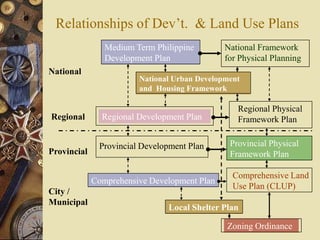
Relationships of Dev’t. & Land Use Plans
National
Medium Term Philippine
Development Plan
National Framework
for Physical Planning
National Urban Development
and Housing Framework
Regional Regional Development Plan
Regional Physical
Framework Plan
Provincial
Provincial Development Plan Provincial Physical
Framework Plan
City /
Municipal
Comprehensive Development Plan
Comprehensive Land
Use Plan (CLUP)
Local Shelter Plan
Zoning Ordinance
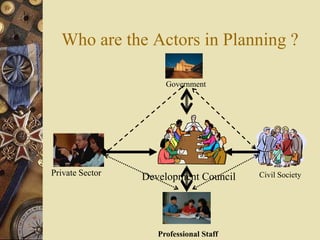
Who are the Actors in Planning ?
Government
Professional Staff
Private Sector Development Council Civil Society
Why Plan ???
Land is a finite resource but
population continues to grow year after
year requiring more land for housing
and other urban uses, agricultural areas
for food production and more forest for
timber production and watershed
protection. Therefore, the need to
allocate land judiciously and
discriminately
LEGAL BASES of PLANNING
Constitutional Provisions on
National Economy and Patrimony
- Article XII, 1987 Constitution
Local Government Code
- Sec. 447 and 458, R.A. 7160
Existing Laws on Land Use Planning
Constitutional Principles
 “The use of property bears a social function,
and all economic agents shall contribute to the
common good. Individuals and private
groups… shall have the right to own,
establish, and operate economic enterprises,
subject to the duty of the State to promote
distributive justice and to intervene when the
common good so demands.”
- Art. XII, Sec. 6
Powers of Local Governments
 Generate and maximize the use of resources and
revenues for the development plans, program
objectives and priorities of the city as provided
for under Section 18 of the Code, with particular
attention to agro-industrial development and city-
wide growth and progress, and relative thereto,
shall:
– Prescribe reasonable limits and restraints on the
use of property within the jurisdiction of the city /
municipality ;
– Adopt a comprehensive land use plan for the city/
municipality;
Powers of Local Governments
 Regulate activities relative to the use of land,
buildings and structures within the city/
municipality in order to promote the general
welfare ;
– Source: Sec 447 and 458, subsec (a) (2) of R.A. 7160
Existing Laws on Land Use Planning
 P.D. 933 as amended by E.O. 648 Series of
1981 and E.O. 90, Series of 1986
 Executive Order 72 Series of 1993
 Sec. 6 of R.A. 7279 (UDHA)
 Sec. 4 of R.A. 8435 (AFMA)
Why the Urgency of Planning ???
 Continuing unmet needs of existing population as well
as projected increasing population for land for various
uses;
 Demand for more cheap and accessible land for urban
development;
 Continuing issues / problems on conversion of
agricultural land to urban uses.
 Accelerating transmigration of rural poor to
Cities/Urban Areas, seeking employment.
 Ongoing environmental degradation;
 Fragmented laws constrain development
Objectives of Land Use Planning
1. Promote the efficient utilization, acquisition
and disposition of land as a limited resources;
a) Make sure there is enough for our future generations to use
and enjoy while addressing the needs of the present times
2. Influence, direct and harmonize decisions and
activities of the public and the private sectors
affecting the use, management and
disposition of lands;
Objectives of Land Use Planning
3. Reconcile land use conflicts between and
among individuals and government agencies
relating to present needs and anticipated
demands for land;
4. Promote desirable and efficient patterns of
land uses and prevent premature and wasteful
development and minimize the cost of public
facilities, services and infrastructure;
5. Protect and preserve valuable agri-
cultural areas consistent with the need to
promote industrialization;
6. Maintain ecological balance thru Control of
development in critical areas such as flood
plains and watershed areas;
7. Integrate programs and projects on land
resources development among land
development agencies;
Objectives of Land Use Planning
8. Conserve areas of ecological, aesthetic
and historical values and maintain and
protect natural open areas and areas of
significant views;
9. Promote and implement a shelter plan
• Thru Identification of sites suitable
for housing; and
10. Promote an efficient circulation system
Objectives of Land Use Planning
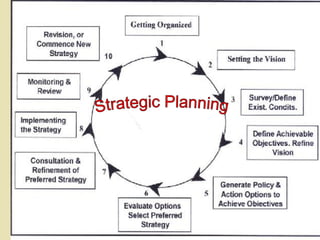
Overview of the Process
 It utilizes the planning methodology which
includes: data gathering, problem identification
and situational analysis; goals / objectives
formulation; generation of alternative spatial
strategies; evaluation and selection of preferred
strategy; formulation of the plan; adoption,
review and approval; and implementation and
monitoring
– Source: National Urban Development and
Housing Framework
The NUDHF and Planning
 The framework shall refer to the comprehensive plan for urban and
urbanizable areas aimed at achieving the objectives of the Program.
In the formulation of the Framework, a review and rationalization of
existing town and land use plans, housing programs, and all other
objectives and activities of government agencies and the private
sectors which may substantially affect urban land use patterns,
transportation and public utilities, infrastructure, environment and
population movement shall be undertaken with the concurrence of the
local government units concerned.
– Source : Sec. 6, R.A. 7279
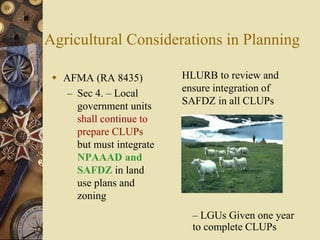
Agricultural Considerations in Planning
 AFMA (RA 8435)
– Sec 4. – Local
government units
shall continue to
prepare CLUPs
but must integrate
NPAAAD and
SAFDZ in land
use plans and
zoning
HLURB to review and
ensure integration of
SAFDZ in all CLUPs
– LGUs Given one year
to complete CLUPs
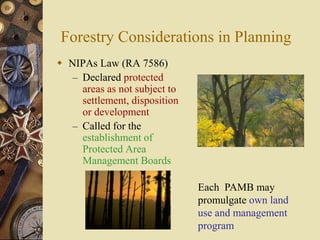
Forestry Considerations in Planning
 NIPAs Law (RA 7586)
– Declared protected
areas as not subject to
settlement, disposition
or development
– Called for the
establishment of
Protected Area
Management Boards
Each PAMB may
promulgate own land
use and management
program
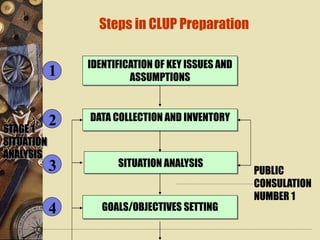
IDENTIFICATION OF KEY ISSUES AND
ASSUMPTIONS
DATA COLLECTION AND INVENTORY
SITUATION ANALYSIS
GOALS/OBJECTIVES SETTING
Steps in CLUP Preparation
1
STAGE 1
SITUATION
ANALYSIS
PUBLIC
CONSULATION
NUMBER 1
2
3
4
25
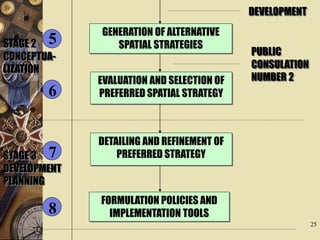
GENERATION OF ALTERNATIVE
SPATIAL STRATEGIES
EVALUATION AND SELECTION OF
PREFERRED SPATIAL STRATEGY
DETAILING AND REFINEMENT OF
PREFERRED STRATEGY
FORMULATION POLICIES AND
IMPLEMENTATION TOOLS
5
8
7
6
STAGE 2
CONCEPTUA-
LIZATION
STAGE 3
DEVELOPMENT
PLANNING
PUBLIC
CONSULATION
NUMBER 2
DEVELOPMENT
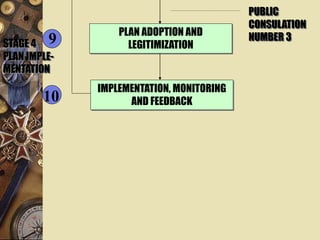
PLAN ADOPTION AND
LEGITIMIZATIONSTAGE 4
PLAN IMPLE-
MENTATION
9
IMPLEMENTATION, MONITORING
AND FEEDBACK10
PUBLIC
CONSULATION
NUMBER 3
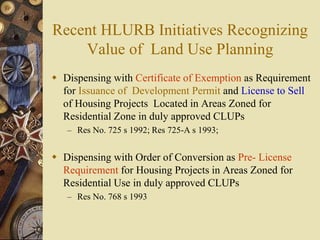
Recent HLURB Initiatives Recognizing
Value of Land Use Planning
 Dispensing with Certificate of Exemption as Requirement
for Issuance of Development Permit and License to Sell
of Housing Projects Located in Areas Zoned for
Residential Zone in duly approved CLUPs
– Res No. 725 s 1992; Res 725-A s 1993;
 Dispensing with Order of Conversion as Pre- License
Requirement for Housing Projects in Areas Zoned for
Residential Use in duly approved CLUPs
– Res No. 768 s 1993
Conclusions
 Preparation of a Good Local Comprehensive
Development Plan , one that is Strategic and
Participatory in Approach, is essential prerequisite for
successful shelter plan
 Properly Prepared Comprehensive Land Use Plan will
eventually obviate need for piece meal approval of
conversion of agricultural lands;
 Suitable Location of Housing Projects best determined in
Land Use Plan;
 Site development plans of housing projects must be
consistent with comprehensive development and land use
plan

Comprehensive planning atty. dagnalan, en.p.

  • 1.
    Comprehensive Planning : AnEssential Framework for Housing and Urban Development Atty. FRANCISCO L. DAGNALAN, En. P. Commissioner , Housing and Land Use Regulatory Board President, Philippine Institute of Environmental Planners
  • 2.
    What is aComprehensive Development Plan ?  The document/s , including maps, charts and other materials embodying goals and objectives, policy guidelines strategies and proposals for over-all socio-economic growth and development of the area – Source – The Language of Environmental Planning in the Philippines , by Endriga, Elum, Yap and Alcalde, School of Urban and Regional Planning, University of the Philippines, Quezon City, 2004
  • 3.
    What is aComprehensive Development Plan ?  It has also been defined as an integrated series of decision documents, including maps specifying the nature of future physical, social, economic and environmental development of the Urban Zone as outlined in the Concept Plan, consisting of, among others, a land use plan, including area phasing, sectoral programs, land acquisition and disposition programs and capital improvement programs – Source : The Language of Environmental Planning in the Philippines , ibid.
  • 4.
    Why Comprehensive &Integrated ?  It covers the entire territorial jurisdiction of the local government unit ( city or municipality) ( forest, lowland, coastal );  It incorporates national policies and links (or is integrated )with other (higher level) plans;  It is based on the detailed scientific analysis of socio- economic (including demographic), physical and environmental data and projected conditions of the planning area; and  It contains multi - sectoral goals, plans, strategies programs and projects , e.g., for production, settlements development and protection .
  • 5.
    What is aLAND USE PLAN ??? An essential component of the comprehensive development plan, it designates the future use or reuse of the land and the structure built upon the land within a given jurisdiction’s planning area and the policies and reasoning used in arriving at the decisions in the plan It projects public and private land uses in accordance with the planned spatial organization of economic and social activities and the traffic of goods and people
  • 6.
    What is LandUse Planning ?  It is the systematic approach / process for identifying, classifying and locating urban land, which is achieved by analyzing the socio- economic needs of the population in consideration of the physical and natural attributes of a city / municipality – Source: National Urban Development and Housing Framework
  • 7.
    Relationships of Dev’t.& Land Use Plans National Medium Term Philippine Development Plan National Framework for Physical Planning National Urban Development and Housing Framework Regional Regional Development Plan Regional Physical Framework Plan Provincial Provincial Development Plan Provincial Physical Framework Plan City / Municipal Comprehensive Development Plan Comprehensive Land Use Plan (CLUP) Local Shelter Plan Zoning Ordinance
  • 8.
    Who are theActors in Planning ? Government Professional Staff Private Sector Development Council Civil Society
  • 9.
    Why Plan ??? Landis a finite resource but population continues to grow year after year requiring more land for housing and other urban uses, agricultural areas for food production and more forest for timber production and watershed protection. Therefore, the need to allocate land judiciously and discriminately
  • 10.
    LEGAL BASES ofPLANNING Constitutional Provisions on National Economy and Patrimony - Article XII, 1987 Constitution Local Government Code - Sec. 447 and 458, R.A. 7160 Existing Laws on Land Use Planning
  • 11.
    Constitutional Principles  “Theuse of property bears a social function, and all economic agents shall contribute to the common good. Individuals and private groups… shall have the right to own, establish, and operate economic enterprises, subject to the duty of the State to promote distributive justice and to intervene when the common good so demands.” - Art. XII, Sec. 6
  • 12.
    Powers of LocalGovernments  Generate and maximize the use of resources and revenues for the development plans, program objectives and priorities of the city as provided for under Section 18 of the Code, with particular attention to agro-industrial development and city- wide growth and progress, and relative thereto, shall: – Prescribe reasonable limits and restraints on the use of property within the jurisdiction of the city / municipality ; – Adopt a comprehensive land use plan for the city/ municipality;
  • 13.
    Powers of LocalGovernments  Regulate activities relative to the use of land, buildings and structures within the city/ municipality in order to promote the general welfare ; – Source: Sec 447 and 458, subsec (a) (2) of R.A. 7160
  • 14.
    Existing Laws onLand Use Planning  P.D. 933 as amended by E.O. 648 Series of 1981 and E.O. 90, Series of 1986  Executive Order 72 Series of 1993  Sec. 6 of R.A. 7279 (UDHA)  Sec. 4 of R.A. 8435 (AFMA)
  • 15.
    Why the Urgencyof Planning ???  Continuing unmet needs of existing population as well as projected increasing population for land for various uses;  Demand for more cheap and accessible land for urban development;  Continuing issues / problems on conversion of agricultural land to urban uses.  Accelerating transmigration of rural poor to Cities/Urban Areas, seeking employment.  Ongoing environmental degradation;  Fragmented laws constrain development
  • 16.
    Objectives of LandUse Planning 1. Promote the efficient utilization, acquisition and disposition of land as a limited resources; a) Make sure there is enough for our future generations to use and enjoy while addressing the needs of the present times 2. Influence, direct and harmonize decisions and activities of the public and the private sectors affecting the use, management and disposition of lands;
  • 17.
    Objectives of LandUse Planning 3. Reconcile land use conflicts between and among individuals and government agencies relating to present needs and anticipated demands for land; 4. Promote desirable and efficient patterns of land uses and prevent premature and wasteful development and minimize the cost of public facilities, services and infrastructure;
  • 18.
    5. Protect andpreserve valuable agri- cultural areas consistent with the need to promote industrialization; 6. Maintain ecological balance thru Control of development in critical areas such as flood plains and watershed areas; 7. Integrate programs and projects on land resources development among land development agencies; Objectives of Land Use Planning
  • 19.
    8. Conserve areasof ecological, aesthetic and historical values and maintain and protect natural open areas and areas of significant views; 9. Promote and implement a shelter plan • Thru Identification of sites suitable for housing; and 10. Promote an efficient circulation system Objectives of Land Use Planning
  • 20.
    Overview of theProcess  It utilizes the planning methodology which includes: data gathering, problem identification and situational analysis; goals / objectives formulation; generation of alternative spatial strategies; evaluation and selection of preferred strategy; formulation of the plan; adoption, review and approval; and implementation and monitoring – Source: National Urban Development and Housing Framework
  • 21.
    The NUDHF andPlanning  The framework shall refer to the comprehensive plan for urban and urbanizable areas aimed at achieving the objectives of the Program. In the formulation of the Framework, a review and rationalization of existing town and land use plans, housing programs, and all other objectives and activities of government agencies and the private sectors which may substantially affect urban land use patterns, transportation and public utilities, infrastructure, environment and population movement shall be undertaken with the concurrence of the local government units concerned. – Source : Sec. 6, R.A. 7279
  • 22.
    Agricultural Considerations inPlanning  AFMA (RA 8435) – Sec 4. – Local government units shall continue to prepare CLUPs but must integrate NPAAAD and SAFDZ in land use plans and zoning HLURB to review and ensure integration of SAFDZ in all CLUPs – LGUs Given one year to complete CLUPs
  • 23.
    Forestry Considerations inPlanning  NIPAs Law (RA 7586) – Declared protected areas as not subject to settlement, disposition or development – Called for the establishment of Protected Area Management Boards Each PAMB may promulgate own land use and management program
  • 24.
    IDENTIFICATION OF KEYISSUES AND ASSUMPTIONS DATA COLLECTION AND INVENTORY SITUATION ANALYSIS GOALS/OBJECTIVES SETTING Steps in CLUP Preparation 1 STAGE 1 SITUATION ANALYSIS PUBLIC CONSULATION NUMBER 1 2 3 4
  • 25.
    25 GENERATION OF ALTERNATIVE SPATIALSTRATEGIES EVALUATION AND SELECTION OF PREFERRED SPATIAL STRATEGY DETAILING AND REFINEMENT OF PREFERRED STRATEGY FORMULATION POLICIES AND IMPLEMENTATION TOOLS 5 8 7 6 STAGE 2 CONCEPTUA- LIZATION STAGE 3 DEVELOPMENT PLANNING PUBLIC CONSULATION NUMBER 2 DEVELOPMENT
  • 26.
    PLAN ADOPTION AND LEGITIMIZATIONSTAGE4 PLAN IMPLE- MENTATION 9 IMPLEMENTATION, MONITORING AND FEEDBACK10 PUBLIC CONSULATION NUMBER 3
  • 28.
    Recent HLURB InitiativesRecognizing Value of Land Use Planning  Dispensing with Certificate of Exemption as Requirement for Issuance of Development Permit and License to Sell of Housing Projects Located in Areas Zoned for Residential Zone in duly approved CLUPs – Res No. 725 s 1992; Res 725-A s 1993;  Dispensing with Order of Conversion as Pre- License Requirement for Housing Projects in Areas Zoned for Residential Use in duly approved CLUPs – Res No. 768 s 1993
  • 29.
    Conclusions  Preparation ofa Good Local Comprehensive Development Plan , one that is Strategic and Participatory in Approach, is essential prerequisite for successful shelter plan  Properly Prepared Comprehensive Land Use Plan will eventually obviate need for piece meal approval of conversion of agricultural lands;  Suitable Location of Housing Projects best determined in Land Use Plan;  Site development plans of housing projects must be consistent with comprehensive development and land use plan