Jit Kumar Gupta,
former Director, College
of Architecture, IET
Bhaddal
Jit.kumar1944@gmail.com
Methodology
for Preparation
of Master Plan
DEMOGRAPHY-
Global & Indian
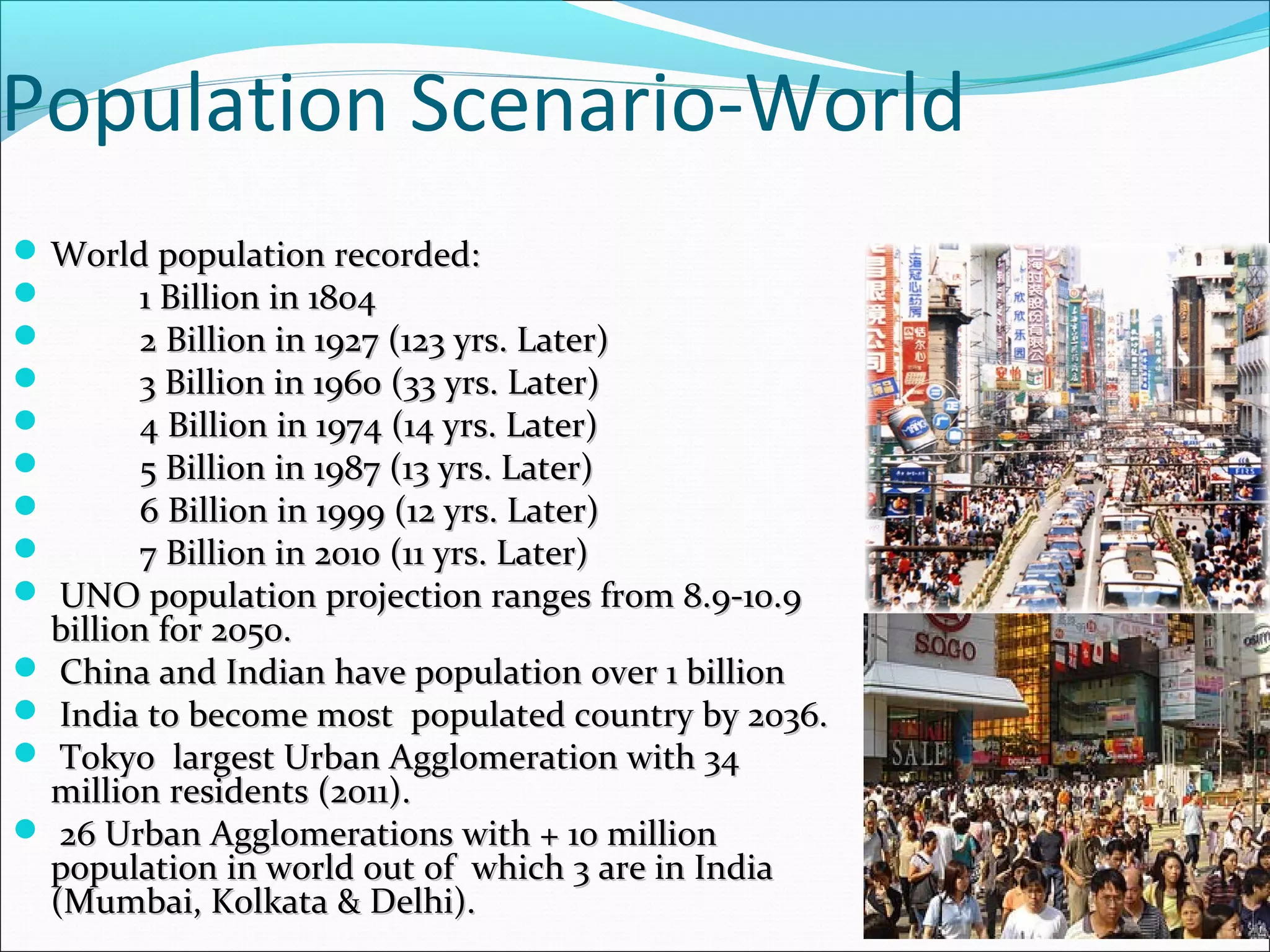
Population Scenario-World
 World population recorded:World population recorded:
 1 Billion in 18041 Billion in 1804
 2 Billion in 1927 (123 yrs. Later)2 Billion in 1927 (123 yrs. Later)
 3 Billion in 1960 (33 yrs. Later)3 Billion in 1960 (33 yrs. Later)
 4 Billion in 1974 (14 yrs. Later)4 Billion in 1974 (14 yrs. Later)
 5 Billion in 1987 (13 yrs. Later)5 Billion in 1987 (13 yrs. Later)
 6 Billion in 1999 (12 yrs. Later)6 Billion in 1999 (12 yrs. Later)
 7 Billion in 2010 (11 yrs. Later)7 Billion in 2010 (11 yrs. Later)
 UNO population projection ranges from 8.9-10.9UNO population projection ranges from 8.9-10.9
billion for 2050.billion for 2050.
 China and Indian have population over 1 billionChina and Indian have population over 1 billion
 India to become most populated country by 2036.India to become most populated country by 2036.
 Tokyo largest Urban Agglomeration with 34Tokyo largest Urban Agglomeration with 34
million residents (2011).million residents (2011).
 26 Urban Agglomerations with + 10 million26 Urban Agglomerations with + 10 million
population in world out of which 3 are in Indiapopulation in world out of which 3 are in India
(Mumbai, Kolkata & Delhi).(Mumbai, Kolkata & Delhi).
Contribution to increase in urban population , 2014 to 2050
Population Scenario- India-2011
 Population of India reached
 250 million in 1919
 500 million in 1966 (47 yrs. Later)
 1000 million in 2000 ( 34 yrs. Later)
 1027 million in 2001 (1yr Later)
 1210 million in 2011 (10 yrs. Later)
 Last century recoded 5 fold increase in population
 2050- India to have population 1800 million with 50% living
in Urban India.
 Urban India- 285.39 million in 2001 (5161 towns)
 377 million in 2011- (7935 towns)
 Metropolitan Centres -5 (1951)- -53 (2011)-68(2031)
 10 m plus- nil (1951)- 3 (2011) -7 (2031)-9 (2051)
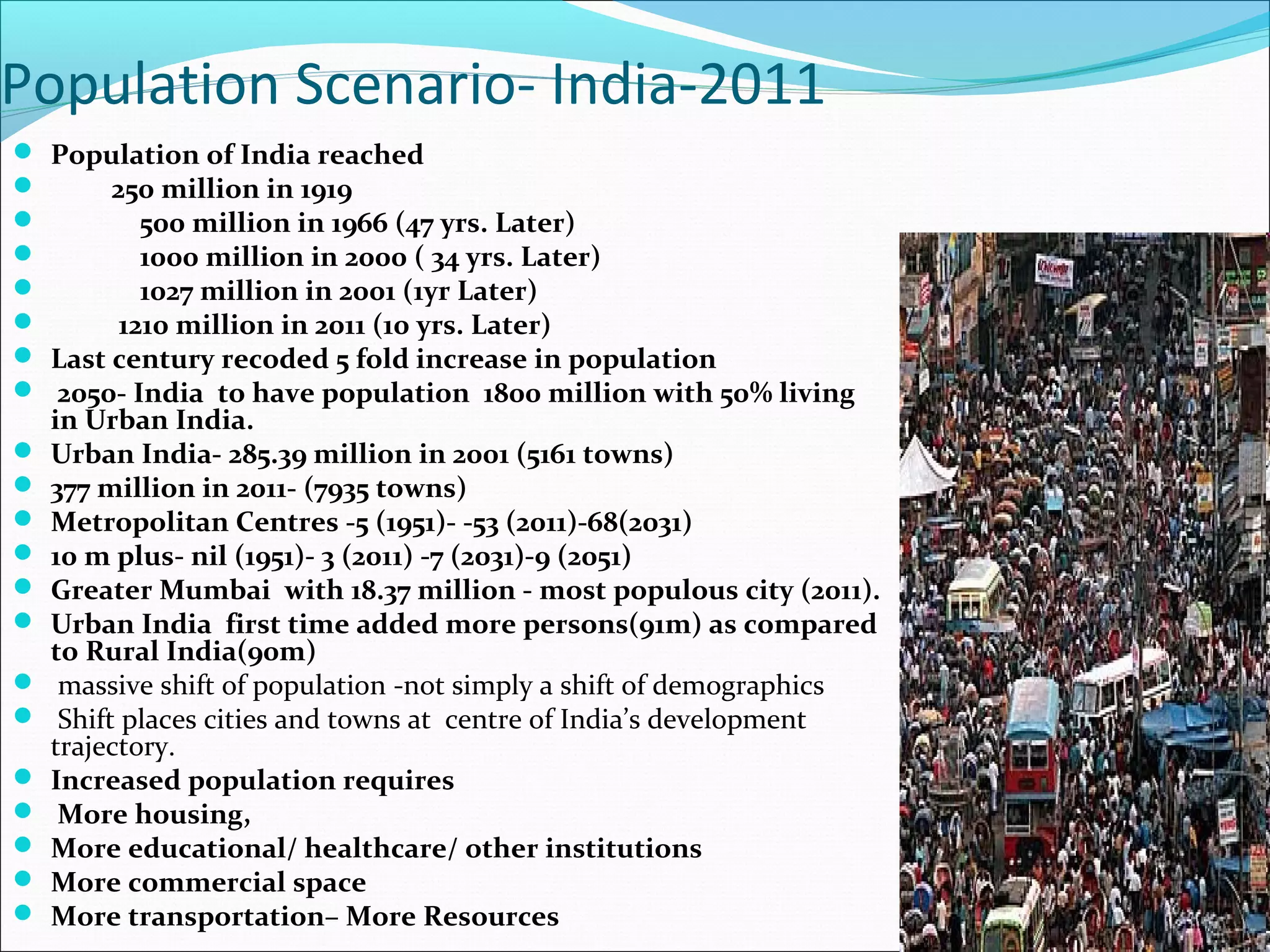
 Greater Mumbai with 18.37 million - most populous city (2011).
 Urban India first time added more persons(91m) as compared
to Rural India(90m)
 massive shift of population -not simply a shift of demographics
 Shift places cities and towns at centre of India’s development
trajectory.
 Increased population requires
 More housing,
 More educational/ healthcare/ other institutions
 More commercial space
 More transportation– More Resources
Population Distribution- India-2011
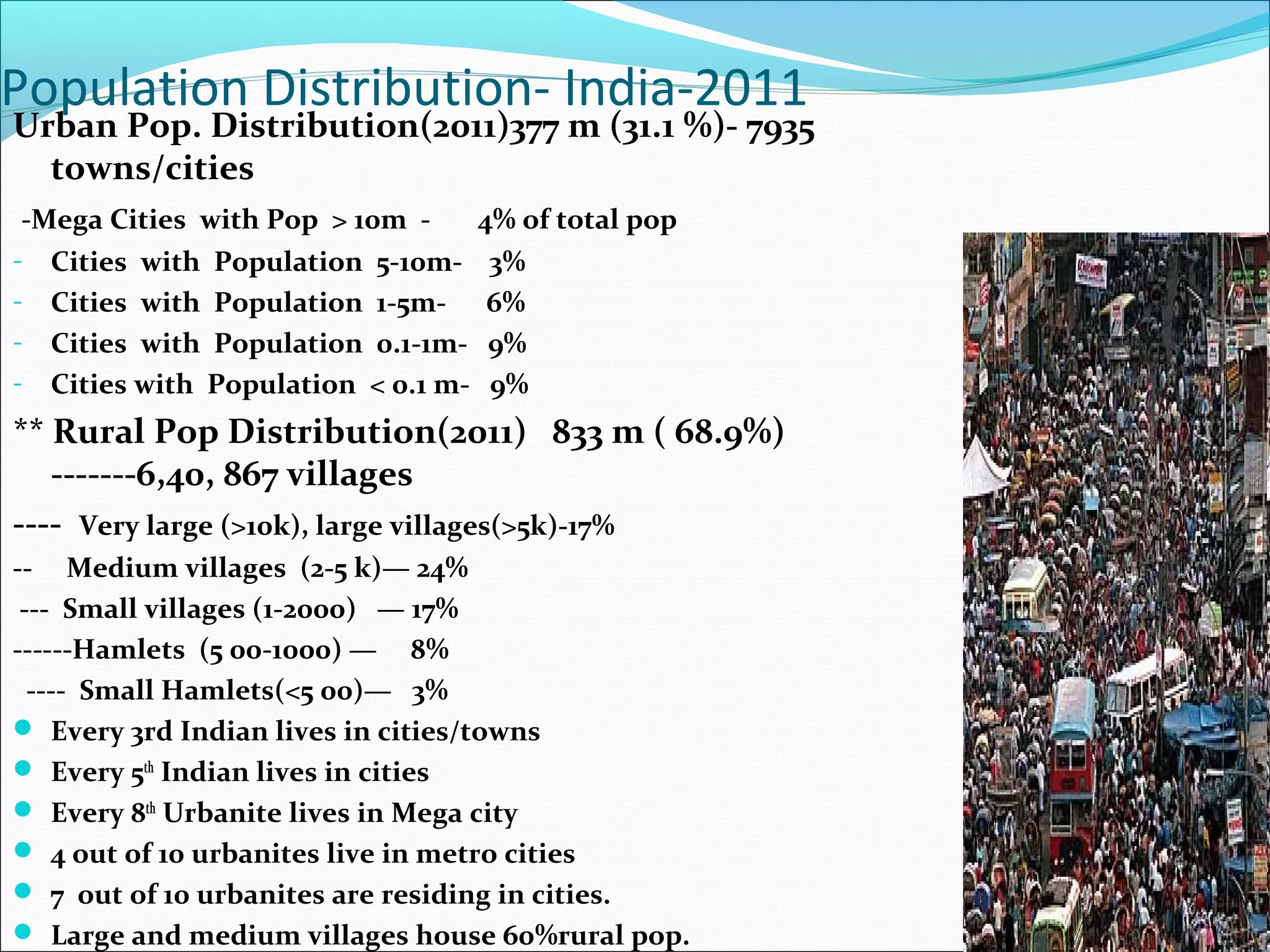
Urban Pop. Distribution(2011)377 m (31.1 %)- 7935
towns/cities
-Mega Cities with Pop > 10m - 4% of total pop
- Cities with Population 5-10m- 3%
- Cities with Population 1-5m- 6%
- Cities with Population 0.1-1m- 9%
- Cities with Population < 0.1 m- 9%
** Rural Pop Distribution(2011) 833 m ( 68.9%)
-------6,40, 867 villages
---- Very large (>10k), large villages(>5k)-17%
-- Medium villages (2-5 k)— 24%
--- Small villages (1-2000) — 17%
------Hamlets (5 00-1000) — 8%
---- Small Hamlets(<5 00)— 3%
 Every 3rd Indian lives in cities/towns
 Every 5th
Indian lives in cities
 Every 8th
Urbanite lives in Mega city
 4 out of 10 urbanites live in metro cities
 7 out of 10 urbanites are residing in cities.
 Large and medium villages house 60%rural pop.
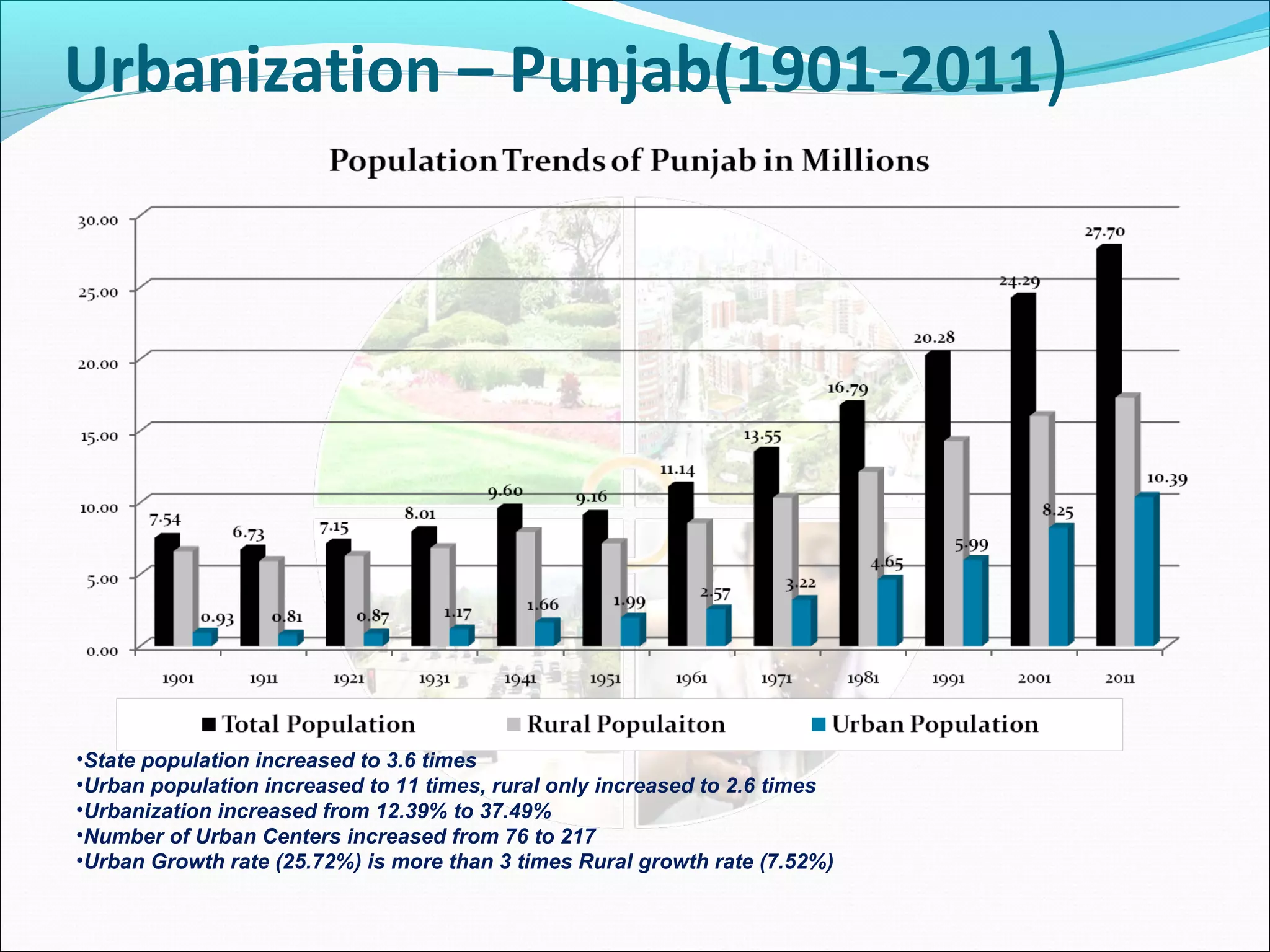
•State population increased to 3.6 times
•Urban population increased to 11 times, rural only increased to 2.6 times
•Urbanization increased from 12.39% to 37.49%
•Number of Urban Centers increased from 76 to 217
•Urban Growth rate (25.72%) is more than 3 times Rural growth rate (7.52%)
Urbanization – Punjab(1901-2011)
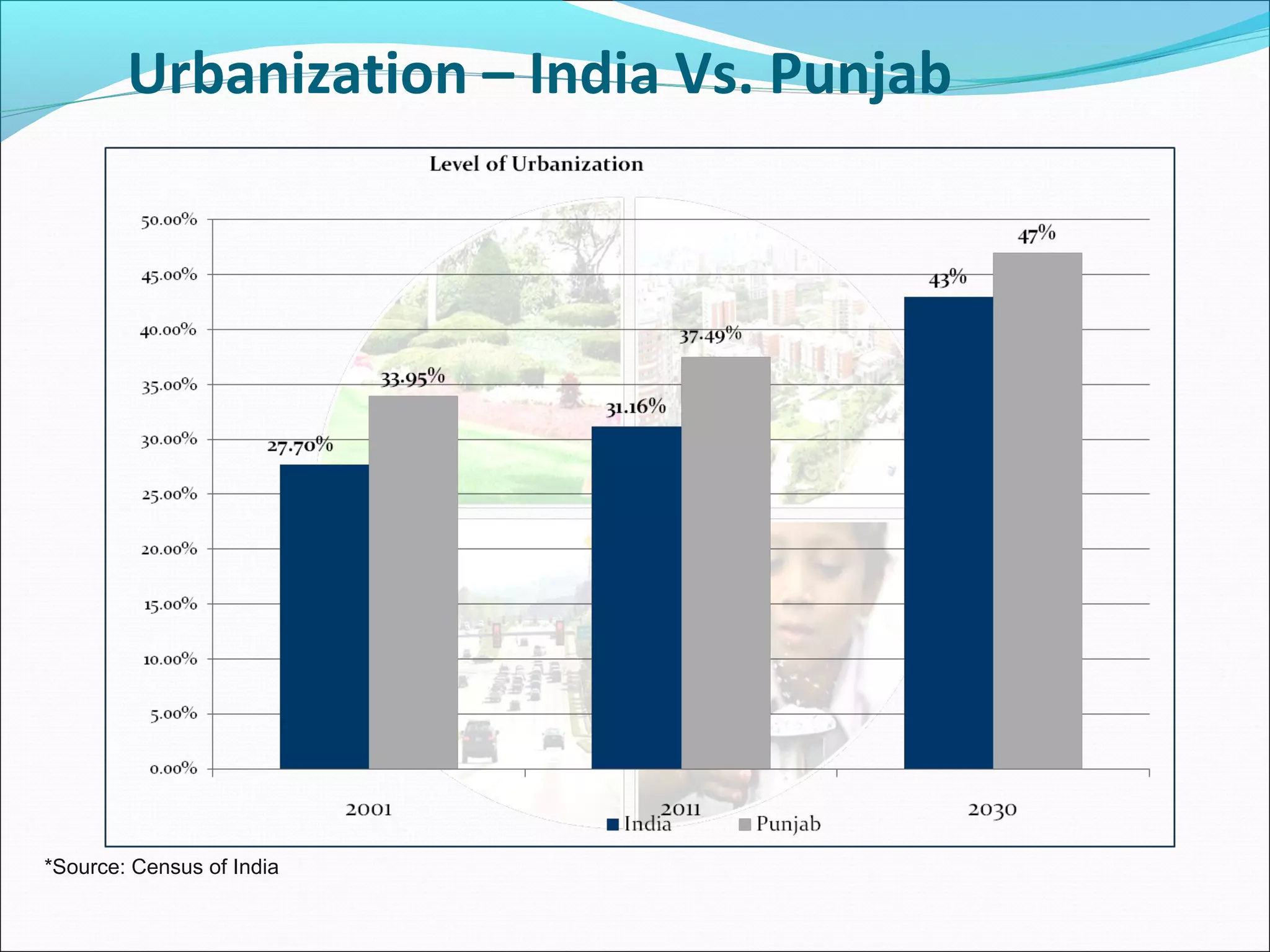
Urbanization – India Vs Punjab
India Punjab
*Source: Census of India
Urbanization – Metros
India Punjab
*Source: Census of India
Urbanization – India Vs. Punjab
*Source: Census of India
Urbanization vis-à-vis GDP
Punjab India
*Source: CII & Planning Commission of India
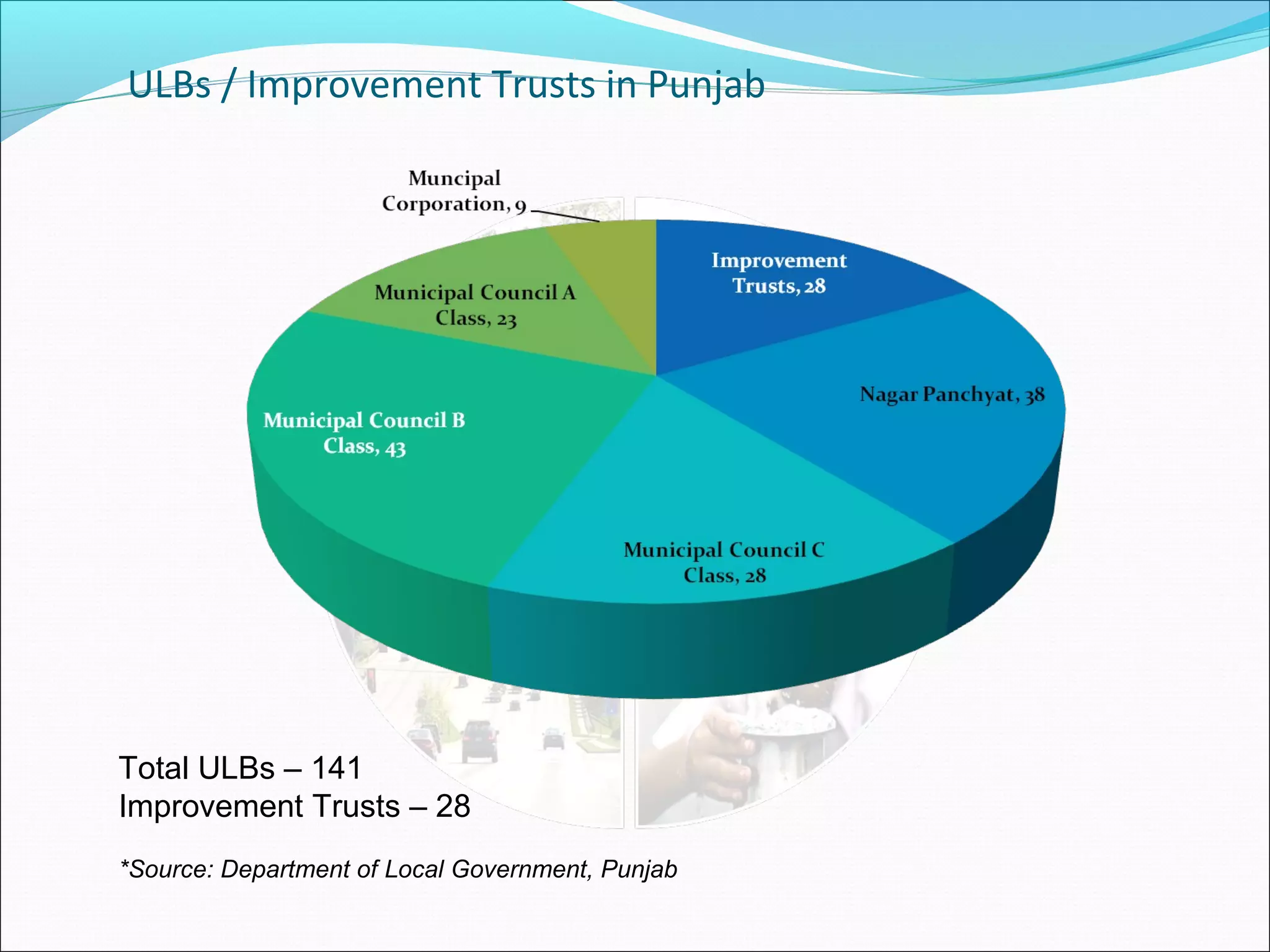
ULBs / Improvement Trusts in Punjab
Total ULBs – 141
Improvement Trusts – 28
*Source: Department of Local Government, Punjab
URBAN INDIA- 2030-Mckinsey Global Inst-
 India Urban Awakening :Building Inclusive Cities-Report- April, 2010
projects that by 2030:
 590 m to live in Urban India- twice the US population
 70% GDP generated by cities
 80% Revenue generated by cities
 4 fold increase in per capita income
 5 times the number by which GDP would multiply
 270 million net increase in working age group
 70% of new jobs(170 mil) generated in cities
 91 M urban households will be middle class-- up from 22 M
 68 Cities will be Metropolises-Europe has 35 only
 $ 1.2T capital needed to meet projected infrastructure demand
 700-900 million Sqmts of residential/ commercial area needed annually- a new
Chicago to be created
 2.5 b Sqmts roads paved-20times created in last decade
 7400km (350-400 km/year) of metro needed -20times created in last decade
 200 million Rural Indians to benefit-living close to top 70 cities
 75%urban India to live in bottom segment -earning Rs 80 per day
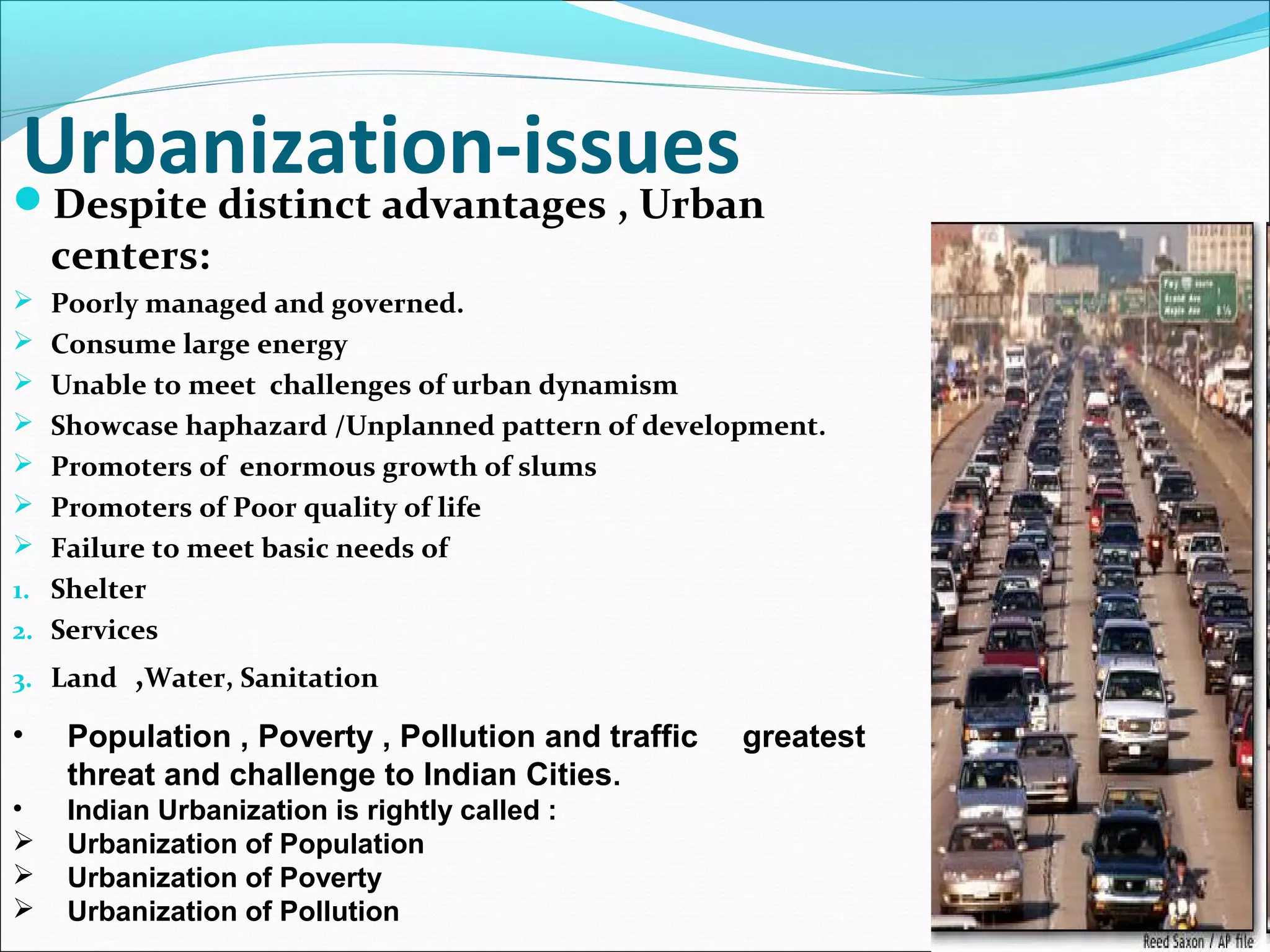
Urbanization-issuesDespite distinct advantages , Urban
centers:
 Poorly managed and governed.
 Consume large energy
 Unable to meet challenges of urban dynamism
 Showcase haphazard /Unplanned pattern of development.
 Promoters of enormous growth of slums
 Promoters of Poor quality of life
 Failure to meet basic needs of
1. Shelter
2. Services
3. Land ,Water, Sanitation
• Population , Poverty , Pollution and traffic greatest
threat and challenge to Indian Cities.
• Indian Urbanization is rightly called :
 Urbanization of Population
 Urbanization of Poverty
 Urbanization of Pollution
• Cities profoundly :
•alter quality of life
• impact local and global environment
• responsible for 70% of global energy consumption
• green house gas emissions-- majority coming from
buildings / transportation
•Cities fast emerging as GREY CITIES, way they:
Create high energy demand and Consume Energy
 Consume resources
 Consume Land
 Increase travel demand
Create heat islands
Generate waste
Create ecological problems
Destroy natural habitat
Add to water pollution
 impact environment
Lower down quality of life
Urbanization-issuesUrbanization-issues
Urban Planning and Legal Framework
• In this era of rapid and massive urbanization:
 urban land development and
 urban development process
emerged critical areas of major concerns to all governments.
• Planning/ Management of urban settlements have major
implications on:
 economic development,
 social change,
 Environmental sustainability,
 operational efficiency of any society and
 Welfare of the community
• At the root of such development / administration are
- human beings and their basic requirements of living, working, cobs
and travel
- land / its allocation / planning and management involving
-- Sub-division and
--- Use of Land
• Land-use planning emerges most powerful element in the process
of urban development.
 For promoting, guiding and rationalizing the
future growth and development of urban
centers.
 Promoting planned development
 Endorsing growth in the desired direction,
 --promote economic development,
 -- improving service delivery
 -- providing basic/essential amenities to
people.
 - an appropriate/ scientific tool for
promoting systematic & planned growth of
the city
Master Plan-Need
OBJECTIVES
 Promotes systematic & planned growth of city by:
 (i) Identifying existing gaps in physical and social infrastructure & to
bridge those gaps
 (ii) Making assessment of city to suggest strategies for economic
development.
 (iii) Leveraging economy
 (iv) Rationalizing land use and their interrelationships
 (v) Minimizing haphazard and uncontrolled growth of town/cities
 (vi) Achieving planned growth and development to provide healthy
living environment
 (vii) Promoting better urban governance and resource generation.
(viii) Rationalizing orderly movement of traffic and transportation
 (ix) defining area for laying down network of various services.
 (x) Indicating spatial distribution of physical/social infrastructure for
optimum use
 (xi) Ensuring systematic, balanced & integrated development
(xii) Framing mechanism/strategies for resolving core area problems
Master Plan- Objectives
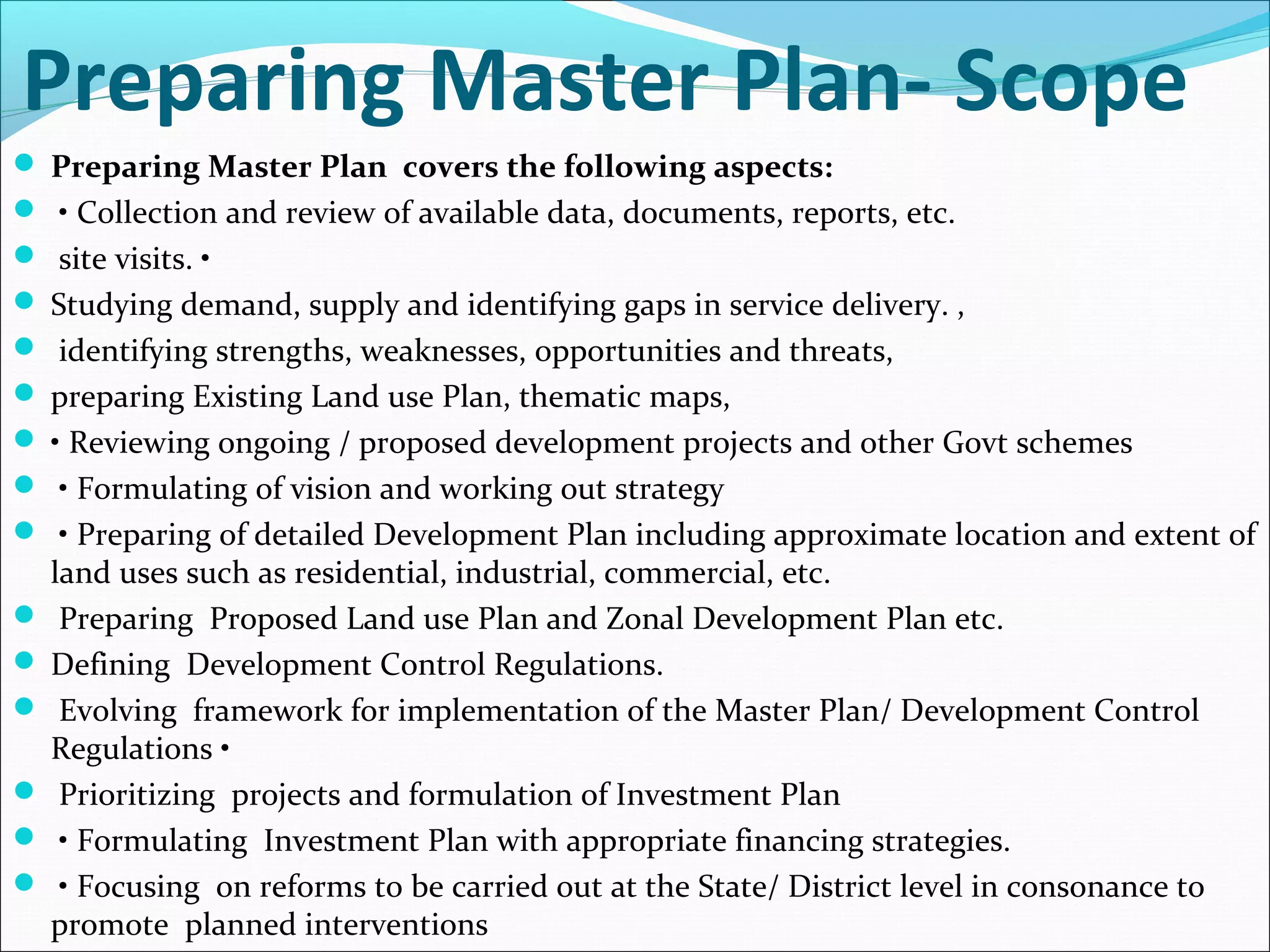
Preparing Master Plan- Scope
 Preparing Master Plan covers the following aspects:
 • Collection and review of available data, documents, reports, etc.
 site visits. •
 Studying demand, supply and identifying gaps in service delivery. ,
 identifying strengths, weaknesses, opportunities and threats,
 preparing Existing Land use Plan, thematic maps,
 • Reviewing ongoing / proposed development projects and other Govt schemes
 • Formulating of vision and working out strategy
 • Preparing of detailed Development Plan including approximate location and extent of
land uses such as residential, industrial, commercial, etc.
 Preparing Proposed Land use Plan and Zonal Development Plan etc.
 Defining Development Control Regulations.
 Evolving framework for implementation of the Master Plan/ Development Control
Regulations •
 Prioritizing projects and formulation of Investment Plan
 • Formulating Investment Plan with appropriate financing strategies.
 • Focusing on reforms to be carried out at the State/ District level in consonance to
promote planned interventions
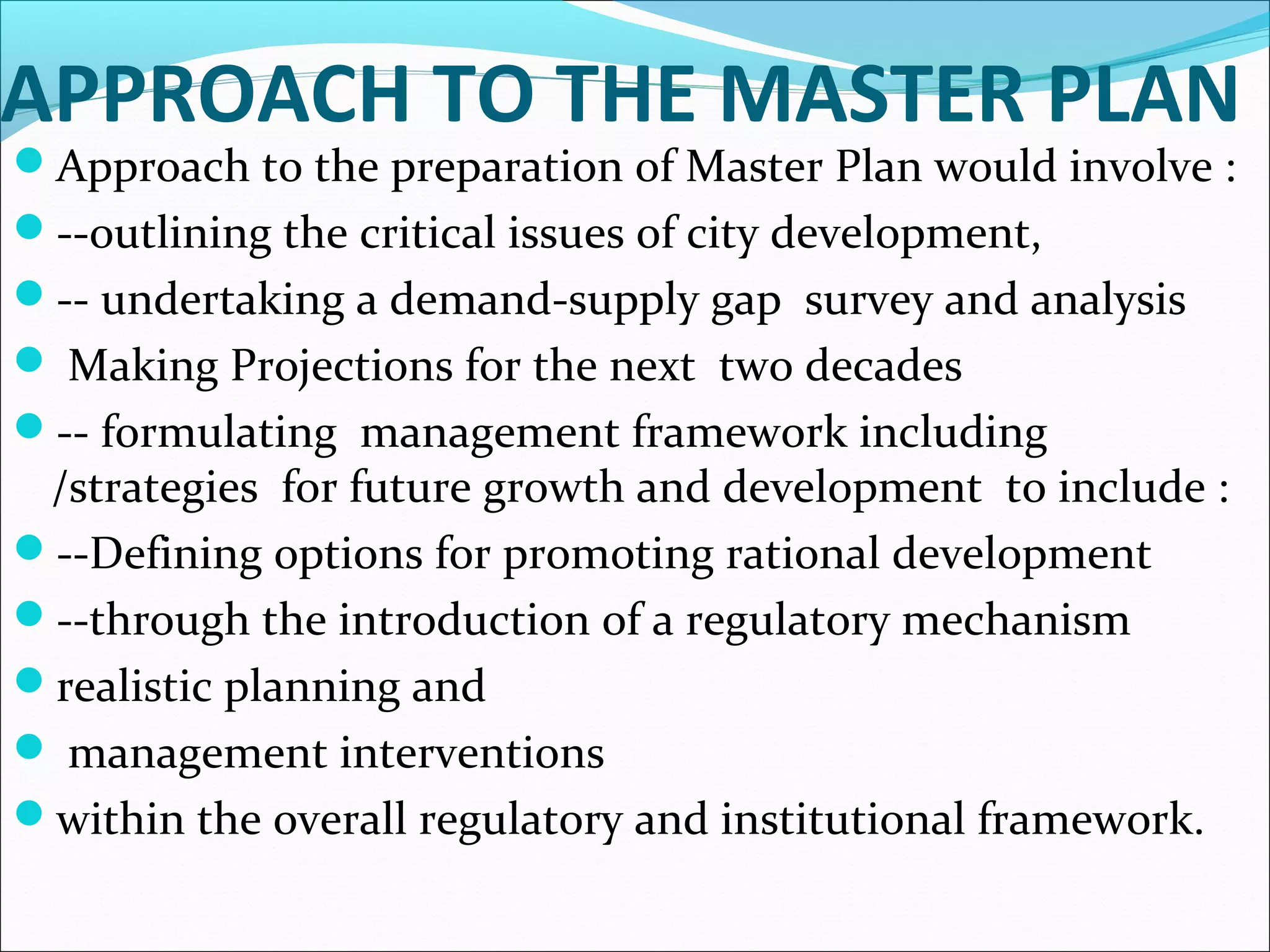
APPROACH TO THE MASTER PLAN
Approach to the preparation of Master Plan would involve :
--outlining the critical issues of city development,
-- undertaking a demand-supply gap survey and analysis
 Making Projections for the next two decades
-- formulating management framework including
/strategies for future growth and development to include :
--Defining options for promoting rational development
--through the introduction of a regulatory mechanism
realistic planning and
 management interventions
within the overall regulatory and institutional framework.
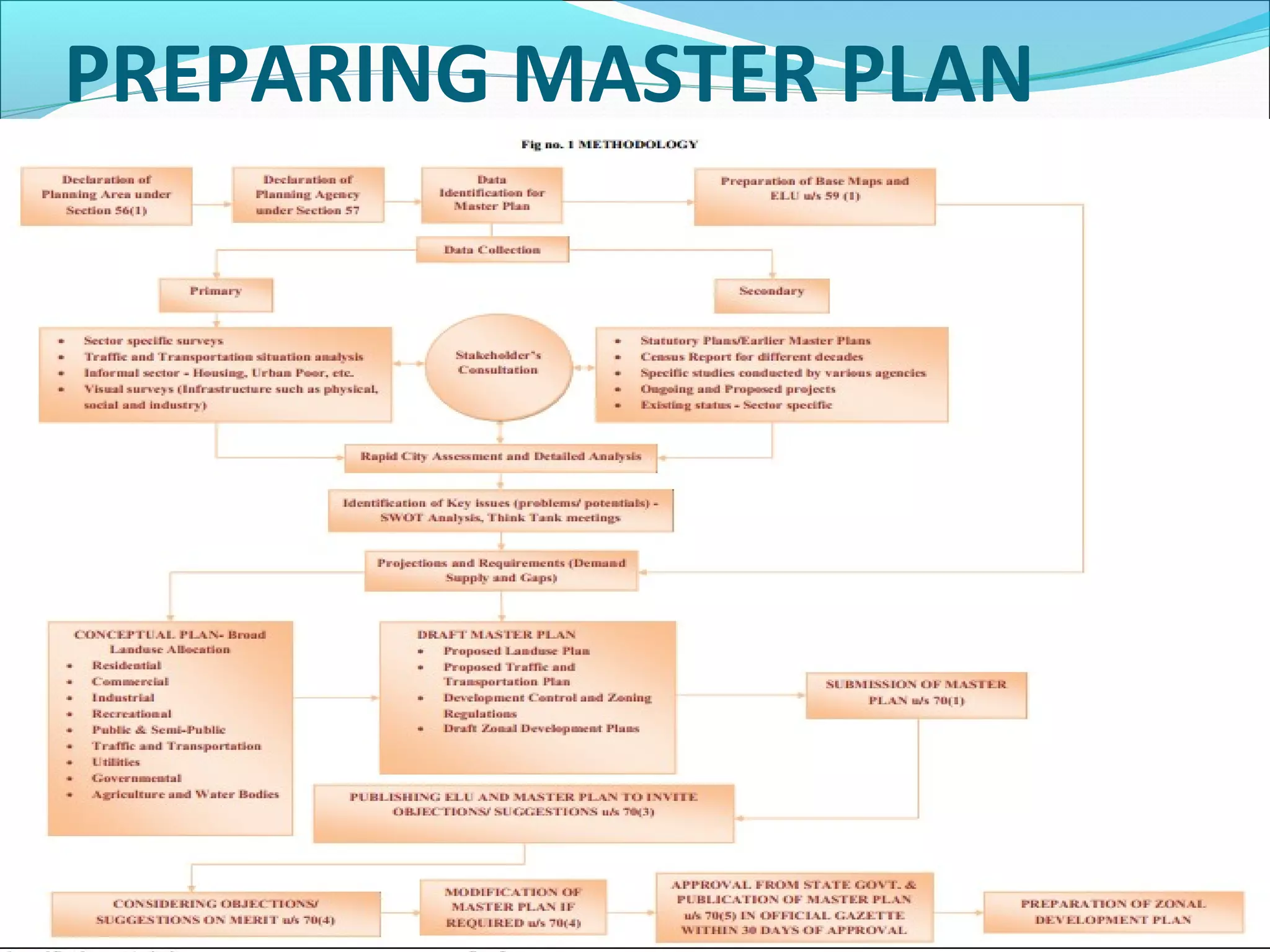
PREPARING MASTER PLAN
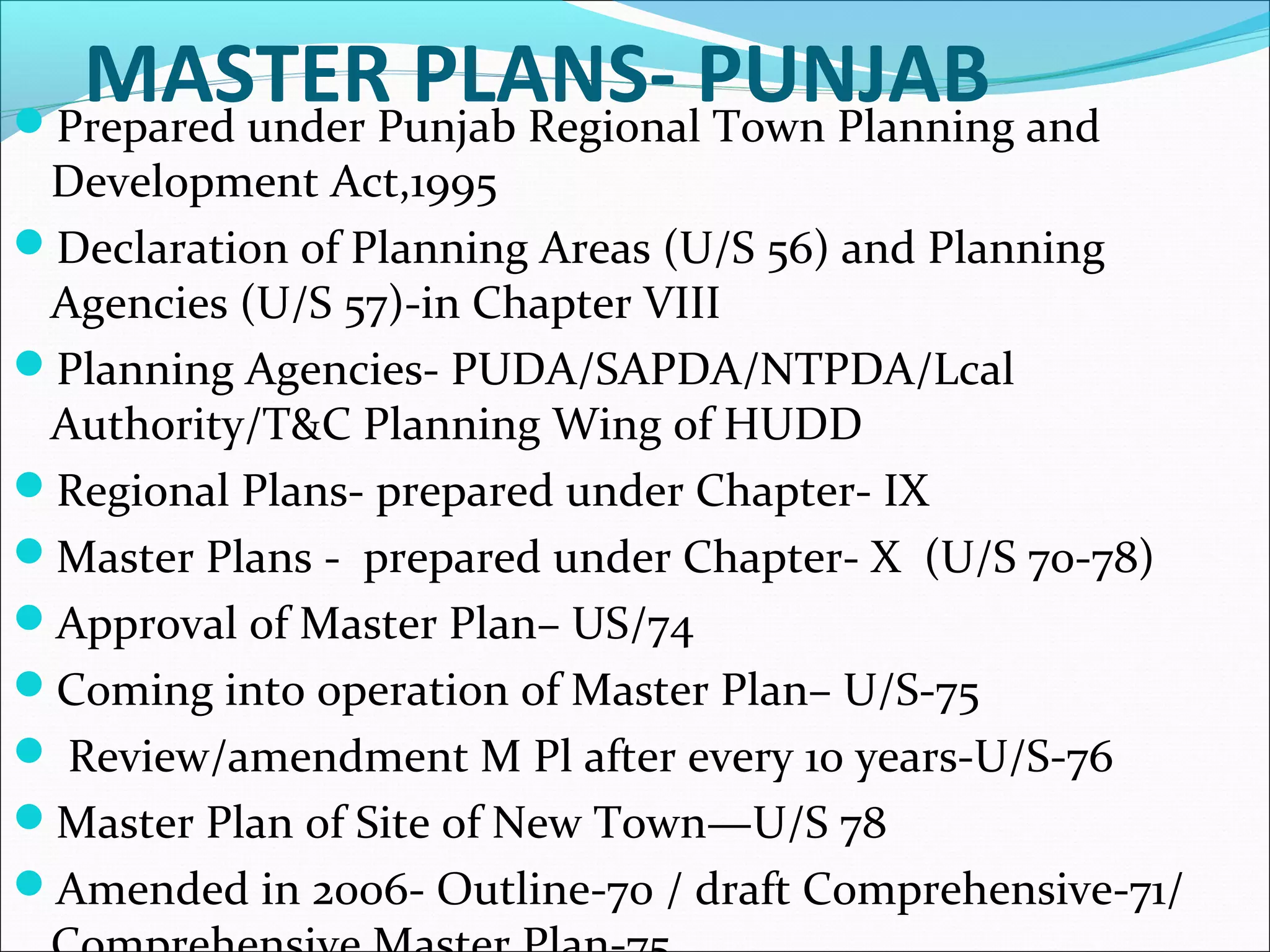
MASTER PLANS- PUNJABPrepared under Punjab Regional Town Planning and
Development Act,1995
Declaration of Planning Areas (U/S 56) and Planning
Agencies (U/S 57)-in Chapter VIII
Planning Agencies- PUDA/SAPDA/NTPDA/Lcal
Authority/T&C Planning Wing of HUDD
Regional Plans- prepared under Chapter- IX
Master Plans - prepared under Chapter- X (U/S 70-78)
Approval of Master Plan– US/74
Coming into operation of Master Plan– U/S-75
 Review/amendment M Pl after every 10 years-U/S-76
Master Plan of Site of New Town—U/S 78
Amended in 2006- Outline-70 / draft Comprehensive-71/
METHODOLGY FOR MASTER PLAN
The various stages of preparation of Master Plan
include:
1.Identification ,defining and notification of
Local Planning Area
2.Identification and notification of Planning
Agency
3.. Preparation of Existing Land Use Plan- ----
--Satellite Imageries,
--Survey of India maps
--Physical Ground Surveys
--Revenue maps
-- other available documents
METHODOLGY FOR MASTER PLAN
· 4. Study, assessment and analysis of Local Planning
Area/urban areas in terms of--
· Regional Setting
· Historical Evolution
· Demographic Studies
· Socio-Economic Studies
• Housing
•Slums & Poverty
•Trade and commerce
•Industries
· Traffic & Transportation
· Physical Infrastructure (Water Supply, Sewerage, Solid Waste
Management,
· Social Infrastructure (Educational, Medical, Recreational, Miscellaneous)
•Environment , Heritage and Tourism
· Growth Pattern
· Land use
· Available studies and report
METHODOLGY FOR MASTER PLAN
5. Involving Stakeholders through:
FGD’s and personal interviews
· Meeting with experts
· Think Tank meetings
· NGOs/ Private agencies/ Public Agencies/state
Departments
· Public Representatives,
6. Identifying Gaps , Issues and Problems through:
-- Comparison with available norms and standards
-- Spatial Distribution
-- Quantitative and Qualitative analysis
METHODOLGY FOR MASTER PLAN

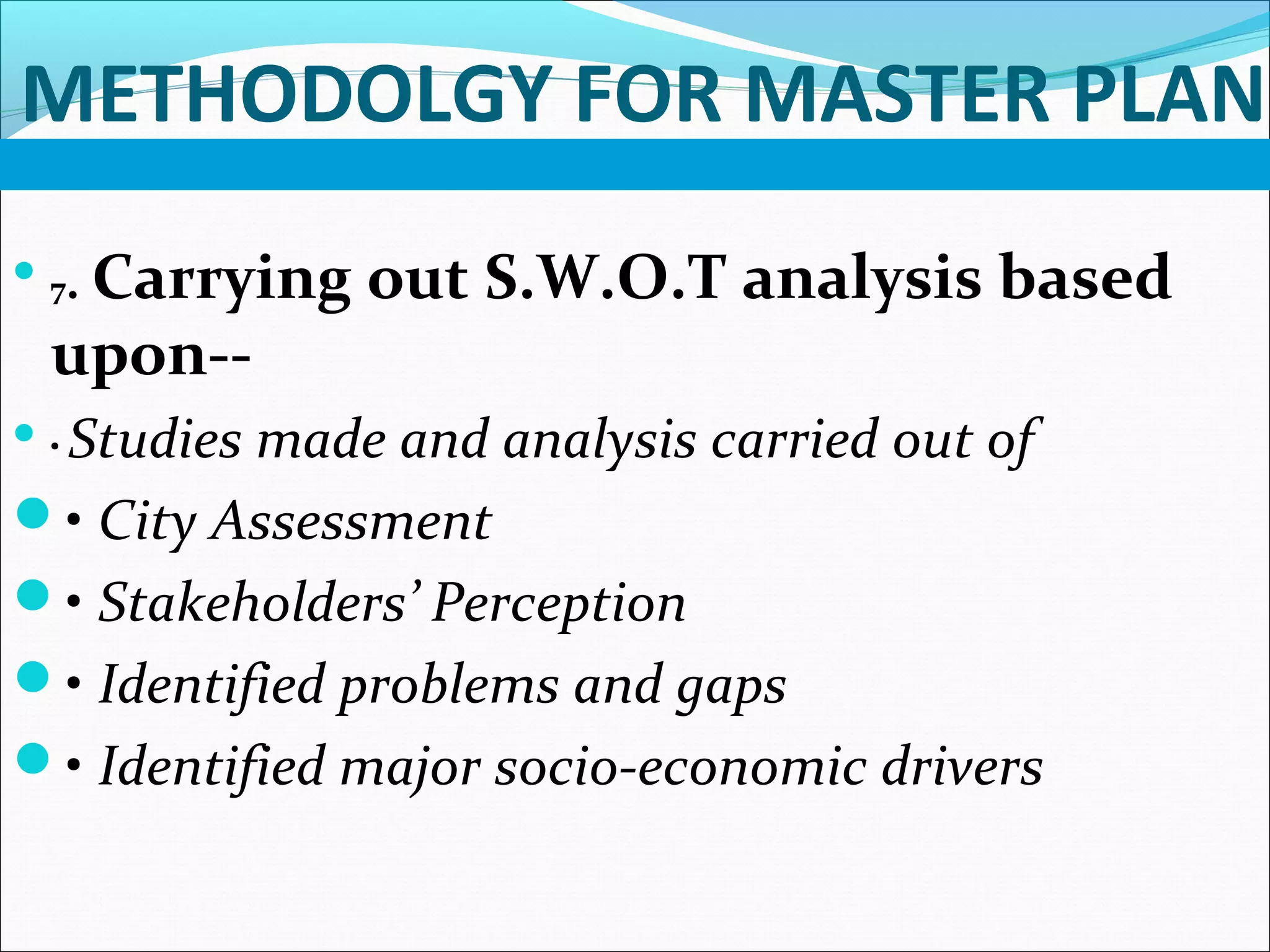
7. Carrying out S.W.O.T analysis based
upon--
 • Studies made and analysis carried out of
• City Assessment
• Stakeholders’ Perception
• Identified problems and gaps
• Identified major socio-economic drivers
METHODOLGY FOR MASTER PLAN
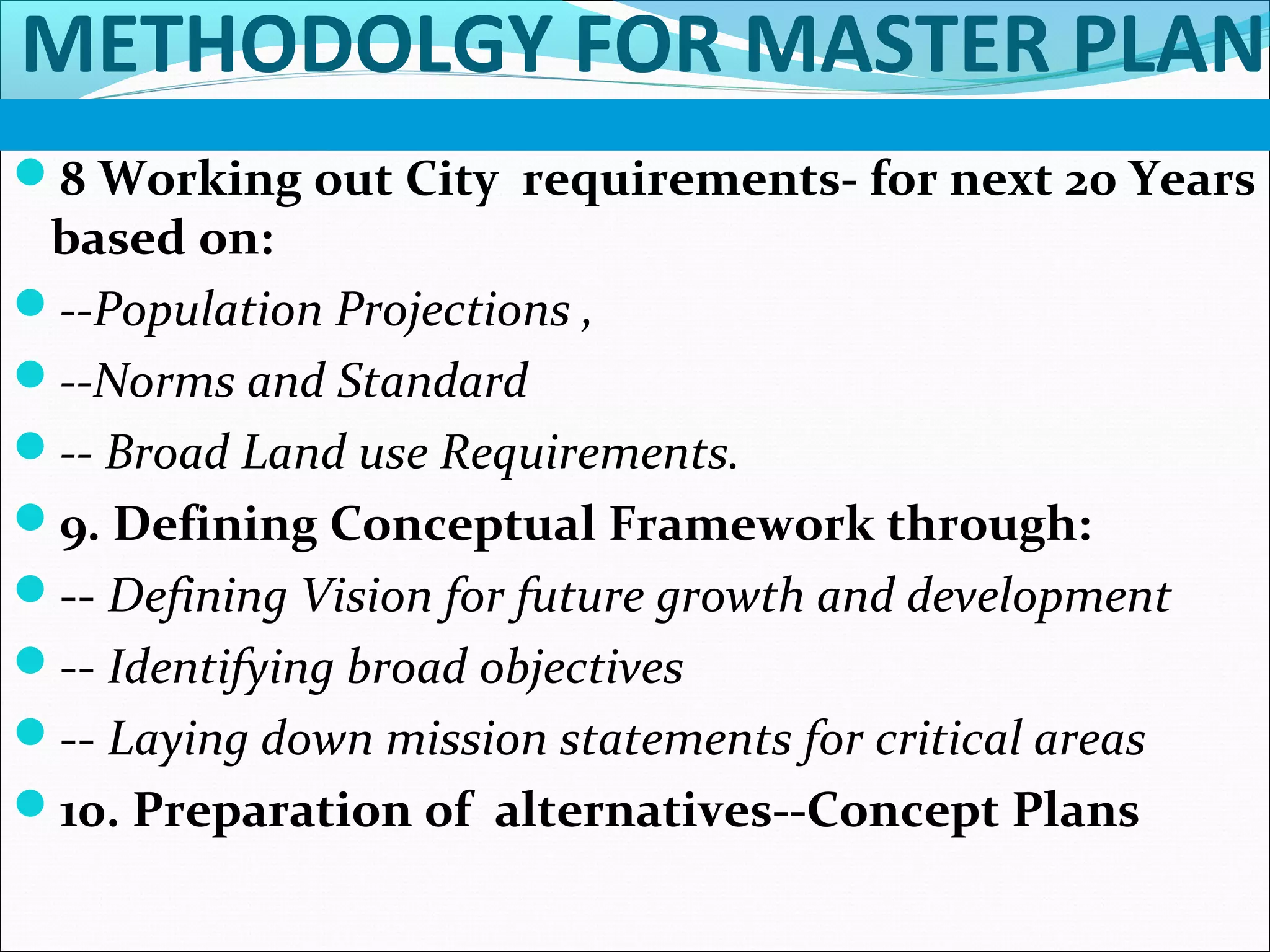
8 Working out City requirements- for next 20 Years
based on:
--Population Projections ,
--Norms and Standard
-- Broad Land use Requirements.
9. Defining Conceptual Framework through:
-- Defining Vision for future growth and development
-- Identifying broad objectives
-- Laying down mission statements for critical areas
10. Preparation of alternatives--Concept Plans
METHODOLGY FOR MASTER PLAN
 11. Evolving Draft Master Plan – Involving Proposed Land Use Plan
/Traffic & Transportation Plan along with Development Control
Regulations (D.C.R)
· Based on existing land use plan , critical areas, growth drivers
 areas to be preserved, conserved and promoted, heritage areas
 land use analysis, land suitability analysis etc
· Studies and assessment made --- Gaps and problems identified
· Stakeholders’ perception ---Objectives/ vision/ Mission framed
· Future population growth---- Future infrastructure requirements/ Available
land for development
 12. Notifying Draft Master Plan for Inviting Public Objections/
Suggestions—
13 Considering Public Objections/Suggestions
14 Finalising Master Plan- Issuing Public notice including Phasing and
Investment Plan
15. Evolving Zonal Plans based on Proposed Land Use
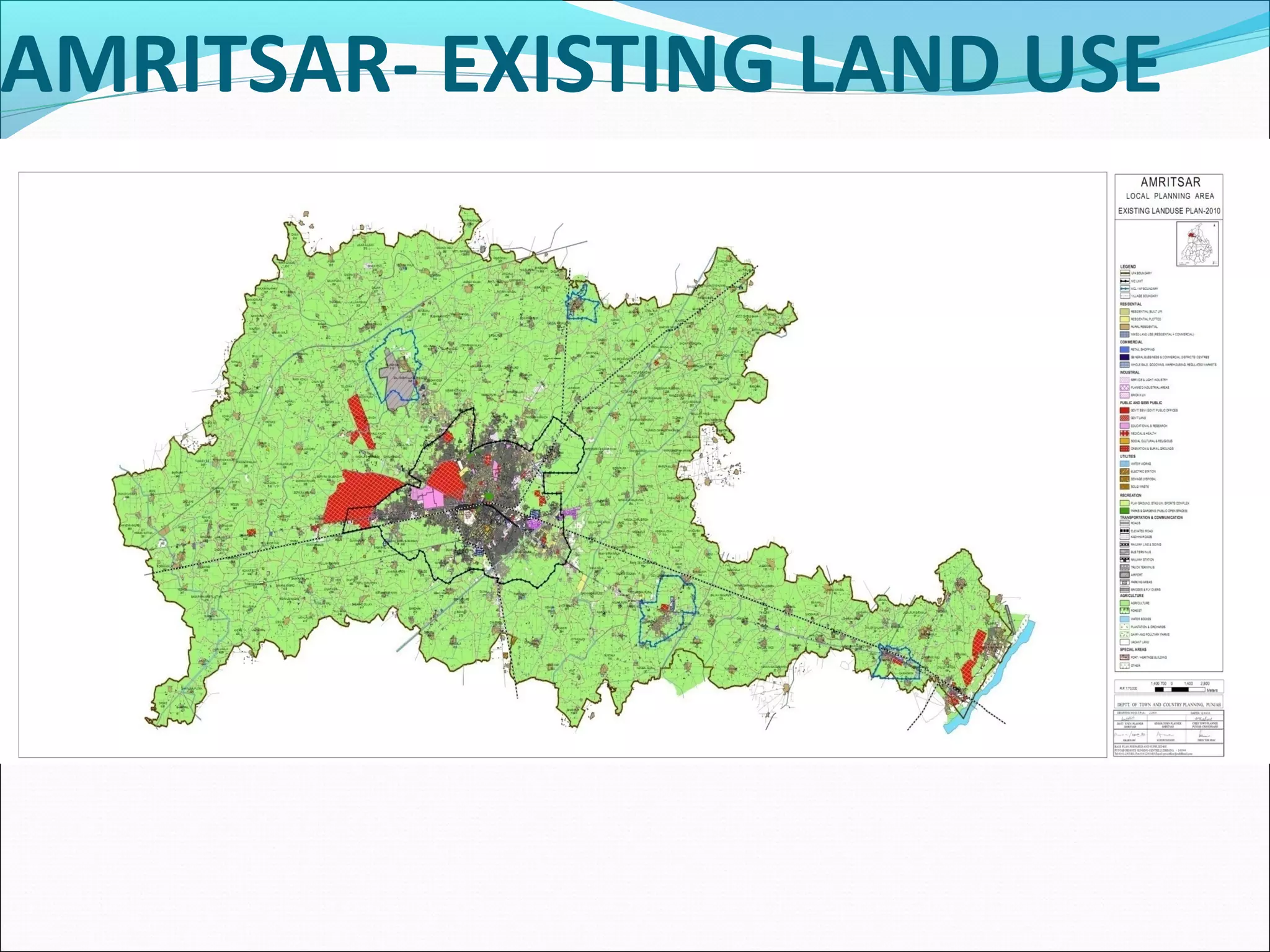
AMRITSAR- EXISTING LAND USE
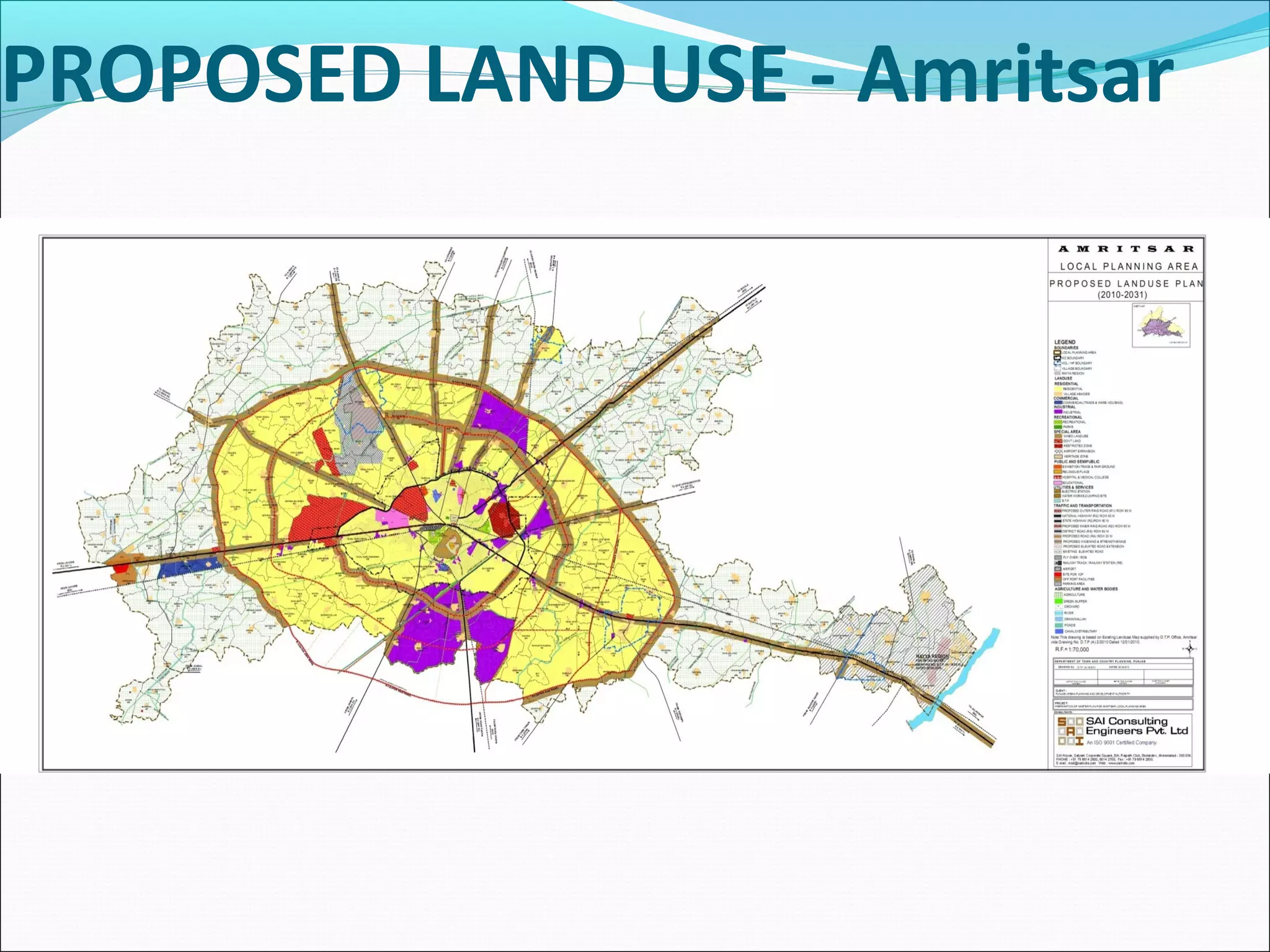
PROPOSED LAND USE - Amritsar
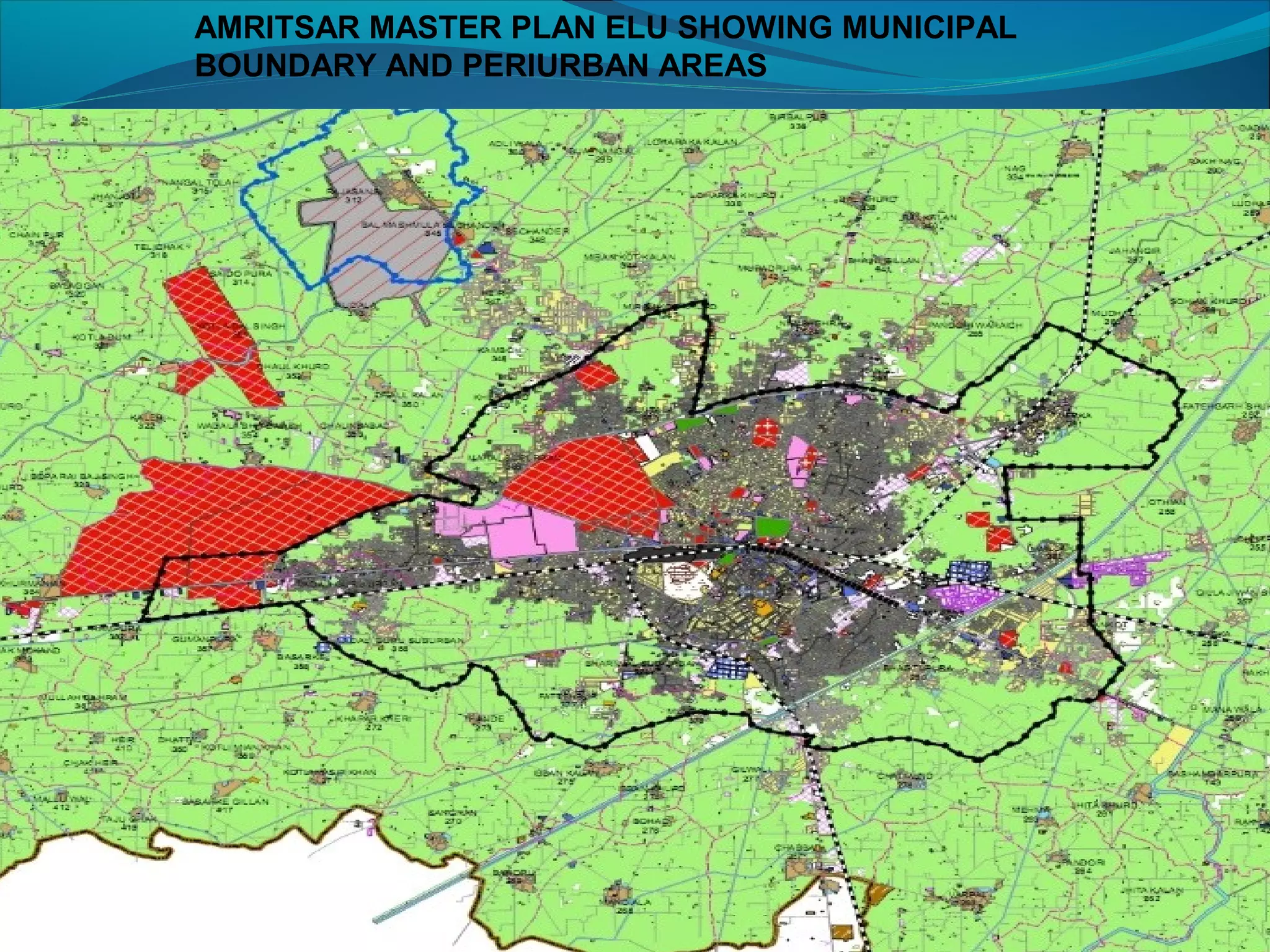
AMRITSAR MASTER PLAN ELU SHOWING MUNICIPAL
BOUNDARY AND PERIURBAN AREAS
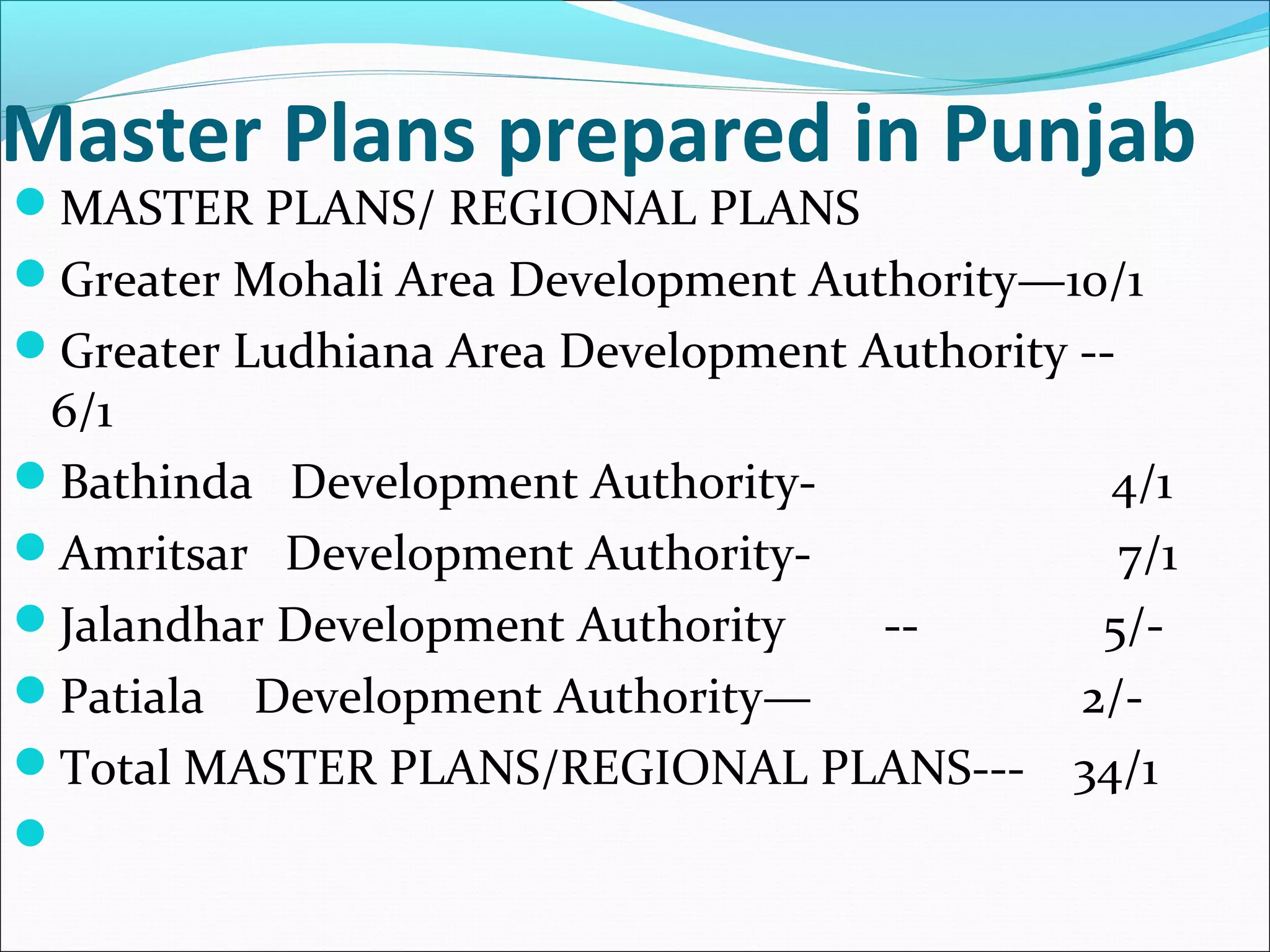
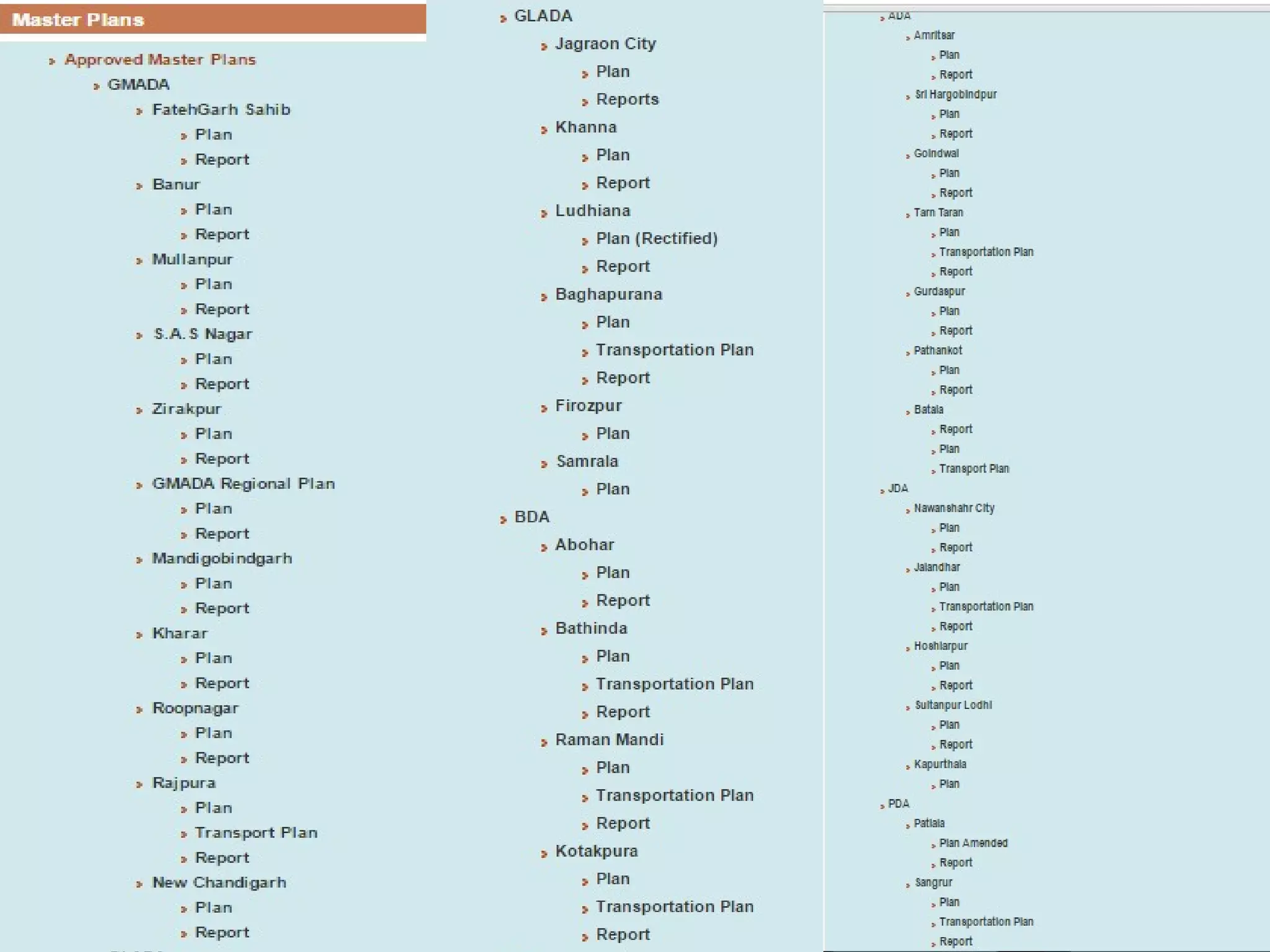
Master Plans prepared in Punjab
MASTER PLANS/ REGIONAL PLANS
Greater Mohali Area Development Authority—10/1
Greater Ludhiana Area Development Authority --
6/1
Bathinda Development Authority- 4/1
Amritsar Development Authority- 7/1
Jalandhar Development Authority -- 5/-
Patiala Development Authority— 2/-
Total MASTER PLANS/REGIONAL PLANS--- 34/1

VACANT POCKETS AND AGRICULTURAL AREA
PERSPECTIVE PLAN CHANDIGARH
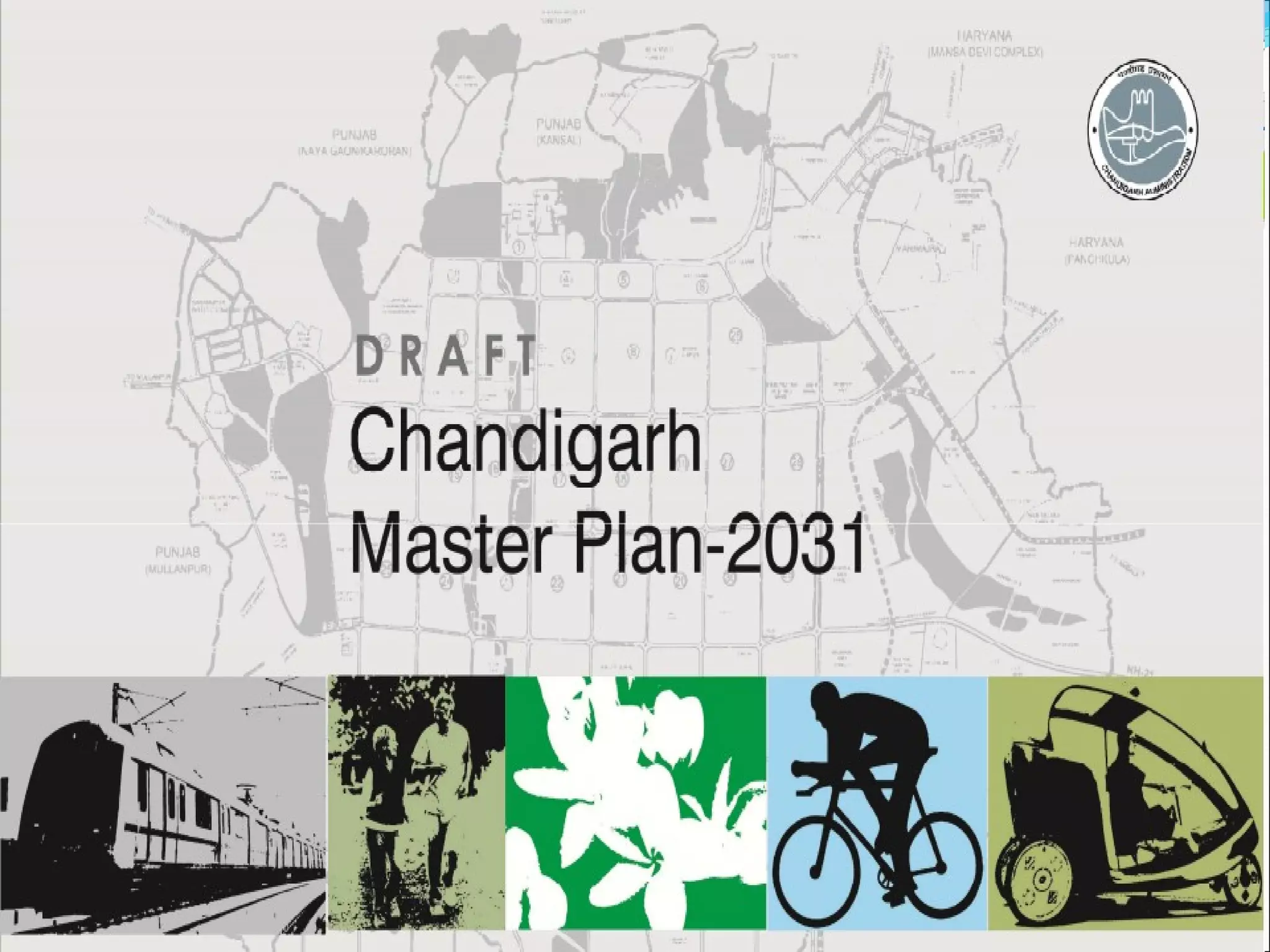
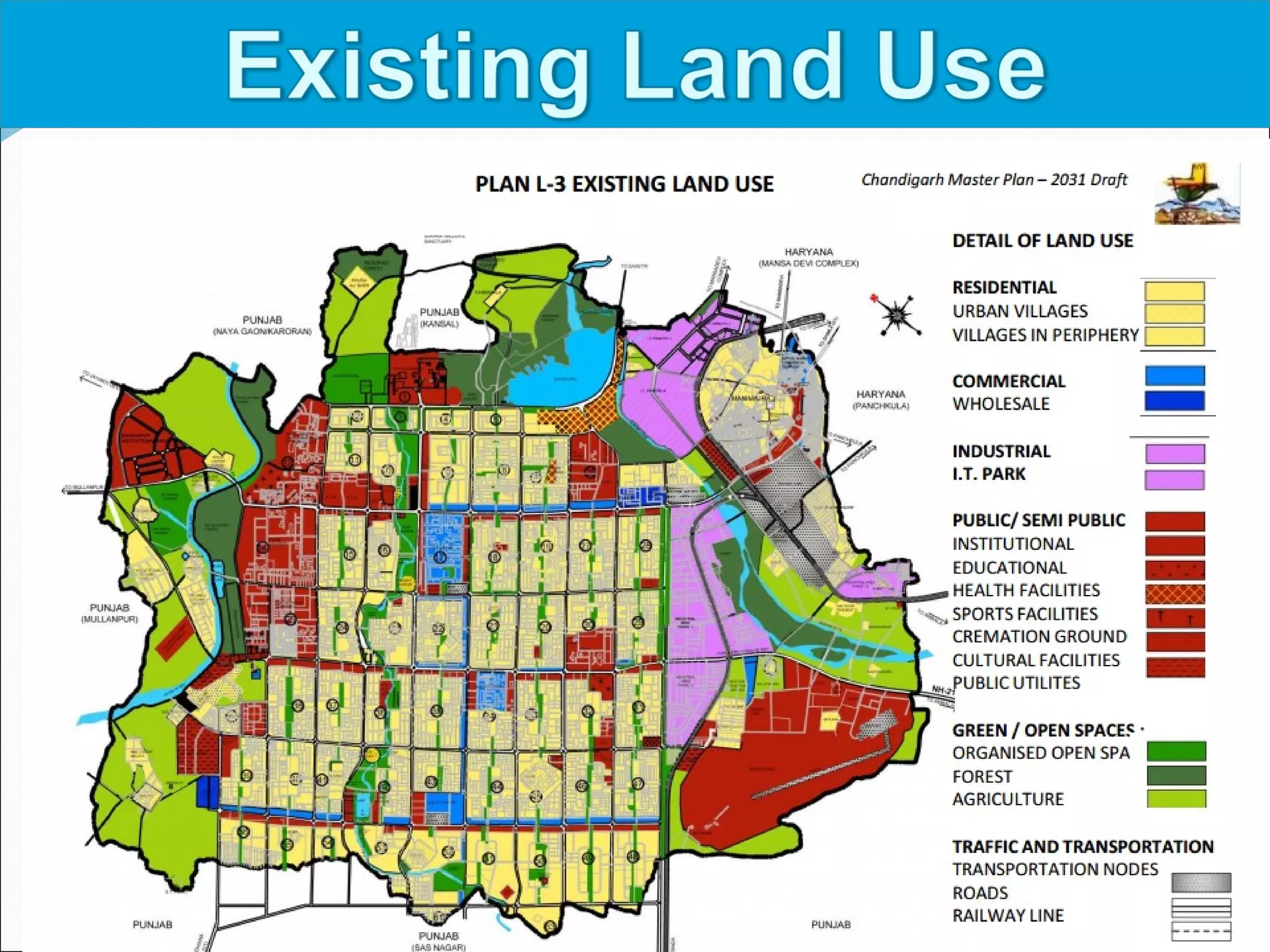
CHANDIGARH MASTER PLAN -2031
MASTER PLANS - Limitations
Lengthy, cumbersome time consuming process--Requires lot of
time
Requires large financial allocation
Rigid- lacks flexibility
Based on only defining land use mechanism
Stresses only physical aspects- ignores large social, economic,
environmental issues- emphasizes plan preparation
Lack of availability of city centric accurate data
Prepared mostly using secondary data; Only few surveys are done
Absence of stakeholders participation
Lack of transparency
Lack of trained manpower/ technology
Inaccurate base plan/ existing land use plan
Mismatch between plan proposals and ground realities
MASTER PLANS - Limitations
Large number of disputes in plan interpretation
Lack of involvement of specialized agencies/expertise
Plan preparation and plan implementation divorced
Freezes city/ Land use for 20 long years
Unable to meet emerging urban challenges
Unable to address urban dynamism
Emerged as the major road block in planned development
Leads to emergence of Slums/ haphazard development
Does not address the needs of the informal sector- document of
exclusion--Emerged as elitist in nature
Major source of corruption/ manipulation
CHANGING CONTEXT OF MASTER PLANS
Need to make Master Plan a better Master Plan
by:
-- changing its intent, content, approach and
philosophy
-- making it people/city centric
-- involving participatory approach
-- bringing flexibility
-- preparing it in a short time,
--structure defined through
 road network,
 infrastructure network and
CHANGING CONTEXT OF MASTER PLANS
Master Plan to be promoter of Planned development rather than
controller of development
Master plan to make city compact
 Master plans prepared with energy efficiency as the focus
To reduce carbon footprints of city
Promoting mixed landuse rather than pure land use planning
Promoting Green Transportation-- pedestrianisation, cycling,
public transport as the-- preferred mode of transportation
Promoting transit oriented development (TOD) to minimise
travel
Minimising use of Agricultural land
 minimum land under urbanization
Promote 24x7 use of land
CHANGING CONTEXT OF MASTER PLANS
Promote self-sufficiency in day to day needs
Promote Decentralization
Provide open spaces on defined norms
Plan city on well defined norms and planning
parameters
Promote water sufficiency
Promote reduce, recycle and reuse in city
Make informal sector integral part of planning process
Promoting Green Energy in city- Solar, Wind, Bio-mass,
Geo-thermal enrgy
Preparing Master Plan using nature as the basis- SUN,
SPACE, VERDURE
THANKS
FOR YOUR
PATIENCE
AND TIME
Methodology  for  Preparation of Master Plan

Methodology for Preparation of Master Plan

  • 1.
    Jit Kumar Gupta, formerDirector, College of Architecture, IET Bhaddal Jit.kumar1944@gmail.com Methodology for Preparation of Master Plan
  • 2.
  • 3.
    Population Scenario-World  Worldpopulation recorded:World population recorded:  1 Billion in 18041 Billion in 1804  2 Billion in 1927 (123 yrs. Later)2 Billion in 1927 (123 yrs. Later)  3 Billion in 1960 (33 yrs. Later)3 Billion in 1960 (33 yrs. Later)  4 Billion in 1974 (14 yrs. Later)4 Billion in 1974 (14 yrs. Later)  5 Billion in 1987 (13 yrs. Later)5 Billion in 1987 (13 yrs. Later)  6 Billion in 1999 (12 yrs. Later)6 Billion in 1999 (12 yrs. Later)  7 Billion in 2010 (11 yrs. Later)7 Billion in 2010 (11 yrs. Later)  UNO population projection ranges from 8.9-10.9UNO population projection ranges from 8.9-10.9 billion for 2050.billion for 2050.  China and Indian have population over 1 billionChina and Indian have population over 1 billion  India to become most populated country by 2036.India to become most populated country by 2036.  Tokyo largest Urban Agglomeration with 34Tokyo largest Urban Agglomeration with 34 million residents (2011).million residents (2011).  26 Urban Agglomerations with + 10 million26 Urban Agglomerations with + 10 million population in world out of which 3 are in Indiapopulation in world out of which 3 are in India (Mumbai, Kolkata & Delhi).(Mumbai, Kolkata & Delhi).
  • 4.
    Contribution to increasein urban population , 2014 to 2050
  • 5.
    Population Scenario- India-2011 Population of India reached  250 million in 1919  500 million in 1966 (47 yrs. Later)  1000 million in 2000 ( 34 yrs. Later)  1027 million in 2001 (1yr Later)  1210 million in 2011 (10 yrs. Later)  Last century recoded 5 fold increase in population  2050- India to have population 1800 million with 50% living in Urban India.  Urban India- 285.39 million in 2001 (5161 towns)  377 million in 2011- (7935 towns)  Metropolitan Centres -5 (1951)- -53 (2011)-68(2031)  10 m plus- nil (1951)- 3 (2011) -7 (2031)-9 (2051)  Greater Mumbai with 18.37 million - most populous city (2011).  Urban India first time added more persons(91m) as compared to Rural India(90m)  massive shift of population -not simply a shift of demographics  Shift places cities and towns at centre of India’s development trajectory.  Increased population requires  More housing,  More educational/ healthcare/ other institutions  More commercial space  More transportation– More Resources
  • 6.
    Population Distribution- India-2011 UrbanPop. Distribution(2011)377 m (31.1 %)- 7935 towns/cities -Mega Cities with Pop > 10m - 4% of total pop - Cities with Population 5-10m- 3% - Cities with Population 1-5m- 6% - Cities with Population 0.1-1m- 9% - Cities with Population < 0.1 m- 9% ** Rural Pop Distribution(2011) 833 m ( 68.9%) -------6,40, 867 villages ---- Very large (>10k), large villages(>5k)-17% -- Medium villages (2-5 k)— 24% --- Small villages (1-2000) — 17% ------Hamlets (5 00-1000) — 8% ---- Small Hamlets(<5 00)— 3%  Every 3rd Indian lives in cities/towns  Every 5th Indian lives in cities  Every 8th Urbanite lives in Mega city  4 out of 10 urbanites live in metro cities  7 out of 10 urbanites are residing in cities.  Large and medium villages house 60%rural pop.
  • 7.
    •State population increasedto 3.6 times •Urban population increased to 11 times, rural only increased to 2.6 times •Urbanization increased from 12.39% to 37.49% •Number of Urban Centers increased from 76 to 217 •Urban Growth rate (25.72%) is more than 3 times Rural growth rate (7.52%) Urbanization – Punjab(1901-2011)
  • 8.
    Urbanization – IndiaVs Punjab India Punjab *Source: Census of India
  • 9.
    Urbanization – Metros IndiaPunjab *Source: Census of India
  • 10.
    Urbanization – IndiaVs. Punjab *Source: Census of India
  • 11.
    Urbanization vis-à-vis GDP PunjabIndia *Source: CII & Planning Commission of India
  • 12.
    ULBs / ImprovementTrusts in Punjab Total ULBs – 141 Improvement Trusts – 28 *Source: Department of Local Government, Punjab
  • 13.
    URBAN INDIA- 2030-MckinseyGlobal Inst-  India Urban Awakening :Building Inclusive Cities-Report- April, 2010 projects that by 2030:  590 m to live in Urban India- twice the US population  70% GDP generated by cities  80% Revenue generated by cities  4 fold increase in per capita income  5 times the number by which GDP would multiply  270 million net increase in working age group  70% of new jobs(170 mil) generated in cities  91 M urban households will be middle class-- up from 22 M  68 Cities will be Metropolises-Europe has 35 only  $ 1.2T capital needed to meet projected infrastructure demand  700-900 million Sqmts of residential/ commercial area needed annually- a new Chicago to be created  2.5 b Sqmts roads paved-20times created in last decade  7400km (350-400 km/year) of metro needed -20times created in last decade  200 million Rural Indians to benefit-living close to top 70 cities  75%urban India to live in bottom segment -earning Rs 80 per day
  • 14.
    Urbanization-issuesDespite distinct advantages, Urban centers:  Poorly managed and governed.  Consume large energy  Unable to meet challenges of urban dynamism  Showcase haphazard /Unplanned pattern of development.  Promoters of enormous growth of slums  Promoters of Poor quality of life  Failure to meet basic needs of 1. Shelter 2. Services 3. Land ,Water, Sanitation • Population , Poverty , Pollution and traffic greatest threat and challenge to Indian Cities. • Indian Urbanization is rightly called :  Urbanization of Population  Urbanization of Poverty  Urbanization of Pollution
  • 15.
    • Cities profoundly: •alter quality of life • impact local and global environment • responsible for 70% of global energy consumption • green house gas emissions-- majority coming from buildings / transportation •Cities fast emerging as GREY CITIES, way they: Create high energy demand and Consume Energy  Consume resources  Consume Land  Increase travel demand Create heat islands Generate waste Create ecological problems Destroy natural habitat Add to water pollution  impact environment Lower down quality of life Urbanization-issuesUrbanization-issues
  • 16.
    Urban Planning andLegal Framework • In this era of rapid and massive urbanization:  urban land development and  urban development process emerged critical areas of major concerns to all governments. • Planning/ Management of urban settlements have major implications on:  economic development,  social change,  Environmental sustainability,  operational efficiency of any society and  Welfare of the community • At the root of such development / administration are - human beings and their basic requirements of living, working, cobs and travel - land / its allocation / planning and management involving -- Sub-division and --- Use of Land • Land-use planning emerges most powerful element in the process of urban development.
  • 17.
     For promoting,guiding and rationalizing the future growth and development of urban centers.  Promoting planned development  Endorsing growth in the desired direction,  --promote economic development,  -- improving service delivery  -- providing basic/essential amenities to people.  - an appropriate/ scientific tool for promoting systematic & planned growth of the city Master Plan-Need
  • 18.
    OBJECTIVES  Promotes systematic& planned growth of city by:  (i) Identifying existing gaps in physical and social infrastructure & to bridge those gaps  (ii) Making assessment of city to suggest strategies for economic development.  (iii) Leveraging economy  (iv) Rationalizing land use and their interrelationships  (v) Minimizing haphazard and uncontrolled growth of town/cities  (vi) Achieving planned growth and development to provide healthy living environment  (vii) Promoting better urban governance and resource generation. (viii) Rationalizing orderly movement of traffic and transportation  (ix) defining area for laying down network of various services.  (x) Indicating spatial distribution of physical/social infrastructure for optimum use  (xi) Ensuring systematic, balanced & integrated development (xii) Framing mechanism/strategies for resolving core area problems Master Plan- Objectives
  • 19.
    Preparing Master Plan-Scope  Preparing Master Plan covers the following aspects:  • Collection and review of available data, documents, reports, etc.  site visits. •  Studying demand, supply and identifying gaps in service delivery. ,  identifying strengths, weaknesses, opportunities and threats,  preparing Existing Land use Plan, thematic maps,  • Reviewing ongoing / proposed development projects and other Govt schemes  • Formulating of vision and working out strategy  • Preparing of detailed Development Plan including approximate location and extent of land uses such as residential, industrial, commercial, etc.  Preparing Proposed Land use Plan and Zonal Development Plan etc.  Defining Development Control Regulations.  Evolving framework for implementation of the Master Plan/ Development Control Regulations •  Prioritizing projects and formulation of Investment Plan  • Formulating Investment Plan with appropriate financing strategies.  • Focusing on reforms to be carried out at the State/ District level in consonance to promote planned interventions
  • 20.
    APPROACH TO THEMASTER PLAN Approach to the preparation of Master Plan would involve : --outlining the critical issues of city development, -- undertaking a demand-supply gap survey and analysis  Making Projections for the next two decades -- formulating management framework including /strategies for future growth and development to include : --Defining options for promoting rational development --through the introduction of a regulatory mechanism realistic planning and  management interventions within the overall regulatory and institutional framework.
  • 21.
  • 22.
    MASTER PLANS- PUNJABPreparedunder Punjab Regional Town Planning and Development Act,1995 Declaration of Planning Areas (U/S 56) and Planning Agencies (U/S 57)-in Chapter VIII Planning Agencies- PUDA/SAPDA/NTPDA/Lcal Authority/T&C Planning Wing of HUDD Regional Plans- prepared under Chapter- IX Master Plans - prepared under Chapter- X (U/S 70-78) Approval of Master Plan– US/74 Coming into operation of Master Plan– U/S-75  Review/amendment M Pl after every 10 years-U/S-76 Master Plan of Site of New Town—U/S 78 Amended in 2006- Outline-70 / draft Comprehensive-71/
  • 23.
    METHODOLGY FOR MASTERPLAN The various stages of preparation of Master Plan include: 1.Identification ,defining and notification of Local Planning Area 2.Identification and notification of Planning Agency 3.. Preparation of Existing Land Use Plan- ---- --Satellite Imageries, --Survey of India maps --Physical Ground Surveys --Revenue maps -- other available documents
  • 24.
    METHODOLGY FOR MASTERPLAN · 4. Study, assessment and analysis of Local Planning Area/urban areas in terms of-- · Regional Setting · Historical Evolution · Demographic Studies · Socio-Economic Studies • Housing •Slums & Poverty •Trade and commerce •Industries · Traffic & Transportation · Physical Infrastructure (Water Supply, Sewerage, Solid Waste Management, · Social Infrastructure (Educational, Medical, Recreational, Miscellaneous) •Environment , Heritage and Tourism · Growth Pattern · Land use · Available studies and report
  • 25.
    METHODOLGY FOR MASTERPLAN 5. Involving Stakeholders through: FGD’s and personal interviews · Meeting with experts · Think Tank meetings · NGOs/ Private agencies/ Public Agencies/state Departments · Public Representatives, 6. Identifying Gaps , Issues and Problems through: -- Comparison with available norms and standards -- Spatial Distribution -- Quantitative and Qualitative analysis
  • 26.
    METHODOLGY FOR MASTERPLAN  7. Carrying out S.W.O.T analysis based upon--  • Studies made and analysis carried out of • City Assessment • Stakeholders’ Perception • Identified problems and gaps • Identified major socio-economic drivers
  • 27.
    METHODOLGY FOR MASTERPLAN 8 Working out City requirements- for next 20 Years based on: --Population Projections , --Norms and Standard -- Broad Land use Requirements. 9. Defining Conceptual Framework through: -- Defining Vision for future growth and development -- Identifying broad objectives -- Laying down mission statements for critical areas 10. Preparation of alternatives--Concept Plans
  • 28.
    METHODOLGY FOR MASTERPLAN  11. Evolving Draft Master Plan – Involving Proposed Land Use Plan /Traffic & Transportation Plan along with Development Control Regulations (D.C.R) · Based on existing land use plan , critical areas, growth drivers  areas to be preserved, conserved and promoted, heritage areas  land use analysis, land suitability analysis etc · Studies and assessment made --- Gaps and problems identified · Stakeholders’ perception ---Objectives/ vision/ Mission framed · Future population growth---- Future infrastructure requirements/ Available land for development  12. Notifying Draft Master Plan for Inviting Public Objections/ Suggestions— 13 Considering Public Objections/Suggestions 14 Finalising Master Plan- Issuing Public notice including Phasing and Investment Plan 15. Evolving Zonal Plans based on Proposed Land Use
  • 29.
  • 30.
  • 31.
    AMRITSAR MASTER PLANELU SHOWING MUNICIPAL BOUNDARY AND PERIURBAN AREAS
  • 32.
    Master Plans preparedin Punjab MASTER PLANS/ REGIONAL PLANS Greater Mohali Area Development Authority—10/1 Greater Ludhiana Area Development Authority -- 6/1 Bathinda Development Authority- 4/1 Amritsar Development Authority- 7/1 Jalandhar Development Authority -- 5/- Patiala Development Authority— 2/- Total MASTER PLANS/REGIONAL PLANS--- 34/1 
  • 36.
    VACANT POCKETS ANDAGRICULTURAL AREA
  • 37.
  • 38.
  • 39.
    MASTER PLANS -Limitations Lengthy, cumbersome time consuming process--Requires lot of time Requires large financial allocation Rigid- lacks flexibility Based on only defining land use mechanism Stresses only physical aspects- ignores large social, economic, environmental issues- emphasizes plan preparation Lack of availability of city centric accurate data Prepared mostly using secondary data; Only few surveys are done Absence of stakeholders participation Lack of transparency Lack of trained manpower/ technology Inaccurate base plan/ existing land use plan Mismatch between plan proposals and ground realities
  • 40.
    MASTER PLANS -Limitations Large number of disputes in plan interpretation Lack of involvement of specialized agencies/expertise Plan preparation and plan implementation divorced Freezes city/ Land use for 20 long years Unable to meet emerging urban challenges Unable to address urban dynamism Emerged as the major road block in planned development Leads to emergence of Slums/ haphazard development Does not address the needs of the informal sector- document of exclusion--Emerged as elitist in nature Major source of corruption/ manipulation
  • 41.
    CHANGING CONTEXT OFMASTER PLANS Need to make Master Plan a better Master Plan by: -- changing its intent, content, approach and philosophy -- making it people/city centric -- involving participatory approach -- bringing flexibility -- preparing it in a short time, --structure defined through  road network,  infrastructure network and
  • 42.
    CHANGING CONTEXT OFMASTER PLANS Master Plan to be promoter of Planned development rather than controller of development Master plan to make city compact  Master plans prepared with energy efficiency as the focus To reduce carbon footprints of city Promoting mixed landuse rather than pure land use planning Promoting Green Transportation-- pedestrianisation, cycling, public transport as the-- preferred mode of transportation Promoting transit oriented development (TOD) to minimise travel Minimising use of Agricultural land  minimum land under urbanization Promote 24x7 use of land
  • 43.
    CHANGING CONTEXT OFMASTER PLANS Promote self-sufficiency in day to day needs Promote Decentralization Provide open spaces on defined norms Plan city on well defined norms and planning parameters Promote water sufficiency Promote reduce, recycle and reuse in city Make informal sector integral part of planning process Promoting Green Energy in city- Solar, Wind, Bio-mass, Geo-thermal enrgy Preparing Master Plan using nature as the basis- SUN, SPACE, VERDURE
  • 44.