
“COMMUNITY CLIMATE CHANGE
ADAPTATION”
THE CONCEPTS AND APPLICATIONS
OBJECTIVES
• To provide concept of Community Climate Change Adaptation.
• To identify resources and partnerships needed to strengthen climate-
related programming in extension
• To delineate policy implication for better community participation &
climate resilience.
• To acknowledge about major challenges & possible pathways of
Community Climate Change Adaptation.
METHODOLOGIES FOLLOWED…….
Conceptualization of idea
Consult with teachers.
Customization the concept.
Surfing internet.
Concept configuration.
Reference books & journals.
Sequencing and resequencing .
BACKGROUND
Climate change
Effects of climate change today & future effects
Agriculture and climate change
Climate change effects in India
Community based adaptation (CBA) & Elements
Climate Smart Agriculture
Role of Extension in CBA
Major Challenges
Possible Pathways
CLIMATE CHANGE
• Climate the long-term average of conditions in the atmosphere, ocean, and ice
sheets and sea ice described by statistics, such as means and extremes.
• Climate system the matter, energy, and processes involved in interactions
among earth’s atmosphere, hydrosphere, cryosphere, lithosphere, biosphere,
and earth-sun interactions.
• Climate change refers to changes in either the average state of the climate or
in its variability persisting for an extended period (typically decades or longer).
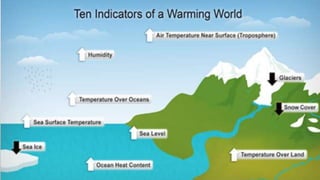
• Global warming the observed increase in average temperature near the earth’s
surface and in the lowest layer of the atmosphere.
EFFECTS OF CLIMATE CHANGE TODAY
The world's surface air temperature increased an average of 0.6°C (1.1°F) during the last
century (IPCC).
6 in 10 people are vulnerable in a physical and socio-economic sense (GHF, 2009; 3).
Sea level rising about 15 cm (6 inches)
 Sea ice is melting & Sea water becoming more acidic.
Ecosystems are changing.
Frequent drought & flood.
Warming of large lakes leading to increase in algal blooms in lakes.
FUTURE EFFECTS….
Expected to increase between 2 and 5 ºc over the next century. (IPCC WG II, 2007)
Sea level will rise to 59 cm (23 inches) during the 21st century
Severe and frequent droughts & tropical cyclones .
India and south Asia may see agricultural production decline by as much as 25% by
2050, compared to a baseline without climate change.
Increase the pressure of weeds, pests and disease on agricultural production.
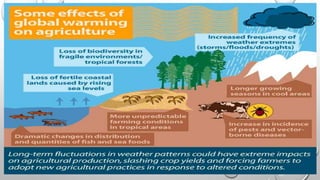
AGRICULTURE AND CLIMATE CHANGE
• Agriculture provides a livelihood for nearly 90 % of people (world bank, 2008)
• More than 75 % of south Asia's people depend on rain-fed agriculture. (sapkota,
2010).
• Significant consequences on food production and food security.
• Withering of Crops .
• A rise in sea temperature leads to occurrence of coral bleaching, with
resulting declines in fish stocks
Agriculture’s contribution to global warming
• Responsible for 14% of total greenhouse gas emissions
• Agriculture is responsible for 58% of NO2 & 47 % of CH4 (Smith et
al., 2007)
• Livestock contribute 18 % of global anthropogenic GHG emissions
(FAO 2006).
CLIMATE CHANGE IMPACTS IN INDIA
 The world's first great civilisations Bronze Age 'megacities' of the Indus Valley appear to
have collapsed because of an ancient episode of climate change. (The Independent, 3 March
2014).
More than 80% of Indian farmers are marginal and small with poor coping capacity.
Over 50 % of India's forests are likely to experience shift in forest types.
It has been projected that under the scenario of a 2.5 °C to 4.9 °C temperature rise in India,
Rice yields will drop by 32 %-40% Wheat yields by 41 %-52 %.
Rising sea levels will cause displacement along one of the most densely 7500 k.m. populated
coastlines in India.
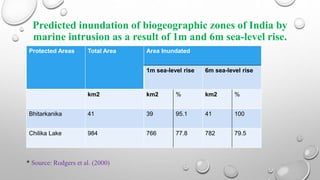
Predicted inundation of biogeographic zones of India by
marine intrusion as a result of 1m and 6m sea-level rise.
Protected Areas Total Area Area Inundated
1m sea-level rise 6m sea-level rise
km2 km2 % km2 %
Bhitarkanika 41 39 95.1 41 100
Chilika Lake 984 766 77.8 782 79.5
* Source: Rodgers et al. (2000)
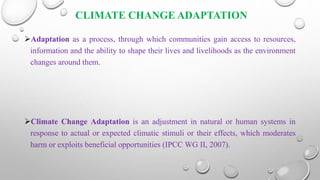
CLIMATE CHANGE ADAPTATION
Adaptation as a process, through which communities gain access to resources,
information and the ability to shape their lives and livelihoods as the environment
changes around them.
Climate Change Adaptation is an adjustment in natural or human systems in
response to actual or expected climatic stimuli or their effects, which moderates
harm or exploits beneficial opportunities (IPCC WG II, 2007).
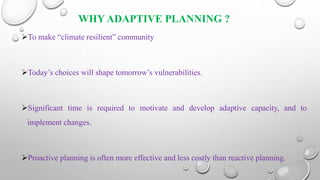
WHY ADAPTIVE PLANNING ?
To make “climate resilient” community
Today’s choices will shape tomorrow’s vulnerabilities.
Significant time is required to motivate and develop adaptive capacity, and to
implement changes.
Proactive planning is often more effective and less costly than reactive planning.
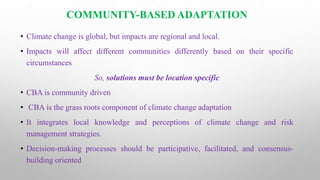
COMMUNITY-BASED ADAPTATION
• Climate change is global, but impacts are regional and local.
• Impacts will affect different communities differently based on their specific
circumstances
So, solutions must be location specific
• CBA is community driven
• CBA is the grass roots component of climate change adaptation
• It integrates local knowledge and perceptions of climate change and risk
management strategies.
• Decision-making processes should be participative, facilitated, and consensus-
building oriented
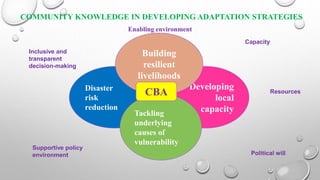
Developing
local
capacity
Disaster
risk
reduction
COMMUNITY KNOWLEDGE IN DEVELOPING ADAPTATION STRATEGIES
Enabling environment
Building
resilient
livelihoods
Tackling
underlying
causes of
vulnerability
CBA
Inclusive and
transparent
decision-making
Capacity
Resources
Political will
Supportive policy
environment
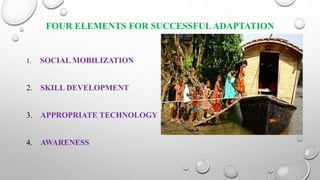
FOUR ELEMENTS FOR SUCCESSFUL ADAPTATION
1. SOCIAL MOBILIZATION
2. SKILL DEVELOPMENT
3. APPROPRIATE TECHNOLOGY
4. AWARENESS
COMMUNITY BASED ADAPTATION AS AN EFFECTIVE TOOL
• An intelligent strategy of both “hard” and “soft” measures in adaptation to
maximise value and impact
• Enables communities to understand and integrate the concept of climate risk into
their livelihood activities.
• Makes link local evidence to national strategies and global policy with local
institutions
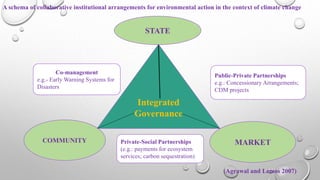
A schema of collaborative institutional arrangements for environmental action in the context of climate change
(Agrawal and Lemos 2007)
Integrated
Governance
STATE
COMMUNITY MARKET
Co-management
e.g.- Early Warning Systems for
Disasters
Public-Private Partnerships
e.g.: Concessionary Arrangements;
CDM projects
Private-Social Partnerships
(e.g.: payments for ecosystem
services; carbon sequestration)
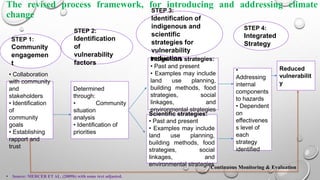
The revised process framework, for introducing and addressing climate
change
Continuous Monitoring & Evaluation
• Source: MERCER ET AL. (2009b) with some text adjusted.
• Collaboration
with community
and
stakeholders
• Identification
of
community
goals
• Establishing
rapport and
trust
Determined
through:
• Community
situation
analysis
• Identification of
priorities
Indigenous strategies:
• Past and present
• Examples may include
land use planning,
building methods, food
strategies, social
linkages, and
environmental strategies
Scientific strategies:
• Past and present
• Examples may include
land use planning,
building methods, food
strategies, social
linkages, and
environmental strategies
•
Addressing
internal
components
to hazards
• Dependent
on
effectivenes
s level of
each
strategy
identified
Reduced
vulnerabilit
y
STEP 1:
Community
engagemen
t
STEP 2:
Identification
of
vulnerability
factors
STEP 3:
Identification of
indigenous and
scientific
strategies for
vulnerability
reduction
STEP 4:
Integrated
Strategy
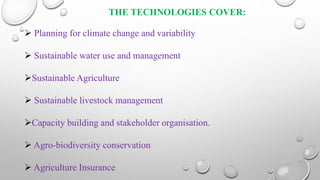
THE TECHNOLOGIES COVER:
 Planning for climate change and variability
 Sustainable water use and management
Sustainable Agriculture
 Sustainable livestock management
Capacity building and stakeholder organisation.
 Agro-biodiversity conservation
 Agriculture Insurance
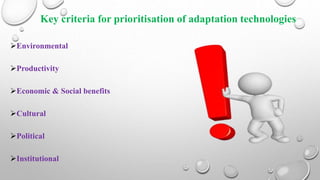
Key criteria for prioritisation of adaptation technologies
Environmental
Productivity
Economic & Social benefits
Cultural
Political
Institutional
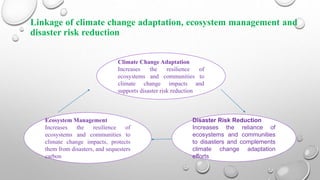
Linkage of climate change adaptation, ecosystem management and
disaster risk reduction
Climate Change Adaptation
Increases the resilience of
ecosystems and communities to
climate change impacts and
supports disaster risk reduction
Ecosystem Management
Increases the resilience of
ecosystems and communities to
climate change impacts, protects
them from disasters, and sequesters
carbon
Disaster Risk Reduction
Increases the reliance of
ecosystems and communities
to disasters and complements
climate change adaptation
efforts
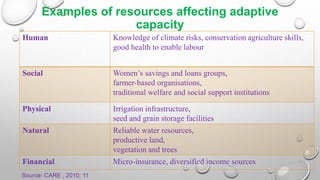
Examples of resources affecting adaptive
capacity
Human Knowledge of climate risks, conservation agriculture skills,
good health to enable labour
Social Women’s savings and loans groups,
farmer-based organisations,
traditional welfare and social support institutions
Physical Irrigation infrastructure,
seed and grain storage facilities
Natural Reliable water resources,
productive land,
vegetation and trees
Financial Micro-insurance, diversified income sources
Source: CARE , 2010; 11
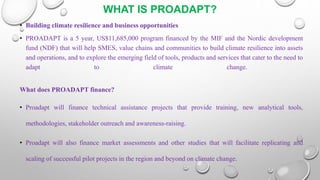
WHAT IS PROADAPT?
• Building climate resilience and business opportunities
• PROADAPT is a 5 year, US$11,685,000 program financed by the MIF and the Nordic development
fund (NDF) that will help SMES, value chains and communities to build climate resilience into assets
and operations, and to explore the emerging field of tools, products and services that cater to the need to
adapt to climate change.
What does PROADAPT finance?
• Proadapt will finance technical assistance projects that provide training, new analytical tools,
methodologies, stakeholder outreach and awareness-raising.
• Proadapt will also finance market assessments and other studies that will facilitate replicating and
scaling of successful pilot projects in the region and beyond on climate change.
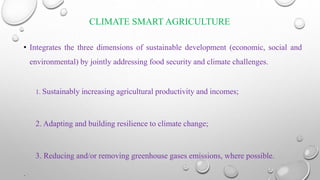
CLIMATE SMART AGRICULTURE
• Integrates the three dimensions of sustainable development (economic, social and
environmental) by jointly addressing food security and climate challenges.
1. Sustainably increasing agricultural productivity and incomes;
2. Adapting and building resilience to climate change;
3. Reducing and/or removing greenhouse gases emissions, where possible.
.
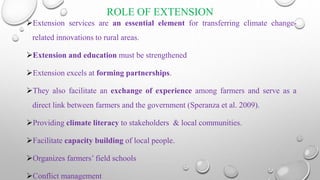
ROLE OF EXTENSION
Extension services are an essential element for transferring climate change-
related innovations to rural areas.
Extension and education must be strengthened
Extension excels at forming partnerships.
They also facilitate an exchange of experience among farmers and serve as a
direct link between farmers and the government (Speranza et al. 2009).
Providing climate literacy to stakeholders & local communities.
Facilitate capacity building of local people.
Organizes farmers’ field schools
Conflict management
MAJOR CHALLENGES
Adaptation/development dilemma
 Uncertainty in characterization of current / future climate variability
Deficits in adaptive capacities
Up-scaling
 Inadequacies in research
 Incoherent policies
 Cost allocation
POSSIBLE PATHWAYS
Integration of climate risks in to development priorities and decision processes
 Strengthen micro-level planning to facilitate better adaptation
Sharing of best practices
 Increase local government capacity (PRI)
Develop climate sensitive research infrastructure
 Education & awareness of communities
Building relationships between policy makers, researchers and communities.
References…….
• Adapt cap: climate proofing vulnerable coastal communities
• Agrawal, A., And M. Lemos. 2007. A greener revolution in making?
Environmental governance in the 21st century.” Environment 49(5): 36-45
• CARE , 2010; 11, toolkit for integrating climate change adaptation into
development projects
• FAO – food and agricultural organisation of the united nations 2007:
adaptation to climate change in agriculture, forestry and fisheries: perspective,
framework and priorities.
• GOI – Government of India 2008: national action plan on climate change
• IPCC – Intergovernmental panel on climate change 2007: climate change
2007: impacts, adaptation and vulnerability.
THANK YOU….

Community climate change adaptation

  • 1.
  • 2.
    OBJECTIVES • To provideconcept of Community Climate Change Adaptation. • To identify resources and partnerships needed to strengthen climate- related programming in extension • To delineate policy implication for better community participation & climate resilience. • To acknowledge about major challenges & possible pathways of Community Climate Change Adaptation.
  • 3.
    METHODOLOGIES FOLLOWED……. Conceptualization ofidea Consult with teachers. Customization the concept. Surfing internet. Concept configuration. Reference books & journals. Sequencing and resequencing .
  • 4.
    BACKGROUND Climate change Effects ofclimate change today & future effects Agriculture and climate change Climate change effects in India Community based adaptation (CBA) & Elements Climate Smart Agriculture Role of Extension in CBA Major Challenges Possible Pathways
  • 5.
    CLIMATE CHANGE • Climatethe long-term average of conditions in the atmosphere, ocean, and ice sheets and sea ice described by statistics, such as means and extremes. • Climate system the matter, energy, and processes involved in interactions among earth’s atmosphere, hydrosphere, cryosphere, lithosphere, biosphere, and earth-sun interactions. • Climate change refers to changes in either the average state of the climate or in its variability persisting for an extended period (typically decades or longer). • Global warming the observed increase in average temperature near the earth’s surface and in the lowest layer of the atmosphere.
  • 7.
    EFFECTS OF CLIMATECHANGE TODAY The world's surface air temperature increased an average of 0.6°C (1.1°F) during the last century (IPCC). 6 in 10 people are vulnerable in a physical and socio-economic sense (GHF, 2009; 3). Sea level rising about 15 cm (6 inches)  Sea ice is melting & Sea water becoming more acidic. Ecosystems are changing. Frequent drought & flood. Warming of large lakes leading to increase in algal blooms in lakes.
  • 8.
    FUTURE EFFECTS…. Expected toincrease between 2 and 5 ºc over the next century. (IPCC WG II, 2007) Sea level will rise to 59 cm (23 inches) during the 21st century Severe and frequent droughts & tropical cyclones . India and south Asia may see agricultural production decline by as much as 25% by 2050, compared to a baseline without climate change. Increase the pressure of weeds, pests and disease on agricultural production.
  • 9.
    AGRICULTURE AND CLIMATECHANGE • Agriculture provides a livelihood for nearly 90 % of people (world bank, 2008) • More than 75 % of south Asia's people depend on rain-fed agriculture. (sapkota, 2010). • Significant consequences on food production and food security. • Withering of Crops . • A rise in sea temperature leads to occurrence of coral bleaching, with resulting declines in fish stocks
  • 11.
    Agriculture’s contribution toglobal warming • Responsible for 14% of total greenhouse gas emissions • Agriculture is responsible for 58% of NO2 & 47 % of CH4 (Smith et al., 2007) • Livestock contribute 18 % of global anthropogenic GHG emissions (FAO 2006).
  • 12.
    CLIMATE CHANGE IMPACTSIN INDIA  The world's first great civilisations Bronze Age 'megacities' of the Indus Valley appear to have collapsed because of an ancient episode of climate change. (The Independent, 3 March 2014). More than 80% of Indian farmers are marginal and small with poor coping capacity. Over 50 % of India's forests are likely to experience shift in forest types. It has been projected that under the scenario of a 2.5 °C to 4.9 °C temperature rise in India, Rice yields will drop by 32 %-40% Wheat yields by 41 %-52 %. Rising sea levels will cause displacement along one of the most densely 7500 k.m. populated coastlines in India.
  • 13.
    Predicted inundation ofbiogeographic zones of India by marine intrusion as a result of 1m and 6m sea-level rise. Protected Areas Total Area Area Inundated 1m sea-level rise 6m sea-level rise km2 km2 % km2 % Bhitarkanika 41 39 95.1 41 100 Chilika Lake 984 766 77.8 782 79.5 * Source: Rodgers et al. (2000)
  • 14.
    CLIMATE CHANGE ADAPTATION Adaptationas a process, through which communities gain access to resources, information and the ability to shape their lives and livelihoods as the environment changes around them. Climate Change Adaptation is an adjustment in natural or human systems in response to actual or expected climatic stimuli or their effects, which moderates harm or exploits beneficial opportunities (IPCC WG II, 2007).
  • 15.
    WHY ADAPTIVE PLANNING? To make “climate resilient” community Today’s choices will shape tomorrow’s vulnerabilities. Significant time is required to motivate and develop adaptive capacity, and to implement changes. Proactive planning is often more effective and less costly than reactive planning.
  • 16.
    COMMUNITY-BASED ADAPTATION • Climatechange is global, but impacts are regional and local. • Impacts will affect different communities differently based on their specific circumstances So, solutions must be location specific • CBA is community driven • CBA is the grass roots component of climate change adaptation • It integrates local knowledge and perceptions of climate change and risk management strategies. • Decision-making processes should be participative, facilitated, and consensus- building oriented
  • 17.
    Developing local capacity Disaster risk reduction COMMUNITY KNOWLEDGE INDEVELOPING ADAPTATION STRATEGIES Enabling environment Building resilient livelihoods Tackling underlying causes of vulnerability CBA Inclusive and transparent decision-making Capacity Resources Political will Supportive policy environment
  • 18.
    FOUR ELEMENTS FORSUCCESSFUL ADAPTATION 1. SOCIAL MOBILIZATION 2. SKILL DEVELOPMENT 3. APPROPRIATE TECHNOLOGY 4. AWARENESS
  • 19.
    COMMUNITY BASED ADAPTATIONAS AN EFFECTIVE TOOL • An intelligent strategy of both “hard” and “soft” measures in adaptation to maximise value and impact • Enables communities to understand and integrate the concept of climate risk into their livelihood activities. • Makes link local evidence to national strategies and global policy with local institutions
  • 20.
    A schema ofcollaborative institutional arrangements for environmental action in the context of climate change (Agrawal and Lemos 2007) Integrated Governance STATE COMMUNITY MARKET Co-management e.g.- Early Warning Systems for Disasters Public-Private Partnerships e.g.: Concessionary Arrangements; CDM projects Private-Social Partnerships (e.g.: payments for ecosystem services; carbon sequestration)
  • 21.
    The revised processframework, for introducing and addressing climate change Continuous Monitoring & Evaluation • Source: MERCER ET AL. (2009b) with some text adjusted. • Collaboration with community and stakeholders • Identification of community goals • Establishing rapport and trust Determined through: • Community situation analysis • Identification of priorities Indigenous strategies: • Past and present • Examples may include land use planning, building methods, food strategies, social linkages, and environmental strategies Scientific strategies: • Past and present • Examples may include land use planning, building methods, food strategies, social linkages, and environmental strategies • Addressing internal components to hazards • Dependent on effectivenes s level of each strategy identified Reduced vulnerabilit y STEP 1: Community engagemen t STEP 2: Identification of vulnerability factors STEP 3: Identification of indigenous and scientific strategies for vulnerability reduction STEP 4: Integrated Strategy
  • 22.
    THE TECHNOLOGIES COVER: Planning for climate change and variability  Sustainable water use and management Sustainable Agriculture  Sustainable livestock management Capacity building and stakeholder organisation.  Agro-biodiversity conservation  Agriculture Insurance
  • 23.
    Key criteria forprioritisation of adaptation technologies Environmental Productivity Economic & Social benefits Cultural Political Institutional
  • 24.
    Linkage of climatechange adaptation, ecosystem management and disaster risk reduction Climate Change Adaptation Increases the resilience of ecosystems and communities to climate change impacts and supports disaster risk reduction Ecosystem Management Increases the resilience of ecosystems and communities to climate change impacts, protects them from disasters, and sequesters carbon Disaster Risk Reduction Increases the reliance of ecosystems and communities to disasters and complements climate change adaptation efforts
  • 25.
    Examples of resourcesaffecting adaptive capacity Human Knowledge of climate risks, conservation agriculture skills, good health to enable labour Social Women’s savings and loans groups, farmer-based organisations, traditional welfare and social support institutions Physical Irrigation infrastructure, seed and grain storage facilities Natural Reliable water resources, productive land, vegetation and trees Financial Micro-insurance, diversified income sources Source: CARE , 2010; 11
  • 26.
    WHAT IS PROADAPT? •Building climate resilience and business opportunities • PROADAPT is a 5 year, US$11,685,000 program financed by the MIF and the Nordic development fund (NDF) that will help SMES, value chains and communities to build climate resilience into assets and operations, and to explore the emerging field of tools, products and services that cater to the need to adapt to climate change. What does PROADAPT finance? • Proadapt will finance technical assistance projects that provide training, new analytical tools, methodologies, stakeholder outreach and awareness-raising. • Proadapt will also finance market assessments and other studies that will facilitate replicating and scaling of successful pilot projects in the region and beyond on climate change.
  • 27.
    CLIMATE SMART AGRICULTURE •Integrates the three dimensions of sustainable development (economic, social and environmental) by jointly addressing food security and climate challenges. 1. Sustainably increasing agricultural productivity and incomes; 2. Adapting and building resilience to climate change; 3. Reducing and/or removing greenhouse gases emissions, where possible. .
  • 28.
    ROLE OF EXTENSION Extensionservices are an essential element for transferring climate change- related innovations to rural areas. Extension and education must be strengthened Extension excels at forming partnerships. They also facilitate an exchange of experience among farmers and serve as a direct link between farmers and the government (Speranza et al. 2009). Providing climate literacy to stakeholders & local communities. Facilitate capacity building of local people. Organizes farmers’ field schools Conflict management
  • 29.
    MAJOR CHALLENGES Adaptation/development dilemma Uncertainty in characterization of current / future climate variability Deficits in adaptive capacities Up-scaling  Inadequacies in research  Incoherent policies  Cost allocation
  • 30.
    POSSIBLE PATHWAYS Integration ofclimate risks in to development priorities and decision processes  Strengthen micro-level planning to facilitate better adaptation Sharing of best practices  Increase local government capacity (PRI) Develop climate sensitive research infrastructure  Education & awareness of communities Building relationships between policy makers, researchers and communities.
  • 31.
    References……. • Adapt cap:climate proofing vulnerable coastal communities • Agrawal, A., And M. Lemos. 2007. A greener revolution in making? Environmental governance in the 21st century.” Environment 49(5): 36-45 • CARE , 2010; 11, toolkit for integrating climate change adaptation into development projects • FAO – food and agricultural organisation of the united nations 2007: adaptation to climate change in agriculture, forestry and fisheries: perspective, framework and priorities. • GOI – Government of India 2008: national action plan on climate change • IPCC – Intergovernmental panel on climate change 2007: climate change 2007: impacts, adaptation and vulnerability.
  • 32.