Thorndike
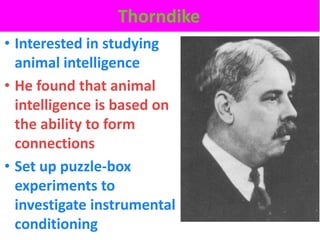
• Interested in studying
  animal intelligence
• He found that animal
  intelligence is based on
  the ability to form
  connections
• Set up puzzle-box
  experiments to
  investigate instrumental
  conditioning
Trial & Error learning - Thorndike
• Describes an organism’s attempts to
   learn/solve a problem by trying alternative
   possibilities until a correct solution or
   desirable outcome is achieved
Usually involves
1. A number of attempts & a number of errors
   - Before correct behaviour is learnt
2. Motivation (to achieve a goal)
3. Exploration – either random or purposeful
4. Reward – the correct response is rewarded –
• which will lead to repeat performance of
   the correct response, strengthening the
   association between the behaviour & its
   outcome
• Once learnt behaviour will usually be
   performed quickly and with fewer errors
Thorndike’s Puzzle-box experiment
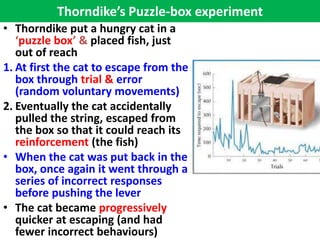
• Thorndike put a hungry cat in a
   ‘puzzle box’ & placed fish, just
   out of reach
1. At first the cat to escape from the
   box through trial & error
   (random voluntary movements)
2. Eventually the cat accidentally
   pulled the string, escaped from
   the box so that it could reach its
   reinforcement (the fish)
• When the cat was put back in the
   box, once again it went through a
   series of incorrect responses
   before pushing the lever
• The cat became progressively
   quicker at escaping (and had
   fewer incorrect behaviours)
Thorndike ‘Law of Effect’
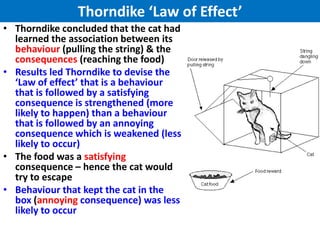
• Thorndike concluded that the cat had
  learned the association between its
  behaviour (pulling the string) & the
  consequences (reaching the food)
• Results led Thorndike to devise the
  ‘Law of effect’ that is a behaviour
  that is followed by a satisfying
  consequence is strengthened (more
  likely to happen) than a behaviour
  that is followed by an annoying
  consequence which is weakened (less
  likely to occur)
• The food was a satisfying
  consequence – hence the cat would
  try to escape
• Behaviour that kept the cat in the
  box (annoying consequence) was less
  likely to occur

Trial & error learning Thorndike - VCE U4 Psych

  • 1.
    Thorndike • Interested instudying animal intelligence • He found that animal intelligence is based on the ability to form connections • Set up puzzle-box experiments to investigate instrumental conditioning
  • 2.
    Trial & Errorlearning - Thorndike • Describes an organism’s attempts to learn/solve a problem by trying alternative possibilities until a correct solution or desirable outcome is achieved Usually involves 1. A number of attempts & a number of errors - Before correct behaviour is learnt 2. Motivation (to achieve a goal) 3. Exploration – either random or purposeful 4. Reward – the correct response is rewarded – • which will lead to repeat performance of the correct response, strengthening the association between the behaviour & its outcome • Once learnt behaviour will usually be performed quickly and with fewer errors
  • 3.
    Thorndike’s Puzzle-box experiment •Thorndike put a hungry cat in a ‘puzzle box’ & placed fish, just out of reach 1. At first the cat to escape from the box through trial & error (random voluntary movements) 2. Eventually the cat accidentally pulled the string, escaped from the box so that it could reach its reinforcement (the fish) • When the cat was put back in the box, once again it went through a series of incorrect responses before pushing the lever • The cat became progressively quicker at escaping (and had fewer incorrect behaviours)
  • 4.
    Thorndike ‘Law ofEffect’ • Thorndike concluded that the cat had learned the association between its behaviour (pulling the string) & the consequences (reaching the food) • Results led Thorndike to devise the ‘Law of effect’ that is a behaviour that is followed by a satisfying consequence is strengthened (more likely to happen) than a behaviour that is followed by an annoying consequence which is weakened (less likely to occur) • The food was a satisfying consequence – hence the cat would try to escape • Behaviour that kept the cat in the box (annoying consequence) was less likely to occur