BEHAVIORAL LEARNING THEORIES

IVAN PAVLOV
Key Individuals Associated with this
Theory:
 IVAN PAVLOV –created the classical conditioning

theory.
 B.F Skinner – created the operant conditioning
theory.
 Albert Bandura - Created the social cognitive
theory.
 John B. Watson – worked with the classical
conditioning theory.
Is a learning theory based on the
idea, that behavior can be controlled or
modified based on the antecedents and
consequences of a behavior .
ANTECEDENTS
An antecedent is an event that occurs
before a behavior and can affect the likelihood of
the behavior occurring.
•EXAMPLE:
•Julius was playing with his blocks in his
room. Dad told Julius it was time to clean up
the blocks for dinner. He threw his blocks
across the room, screamed loudly, and threw
himself on the floor. Dad walked out of the
room.
A behavior will only occur if given the

right environment or antecedent.
The behavior is more or less likely to re

occur based on the reinforcements or
consequences that fallow, such as
rewards and punishments.
 Is a type of learning that had a major

influence on the school of thought in
psychology
known
as
behaviorism.
Discovered by Russian physiologist
, classical conditioning is a learning
process that occurs through associations
between an environmental stimulus and a
naturally occurring stimulus.
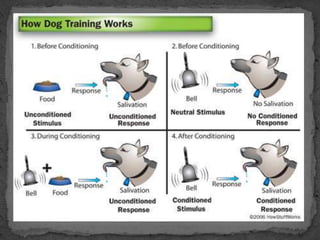
The Unconditioned Stimulus

is one that unconditionally, naturally, and
automatically triggers a response.
The Unconditioned Response

is the unlearned response that occurs
naturally in response to the unconditioned
stimulus.
The Conditioned Stimulus

is previously neutral stimulus that, after
becoming associated with the unconditioned
stimulus, eventually comes to trigger a
conditioned response.
The Conditioned Response

is the learned response to the previously
neutral stimulus.
One of the most famous examples of
classical conditioning was John B. Watson's
experiment in which a fear response was
conditioned in a young boy known as “Little
Albert”. The child initially showed no fear of a
white rat, but after the presentation of the rat
was paired repeatedly with loud, scary
sounds, the child would cry when the rat was
present. The child's fear also generalized to
other fuzzy white objects.








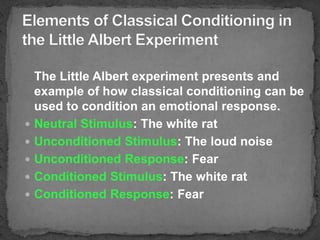
The Little Albert experiment presents and
example of how classical conditioning can be
used to condition an emotional response.
Neutral Stimulus: The white rat
Unconditioned Stimulus: The loud noise
Unconditioned Response: Fear
Conditioned Stimulus: The white rat
Conditioned Response: Fear
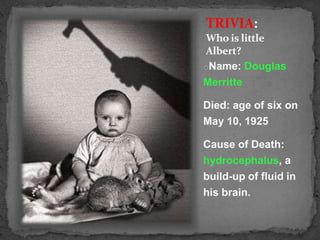
TRIVIA:
Who is little
Albert?
oName: Douglas

Merritte
Died: age of six on
May 10, 1925

Cause of Death:
hydrocephalus, a
build-up of fluid in
his brain.
Classical conditioning IVAN PAVLOV

Classical conditioning IVAN PAVLOV

  • 1.
  • 2.
    Key Individuals Associatedwith this Theory:  IVAN PAVLOV –created the classical conditioning theory.  B.F Skinner – created the operant conditioning theory.  Albert Bandura - Created the social cognitive theory.  John B. Watson – worked with the classical conditioning theory.
  • 3.
    Is a learningtheory based on the idea, that behavior can be controlled or modified based on the antecedents and consequences of a behavior .
  • 4.
    ANTECEDENTS An antecedent isan event that occurs before a behavior and can affect the likelihood of the behavior occurring. •EXAMPLE: •Julius was playing with his blocks in his room. Dad told Julius it was time to clean up the blocks for dinner. He threw his blocks across the room, screamed loudly, and threw himself on the floor. Dad walked out of the room.
  • 5.
    A behavior willonly occur if given the right environment or antecedent. The behavior is more or less likely to re occur based on the reinforcements or consequences that fallow, such as rewards and punishments.
  • 6.
     Is atype of learning that had a major influence on the school of thought in psychology known as behaviorism. Discovered by Russian physiologist , classical conditioning is a learning process that occurs through associations between an environmental stimulus and a naturally occurring stimulus.
  • 7.
    The Unconditioned Stimulus isone that unconditionally, naturally, and automatically triggers a response. The Unconditioned Response is the unlearned response that occurs naturally in response to the unconditioned stimulus.
  • 8.
    The Conditioned Stimulus ispreviously neutral stimulus that, after becoming associated with the unconditioned stimulus, eventually comes to trigger a conditioned response. The Conditioned Response is the learned response to the previously neutral stimulus.
  • 14.
    One of themost famous examples of classical conditioning was John B. Watson's experiment in which a fear response was conditioned in a young boy known as “Little Albert”. The child initially showed no fear of a white rat, but after the presentation of the rat was paired repeatedly with loud, scary sounds, the child would cry when the rat was present. The child's fear also generalized to other fuzzy white objects.
  • 15.
         The Little Albertexperiment presents and example of how classical conditioning can be used to condition an emotional response. Neutral Stimulus: The white rat Unconditioned Stimulus: The loud noise Unconditioned Response: Fear Conditioned Stimulus: The white rat Conditioned Response: Fear
  • 17.
    TRIVIA: Who is little Albert? oName:Douglas Merritte Died: age of six on May 10, 1925 Cause of Death: hydrocephalus, a build-up of fluid in his brain.