VinayakaEducation Society (R)
National College of Education
Harihara Road, Hosapete
Bachelor of Education (B.Ed)
B.Ed I Year II Semester
2023-2024
Paper Title: PEC - 4 Learning and Teaching Process
Seminar Topic On
Learning Theory of E.L. Thorndike
Guided By: Presented By:
MKarthik Gayathri K H
Assistant Professor Reg No: - U16NH23E0054
National B. Ed College National B. Ed College
Hosapete Hosapete
INDEX
1. Introduction
2. Meaning and Definition of Learning
3. E.L. Thorndike’s – Trial and Error Theory of Learning
4. Life History of E.L. Thorndike
5. Thorndike’s Experiment of Puzzle Box on Cat
i. Main Objectives of Theory
ii. Equipment Used in Experiment
iii. Experiment Method
6. Law of Learning
7. Education Implication
8. Conclusion
LEARNING THEORIES OF THORNDIKES
INTRODUCTION
LEARNING THEORIES
Learning theory is a set of ideas that explain how people learn, acquire, process and retain
knowledge.
It also describes the conditions and processes that facilitate learning and how these processes can
be used to create a better learning environment.
Learning theories can help teachers develop instruction sessions that consider cognitive, emotional,
and environmental influences as well as prior experience.
Some major learning theories include behaviorism, social learning theory and constructivism. These
theories emphasize different aspects of the learning process, such as the role of the brain, the
learning environment, and the associations and connections people make. They also cover various
methods of learning, such as deserving others, practicing, and thinking critically.
MEANING AND DEFINATION OF LEARNING
MEANING OF LEARNING
Learning is the activity or process of gaining knowledge or skill by studying, practicing or
experiencing something.
➢ Learning is the act of acquiring new knowledge behaviors, skills and values.
➢ Learning is the act of experiencing skills acquired by instruction.
➢ Learning may be viewed as a process rather than a collection of procedural knowledge.
➢ It is a lifelong process.
DEFINATIONS
J.P Guilford:
Learning is any change in behavior resulting from behavior.
Skinner:
Learning is the process of adapting to progressive behavior.
Malcolm Knowles:
Learning is the process of gaining knowledge and expertise.
Cronbach:
To learn is to modify behavior and experience.
Gates:
Learning is the modification behavior through experience.
E.L THORNDIKE – TRAIL & ERROR OF LEARNING
➢ Edward Lee Thorndike (1874 -1949) was the first American Psychologist who put forward the
trial-and-error theory of learning.
➢ According to Thorndike, all learning takes place because of the bond between stimulus and
response.
➢ He further says that learning takes place through a process of approximation and
corrections.
➢ A person makes several trials. Some responses do not give satisfaction to the individual, but
he goes on making further trials until he gets satisfactory responses.
➢ Thorndike theory has observed three mains
1. Stimulus
2. Response
3. Bond
➢ Describes an organism’s attempts to learn/Solve a problem by trying alternative possibilities
until a correct solution or desirable outcome.
➢ In learning the learner selects a correct response out of many possible ones and connects it
with the appropriate stimulus.
➢ Learning by this method is called trial and error learning theory.
USUALLY INVOLVES
1. Several of several errors before correct behavior is learnt
2. Motivation (To achieve a goal)
3. Exploration either random or purposeful
4. Reward The correct response is rewarded
Once learnt behavior will usually be performed quickly and with fewer errors.
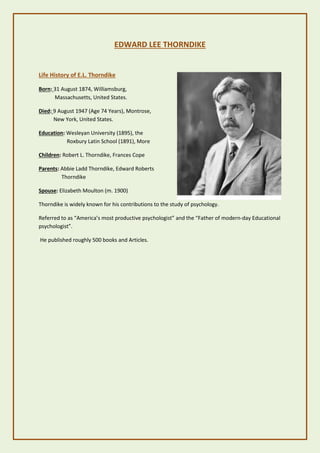
EDWARD LEE THORNDIKE
Life History of E.L. Thorndike
Born: 31 August 1874, Williamsburg,
Massachusetts, United States.
Died: 9 August 1947 (Age 74 Years), Montrose,
New York, United States.
Education: Wesleyan University (1895), the
Roxbury Latin School (1891), More
Children: Robert L. Thorndike, Frances Cope
Parents: Abbie Ladd Thorndike, Edward Roberts
Thorndike
Spouse: Elizabeth Moulton (m. 1900)
Thorndike is widely known for his contributions to the study of psychology.
Referred to as “America’s most productive psychologist” and the “Father of modern-day Educational
psychologist”.
He published roughly 500 books and Articles.
THORNDIKES PUZZLE BOX EXPERIMENT ON CAT
Thorndike conducted several experiments on animals to explain the process of learning.
His most widely quoted experiment is with a cat placed in a puzzle box.
A} Main Objectives of Theory
❖ This Learning theory represents the original stimuli response framework of behavioral
psychology.
❖ It states that learning is the result of associations forming between stimuli and responses.
B} Equipment Used in Experiment
A} Hungry Cat
B} Fish Plate
C} Puzzle Box
C} Experiment Method
Thorndike put a hungry cat in a puzzle box. The box had one deer, which could be opened by
manipulating a watch on the door. A fish was placed outside the box. The cat was hungry and had
the motivation to eat fish outside the box, however the obstacle was catch on the door. The cat
made random movements inside the box indicating trial & error type of behavior biting at the box,
scratching the box, walking around pulling and jumping etc. to come out to get the food. Now during
her movements, the latch was manipulated accidentally, and cat came out to get the food. Over a
series of successive trails the cat took shorter and shorter time, committed less number of errors &
was in a position to manipulate the latch as soon as it was put in the box and learnt the art of
opening the door.
First Trail
Hungry cats are placed inside the box. Fish kept outside the box works as a motive. Cat started doing
random movements for getting food. Cat bites at the bars of wires thrust it paws through any
opening responses continued for several minutes by chance cat came out and got its reward (Fish)
Second Trail
With increasing trails, the time it takes to pull the loop decreased. The wrong responses that the cat
was showing also decreased, as trails increased. Finally, the cat learned the trick. The name trial and
error learning come from the fact that errors decreased over trails.
❖ Drive: Hungry cat intensified by sight of the food
❖ Goal: To get food by getting out of the box
❖ Block: The cat was confined in the box with a closed door.
❖ Random Movements: The cat persistently tried to come out of the box without knowing
how.
❖ Chance Success: Striving and random movements the cat by chance succeeded in opening
the door
❖ Selection: Gradually cat recognized the correct way to manipulate the latch
❖ Fixation: At last the cat learned the proper way to open the door by eliminating all the
incorrect responses eliminating all the incorrect responses and fixing only the right response.
LAWS OF LEARNING
Based on this experiment, Thorndike propounded three laws of learning.
1} Law of Readiness:
It is stated as “When any conduction unit is ready to conduct for it to do so is satisfying”, Readiness
is preparation for action. It is essential for learning
2} Law of Exercise:
The second law of learning is the “Law of Exercise” which means that drill or practice helps in
increasing efficiency and durability of learning and according to Thorndike’s S-R bond theory with
trial & the connections are weakened when trial or practice is discontinued.
Law of Exercise is divided into two parts
❖ Law of Use
❖ Law of Disuse
A} Law of Use states that other think beings equal, the more frequently a modifiable connection
between S-R is made, the stronger that connection will be.
B} The Law of Disuse states that other things being equal, when a modifiable connection between
S-R is not made over a period, the strength of that connection is weakened.
3} Law of Effect:
The third law is the “Law of Effect”, according to which the trial leading to satisfaction stamps in the
bond. Satisfying state led to consolidation and strengthening of the connection is satisfaction or pain
led to the weakening of the connection.
EDUCATIONAL IMPLICATIONS
❖ Use in insightful learning:
Even in insightful learning, trial & error is involved
❖ Transfer of Learning:
Transfer of Learning takes place because of identical elements in two situations
❖ Learning Skills:
Various skills like sitting, standing, walking, running skills are learnt by trial & error
❖ Scientific Inventions:
Many scientific inventions, machines and improvements are the result of trial & error
CONCLUSION
In conclusion, theorists have discovered many learning theories, to help describe the learning
styles that people utilized today. Neither one is correct, but we determined which learning
theory will help learn and continue to grow. We can conclude from the above points that
Thorndike’s theory and laws of learning have contributed a lot to educational theory and
practice.
It has made learning purposeful, and goal directed and has brought motivation to the forefront.
It has also given impulse to the work of practice, drill & repetition & realized to psychological
importance of rewards & praise in the process of the teaching and learning.
REFERENCES
1) C.B Saraswathi. “Learning, Teaching and assessment. 2016 Vismaya Prakashana, Mysore
2) DR. S.B Yadwad, “Learning and Teaching processes” Vidyanidhi Prakashana.

Learning and Teaching Process of E.L Thorndike

  • 1.
    VinayakaEducation Society (R) NationalCollege of Education Harihara Road, Hosapete Bachelor of Education (B.Ed) B.Ed I Year II Semester 2023-2024 Paper Title: PEC - 4 Learning and Teaching Process Seminar Topic On Learning Theory of E.L. Thorndike Guided By: Presented By: MKarthik Gayathri K H Assistant Professor Reg No: - U16NH23E0054 National B. Ed College National B. Ed College Hosapete Hosapete
  • 2.
    INDEX 1. Introduction 2. Meaningand Definition of Learning 3. E.L. Thorndike’s – Trial and Error Theory of Learning 4. Life History of E.L. Thorndike 5. Thorndike’s Experiment of Puzzle Box on Cat i. Main Objectives of Theory ii. Equipment Used in Experiment iii. Experiment Method 6. Law of Learning 7. Education Implication 8. Conclusion
  • 3.
    LEARNING THEORIES OFTHORNDIKES INTRODUCTION LEARNING THEORIES Learning theory is a set of ideas that explain how people learn, acquire, process and retain knowledge. It also describes the conditions and processes that facilitate learning and how these processes can be used to create a better learning environment. Learning theories can help teachers develop instruction sessions that consider cognitive, emotional, and environmental influences as well as prior experience. Some major learning theories include behaviorism, social learning theory and constructivism. These theories emphasize different aspects of the learning process, such as the role of the brain, the learning environment, and the associations and connections people make. They also cover various methods of learning, such as deserving others, practicing, and thinking critically. MEANING AND DEFINATION OF LEARNING MEANING OF LEARNING Learning is the activity or process of gaining knowledge or skill by studying, practicing or experiencing something. ➢ Learning is the act of acquiring new knowledge behaviors, skills and values. ➢ Learning is the act of experiencing skills acquired by instruction. ➢ Learning may be viewed as a process rather than a collection of procedural knowledge. ➢ It is a lifelong process.
  • 4.
    DEFINATIONS J.P Guilford: Learning isany change in behavior resulting from behavior. Skinner: Learning is the process of adapting to progressive behavior. Malcolm Knowles: Learning is the process of gaining knowledge and expertise. Cronbach: To learn is to modify behavior and experience. Gates: Learning is the modification behavior through experience. E.L THORNDIKE – TRAIL & ERROR OF LEARNING ➢ Edward Lee Thorndike (1874 -1949) was the first American Psychologist who put forward the trial-and-error theory of learning. ➢ According to Thorndike, all learning takes place because of the bond between stimulus and response. ➢ He further says that learning takes place through a process of approximation and corrections. ➢ A person makes several trials. Some responses do not give satisfaction to the individual, but he goes on making further trials until he gets satisfactory responses. ➢ Thorndike theory has observed three mains 1. Stimulus 2. Response 3. Bond ➢ Describes an organism’s attempts to learn/Solve a problem by trying alternative possibilities until a correct solution or desirable outcome. ➢ In learning the learner selects a correct response out of many possible ones and connects it with the appropriate stimulus. ➢ Learning by this method is called trial and error learning theory. USUALLY INVOLVES 1. Several of several errors before correct behavior is learnt 2. Motivation (To achieve a goal) 3. Exploration either random or purposeful 4. Reward The correct response is rewarded Once learnt behavior will usually be performed quickly and with fewer errors.
  • 5.
    EDWARD LEE THORNDIKE LifeHistory of E.L. Thorndike Born: 31 August 1874, Williamsburg, Massachusetts, United States. Died: 9 August 1947 (Age 74 Years), Montrose, New York, United States. Education: Wesleyan University (1895), the Roxbury Latin School (1891), More Children: Robert L. Thorndike, Frances Cope Parents: Abbie Ladd Thorndike, Edward Roberts Thorndike Spouse: Elizabeth Moulton (m. 1900) Thorndike is widely known for his contributions to the study of psychology. Referred to as “America’s most productive psychologist” and the “Father of modern-day Educational psychologist”. He published roughly 500 books and Articles.
  • 6.
    THORNDIKES PUZZLE BOXEXPERIMENT ON CAT Thorndike conducted several experiments on animals to explain the process of learning. His most widely quoted experiment is with a cat placed in a puzzle box. A} Main Objectives of Theory ❖ This Learning theory represents the original stimuli response framework of behavioral psychology. ❖ It states that learning is the result of associations forming between stimuli and responses. B} Equipment Used in Experiment A} Hungry Cat B} Fish Plate C} Puzzle Box C} Experiment Method Thorndike put a hungry cat in a puzzle box. The box had one deer, which could be opened by manipulating a watch on the door. A fish was placed outside the box. The cat was hungry and had the motivation to eat fish outside the box, however the obstacle was catch on the door. The cat made random movements inside the box indicating trial & error type of behavior biting at the box, scratching the box, walking around pulling and jumping etc. to come out to get the food. Now during her movements, the latch was manipulated accidentally, and cat came out to get the food. Over a series of successive trails the cat took shorter and shorter time, committed less number of errors & was in a position to manipulate the latch as soon as it was put in the box and learnt the art of opening the door.
  • 7.
    First Trail Hungry catsare placed inside the box. Fish kept outside the box works as a motive. Cat started doing random movements for getting food. Cat bites at the bars of wires thrust it paws through any opening responses continued for several minutes by chance cat came out and got its reward (Fish) Second Trail With increasing trails, the time it takes to pull the loop decreased. The wrong responses that the cat was showing also decreased, as trails increased. Finally, the cat learned the trick. The name trial and error learning come from the fact that errors decreased over trails. ❖ Drive: Hungry cat intensified by sight of the food ❖ Goal: To get food by getting out of the box ❖ Block: The cat was confined in the box with a closed door. ❖ Random Movements: The cat persistently tried to come out of the box without knowing how. ❖ Chance Success: Striving and random movements the cat by chance succeeded in opening the door ❖ Selection: Gradually cat recognized the correct way to manipulate the latch ❖ Fixation: At last the cat learned the proper way to open the door by eliminating all the incorrect responses eliminating all the incorrect responses and fixing only the right response. LAWS OF LEARNING Based on this experiment, Thorndike propounded three laws of learning. 1} Law of Readiness: It is stated as “When any conduction unit is ready to conduct for it to do so is satisfying”, Readiness is preparation for action. It is essential for learning 2} Law of Exercise: The second law of learning is the “Law of Exercise” which means that drill or practice helps in increasing efficiency and durability of learning and according to Thorndike’s S-R bond theory with trial & the connections are weakened when trial or practice is discontinued. Law of Exercise is divided into two parts ❖ Law of Use ❖ Law of Disuse A} Law of Use states that other think beings equal, the more frequently a modifiable connection between S-R is made, the stronger that connection will be. B} The Law of Disuse states that other things being equal, when a modifiable connection between S-R is not made over a period, the strength of that connection is weakened.
  • 8.
    3} Law ofEffect: The third law is the “Law of Effect”, according to which the trial leading to satisfaction stamps in the bond. Satisfying state led to consolidation and strengthening of the connection is satisfaction or pain led to the weakening of the connection. EDUCATIONAL IMPLICATIONS ❖ Use in insightful learning: Even in insightful learning, trial & error is involved ❖ Transfer of Learning: Transfer of Learning takes place because of identical elements in two situations ❖ Learning Skills: Various skills like sitting, standing, walking, running skills are learnt by trial & error ❖ Scientific Inventions: Many scientific inventions, machines and improvements are the result of trial & error
  • 9.
    CONCLUSION In conclusion, theoristshave discovered many learning theories, to help describe the learning styles that people utilized today. Neither one is correct, but we determined which learning theory will help learn and continue to grow. We can conclude from the above points that Thorndike’s theory and laws of learning have contributed a lot to educational theory and practice. It has made learning purposeful, and goal directed and has brought motivation to the forefront. It has also given impulse to the work of practice, drill & repetition & realized to psychological importance of rewards & praise in the process of the teaching and learning. REFERENCES 1) C.B Saraswathi. “Learning, Teaching and assessment. 2016 Vismaya Prakashana, Mysore 2) DR. S.B Yadwad, “Learning and Teaching processes” Vidyanidhi Prakashana.