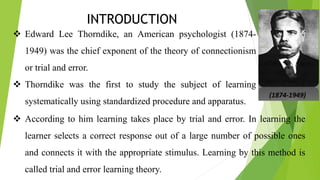
Thorndike's theory of connectionism or trial and error learning posits that learning occurs through a process of trial and error. In his famous puzzle box experiments, Thorndike observed that cats placed in a box would at first make random movements to escape but gradually learned to pull a string to open the door and get food. Over successive trials, the time taken to learn the correct response decreased as incorrect responses were eliminated. Thorndike concluded that learning involves forming direct connections between stimuli and responses through a gradual process of selecting satisfying responses that meet a goal and eliminating annoying responses that do not.