Behaviourism
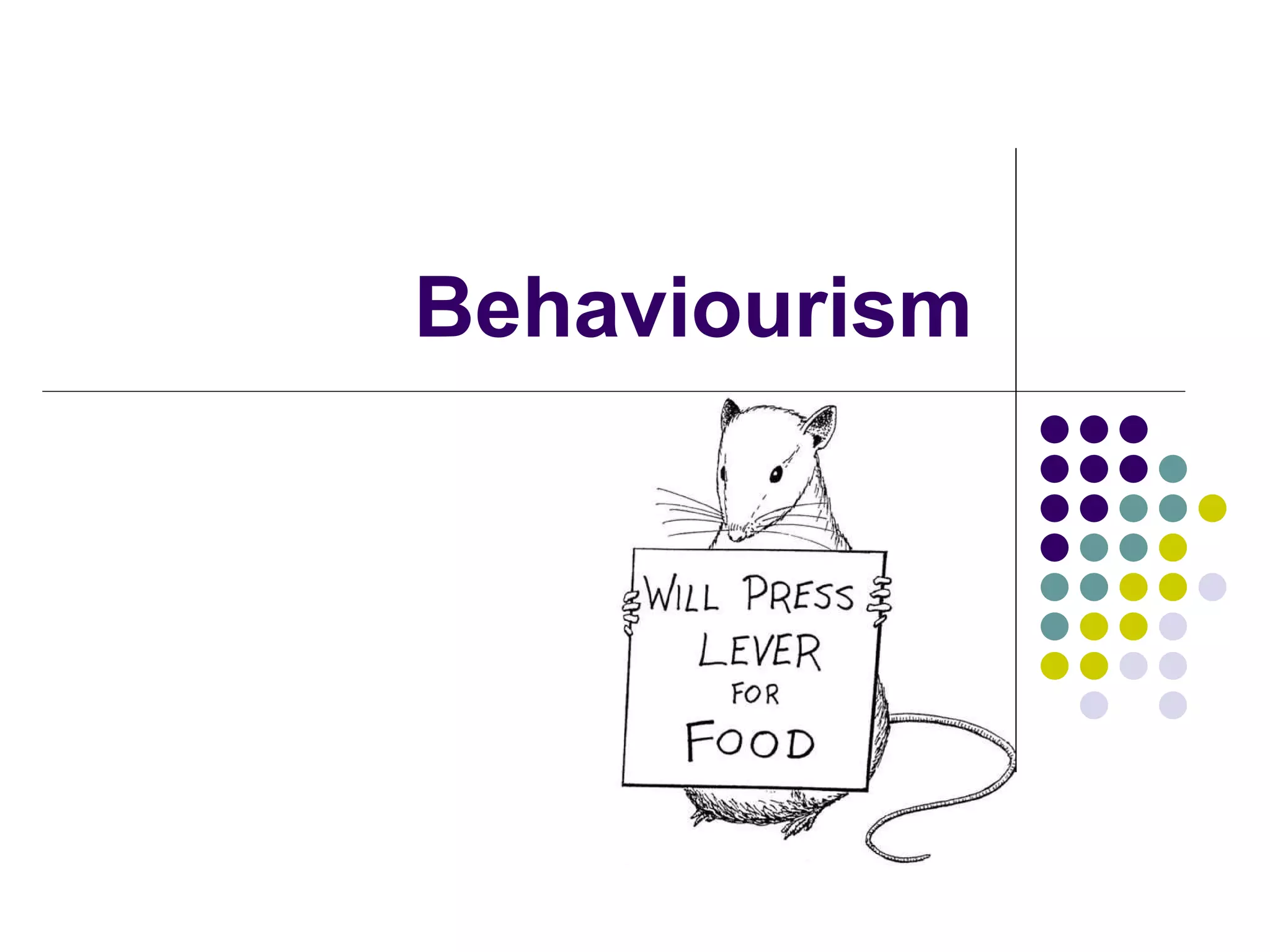
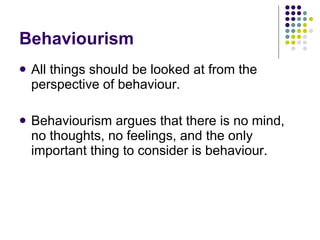
Behaviourism All things should be looked at from the perspective of behaviour. Behaviourism argues that there is no mind, no thoughts, no feelings, and the only important thing to consider is behaviour.
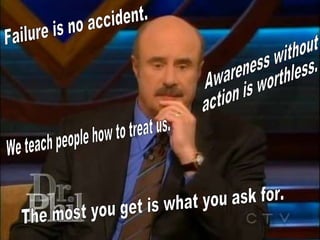
We teach people how to treat us. Awareness without  action is worthless. Failure is no accident. The most you get is what you ask for.
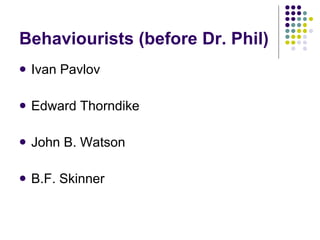
Behaviourists (before Dr. Phil) Ivan Pavlov Edward Thorndike John B. Watson B.F. Skinner
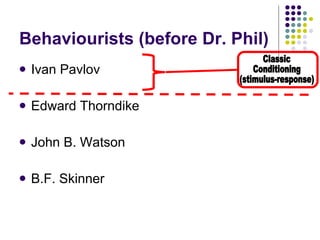
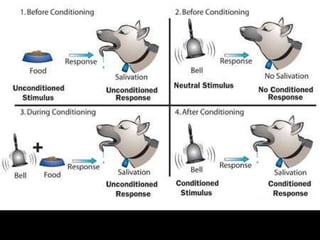
Ivan Pavlov Edward Thorndike John B. Watson B.F. Skinner  Behaviourists (before Dr. Phil) Classic Conditioning (stimulus-response)
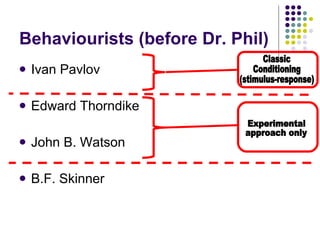
Ivan Pavlov Edward Thorndike John B. Watson B.F. Skinner  Behaviourists (before Dr. Phil) Classic Conditioning (stimulus-response) Experimental approach only
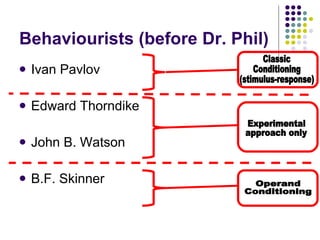
Ivan Pavlov Edward Thorndike John B. Watson B.F. Skinner  Behaviourists (before Dr. Phil) Classic Conditioning (stimulus-response) Experimental approach only Operand Conditioning
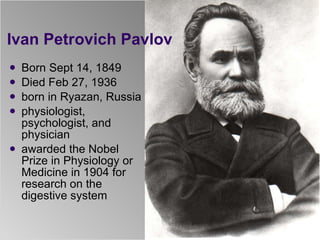
Ivan Petrovich Pavlov  Born Sept 14, 1849 Died Feb 27, 1936 born in Ryazan, Russia physiologist, psychologist, and physician awarded the Nobel Prize in Physiology or Medicine in 1904 for research on the digestive system


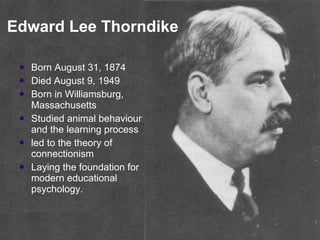
Edward Lee Thorndike Born August 31, 1874  Died August 9, 1949  Born in Williamsburg, Massachusetts Studied animal behaviour and the learning process  led to the theory of connectionism  Laying the foundation for modern educational psychology.
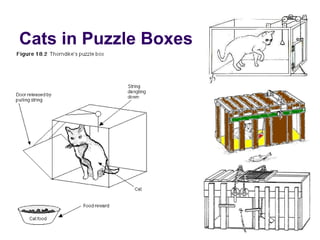
Cats in Puzzle Boxes
Cats in Puzzle Boxes Thorndike looked at how cats learned to escape from puzzle boxes  The puzzle box experiments were motivated by Thorndike's dislike for statements that animals made use of extraordinary faculties such as insight in their problem solving.
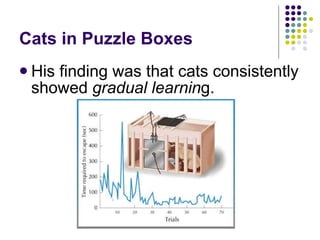
Cats in Puzzle Boxes Thorndike's instruments in answering this question were learning curves revealed by plotting the time it took for an animal to escape the box each time it was in the box if the animals were showing insight, then their time to escape would suddenly drop to a negligible period, which would also be shown in the learning curve as an abrupt drop;  while animals using a more ordinary method of trial and error would show gradual curves.
Cats in Puzzle Boxes His finding was that cats consistently showed  gradual learnin g.
Cats in Puzzle Boxes So it was trial-and-error These led Thorndike to formulate first his  Principles of Learning  and then his  Theory of Learning  that became the foundation of modern educational psychology.
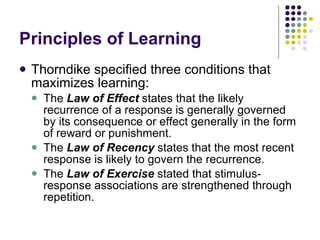
Principles of Learning Thorndike specified three conditions that maximizes learning: The  Law of Effect  states that the likely recurrence of a response is generally governed by its consequence or effect generally in the form of reward or punishment. The  Law of Recency  states that the most recent response is likely to govern the recurrence. The  Law of Exercise  stated that stimulus-response associations are strengthened through repetition.
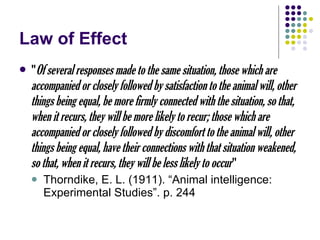
Law of Effect " Of several responses made to the same situation, those which are accompanied or closely followed by satisfaction to the animal will, other things being equal, be more firmly connected with the situation, so that, when it recurs, they will be more likely to recur; those which are accompanied or closely followed by discomfort to the animal will, other things being equal, have their connections with that situation weakened, so that, when it recurs, they will be less likely to occur " Thorndike, E. L. (1911). “Animal intelligence: Experimental Studies”. p. 244
Theory of Learning Thorndike created 13 basic rules I want us to pause after each one and check if you think this is a universal principle. Also see if there is some technology or teaching approach you can imagine that might help support this rule
Theory of Learning 1. The most basic form of learning is trial and error learning.
Theory of Learning 2. Learning is incremental not insightful.
Theory of Learning 3. Learning is not mediated by ideas.
Theory of Learning 4. All mammals learn in the same manner.
Theory of Learning 5.  Law of Readiness:  Interference with goal directed behaviour causes frustration and causing someone to do something they do not want to do is also frustrating.  a. When someone is ready to perform some act, to do so is satisfying. b. When someone is ready to perform some act, not to do so is annoying. c. When someone is not ready to perform some act and is forced to do so, it is annoying.
Theory of Learning 6.  Law of Exercise:  We learn by doing. We forget by not doing, although to a small extent only.  a. Connections between a stimulus and a response are strengthened as they are used. (law of use) b. Connections between a stimulus and a response are weakened as they are not used. (law of disuse)
Theory of Learning 7.  Law of Effect:  If the response in a connection is followed by a satisfying state of affairs, the strength of the connection is considerably increased whereas if followed by an annoying state of affairs, then the strength of the connection is marginally decreased.
Theory of Learning 8.  Multiple Responses:  A learner would keep trying multiple responses to solve a problem before it is actually solved.
Theory of Learning 9.  Set or Attitude:  What the learner already possesses, like prior learning experiences, present state of the learner, etc., while it begins learning a new task.
Theory of Learning 10.  Prepotency of Elements:  Different responses to the same environment would be evoked by different perceptions of the environment which act as the stimulus to the responses. Different perceptions would be subject to the prepotency of different elements for different perceivers.
Theory of Learning 11.  Response from analogy:  New problems are solved by using solution techniques employed to solve analogous problems.
Theory of Learning 12.  Associative Shifting:  Let stimulus S be paired with response R. Now, if stimulus Q is presented simultaneously with stimulus S repeatedly, then stimulus Q is likely to get paired with response R.
Theory of Learning 13.  Belongingness:  If there is a natural relationship between the need state of an organism and the effect caused by a response, learning is more effective than if the relationship is unnatural.
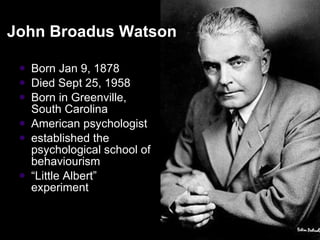
John Broadus Watson  Born Jan 9, 1878 Died Sept 25, 1958  Born in Greenville, South Carolina American psychologist  established the psychological school of behaviourism “ Little Albert” experiment
The Behaviorist Manifesto In 1913, Watson published the article " Psychology as the Behaviorist Views It " — sometimes called " The Behaviorist Manifesto ". In this article, Watson outlined the major features of his new philosophy of psychology, called "behaviorism".
The Behaviorist Manifesto The first paragraph of the article concisely described Watson's behaviorist position: “ Psychology as the behaviorist views it is a purely objective experimental branch of natural science. Its theoretical goal is the prediction and control of behavior. Introspection forms no essential part of its methods, nor is the scientific value of its data dependent upon the readiness with which they lend themselves to interpretation in terms of consciousness. The behaviorist, in his efforts to get a unitary scheme of animal response, recognizes no dividing line between man and brute. The behavior of man, with all of its refinement and complexity, forms only a part of the behaviorist's total scheme of investigation .”
 
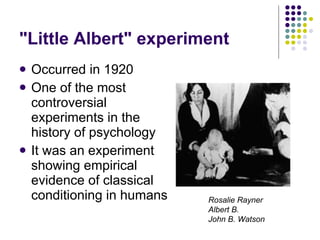
"Little Albert" experiment Occurred in 1920 One of the most controversial experiments in the history of psychology It was an experiment showing empirical evidence of classical conditioning in humans Rosalie Rayner   Albert B. John B. Watson
"Little Albert" experiment Watson and Rayner selected an infant named Albert, at approximately 9 months of age, he was tested and was judged to show no fear when successively observing a number of live animals (e.g., a rat, a rabbit, a dog, and a monkey), and various inanimate objects (e.g., cotton, human masks, a burning newspaper).
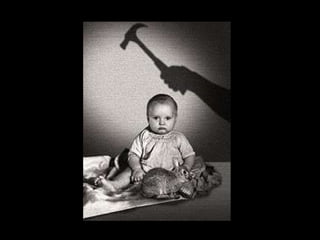
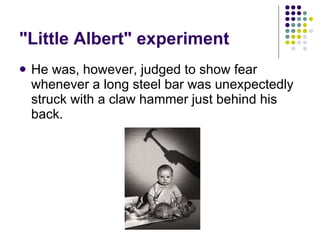
"Little Albert" experiment He was, however, judged to show fear whenever a long steel bar was unexpectedly struck with a claw hammer just behind his back.
"Little Albert" experiment Two months after testing Albert's apparently unconditioned reactions to various stimuli, Watson and Rayner attempted to condition him to fear a white rat. This was done by presenting a white rat to Albert, followed by a loud clanging sound (of the hammer and steel bar) whenever Albert touched the animal. After seven pairings of the rat and noise (in two sessions, one week apart), Albert reacted with crying and avoidance when the rat was presented without the loud noise.
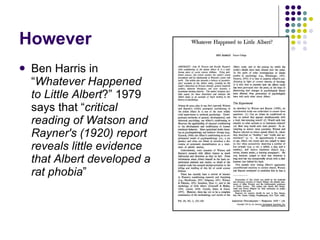
However Ben Harris in “ Whatever Happened to Little Albert ?” 1979 says that “ critical reading of Watson and Rayner's (1920) report reveals little evidence that Albert developed a rat phobia ”
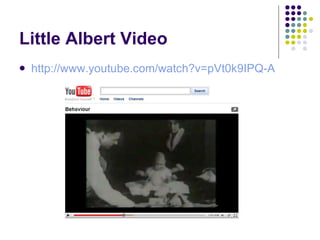
Little Albert Video http://www.youtube.com/watch?v=pVt0k9IPQ-A
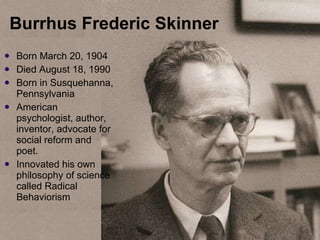
Burrhus Frederic Skinner  Born  March 20, 1904 Died August 18, 1990 Born in Susquehanna, Pennsylvania American psychologist, author, inventor, advocate for social reform and poet. Innovated his own philosophy of science called Radical Behaviorism
Radical Behaviorism Skinner views (Radical behaviourism) differed from other behaviourists (Methodological behaviourism) in that he felt that thoughts and feelings could be taken into account when considering that psychology of the individual
Radical Behaviorism Radical behaviourism seeks to understand behaviour as a function of environmental histories of reinforcing consequences. Reinforcement processes were emphasized by Skinner, and were seen as primary in the shaping of behaviour.  A common misconception is that negative reinforcement is some form of punishment.
Radical Behaviorism Positive reinforcement is the strengthening of behaviour by the application of some event (e.g., praise after some behaviour is performed), Negative reinforcement is the strengthening of behaviour by the removal or avoidance of some aversive event (e.g., opening and raising an umbrella over your head on a rainy day is reinforced by the cessation of rain falling on you).  Both types of reinforcement strengthen behaviour, or increase the probability of a behaviour reoccurring.
Radical Behaviorism Punishment and extinction have the effect of weakening behaviour, or decreasing the probability of a behaviour reoccurring, by the application of an aversive event (punishment) or the removal of a rewarding event (extinction).
Inventor Cumulative Recorder Operant Conditioning Chamber (“Skinner Box”) Teaching Machine Air Crib
Cumulative Recorder
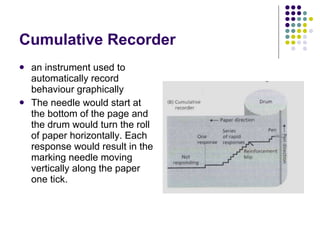
Cumulative Recorder an instrument used to automatically record behaviour graphically  The needle would start at the bottom of the page and the drum would turn the roll of paper horizontally. Each response would result in the marking needle moving vertically along the paper one tick.
Operant Conditioning Chamber
 
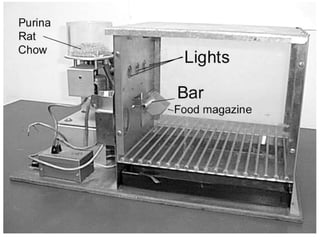
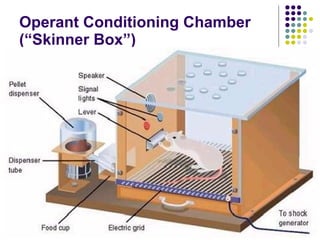
Operant Conditioning Chamber (“Skinner Box”) A box large enough to easily accommodate the animal being used as a subject (including lab rats, pigeons, and primates).  It contains one or more levers which an animal can press, one or more stimulus lights and one or more places in which reinforcers like food can be delivered. It is often sound-proof and light-proof to avoid distracting stimuli.
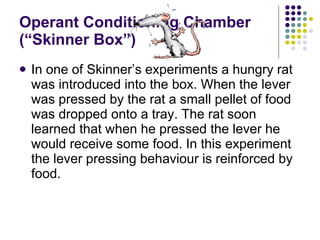
Operant Conditioning Chamber (“Skinner Box”) In one of Skinner’s experiments a hungry rat was introduced into the box. When the lever was pressed by the rat a small pellet of food was dropped onto a tray. The rat soon learned that when he pressed the lever he would receive some food. In this experiment the lever pressing behaviour is reinforced by food.
Operant Conditioning Chamber (“Skinner Box”)
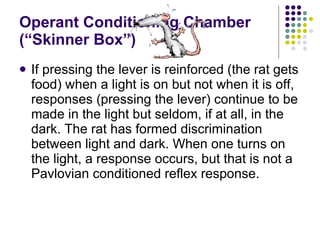
Operant Conditioning Chamber (“Skinner Box”) If pressing the lever is reinforced (the rat gets food) when a light is on but not when it is off, responses (pressing the lever) continue to be made in the light but seldom, if at all, in the dark. The rat has formed discrimination between light and dark. When one turns on the light, a response occurs, but that is not a Pavlovian conditioned reflex response.
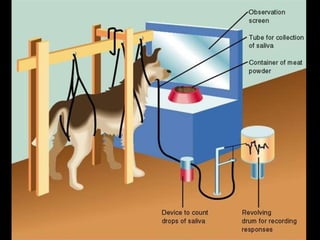
Operant Conditioning Chamber (“Skinner Box”) In this experiment Skinner demonstrated the ideas of "operant conditioning" and "shaping behaviour." Unlike Pavlov's "classical conditioning," where an existing behaviour (salivating for food) is shaped by associating it with a new stimulus (ringing of a bell or a metronome), operant conditioning is the rewarding of an act that approaches a new desired behavior.
Operant Conditioning Chamber (“Skinner Box”) Skinner's operant chamber allowed him to explore the rate of response as a dependent variable, as well as develop his theory of schedules of reinforcement. The first operant chambers were attached to cumulative records on drums producing characteristic pauses, scallops, and other lines.
How pigeons get to be superstitious
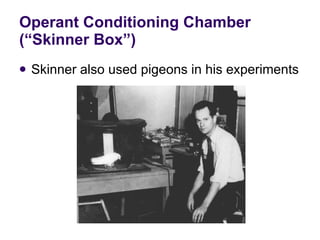
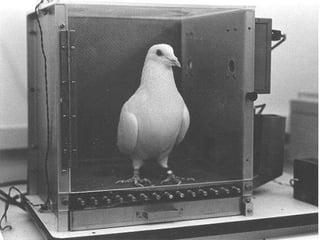
Operant Conditioning Chamber (“Skinner Box”) Skinner also used pigeons in his experiments
Operant Conditioning Chamber (“Skinner Box”) In one experiment he decided to drop food into the box at completely random times, independent of any behaviour on the part of the pigeons.  Amazingly the pigeons behaviour soon started to display a consistent type of behaviour. Each pigeon did different things.
Operant Conditioning Chamber (“Skinner Box”) One circled counter-clockwise, another spun around in circles; seventy-five percent of them exhibited some kind of odd behaviour. Skinner concluded that the pigeons had incorrectly associated their behaviour at the times of the food drops to the food appearing, and had become 'superstitious'.
 
Teaching Machine
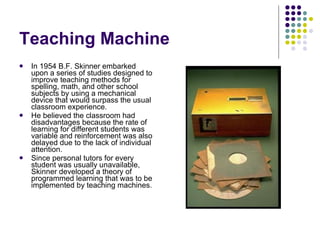
Teaching Machine In 1954 B.F. Skinner embarked upon a series of studies designed to improve teaching methods for spelling, math, and other school subjects by using a mechanical device that would surpass the usual classroom experience.  He believed the classroom had disadvantages because the rate of learning for different students was variable and reinforcement was also delayed due to the lack of individual attention.  Since personal tutors for every student was usually unavailable, Skinner developed a theory of programmed learning that was to be implemented by teaching machines.
Teaching Machine The teaching machine is composed of mainly a program, which is a system of combined teaching and test items that carries the student gradually through the material to be learned.  The "machine" is composed by a fill-in-the-blank method on either a workbook or in a computer. If the subject is correct, he/she gets reinforcement and moves on to the next question. If the answer is incorrect, the subject studies the correct answer to increase the chance of getting reinforced next time.
Teaching Machine The teaching machine is merely a device for presenting the set of frames of which the program is composed.  However, it is not supplementary but all-inclusive. The program will do all the teaching through a response/reward mechanism.  Skinner also noted that the learning process should be divided into a large number of very small steps and reinforcement must be dependent upon the completion of each step.  Skinner suggested that the machine itself should not teach, but bring the student into contact with the person who composed the material it presented. He believed this was the best possible arrangement for learning because it took into account the rate of learning for each individual student.
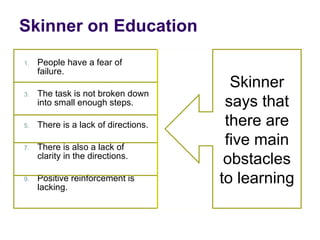
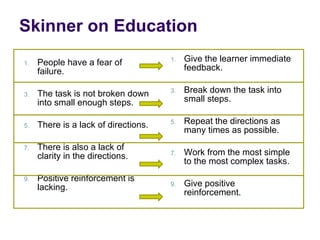
People have a fear of failure.  The task is not broken down into small enough steps.  There is a lack of directions.  There is also a lack of clarity in the directions.  Positive reinforcement is lacking.  Give the learner immediate feedback.  Break down the task into small steps. Repeat the directions as many times as possible.  Work from the most simple to the most complex tasks. Give positive reinforcement.  Skinner on Education  Skinner says that there are five main obstacles to learning
People have a fear of failure.  The task is not broken down into small enough steps.  There is a lack of directions.  There is also a lack of clarity in the directions.  Positive reinforcement is lacking.  Give the learner immediate feedback.  Break down the task into small steps. Repeat the directions as many times as possible.  Work from the most simple to the most complex tasks. Give positive reinforcement.  Skinner on Education
Air Crib
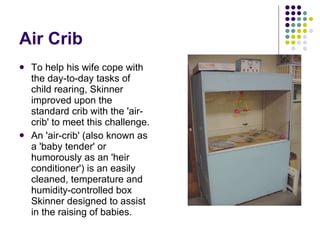
Air Crib To help his wife cope with the day-to-day tasks of child rearing, Skinner improved upon the standard crib with the 'air-crib' to meet this challenge.  An 'air-crib' (also known as a 'baby tender' or humorously as an 'heir conditioner') is an easily cleaned, temperature and humidity-controlled box Skinner designed to assist in the raising of babies.
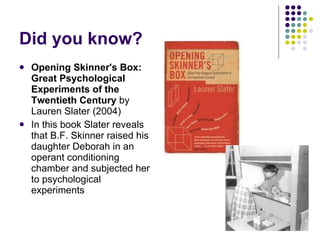
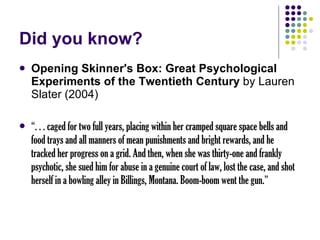
Did you know? Opening Skinner's Box: Great Psychological Experiments of the Twentieth Century  by Lauren Slater (2004) In this book Slater reveals that B.F. Skinner raised his daughter Deborah in an operant conditioning chamber and subjected her to psychological experiments
Did you know? Opening Skinner's Box: Great Psychological Experiments of the Twentieth Century  by Lauren Slater (2004) “ . . . caged for two full years, placing within her cramped square space bells and food trays and all manners of mean punishments and bright rewards, and he tracked her progress on a grid. And then, when she was thirty-one and frankly psychotic, she sued him for abuse in a genuine court of law, lost the case, and shot herself in a bowling alley in Billings, Montana. Boom-boom went the gun. ”
Wow
But…
It is totally untrue
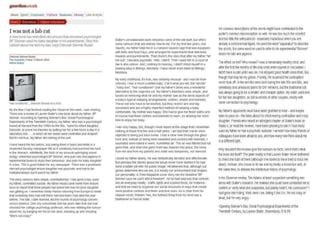
Deborah Skinner is alive and well, living in the UK. She was understandably upset about these stories (something of an urban legend) and wrote an article in The Guardian
The Guardian, Friday 12 March 2004  I was not a lab rat By Deborah Skinner Buzan
 
Skinner’s Critics We will look at a few of Skinner’s most famous critics Harry Harlow Anthony Burgess Noam Chomsky
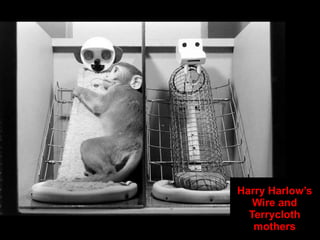
Harry Harlow’s Wire and Terrycloth mothers
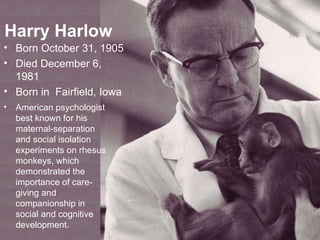
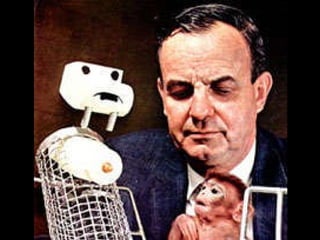
Harry Harlow Born  October 31, 1905 Died December 6, 1981 Born in  Fairfield, Iowa American psychologist best known for his maternal-separation and social isolation experiments on rhesus monkeys, which demonstrated the importance of care-giving and companionship in social and cognitive development.
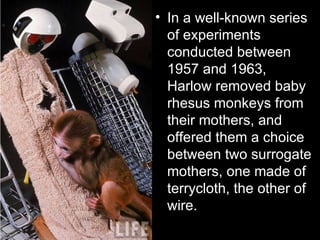
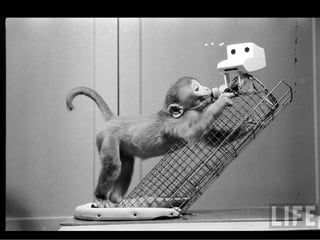
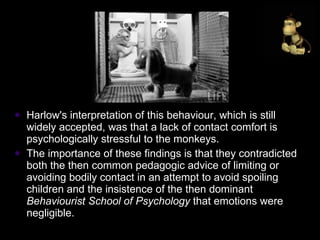
In a well-known series of experiments conducted between 1957 and 1963, Harlow removed baby rhesus monkeys from their mothers, and offered them a choice between two surrogate mothers, one made of terrycloth, the other of wire.
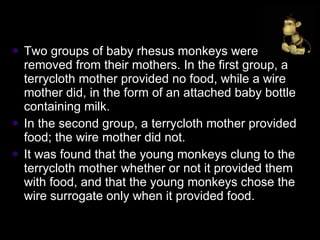
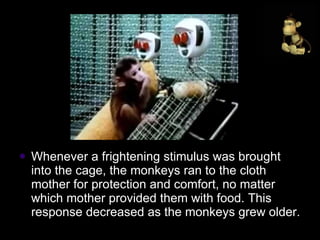
Two groups of baby rhesus monkeys were removed from their mothers. In the first group, a terrycloth mother provided no food, while a wire mother did, in the form of an attached baby bottle containing milk.  In the second group, a terrycloth mother provided food; the wire mother did not.  It was found that the young monkeys clung to the terrycloth mother whether or not it provided them with food, and that the young monkeys chose the wire surrogate only when it provided food.
 
Whenever a frightening stimulus was brought into the cage, the monkeys ran to the cloth mother for protection and comfort, no matter which mother provided them with food. This response decreased as the monkeys grew older.
 
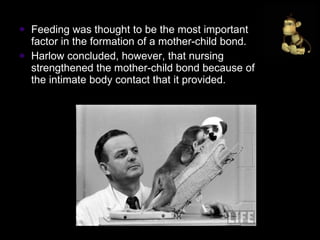
Harlow's interpretation of this behaviour, which is still widely accepted, was that a lack of contact comfort is psychologically stressful to the monkeys.  The importance of these findings is that they contradicted both the then common pedagogic advice of limiting or avoiding bodily contact in an attempt to avoid spoiling children and the insistence of the then dominant  Behaviourist School of Psychology  that emotions were negligible.
Feeding was thought to be the most important factor in the formation of a mother-child bond.  Harlow concluded, however, that nursing strengthened the mother-child bond because of the intimate body contact that it provided.
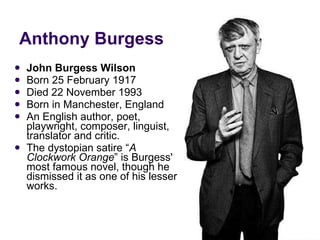
Anthony Burgess John Burgess Wilson Born 25 February 1917 Died 22 November 1993 Born in Manchester, England An English author, poet, playwright, composer, linguist, translator and critic. The dystopian satire “ A Clockwork Orange ” is Burgess' most famous novel, though he dismissed it as one of his lesser works.
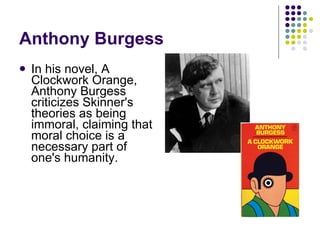
Anthony Burgess In his novel, A Clockwork Orange, Anthony Burgess criticizes Skinner's theories as being immoral, claiming that moral choice is a necessary part of one's humanity.
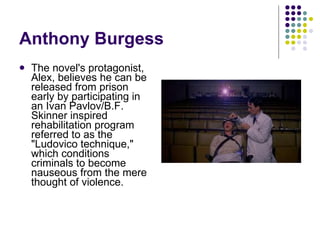
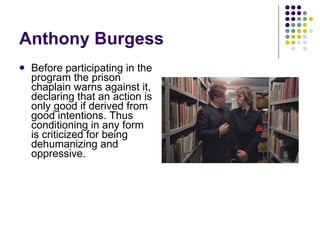
Anthony Burgess The novel's protagonist, Alex, believes he can be released from prison early by participating in an Ivan Pavlov/B.F. Skinner inspired rehabilitation program referred to as the "Ludovico technique," which conditions criminals to become nauseous from the mere thought of violence.
Anthony Burgess Before participating in the program the prison chaplain warns against it, declaring that an action is only good if derived from good intentions. Thus conditioning in any form is criticized for being dehumanizing and oppressive.
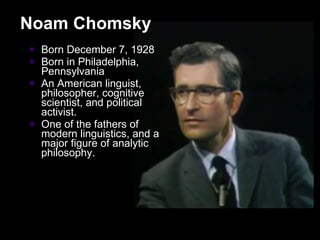
Born December 7, 1928 Born in Philadelphia, Pennsylvania An American linguist, philosopher, cognitive scientist, and political activist.  One of the fathers of modern linguistics, and a major figure of analytic philosophy. Noam Chomsky
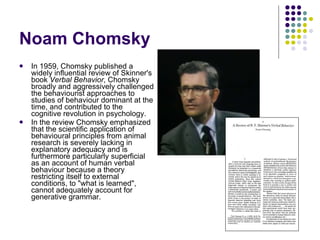
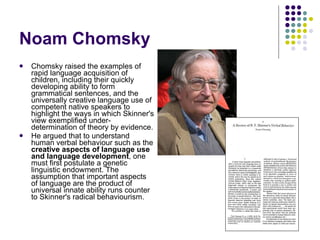
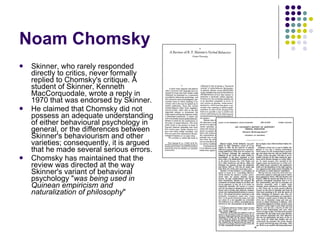
Noam Chomsky In 1959, Chomsky published a widely influential review of Skinner's book  Verbal Behavior , Chomsky broadly and aggressively challenged the behaviourist approaches to studies of behaviour dominant at the time, and contributed to the cognitive revolution in psychology. In the review Chomsky emphasized that the scientific application of behavioural principles from animal research is severely lacking in explanatory adequacy and is furthermore particularly superficial as an account of human verbal behaviour because a theory restricting itself to external conditions, to "what is learned", cannot adequately account for generative grammar.
Noam Chomsky Chomsky raised the examples of rapid language acquisition of children, including their quickly developing ability to form grammatical sentences, and the universally creative language use of competent native speakers to highlight the ways in which Skinner's view exemplified under-determination of theory by evidence.  He argued that to understand human verbal behaviour such as the  creative aspects of language use and language development , one must first postulate a genetic linguistic endowment. The assumption that important aspects of language are the product of universal innate ability runs counter to Skinner's radical behaviourism.
Noam Chomsky Skinner, who rarely responded directly to critics, never formally replied to Chomsky's critique. A student of Skinner, Kenneth MacCorquodale, wrote a reply in 1970 that was endorsed by Skinner. He claimed that Chomsky did not possess an adequate understanding of either behavioural psychology in general, or the differences between Skinner's behaviourism and other varieties; consequently, it is argued that he made several serious errors.  Chomsky has maintained that the review was directed at the way Skinner's variant of behavioral psychology " was being used in Quinean empiricism and naturalization of philosophy "
That’s it, thanks.

Behaviourism

  • 1.
  • 2.
    Behaviourism All thingsshould be looked at from the perspective of behaviour. Behaviourism argues that there is no mind, no thoughts, no feelings, and the only important thing to consider is behaviour.
  • 3.
    We teach peoplehow to treat us. Awareness without action is worthless. Failure is no accident. The most you get is what you ask for.
  • 4.
    We teach peoplehow to treat us. Awareness without action is worthless. Failure is no accident. The most you get is what you ask for.
  • 5.
    Behaviourists (before Dr.Phil) Ivan Pavlov Edward Thorndike John B. Watson B.F. Skinner
  • 6.
    Ivan Pavlov EdwardThorndike John B. Watson B.F. Skinner Behaviourists (before Dr. Phil) Classic Conditioning (stimulus-response)
  • 7.
    Ivan Pavlov EdwardThorndike John B. Watson B.F. Skinner Behaviourists (before Dr. Phil) Classic Conditioning (stimulus-response) Experimental approach only
  • 8.
    Ivan Pavlov EdwardThorndike John B. Watson B.F. Skinner Behaviourists (before Dr. Phil) Classic Conditioning (stimulus-response) Experimental approach only Operand Conditioning
  • 9.
    Ivan Petrovich Pavlov Born Sept 14, 1849 Died Feb 27, 1936 born in Ryazan, Russia physiologist, psychologist, and physician awarded the Nobel Prize in Physiology or Medicine in 1904 for research on the digestive system
  • 10.
  • 11.
  • 12.
  • 13.
  • 14.
  • 15.
    Edward Lee ThorndikeBorn August 31, 1874 Died August 9, 1949 Born in Williamsburg, Massachusetts Studied animal behaviour and the learning process led to the theory of connectionism Laying the foundation for modern educational psychology.
  • 16.
  • 17.
    Cats in PuzzleBoxes Thorndike looked at how cats learned to escape from puzzle boxes The puzzle box experiments were motivated by Thorndike's dislike for statements that animals made use of extraordinary faculties such as insight in their problem solving.
  • 18.
    Cats in PuzzleBoxes Thorndike's instruments in answering this question were learning curves revealed by plotting the time it took for an animal to escape the box each time it was in the box if the animals were showing insight, then their time to escape would suddenly drop to a negligible period, which would also be shown in the learning curve as an abrupt drop; while animals using a more ordinary method of trial and error would show gradual curves.
  • 19.
    Cats in PuzzleBoxes His finding was that cats consistently showed gradual learnin g.
  • 20.
    Cats in PuzzleBoxes So it was trial-and-error These led Thorndike to formulate first his Principles of Learning and then his Theory of Learning that became the foundation of modern educational psychology.
  • 21.
    Principles of LearningThorndike specified three conditions that maximizes learning: The Law of Effect states that the likely recurrence of a response is generally governed by its consequence or effect generally in the form of reward or punishment. The Law of Recency states that the most recent response is likely to govern the recurrence. The Law of Exercise stated that stimulus-response associations are strengthened through repetition.
  • 22.
    Law of Effect" Of several responses made to the same situation, those which are accompanied or closely followed by satisfaction to the animal will, other things being equal, be more firmly connected with the situation, so that, when it recurs, they will be more likely to recur; those which are accompanied or closely followed by discomfort to the animal will, other things being equal, have their connections with that situation weakened, so that, when it recurs, they will be less likely to occur " Thorndike, E. L. (1911). “Animal intelligence: Experimental Studies”. p. 244
  • 23.
    Theory of LearningThorndike created 13 basic rules I want us to pause after each one and check if you think this is a universal principle. Also see if there is some technology or teaching approach you can imagine that might help support this rule
  • 24.
    Theory of Learning1. The most basic form of learning is trial and error learning.
  • 25.
    Theory of Learning2. Learning is incremental not insightful.
  • 26.
    Theory of Learning3. Learning is not mediated by ideas.
  • 27.
    Theory of Learning4. All mammals learn in the same manner.
  • 28.
    Theory of Learning5. Law of Readiness: Interference with goal directed behaviour causes frustration and causing someone to do something they do not want to do is also frustrating. a. When someone is ready to perform some act, to do so is satisfying. b. When someone is ready to perform some act, not to do so is annoying. c. When someone is not ready to perform some act and is forced to do so, it is annoying.
  • 29.
    Theory of Learning6. Law of Exercise: We learn by doing. We forget by not doing, although to a small extent only. a. Connections between a stimulus and a response are strengthened as they are used. (law of use) b. Connections between a stimulus and a response are weakened as they are not used. (law of disuse)
  • 30.
    Theory of Learning7. Law of Effect: If the response in a connection is followed by a satisfying state of affairs, the strength of the connection is considerably increased whereas if followed by an annoying state of affairs, then the strength of the connection is marginally decreased.
  • 31.
    Theory of Learning8. Multiple Responses: A learner would keep trying multiple responses to solve a problem before it is actually solved.
  • 32.
    Theory of Learning9. Set or Attitude: What the learner already possesses, like prior learning experiences, present state of the learner, etc., while it begins learning a new task.
  • 33.
    Theory of Learning10. Prepotency of Elements: Different responses to the same environment would be evoked by different perceptions of the environment which act as the stimulus to the responses. Different perceptions would be subject to the prepotency of different elements for different perceivers.
  • 34.
    Theory of Learning11. Response from analogy: New problems are solved by using solution techniques employed to solve analogous problems.
  • 35.
    Theory of Learning12. Associative Shifting: Let stimulus S be paired with response R. Now, if stimulus Q is presented simultaneously with stimulus S repeatedly, then stimulus Q is likely to get paired with response R.
  • 36.
    Theory of Learning13. Belongingness: If there is a natural relationship between the need state of an organism and the effect caused by a response, learning is more effective than if the relationship is unnatural.
  • 37.
    John Broadus Watson Born Jan 9, 1878 Died Sept 25, 1958 Born in Greenville, South Carolina American psychologist established the psychological school of behaviourism “ Little Albert” experiment
  • 38.
    The Behaviorist ManifestoIn 1913, Watson published the article " Psychology as the Behaviorist Views It " — sometimes called " The Behaviorist Manifesto ". In this article, Watson outlined the major features of his new philosophy of psychology, called "behaviorism".
  • 39.
    The Behaviorist ManifestoThe first paragraph of the article concisely described Watson's behaviorist position: “ Psychology as the behaviorist views it is a purely objective experimental branch of natural science. Its theoretical goal is the prediction and control of behavior. Introspection forms no essential part of its methods, nor is the scientific value of its data dependent upon the readiness with which they lend themselves to interpretation in terms of consciousness. The behaviorist, in his efforts to get a unitary scheme of animal response, recognizes no dividing line between man and brute. The behavior of man, with all of its refinement and complexity, forms only a part of the behaviorist's total scheme of investigation .”
  • 40.
  • 41.
    "Little Albert" experimentOccurred in 1920 One of the most controversial experiments in the history of psychology It was an experiment showing empirical evidence of classical conditioning in humans Rosalie Rayner Albert B. John B. Watson
  • 42.
    "Little Albert" experimentWatson and Rayner selected an infant named Albert, at approximately 9 months of age, he was tested and was judged to show no fear when successively observing a number of live animals (e.g., a rat, a rabbit, a dog, and a monkey), and various inanimate objects (e.g., cotton, human masks, a burning newspaper).
  • 43.
    "Little Albert" experimentHe was, however, judged to show fear whenever a long steel bar was unexpectedly struck with a claw hammer just behind his back.
  • 44.
    "Little Albert" experimentTwo months after testing Albert's apparently unconditioned reactions to various stimuli, Watson and Rayner attempted to condition him to fear a white rat. This was done by presenting a white rat to Albert, followed by a loud clanging sound (of the hammer and steel bar) whenever Albert touched the animal. After seven pairings of the rat and noise (in two sessions, one week apart), Albert reacted with crying and avoidance when the rat was presented without the loud noise.
  • 45.
    However Ben Harrisin “ Whatever Happened to Little Albert ?” 1979 says that “ critical reading of Watson and Rayner's (1920) report reveals little evidence that Albert developed a rat phobia ”
  • 46.
    Little Albert Videohttp://www.youtube.com/watch?v=pVt0k9IPQ-A
  • 47.
    Burrhus Frederic Skinner Born March 20, 1904 Died August 18, 1990 Born in Susquehanna, Pennsylvania American psychologist, author, inventor, advocate for social reform and poet. Innovated his own philosophy of science called Radical Behaviorism
  • 48.
    Radical Behaviorism Skinnerviews (Radical behaviourism) differed from other behaviourists (Methodological behaviourism) in that he felt that thoughts and feelings could be taken into account when considering that psychology of the individual
  • 49.
    Radical Behaviorism Radicalbehaviourism seeks to understand behaviour as a function of environmental histories of reinforcing consequences. Reinforcement processes were emphasized by Skinner, and were seen as primary in the shaping of behaviour. A common misconception is that negative reinforcement is some form of punishment.
  • 50.
    Radical Behaviorism Positivereinforcement is the strengthening of behaviour by the application of some event (e.g., praise after some behaviour is performed), Negative reinforcement is the strengthening of behaviour by the removal or avoidance of some aversive event (e.g., opening and raising an umbrella over your head on a rainy day is reinforced by the cessation of rain falling on you). Both types of reinforcement strengthen behaviour, or increase the probability of a behaviour reoccurring.
  • 51.
    Radical Behaviorism Punishmentand extinction have the effect of weakening behaviour, or decreasing the probability of a behaviour reoccurring, by the application of an aversive event (punishment) or the removal of a rewarding event (extinction).
  • 52.
    Inventor Cumulative RecorderOperant Conditioning Chamber (“Skinner Box”) Teaching Machine Air Crib
  • 53.
  • 54.
    Cumulative Recorder aninstrument used to automatically record behaviour graphically The needle would start at the bottom of the page and the drum would turn the roll of paper horizontally. Each response would result in the marking needle moving vertically along the paper one tick.
  • 55.
  • 56.
  • 57.
    Operant Conditioning Chamber(“Skinner Box”) A box large enough to easily accommodate the animal being used as a subject (including lab rats, pigeons, and primates). It contains one or more levers which an animal can press, one or more stimulus lights and one or more places in which reinforcers like food can be delivered. It is often sound-proof and light-proof to avoid distracting stimuli.
  • 58.
    Operant Conditioning Chamber(“Skinner Box”) In one of Skinner’s experiments a hungry rat was introduced into the box. When the lever was pressed by the rat a small pellet of food was dropped onto a tray. The rat soon learned that when he pressed the lever he would receive some food. In this experiment the lever pressing behaviour is reinforced by food.
  • 59.
    Operant Conditioning Chamber(“Skinner Box”)
  • 60.
    Operant Conditioning Chamber(“Skinner Box”) If pressing the lever is reinforced (the rat gets food) when a light is on but not when it is off, responses (pressing the lever) continue to be made in the light but seldom, if at all, in the dark. The rat has formed discrimination between light and dark. When one turns on the light, a response occurs, but that is not a Pavlovian conditioned reflex response.
  • 61.
    Operant Conditioning Chamber(“Skinner Box”) In this experiment Skinner demonstrated the ideas of "operant conditioning" and "shaping behaviour." Unlike Pavlov's "classical conditioning," where an existing behaviour (salivating for food) is shaped by associating it with a new stimulus (ringing of a bell or a metronome), operant conditioning is the rewarding of an act that approaches a new desired behavior.
  • 62.
    Operant Conditioning Chamber(“Skinner Box”) Skinner's operant chamber allowed him to explore the rate of response as a dependent variable, as well as develop his theory of schedules of reinforcement. The first operant chambers were attached to cumulative records on drums producing characteristic pauses, scallops, and other lines.
  • 63.
    How pigeons getto be superstitious
  • 64.
    Operant Conditioning Chamber(“Skinner Box”) Skinner also used pigeons in his experiments
  • 65.
    Operant Conditioning Chamber(“Skinner Box”) In one experiment he decided to drop food into the box at completely random times, independent of any behaviour on the part of the pigeons. Amazingly the pigeons behaviour soon started to display a consistent type of behaviour. Each pigeon did different things.
  • 66.
    Operant Conditioning Chamber(“Skinner Box”) One circled counter-clockwise, another spun around in circles; seventy-five percent of them exhibited some kind of odd behaviour. Skinner concluded that the pigeons had incorrectly associated their behaviour at the times of the food drops to the food appearing, and had become 'superstitious'.
  • 67.
  • 68.
  • 69.
    Teaching Machine In1954 B.F. Skinner embarked upon a series of studies designed to improve teaching methods for spelling, math, and other school subjects by using a mechanical device that would surpass the usual classroom experience. He believed the classroom had disadvantages because the rate of learning for different students was variable and reinforcement was also delayed due to the lack of individual attention. Since personal tutors for every student was usually unavailable, Skinner developed a theory of programmed learning that was to be implemented by teaching machines.
  • 70.
    Teaching Machine Theteaching machine is composed of mainly a program, which is a system of combined teaching and test items that carries the student gradually through the material to be learned. The "machine" is composed by a fill-in-the-blank method on either a workbook or in a computer. If the subject is correct, he/she gets reinforcement and moves on to the next question. If the answer is incorrect, the subject studies the correct answer to increase the chance of getting reinforced next time.
  • 71.
    Teaching Machine Theteaching machine is merely a device for presenting the set of frames of which the program is composed. However, it is not supplementary but all-inclusive. The program will do all the teaching through a response/reward mechanism. Skinner also noted that the learning process should be divided into a large number of very small steps and reinforcement must be dependent upon the completion of each step. Skinner suggested that the machine itself should not teach, but bring the student into contact with the person who composed the material it presented. He believed this was the best possible arrangement for learning because it took into account the rate of learning for each individual student.
  • 72.
    People have afear of failure. The task is not broken down into small enough steps. There is a lack of directions. There is also a lack of clarity in the directions. Positive reinforcement is lacking. Give the learner immediate feedback. Break down the task into small steps. Repeat the directions as many times as possible. Work from the most simple to the most complex tasks. Give positive reinforcement. Skinner on Education Skinner says that there are five main obstacles to learning
  • 73.
    People have afear of failure. The task is not broken down into small enough steps. There is a lack of directions. There is also a lack of clarity in the directions. Positive reinforcement is lacking. Give the learner immediate feedback. Break down the task into small steps. Repeat the directions as many times as possible. Work from the most simple to the most complex tasks. Give positive reinforcement. Skinner on Education
  • 74.
  • 75.
    Air Crib Tohelp his wife cope with the day-to-day tasks of child rearing, Skinner improved upon the standard crib with the 'air-crib' to meet this challenge. An 'air-crib' (also known as a 'baby tender' or humorously as an 'heir conditioner') is an easily cleaned, temperature and humidity-controlled box Skinner designed to assist in the raising of babies.
  • 76.
    Did you know?Opening Skinner's Box: Great Psychological Experiments of the Twentieth Century by Lauren Slater (2004) In this book Slater reveals that B.F. Skinner raised his daughter Deborah in an operant conditioning chamber and subjected her to psychological experiments
  • 77.
    Did you know?Opening Skinner's Box: Great Psychological Experiments of the Twentieth Century by Lauren Slater (2004) “ . . . caged for two full years, placing within her cramped square space bells and food trays and all manners of mean punishments and bright rewards, and he tracked her progress on a grid. And then, when she was thirty-one and frankly psychotic, she sued him for abuse in a genuine court of law, lost the case, and shot herself in a bowling alley in Billings, Montana. Boom-boom went the gun. ”
  • 78.
  • 79.
  • 80.
  • 81.
    Deborah Skinner isalive and well, living in the UK. She was understandably upset about these stories (something of an urban legend) and wrote an article in The Guardian
  • 82.
    The Guardian, Friday12 March 2004 I was not a lab rat By Deborah Skinner Buzan
  • 83.
  • 84.
    Skinner’s Critics Wewill look at a few of Skinner’s most famous critics Harry Harlow Anthony Burgess Noam Chomsky
  • 85.
    Harry Harlow’s Wireand Terrycloth mothers
  • 86.
    Harry Harlow Born October 31, 1905 Died December 6, 1981 Born in Fairfield, Iowa American psychologist best known for his maternal-separation and social isolation experiments on rhesus monkeys, which demonstrated the importance of care-giving and companionship in social and cognitive development.
  • 87.
    In a well-knownseries of experiments conducted between 1957 and 1963, Harlow removed baby rhesus monkeys from their mothers, and offered them a choice between two surrogate mothers, one made of terrycloth, the other of wire.
  • 88.
    Two groups ofbaby rhesus monkeys were removed from their mothers. In the first group, a terrycloth mother provided no food, while a wire mother did, in the form of an attached baby bottle containing milk. In the second group, a terrycloth mother provided food; the wire mother did not. It was found that the young monkeys clung to the terrycloth mother whether or not it provided them with food, and that the young monkeys chose the wire surrogate only when it provided food.
  • 89.
  • 90.
    Whenever a frighteningstimulus was brought into the cage, the monkeys ran to the cloth mother for protection and comfort, no matter which mother provided them with food. This response decreased as the monkeys grew older.
  • 91.
  • 92.
    Harlow's interpretation ofthis behaviour, which is still widely accepted, was that a lack of contact comfort is psychologically stressful to the monkeys. The importance of these findings is that they contradicted both the then common pedagogic advice of limiting or avoiding bodily contact in an attempt to avoid spoiling children and the insistence of the then dominant Behaviourist School of Psychology that emotions were negligible.
  • 93.
    Feeding was thoughtto be the most important factor in the formation of a mother-child bond. Harlow concluded, however, that nursing strengthened the mother-child bond because of the intimate body contact that it provided.
  • 94.
    Anthony Burgess JohnBurgess Wilson Born 25 February 1917 Died 22 November 1993 Born in Manchester, England An English author, poet, playwright, composer, linguist, translator and critic. The dystopian satire “ A Clockwork Orange ” is Burgess' most famous novel, though he dismissed it as one of his lesser works.
  • 95.
    Anthony Burgess Inhis novel, A Clockwork Orange, Anthony Burgess criticizes Skinner's theories as being immoral, claiming that moral choice is a necessary part of one's humanity.
  • 96.
    Anthony Burgess Thenovel's protagonist, Alex, believes he can be released from prison early by participating in an Ivan Pavlov/B.F. Skinner inspired rehabilitation program referred to as the "Ludovico technique," which conditions criminals to become nauseous from the mere thought of violence.
  • 97.
    Anthony Burgess Beforeparticipating in the program the prison chaplain warns against it, declaring that an action is only good if derived from good intentions. Thus conditioning in any form is criticized for being dehumanizing and oppressive.
  • 98.
    Born December 7,1928 Born in Philadelphia, Pennsylvania An American linguist, philosopher, cognitive scientist, and political activist. One of the fathers of modern linguistics, and a major figure of analytic philosophy. Noam Chomsky
  • 99.
    Noam Chomsky In1959, Chomsky published a widely influential review of Skinner's book Verbal Behavior , Chomsky broadly and aggressively challenged the behaviourist approaches to studies of behaviour dominant at the time, and contributed to the cognitive revolution in psychology. In the review Chomsky emphasized that the scientific application of behavioural principles from animal research is severely lacking in explanatory adequacy and is furthermore particularly superficial as an account of human verbal behaviour because a theory restricting itself to external conditions, to "what is learned", cannot adequately account for generative grammar.
  • 100.
    Noam Chomsky Chomskyraised the examples of rapid language acquisition of children, including their quickly developing ability to form grammatical sentences, and the universally creative language use of competent native speakers to highlight the ways in which Skinner's view exemplified under-determination of theory by evidence. He argued that to understand human verbal behaviour such as the creative aspects of language use and language development , one must first postulate a genetic linguistic endowment. The assumption that important aspects of language are the product of universal innate ability runs counter to Skinner's radical behaviourism.
  • 101.
    Noam Chomsky Skinner,who rarely responded directly to critics, never formally replied to Chomsky's critique. A student of Skinner, Kenneth MacCorquodale, wrote a reply in 1970 that was endorsed by Skinner. He claimed that Chomsky did not possess an adequate understanding of either behavioural psychology in general, or the differences between Skinner's behaviourism and other varieties; consequently, it is argued that he made several serious errors. Chomsky has maintained that the review was directed at the way Skinner's variant of behavioral psychology " was being used in Quinean empiricism and naturalization of philosophy "
  • 102.