Observational learning
• First discussed by Bandurra
• Occurs by watching others
• Noting the positive and
  negative consequences of their
  actions
• Then imitating these actions
• Eg. Learning to shake hands,
  dance moves
• Classical and operant
  conditioning can occur
  (indirectly) through Vicarious
  Conditioning –
• Hence: modelling is not totally
  separate from O.C or C.C
Observational (vicarious) learning
• Vicarious Conditioning
• Learning indirectly by
  observing others
• Involves observing the
  consequences (reinforcement
  or punishment) of others
  behaviour and then modifying
  own behaviour according to
  those consequences observed.
• Hence Modelling is often
  referred to as a form of Operant
  conditioning (because the
  learning is controlled by the
  consequences)
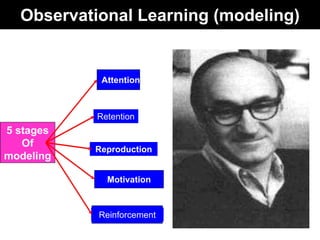
Observational Learning (modeling)


            Attention


           Retention
5 stages
   Of
           Reproduction
modeling

             Motivation


           Reinforcement
5 stages of Observational learning
•  1: Attention – the observer must
   actively watch the model when
   completing the task
• Attention is Influenced by
1. Motivation & interest of observer
2. Personality characteristics of
   model
3. Avoidance of distracters
4. Distinctiveness, importance, Etc
Bandurra felt we are more likely to
   attend to model if model has/ is
1. High status
2. Similar in nature to observer
3. Is well liked, is known, behavior is
   visible/ distinctive
4. Etc
Stages 2, 3: Retention, Reproduction
•   2: Retention – the observer must
    be able to make a mental
    representation (step by step) of
    the model’s behaviour
•   The more meaningful you can
    make that image (i.e. mental
    representation of what you
    observed) the more accurately
    you will be able to replicate that
    behaviour.
•   3: Reproduction – the observer
    must have the ability to perform
    the action
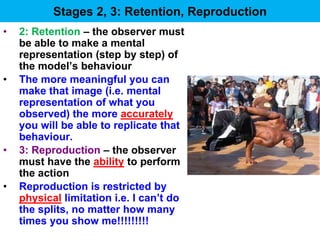
•   Reproduction is restricted by
    physical limitation i.e. I can’t do
    the splits, no matter how many
    times you show me!!!!!!!!!
Stages 4 Motivation & 5 & Reinforcement
•   4: Motivation– the learner must want
    to perform behaviour. So if being taught
    something, then the teacher should
    encourage the learner to repeat the
    behaviour just seen
•   E.g. – Answering questions in a Psych
    class after observing a student praised
    for giving the right answer.
•   5 Reinforcement
•   If the model receives positive
    reinforcement, then this will increase
    the liklihood that the observer will
    repeat the behaviour
•   E.g. Your friend dyes their hair black
    and everyone compliments her (you
    look pretty) then you might be inclined
    to try a similar strategy to you hair color

Observational learning

  • 1.
    Observational learning • Firstdiscussed by Bandurra • Occurs by watching others • Noting the positive and negative consequences of their actions • Then imitating these actions • Eg. Learning to shake hands, dance moves • Classical and operant conditioning can occur (indirectly) through Vicarious Conditioning – • Hence: modelling is not totally separate from O.C or C.C
  • 2.
    Observational (vicarious) learning •Vicarious Conditioning • Learning indirectly by observing others • Involves observing the consequences (reinforcement or punishment) of others behaviour and then modifying own behaviour according to those consequences observed. • Hence Modelling is often referred to as a form of Operant conditioning (because the learning is controlled by the consequences)
  • 3.
    Observational Learning (modeling) Attention Retention 5 stages Of Reproduction modeling Motivation Reinforcement
  • 4.
    5 stages ofObservational learning • 1: Attention – the observer must actively watch the model when completing the task • Attention is Influenced by 1. Motivation & interest of observer 2. Personality characteristics of model 3. Avoidance of distracters 4. Distinctiveness, importance, Etc Bandurra felt we are more likely to attend to model if model has/ is 1. High status 2. Similar in nature to observer 3. Is well liked, is known, behavior is visible/ distinctive 4. Etc
  • 5.
    Stages 2, 3:Retention, Reproduction • 2: Retention – the observer must be able to make a mental representation (step by step) of the model’s behaviour • The more meaningful you can make that image (i.e. mental representation of what you observed) the more accurately you will be able to replicate that behaviour. • 3: Reproduction – the observer must have the ability to perform the action • Reproduction is restricted by physical limitation i.e. I can’t do the splits, no matter how many times you show me!!!!!!!!!
  • 6.
    Stages 4 Motivation& 5 & Reinforcement • 4: Motivation– the learner must want to perform behaviour. So if being taught something, then the teacher should encourage the learner to repeat the behaviour just seen • E.g. – Answering questions in a Psych class after observing a student praised for giving the right answer. • 5 Reinforcement • If the model receives positive reinforcement, then this will increase the liklihood that the observer will repeat the behaviour • E.g. Your friend dyes their hair black and everyone compliments her (you look pretty) then you might be inclined to try a similar strategy to you hair color