MARY DELA CRUZ
Kohler’s Insight
Kohler’s Insight
Learning Theory
Learning Theory
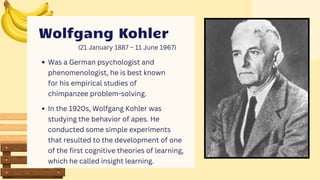
Wolfgang Kohler
Wolfgang Kohler
Was a German psychologist and
phenomenologist, he is best known
for his empirical studies of
chimpanzee problem-solving.
(21 January 1887 – 11 June 1967)
In the 1920s, Wolfgang Kohler was
studying the behavior of apes. He
conducted some simple experiments
that resulted to the development of one
of the first cognitive theories of learning,
which he called insight learning.
Insight learning is the sudden realization of a problem's
solution. Insight learning is not the result of trial and
error, but responding to an environmental stimulus and
the result of observing someone else attempting the
problem. It is a completely cognitive experience that
requires the ability to visualize the problem and the
solution internally.
Insight Learning
Insight Learning
1. Experiment- Sultan was placed in a cage. A stick was placed in the cage and a
banana just outside the cage, but outside Sultans direct reach. Sultan made many
attempts to obtain the banana but it failed. It sat down in despair. But, after
sometime it suddenly got up, lifted the stick and used it to draw the banana towards
itself.
2. Experiment- In the second stage, Kohler placed inside the cage two sticks which
could be joined to each other. This time the banana was so placed that it could not be
drown by the chimpanzee towards itself with a single stick. After numerous attempts,
Sultan joined the two sticks together and succeeded in obtaining the banana.
Kohler conducted a number of experiments on a chimpanzee
named Sultan.
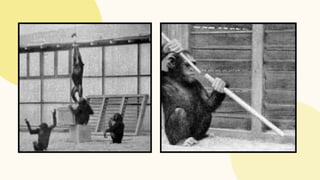
3. Experiment- In the third step, Kohler hung the banana from the roof of the
cage of such a height as to ensure that Sultan could not reach it even by
jumping upwards. A box was also placed inside the cage. After many attempts,
Sultan climbed up on the box and obtained the bananas.
4. Experiment- In the final step, Kohler placed two boxes at one place in the
cage the banana was placed at an even high level. At first, Sultan kept on
trying to reach the banana by standing up on one box, but after numerous
failures, it placed one box upon the other and claiming quit obtained the
banana.
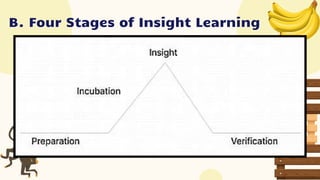
B. Four Stages of Insight Learning
1. Experience - Past experiences help in the insightful solution of the problems. A child
cannot solve the problems of Modern Mathematics unless he is well acquainted with
its symbolic language.
2. Intelligence – Insightful solution depends upon the basic intelligence of the learner.
The more intelligent the individual is the greater will be his insight.
3. Initial Efforts or Trial and Error – Insightful learning has to pass through the
process of trial and error. Whatever an activity may be, attempts or efforts or trials
always lie at its root. This opens the way for insightful learning.
4. Repetition and Generalization – After having an insightful solution of a particular
type of problem, the organism tries to repeat it in another situation, demanding
similar type of solution. The way found in one situation helps him to react insightfully
in the other identical situations.
Factors Influencing Insight
References:
References:
Hoque, E. (2022, July 16). Kohler Learning By Insight Theory-Gestalt Theory
Of Learning. EduCere Centre. https://educerecentre.com/kohler-insight-
learning-theory/
Kumari, K. THEORY OF LEARNING BY INSIGHT.
https://www.ssinhacollege.co.in/images/econtent/vocational%20courses/
BED/B.%20Ed.%20(1st%20Year)_Paper-III_(Topic-
%20Insight%20Theory).pdf
Kerwin, G. (2014). Chimpanzee Insight (Kohler Study Footage).
https://youtu.be/6-YWrPzsmEE?si=ltC2GnkjP9aURV-N

Insight Learning Theory.pdf

  • 1.
    MARY DELA CRUZ Kohler’sInsight Kohler’s Insight Learning Theory Learning Theory
  • 2.
    Wolfgang Kohler Wolfgang Kohler Wasa German psychologist and phenomenologist, he is best known for his empirical studies of chimpanzee problem-solving. (21 January 1887 – 11 June 1967) In the 1920s, Wolfgang Kohler was studying the behavior of apes. He conducted some simple experiments that resulted to the development of one of the first cognitive theories of learning, which he called insight learning.
  • 3.
    Insight learning isthe sudden realization of a problem's solution. Insight learning is not the result of trial and error, but responding to an environmental stimulus and the result of observing someone else attempting the problem. It is a completely cognitive experience that requires the ability to visualize the problem and the solution internally. Insight Learning Insight Learning
  • 4.
    1. Experiment- Sultanwas placed in a cage. A stick was placed in the cage and a banana just outside the cage, but outside Sultans direct reach. Sultan made many attempts to obtain the banana but it failed. It sat down in despair. But, after sometime it suddenly got up, lifted the stick and used it to draw the banana towards itself. 2. Experiment- In the second stage, Kohler placed inside the cage two sticks which could be joined to each other. This time the banana was so placed that it could not be drown by the chimpanzee towards itself with a single stick. After numerous attempts, Sultan joined the two sticks together and succeeded in obtaining the banana. Kohler conducted a number of experiments on a chimpanzee named Sultan.
  • 5.
    3. Experiment- Inthe third step, Kohler hung the banana from the roof of the cage of such a height as to ensure that Sultan could not reach it even by jumping upwards. A box was also placed inside the cage. After many attempts, Sultan climbed up on the box and obtained the bananas. 4. Experiment- In the final step, Kohler placed two boxes at one place in the cage the banana was placed at an even high level. At first, Sultan kept on trying to reach the banana by standing up on one box, but after numerous failures, it placed one box upon the other and claiming quit obtained the banana.
  • 7.
    B. Four Stagesof Insight Learning B. Four Stages of Insight Learning
  • 8.
    1. Experience -Past experiences help in the insightful solution of the problems. A child cannot solve the problems of Modern Mathematics unless he is well acquainted with its symbolic language. 2. Intelligence – Insightful solution depends upon the basic intelligence of the learner. The more intelligent the individual is the greater will be his insight. 3. Initial Efforts or Trial and Error – Insightful learning has to pass through the process of trial and error. Whatever an activity may be, attempts or efforts or trials always lie at its root. This opens the way for insightful learning. 4. Repetition and Generalization – After having an insightful solution of a particular type of problem, the organism tries to repeat it in another situation, demanding similar type of solution. The way found in one situation helps him to react insightfully in the other identical situations. Factors Influencing Insight Factors Influencing Insight
  • 9.
    References: References: Hoque, E. (2022,July 16). Kohler Learning By Insight Theory-Gestalt Theory Of Learning. EduCere Centre. https://educerecentre.com/kohler-insight- learning-theory/ Kumari, K. THEORY OF LEARNING BY INSIGHT. https://www.ssinhacollege.co.in/images/econtent/vocational%20courses/ BED/B.%20Ed.%20(1st%20Year)_Paper-III_(Topic- %20Insight%20Theory).pdf Kerwin, G. (2014). Chimpanzee Insight (Kohler Study Footage). https://youtu.be/6-YWrPzsmEE?si=ltC2GnkjP9aURV-N