Insight learning - Kohler
•   Insight learning refers to the sudden
    realisation of a solution of a problem
•   After a period of mentally manipulation
    of aspects of a problem for a while

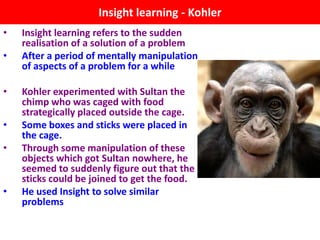
•   Kohler experimented with Sultan the
    chimp who was caged with food
    strategically placed outside the cage.
•   Some boxes and sticks were placed in
    the cage.
•   Through some manipulation of these
    objects which got Sultan nowhere, he
    seemed to suddenly figure out that the
    sticks could be joined to get the food.
•   He used Insight to solve similar
    problems
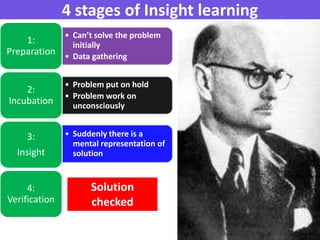
4 stages of Insight learning
               • Can’t solve the problem
    1:        initially
Preparation • Data gathering


               • Problem put on hold
    2:
               • Problem work on
Incubation       unconsciously


     3:        • Suddenly there is a
                 mental representation of
  Insight        solution


     4:              Solution
Verification         checked
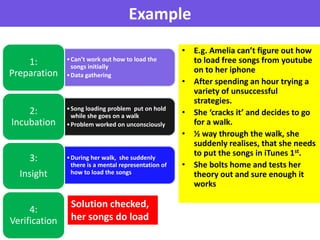
Example
                                                       • E.g. Amelia can’t figure out how
    1:         • Can’t work out how to load the          to load free songs from youtube
                 songs initially
Preparation                                              on to her iphone
               • Data gathering
                                                       • After spending an hour trying a
                                                         variety of unsuccessful
                                                         strategies.
    2:         • Song loading problem put on hold
                 while she goes on a walk              • She ‘cracks it’ and decides to go
Incubation     • Problem worked on unconsciously         for a walk.
                                                       • ½ way through the walk, she
                                                         suddenly realises, that she needs
                                                         to put the songs in iTunes 1st.
     3:        • During her walk, she suddenly
                 there is a mental representation of   • She bolts home and tests her
  Insight        how to load the songs                   theory out and sure enough it
                                                         works

                Solution checked,
     4:
Verification    her songs do load
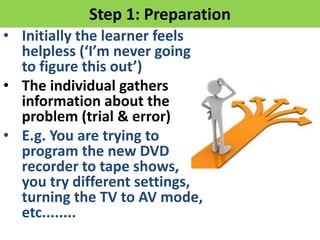
Step 1: Preparation
• Initially the learner feels
  helpless (‘I’m never going
  to figure this out’)
• The individual gathers
  information about the
  problem (trial & error)
• E.g. You are trying to
  program the new DVD
  recorder to tape shows,
  you try different settings,
  turning the TV to AV mode,
  etc........
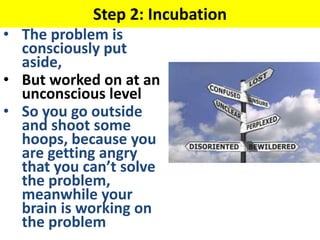
Step 2: Incubation
• The problem is
  consciously put
  aside,
• But worked on at an
  unconscious level
• So you go outside
  and shoot some
  hoops, because you
  are getting angry
  that you can’t solve
  the problem,
  meanwhile your
  brain is working on
  the problem
Step 3: Insight – ‘Aha’
• ‘Aha – now I know
  what to do’
• Some mental
  event bridges the
  gap between the
  problem & the
  solution
• Unconsciously the
  learner has
  reassembled the
  elements of the
  problem into a
  meaningful whole
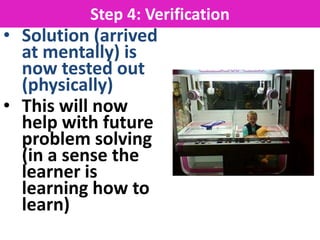
Step 4: Verification
• Solution (arrived
  at mentally) is
  now tested out
  (physically)
• This will now
  help with future
  problem solving
  (in a sense the
  learner is
  learning how to
  learn)
Insight Learning: key points
•   The learning appears
    suddenly
•   The 1st time the solution
    is tried, it is generally
    done correctly (few/no
    errors) despite the lack
    of reinforcement given
•   We tend not to forget
    the solution
•   Learning can be applied
    to similar problems in
    the future
•   i.e. We can use the
    insight gained to help up
    us with future problems.
•   Thus it is a more
    cognitive process (than
    classical conditioning or
    operant conditioning)

Insight learning - VCE U4 Psych

  • 1.
    Insight learning -Kohler • Insight learning refers to the sudden realisation of a solution of a problem • After a period of mentally manipulation of aspects of a problem for a while • Kohler experimented with Sultan the chimp who was caged with food strategically placed outside the cage. • Some boxes and sticks were placed in the cage. • Through some manipulation of these objects which got Sultan nowhere, he seemed to suddenly figure out that the sticks could be joined to get the food. • He used Insight to solve similar problems
  • 2.
    4 stages ofInsight learning • Can’t solve the problem 1: initially Preparation • Data gathering • Problem put on hold 2: • Problem work on Incubation unconsciously 3: • Suddenly there is a mental representation of Insight solution 4: Solution Verification checked
  • 3.
    Example • E.g. Amelia can’t figure out how 1: • Can’t work out how to load the to load free songs from youtube songs initially Preparation on to her iphone • Data gathering • After spending an hour trying a variety of unsuccessful strategies. 2: • Song loading problem put on hold while she goes on a walk • She ‘cracks it’ and decides to go Incubation • Problem worked on unconsciously for a walk. • ½ way through the walk, she suddenly realises, that she needs to put the songs in iTunes 1st. 3: • During her walk, she suddenly there is a mental representation of • She bolts home and tests her Insight how to load the songs theory out and sure enough it works Solution checked, 4: Verification her songs do load
  • 4.
    Step 1: Preparation •Initially the learner feels helpless (‘I’m never going to figure this out’) • The individual gathers information about the problem (trial & error) • E.g. You are trying to program the new DVD recorder to tape shows, you try different settings, turning the TV to AV mode, etc........
  • 5.
    Step 2: Incubation •The problem is consciously put aside, • But worked on at an unconscious level • So you go outside and shoot some hoops, because you are getting angry that you can’t solve the problem, meanwhile your brain is working on the problem
  • 6.
    Step 3: Insight– ‘Aha’ • ‘Aha – now I know what to do’ • Some mental event bridges the gap between the problem & the solution • Unconsciously the learner has reassembled the elements of the problem into a meaningful whole
  • 7.
    Step 4: Verification •Solution (arrived at mentally) is now tested out (physically) • This will now help with future problem solving (in a sense the learner is learning how to learn)
  • 8.
    Insight Learning: keypoints • The learning appears suddenly • The 1st time the solution is tried, it is generally done correctly (few/no errors) despite the lack of reinforcement given • We tend not to forget the solution • Learning can be applied to similar problems in the future • i.e. We can use the insight gained to help up us with future problems. • Thus it is a more cognitive process (than classical conditioning or operant conditioning)

Editor's Notes

  • #2 i.e. stacking boxes to get too food suspended from the top of the cage.
  • #3 i.e. stacking boxes to get too food suspended from the top of the cage.
  • #4 i.e. stacking boxes to get too food suspended from the top of the cage.