
INSTITUTE:UNIVERSITY OF SINDH PK
(FACULTY OF EDUCATION)
ASSIGNED BY:DR AMJAD ALI ARAIN
NAME:SUNENA IMTIAZ
(CLASSICAL CONDITIONING)
 A process by which people or animals are
trained to behave in a particular way ,when
particular things happen.
 Proposed by: DR Ivan Pavlov (1849-1936), a
famous Russian psychologist. He has won
noble prize for this discovery.
 Definition: Learning that takes place when a
conditioned stimulus is paired with an un
conditioned stimulus.
 Actually Pavlov was studying the digestive
system of dog. During his studies he noticed
that his dogs, started secreting as saliva as
soon as they saw the empty plate in which
food was served.
 Ideally, Plate is not a stimuli that is sufficient
to activate hunger drive and to secrete saliva.
So he designed experiment to see if other
neutral stimuli can also do the same job.
 SETUP: Dog is kept hungry on experimental
table fitted with mechanical controlled
devices observer is hidden from dog but he
can see the dog through mirrors.
 PROCEDURE:
 1:Bell sound =food is produced
 2:Dog=see food=salivates
 3: Step 1 is repeated several times
 4: Bell sound = Dog salivates
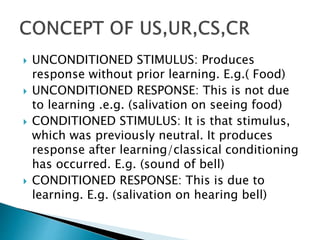
 UNCONDITIONED STIMULUS: Produces
response without prior learning. E.g.( Food)
 UNCONDITIONED RESPONSE: This is not due
to learning .e.g. (salivation on seeing food)
 CONDITIONED STIMULUS: It is that stimulus,
which was previously neutral. It produces
response after learning/classical conditioning
has occurred. E.g. (sound of bell)
 CONDITIONED RESPONSE: This is due to
learning. E.g. (salivation on hearing bell)
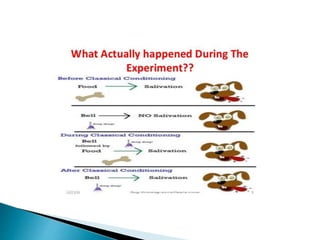
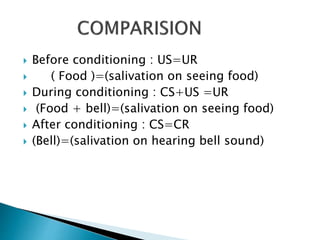
 Before conditioning : US=UR
 ( Food )=(salivation on seeing food)
 During conditioning : CS+US =UR
 (Food + bell)=(salivation on seeing food)
 After conditioning : CS=CR
 (Bell)=(salivation on hearing bell sound)
 Time relation between stimuli:
 Simultaneous conditioning
 Delayed conditioning
 Trace conditioning
 Backward conditioning(a,b,c are also called as
forward conditioning)
 Appetitive
 Aversive
 SIMULTANEOUS CONDITIONING: CS and US
are presented and terminated together.
 DELAYED CONDITIONING: CS is presented,
leave it for a while present US and terminate
CS and US together. This is the most effective
way.
 TRACE CONDITIONING: CS begins and end
before US is presented.
 BACKWARD CONDITIONING: CS is presented
after US is terminated.
 APETITIVE US: Automatically elicits approach
responses, such as eating ,drinking ,
caressing etc. These response gave
satisfaction on and pleasure.
 AVERSIVE US: Such as noise, bitter taste,
electric shock ,painful injections etc are
painful, harmful and elicit avoidance and
escape responses.
 This influences the course of both appetitive
and aversive classical conditioning.
 More intense CS are more effective in
accelerating the acquisition of CR.
 The more intense the CS ,the fewer are
number of acquisition trials needed for
conditioning.
 Most fears are produced by CC. Therefore CC
techniques are used to eliminate phobia.
Most of the treatments for phobia are based
on CC principles.
 CC plays an important role in hypertension as
well. Research says that high blood pressure
is easily conditioned to stressful events.
Thus, a person who has experienced many at
home/workplace ,shows high blood pressure
by simply walking in to that environment.
Thank you

Theory of Learning (Classical Conditioning)

  • 1.
    INSTITUTE:UNIVERSITY OF SINDHPK (FACULTY OF EDUCATION) ASSIGNED BY:DR AMJAD ALI ARAIN NAME:SUNENA IMTIAZ
  • 2.
  • 3.
     A processby which people or animals are trained to behave in a particular way ,when particular things happen.
  • 4.
     Proposed by:DR Ivan Pavlov (1849-1936), a famous Russian psychologist. He has won noble prize for this discovery.  Definition: Learning that takes place when a conditioned stimulus is paired with an un conditioned stimulus.
  • 5.
     Actually Pavlovwas studying the digestive system of dog. During his studies he noticed that his dogs, started secreting as saliva as soon as they saw the empty plate in which food was served.  Ideally, Plate is not a stimuli that is sufficient to activate hunger drive and to secrete saliva. So he designed experiment to see if other neutral stimuli can also do the same job.
  • 6.
     SETUP: Dogis kept hungry on experimental table fitted with mechanical controlled devices observer is hidden from dog but he can see the dog through mirrors.  PROCEDURE:  1:Bell sound =food is produced  2:Dog=see food=salivates  3: Step 1 is repeated several times  4: Bell sound = Dog salivates
  • 8.
     UNCONDITIONED STIMULUS:Produces response without prior learning. E.g.( Food)  UNCONDITIONED RESPONSE: This is not due to learning .e.g. (salivation on seeing food)  CONDITIONED STIMULUS: It is that stimulus, which was previously neutral. It produces response after learning/classical conditioning has occurred. E.g. (sound of bell)  CONDITIONED RESPONSE: This is due to learning. E.g. (salivation on hearing bell)
  • 9.
     Before conditioning: US=UR  ( Food )=(salivation on seeing food)  During conditioning : CS+US =UR  (Food + bell)=(salivation on seeing food)  After conditioning : CS=CR  (Bell)=(salivation on hearing bell sound)
  • 10.
     Time relationbetween stimuli:  Simultaneous conditioning  Delayed conditioning  Trace conditioning  Backward conditioning(a,b,c are also called as forward conditioning)
  • 11.
  • 12.
     SIMULTANEOUS CONDITIONING:CS and US are presented and terminated together.  DELAYED CONDITIONING: CS is presented, leave it for a while present US and terminate CS and US together. This is the most effective way.  TRACE CONDITIONING: CS begins and end before US is presented.  BACKWARD CONDITIONING: CS is presented after US is terminated.
  • 13.
     APETITIVE US:Automatically elicits approach responses, such as eating ,drinking , caressing etc. These response gave satisfaction on and pleasure.  AVERSIVE US: Such as noise, bitter taste, electric shock ,painful injections etc are painful, harmful and elicit avoidance and escape responses.
  • 14.
     This influencesthe course of both appetitive and aversive classical conditioning.  More intense CS are more effective in accelerating the acquisition of CR.  The more intense the CS ,the fewer are number of acquisition trials needed for conditioning.
  • 15.
     Most fearsare produced by CC. Therefore CC techniques are used to eliminate phobia. Most of the treatments for phobia are based on CC principles.  CC plays an important role in hypertension as well. Research says that high blood pressure is easily conditioned to stressful events. Thus, a person who has experienced many at home/workplace ,shows high blood pressure by simply walking in to that environment.
  • 16.