




Operant /
Instrumental
Conditioning
Dr. Pratibha Sagar
Department of Education
MJP Rohilkhand University
Bareilly
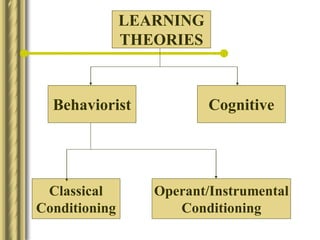
LEARNING
THEORIES
Behaviorist Cognitive
Classical
Conditioning
Operant/Instrumental
Conditioning
Operant Conditioning
Instrumental learning involves
learning the connection between a
behaviour and its consequence.
Operant Conditioning
The term “instrumental” is used as
the behaviour of an organism is
instrumental in producing both
positive and negative outcomes.
Operant Conditioning
It involves three key elements:
a response
an outcome (the reinforcer)
a relation between the R and O
Operant Conditioning
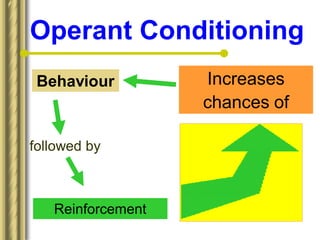
Behaviour
followed by
Reinforcement
Increases
chances of
Operant Conditioning
Thorndike & Skinner believed that
the majority of human behaviours are
not random responses to stimuli but
are purposive.
Background
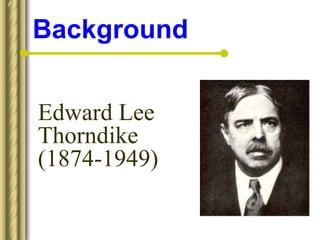
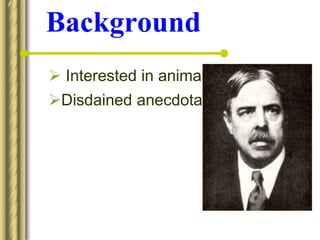
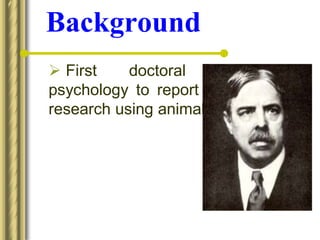
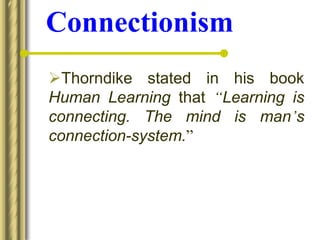
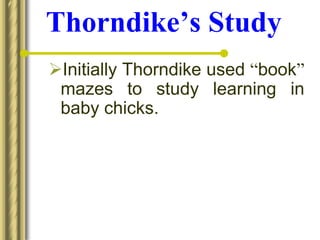
Edward Lee
Thorndike
(1874-1949)
Background
Background
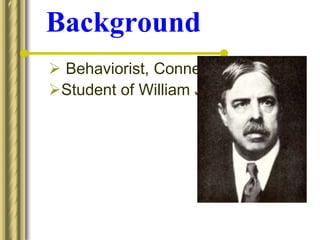
 Behaviorist, Connectionist.
Student of William James
Background
 Interested in animal intelligence.
Disdained anecdotal method.
Background
 First doctoral thesis in
psychology to report the results of
research using animal subjects.
Connectionism
Thorndike stated in his book
Human Learning that “Learning is
connecting. The mind is man’s
connection-system.”
Thorndike’s
Study
Thorndike’s Study
Initially Thorndike used “book”
mazes to study learning in
baby chicks.
Thorndike’s Study
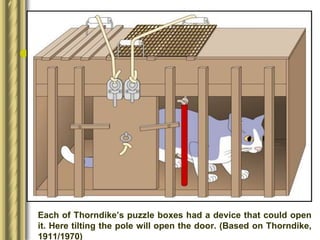
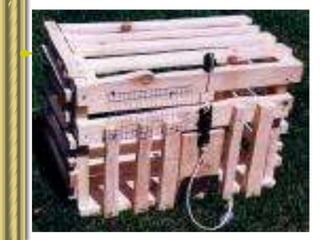
He then constructed “puzzle
boxes” to study learning in
cats.
Thorndike’s Study
He used a learning curve, for the
changes in behaviour that occur
over successive trials to record how
quickly cats learned to escape from
the puzzle box.
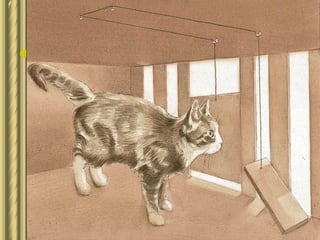
Each of Thorndike’s puzzle boxes had a device that could open
it. Here tilting the pole will open the door. (Based on Thorndike,
1911/1970)
Thorndike’s
Experiment
Thorndike’s Experiment
 A hungry cat was put inside a
puzzle box & a fish, as an
incentive, was put outside the box
beyond its reach .
Thorndike’s Experiment
The box was designed in such a
way that the door can be released
by simple act like depressing a
lever inside the box.
Thorndike’s Experiment
As the cat was hungry and
wanted to get out of the box to
reach the food, it made a great deal
of varied attempts.
Thorndike’s Experiment
All attempt were in trial and error
manner like jumping, clawing at the
bars, scratching the box, trying to
push bars, pawing & shaking
movable parts of the box.
Thorndike’s Experiment
But all attempts proved to vain.
Ultimately by chance her paw fell on
the loop of the rope and door
opened.
Thorndike’s Experiment
The cat jumped out immediately
and ate the fish. Cat was rewarded
for these behaviours by food, which
was placed outside the box.
Thorndike’s Experiment
This experiment was repeated
several times. Initially, the number
of unproductive efforts made by the
cat was very high.
Thorndike’s Experiment
But gradually the results become
productive in less time. Finally, a
stage came when the cat managed
to open the box at the first attempt,
without making any false moves.
Thorndike Theory.pdf

Thorndike Theory.pdf