By the
thinkers
 “A school of thought is the collection or
group of people who share common
characteristics of opinion or out look of a
philosophy , discipline , belief , social
movement , economics , cultural movement ,
or art movement.”
 When psychology first emerged as a science
separate from biology and philosophy , the
debate over how to describe and explain the
human mind and behavior began. The
different school of psychology represent how
to represent the major theories with in
psychology.
psychoanalysis
gestalt
neobehavorism
behaviorism
Functionalism
structuralism
 Is a learning theory based on the idea , that
behavior can be controlled or modified based
on the antecedents and consequences of
behaviour.
 All of our behaviors consists of responses to
certain stimuli.
 All behavior is learnt from the environment.
 Our behavior I determined by reinforcement
of things we do.
 Psychology should only focus on observable
rather then then the mind.
 It was reductionist .
 It was elementalistic
 It was mentalistic
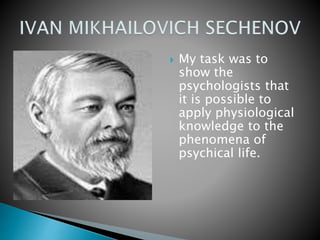
 My task was to
show the
psychologists that
it is possible to
apply physiological
knowledge to the
phenomena of
psychical life.
 Born : 1829
 Nationality : Russian
 Place of birth : village of tyoply
 Occupation : physiologist & neurologist
 Focus of study : reflexes of brain
association and materialism
Died : 1905
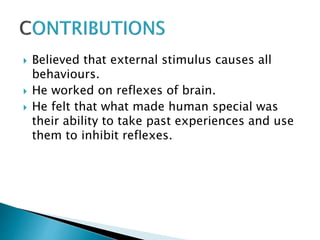
 Believed that external stimulus causes all
behaviours.
 He worked on reflexes of brain.
 He felt that what made human special was
their ability to take past experiences and use
them to inhibit reflexes.
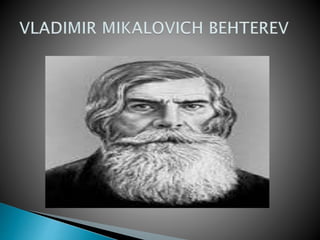
 Born : 1857
 Nationality : Russian
 Place of birth : sorali ,vyatka
 Occupation : neurophysiologist & psychiatrist
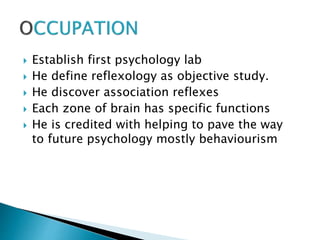
 Establish first psychology lab
 He define reflexology as objective study.
 He discover association reflexes
 Each zone of brain has specific functions
 He is credited with helping to pave the way
to future psychology mostly behaviourism
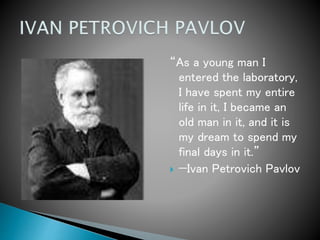
“As a young man I
entered the laboratory,
I have spent my entire
life in it, I became an
old man in it, and it is
my dream to spend my
final days in it.”
 —Ivan Petrovich Pavlov
 Ivan Pavlov was a famous Russian
psychologist
 He lived from 1849 to 1936
 He made many discoveries in the field of
psychology.
 He won noble prize in psychology in 1904.
 CLASSICAL CONDITIONING
 BEHAVIOR MODIFICATION
 conditioning in which the conditioned
stimulus (as the sound of a bell) is paired
with and precedes the unconditioned
stimulus (as the sight of food) until the
conditioned stimulus alone is sufficient to
elicit the response (as salivation in a dog).
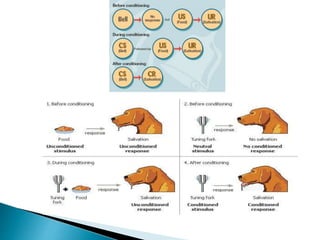
 Pavlov place a dog in an isolated
environment.
 He kept the food in front of the dog.
 The dog salivate when they saw the food.
 The salivation of a dog at the sight of food is
a neutral response.
NATURAL RESPONCE:-AN UN
CONDITION REFLEX TO AN UN CONDOTION
STIMULUS.
 Then he present a food along with the sound
of the bell(neutral stimulus)
 After many trials the dog salivate after
listening of the sound of bell.
 It mean that the neutral stimulus produce the
same response which is called the conditional
response
 From this experiment the Pavlov concluded
that classical conditioning had taken place
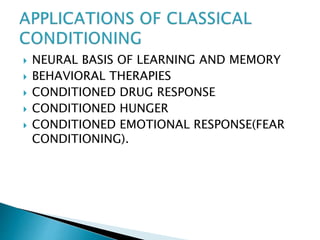
 NEURAL BASIS OF LEARNING AND MEMORY
 BEHAVIORAL THERAPIES
 CONDITIONED DRUG RESPONSE
 CONDITIONED HUNGER
 CONDITIONED EMOTIONAL RESPONSE(FEAR
CONDITIONING).
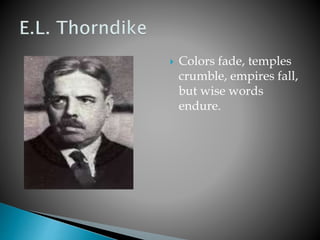
 Colors fade, temples
crumble, empires fall,
but wise words
endure.
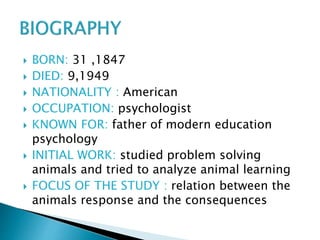
 BORN: 31 ,1847
 DIED: 9,1949
 NATIONALITY : American
 OCCUPATION: psychologist
 KNOWN FOR: father of modern education
psychology
 INITIAL WORK: studied problem solving
animals and tried to analyze animal learning
 FOCUS OF THE STUDY : relation between the
animals response and the consequences
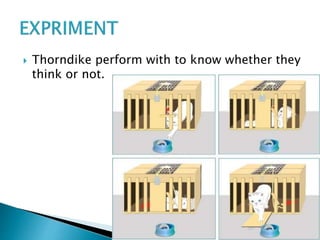
 Thorndike perform with to know whether they
think or not.
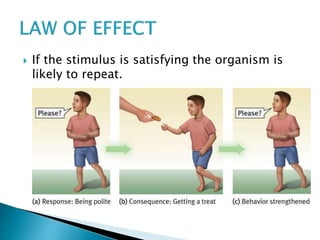
 If the stimulus is satisfying the organism is
likely to repeat.
 More often an association is used , the
stronger the connection. Naturally less it is
used , the weaker the connection.
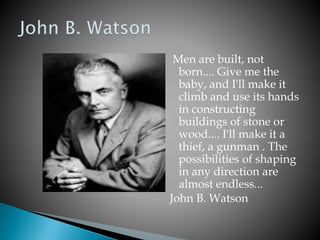
Men are built, not
born.... Give me the
baby, and I'll make it
climb and use its hands
in constructing
buildings of stone or
wood.... I'll make it a
thief, a gunman . The
possibilities of shaping
in any direction are
almost endless...
John B. Watson
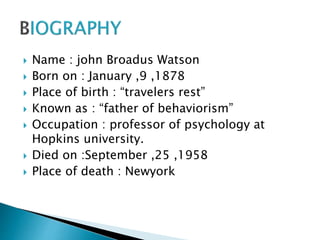
 Name : john Broadus Watson
 Born on : January ,9 ,1878
 Place of birth : “travelers rest”
 Known as : “father of behaviorism”
 Occupation : professor of psychology at
Hopkins university.
 Died on :September ,25 ,1958
 Place of death : Newyork
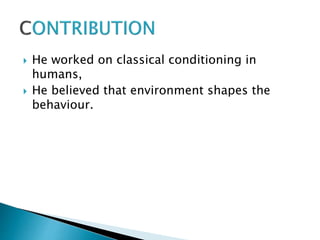
 He worked on classical conditioning in
humans,
 He believed that environment shapes the
behaviour.
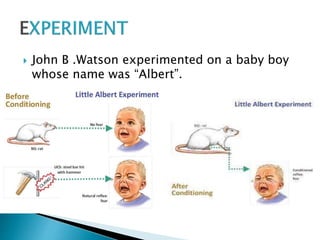
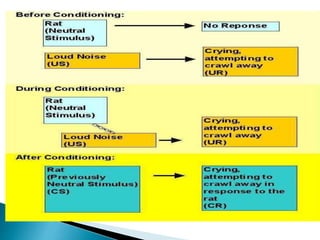
 John B .Watson experimented on a baby boy
whose name was “Albert”.
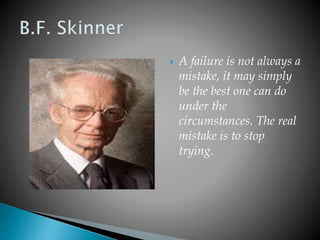
 A failure is not always a
mistake, it may simply
be the best one can do
under the
circumstances. The real
mistake is to stop
trying.
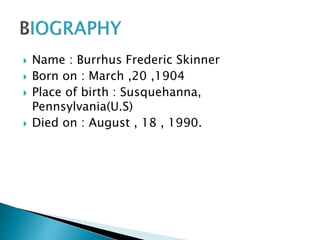
 Name : Burrhus Frederic Skinner
 Born on : March ,20 ,1904
 Place of birth : Susquehanna,
Pennsylvania(U.S)
 Died on : August , 18 , 1990.
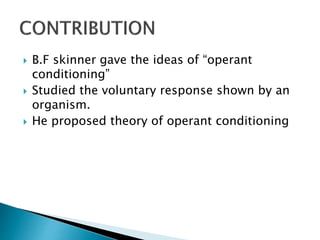
 B.F skinner gave the ideas of “operant
conditioning”
 Studied the voluntary response shown by an
organism.
 He proposed theory of operant conditioning
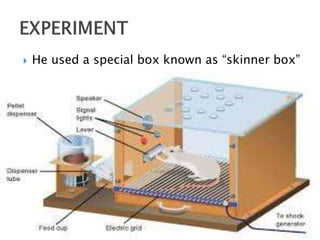
 He used a special box known as “skinner box”
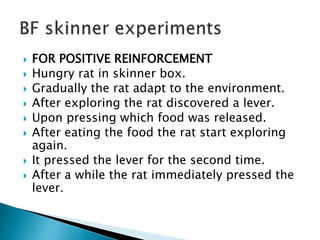
 FOR POSITIVE REINFORCEMENT
 Hungry rat in skinner box.
 Gradually the rat adapt to the environment.
 After exploring the rat discovered a lever.
 Upon pressing which food was released.
 After eating the food the rat start exploring
again.
 It pressed the lever for the second time.
 After a while the rat immediately pressed the
lever.
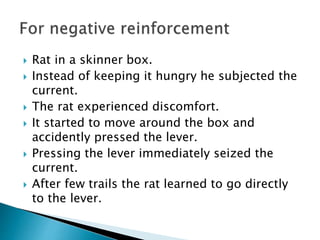
 Rat in a skinner box.
 Instead of keeping it hungry he subjected the
current.
 The rat experienced discomfort.
 It started to move around the box and
accidently pressed the lever.
 Pressing the lever immediately seized the
current.
 After few trails the rat learned to go directly
to the lever.
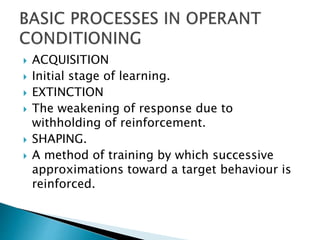
 ACQUISITION
 Initial stage of learning.
 EXTINCTION
 The weakening of response due to
withholding of reinforcement.
 SHAPING.
 A method of training by which successive
approximations toward a target behaviour is
reinforced.
positive negative
 IGNORANCE OF GENETICS
 GENERALIZATION
 COGNITIVE ISSUE
 HUMANISM
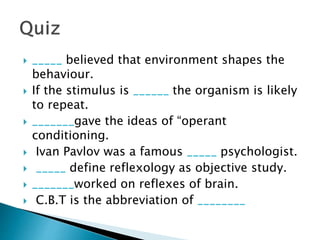
 _____ believed that environment shapes the
behaviour.
 If the stimulus is ______ the organism is likely
to repeat.
 _______gave the ideas of “operant
conditioning.
 Ivan Pavlov was a famous _____ psychologist.
 _____ define reflexology as objective study.
 _______worked on reflexes of brain.
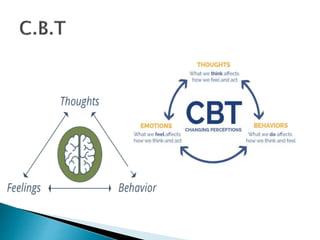
 C.B.T is the abbreviation of ________
behaviorism school of thought

behaviorism school of thought

  • 2.
  • 3.
     “A schoolof thought is the collection or group of people who share common characteristics of opinion or out look of a philosophy , discipline , belief , social movement , economics , cultural movement , or art movement.”
  • 4.
     When psychologyfirst emerged as a science separate from biology and philosophy , the debate over how to describe and explain the human mind and behavior began. The different school of psychology represent how to represent the major theories with in psychology.
  • 5.
  • 6.
     Is alearning theory based on the idea , that behavior can be controlled or modified based on the antecedents and consequences of behaviour.
  • 7.
     All ofour behaviors consists of responses to certain stimuli.  All behavior is learnt from the environment.  Our behavior I determined by reinforcement of things we do.  Psychology should only focus on observable rather then then the mind.
  • 8.
     It wasreductionist .  It was elementalistic  It was mentalistic
  • 10.
     My taskwas to show the psychologists that it is possible to apply physiological knowledge to the phenomena of psychical life.
  • 11.
     Born :1829  Nationality : Russian  Place of birth : village of tyoply  Occupation : physiologist & neurologist  Focus of study : reflexes of brain association and materialism Died : 1905
  • 12.
     Believed thatexternal stimulus causes all behaviours.  He worked on reflexes of brain.  He felt that what made human special was their ability to take past experiences and use them to inhibit reflexes.
  • 14.
     Born :1857  Nationality : Russian  Place of birth : sorali ,vyatka  Occupation : neurophysiologist & psychiatrist
  • 15.
     Establish firstpsychology lab  He define reflexology as objective study.  He discover association reflexes  Each zone of brain has specific functions  He is credited with helping to pave the way to future psychology mostly behaviourism
  • 16.
    “As a youngman I entered the laboratory, I have spent my entire life in it, I became an old man in it, and it is my dream to spend my final days in it.”  —Ivan Petrovich Pavlov
  • 17.
     Ivan Pavlovwas a famous Russian psychologist  He lived from 1849 to 1936  He made many discoveries in the field of psychology.  He won noble prize in psychology in 1904.
  • 18.
     CLASSICAL CONDITIONING BEHAVIOR MODIFICATION
  • 19.
     conditioning inwhich the conditioned stimulus (as the sound of a bell) is paired with and precedes the unconditioned stimulus (as the sight of food) until the conditioned stimulus alone is sufficient to elicit the response (as salivation in a dog).
  • 20.
     Pavlov placea dog in an isolated environment.  He kept the food in front of the dog.  The dog salivate when they saw the food.  The salivation of a dog at the sight of food is a neutral response. NATURAL RESPONCE:-AN UN CONDITION REFLEX TO AN UN CONDOTION STIMULUS.
  • 21.
     Then hepresent a food along with the sound of the bell(neutral stimulus)  After many trials the dog salivate after listening of the sound of bell.  It mean that the neutral stimulus produce the same response which is called the conditional response  From this experiment the Pavlov concluded that classical conditioning had taken place
  • 23.
     NEURAL BASISOF LEARNING AND MEMORY  BEHAVIORAL THERAPIES  CONDITIONED DRUG RESPONSE  CONDITIONED HUNGER  CONDITIONED EMOTIONAL RESPONSE(FEAR CONDITIONING).
  • 24.
     Colors fade,temples crumble, empires fall, but wise words endure.
  • 25.
     BORN: 31,1847  DIED: 9,1949  NATIONALITY : American  OCCUPATION: psychologist  KNOWN FOR: father of modern education psychology  INITIAL WORK: studied problem solving animals and tried to analyze animal learning  FOCUS OF THE STUDY : relation between the animals response and the consequences
  • 26.
     Thorndike performwith to know whether they think or not.
  • 27.
     If thestimulus is satisfying the organism is likely to repeat.
  • 28.
     More oftenan association is used , the stronger the connection. Naturally less it is used , the weaker the connection.
  • 29.
    Men are built,not born.... Give me the baby, and I'll make it climb and use its hands in constructing buildings of stone or wood.... I'll make it a thief, a gunman . The possibilities of shaping in any direction are almost endless... John B. Watson
  • 30.
     Name :john Broadus Watson  Born on : January ,9 ,1878  Place of birth : “travelers rest”  Known as : “father of behaviorism”  Occupation : professor of psychology at Hopkins university.  Died on :September ,25 ,1958  Place of death : Newyork
  • 31.
     He workedon classical conditioning in humans,  He believed that environment shapes the behaviour.
  • 32.
     John B.Watson experimented on a baby boy whose name was “Albert”.
  • 35.
     A failureis not always a mistake, it may simply be the best one can do under the circumstances. The real mistake is to stop trying.
  • 36.
     Name :Burrhus Frederic Skinner  Born on : March ,20 ,1904  Place of birth : Susquehanna, Pennsylvania(U.S)  Died on : August , 18 , 1990.
  • 37.
     B.F skinnergave the ideas of “operant conditioning”  Studied the voluntary response shown by an organism.  He proposed theory of operant conditioning
  • 38.
     He useda special box known as “skinner box”
  • 39.
     FOR POSITIVEREINFORCEMENT  Hungry rat in skinner box.  Gradually the rat adapt to the environment.  After exploring the rat discovered a lever.  Upon pressing which food was released.  After eating the food the rat start exploring again.  It pressed the lever for the second time.  After a while the rat immediately pressed the lever.
  • 40.
     Rat ina skinner box.  Instead of keeping it hungry he subjected the current.  The rat experienced discomfort.  It started to move around the box and accidently pressed the lever.  Pressing the lever immediately seized the current.  After few trails the rat learned to go directly to the lever.
  • 41.
     ACQUISITION  Initialstage of learning.  EXTINCTION  The weakening of response due to withholding of reinforcement.  SHAPING.  A method of training by which successive approximations toward a target behaviour is reinforced.
  • 45.
  • 46.
     IGNORANCE OFGENETICS  GENERALIZATION  COGNITIVE ISSUE  HUMANISM
  • 48.
     _____ believedthat environment shapes the behaviour.  If the stimulus is ______ the organism is likely to repeat.  _______gave the ideas of “operant conditioning.  Ivan Pavlov was a famous _____ psychologist.  _____ define reflexology as objective study.  _______worked on reflexes of brain.  C.B.T is the abbreviation of ________