

M. Nisha Ragavi
Arasan Ganesan College of
Preceptors, Sivakasi.
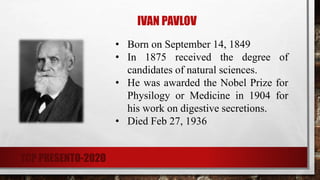
• Born on September 14, 1849
• In 1875 received the degree of
candidates of natural sciences.
• He was awarded the Nobel Prize for
Physilogy or Medicine in 1904 for
his work on digestive secretions.
• Died Feb 27, 1936
IVAN PAVLOV
TCP PRESENTO-2020
CONDITIONING
Learning which has been acquired through
experience.
“It’s not accidental that all phenomenoa of human life
are dominated by the search for daily bread, the oldest
link connecting all living things, man included,
surrounding nature. “
TCP PRESENTO-2020
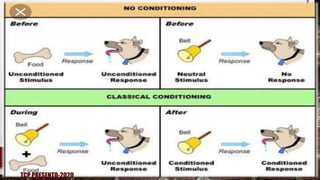
CLASSICAL CONDITIONING
Conditioning can be Defined as “a process in which
a neutral stimulus which is not associated with any
specific natural response, on paring with the natural
stimulus, acquires the characteristics of natural
stimulus.
TCP PRESENTO-2020
TCP PRESENTO-2020
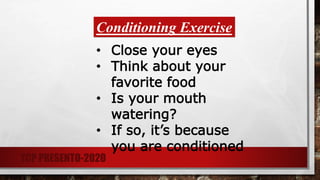
Conditioning Exercise
• Close your eyes
• Think about your
favorite food
• Is your mouth
watering?
• If so, it’s because
you are conditioned
TCP PRESENTO-2020
TCP PRESENTO-2020
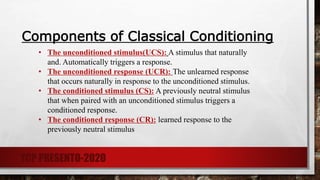
Components of Classical Conditioning
• The unconditioned stimulus(UCS): A stimulus that naturally
and. Automatically triggers a response.
• The unconditioned response (UCR): The unlearned response
that occurs naturally in response to the unconditioned stimulus.
• The conditioned stimulus (CS): A previously neutral stimulus
that when paired with an unconditioned stimulus triggers a
conditioned response.
• The conditioned response (CR): learned response to the
previously neutral stimulus
TCP PRESENTO-2020
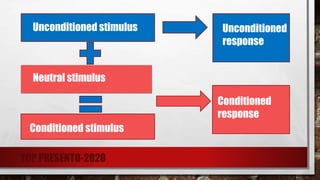
Unconditioned stimulus
Neutral stimulus
Conditioned stimulus
Unconditioned
response
Conditioned
response
TCP PRESENTO-2020
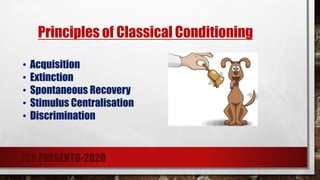
Principles of Classical Conditioning
• Acquisition
• Extinction
• Spontaneous Recovery
• Stimulus Centralisation
• Discrimination
TCP PRESENTO-2020
Summary
• To summarize, classical conditioning (later
developed by Watson, 1913) involves learning to
associate an unconditioned stimulus that already
brings about a particular response (i.e., a reflex)
with a new (conditioned) stimulus, so that the new
stimulus brings about the same response.
TCP PRESENTO-2020
• Pavlov developed some rather unfriendly technical terms to
describe this process. The unconditioned stimulus (or UCS)
is the object or event that originally produces the reflexive /
natural response.The response to this is called the
unconditioned response (or UCR).
• The neutral stimulus (NS) is a new stimulus that does not
produce a response.Once the neutral stimulus has become
associated with the unconditioned stimulus, it becomes a
conditioned stimulus (CS). The conditioned response (CR)
is the response to the conditioned stimulus.
TCP PRESENTO-2020
Educational implications of conditioning
theory of learning
1) Classical conditioning is used in language learning by associating
words with pictures or meaning.
2) It can be used to develop favourable attitudes towards learning,
teachers, subjects and the school.
TCP PRESENTO-2020
3) developing good habits in children such as cleanliness, respect for
elders, punctuality etc. through the use of conditioning.
4) Breaking of bad habits and elimination of conditioned fear through
the use of deconditioning process.
TCP PRESENTO-2020
Limitations of conditioning theory of
learning• Complex areas of learning, involving generalization,
abstraction, problem solving cannot be explained by
conditioning process.
• It can be describe only those learning related to
emotional shaping and habits formation and not higher
order human learning.
TCP PRESENTO-2020
Reference:
Nagarajan (2019) “Learning and Teaching”, Sriram
publishers, Chennai -93.
TCP PRESENTO-2020
TCP PRESENTO-2020

PAVLOV'S CLASSICAL CONDITIONING THEORY

  • 1.
    M. Nisha Ragavi ArasanGanesan College of Preceptors, Sivakasi.
  • 2.
    • Born onSeptember 14, 1849 • In 1875 received the degree of candidates of natural sciences. • He was awarded the Nobel Prize for Physilogy or Medicine in 1904 for his work on digestive secretions. • Died Feb 27, 1936 IVAN PAVLOV TCP PRESENTO-2020
  • 3.
    CONDITIONING Learning which hasbeen acquired through experience. “It’s not accidental that all phenomenoa of human life are dominated by the search for daily bread, the oldest link connecting all living things, man included, surrounding nature. “ TCP PRESENTO-2020
  • 4.
    CLASSICAL CONDITIONING Conditioning canbe Defined as “a process in which a neutral stimulus which is not associated with any specific natural response, on paring with the natural stimulus, acquires the characteristics of natural stimulus. TCP PRESENTO-2020
  • 5.
  • 6.
    Conditioning Exercise • Closeyour eyes • Think about your favorite food • Is your mouth watering? • If so, it’s because you are conditioned TCP PRESENTO-2020
  • 7.
  • 8.
    Components of ClassicalConditioning • The unconditioned stimulus(UCS): A stimulus that naturally and. Automatically triggers a response. • The unconditioned response (UCR): The unlearned response that occurs naturally in response to the unconditioned stimulus. • The conditioned stimulus (CS): A previously neutral stimulus that when paired with an unconditioned stimulus triggers a conditioned response. • The conditioned response (CR): learned response to the previously neutral stimulus TCP PRESENTO-2020
  • 9.
    Unconditioned stimulus Neutral stimulus Conditionedstimulus Unconditioned response Conditioned response TCP PRESENTO-2020
  • 10.
    Principles of ClassicalConditioning • Acquisition • Extinction • Spontaneous Recovery • Stimulus Centralisation • Discrimination TCP PRESENTO-2020
  • 11.
    Summary • To summarize,classical conditioning (later developed by Watson, 1913) involves learning to associate an unconditioned stimulus that already brings about a particular response (i.e., a reflex) with a new (conditioned) stimulus, so that the new stimulus brings about the same response. TCP PRESENTO-2020
  • 12.
    • Pavlov developedsome rather unfriendly technical terms to describe this process. The unconditioned stimulus (or UCS) is the object or event that originally produces the reflexive / natural response.The response to this is called the unconditioned response (or UCR). • The neutral stimulus (NS) is a new stimulus that does not produce a response.Once the neutral stimulus has become associated with the unconditioned stimulus, it becomes a conditioned stimulus (CS). The conditioned response (CR) is the response to the conditioned stimulus. TCP PRESENTO-2020
  • 13.
    Educational implications ofconditioning theory of learning 1) Classical conditioning is used in language learning by associating words with pictures or meaning. 2) It can be used to develop favourable attitudes towards learning, teachers, subjects and the school. TCP PRESENTO-2020
  • 14.
    3) developing goodhabits in children such as cleanliness, respect for elders, punctuality etc. through the use of conditioning. 4) Breaking of bad habits and elimination of conditioned fear through the use of deconditioning process. TCP PRESENTO-2020
  • 15.
    Limitations of conditioningtheory of learning• Complex areas of learning, involving generalization, abstraction, problem solving cannot be explained by conditioning process. • It can be describe only those learning related to emotional shaping and habits formation and not higher order human learning. TCP PRESENTO-2020
  • 16.
    Reference: Nagarajan (2019) “Learningand Teaching”, Sriram publishers, Chennai -93. TCP PRESENTO-2020
  • 17.