Dimensional Approach
        – to classification of mental disorder
• Categorically classifying
  mental disorders focuses on
  the KIND of problem a
  person is experiencing.
• A dimensional approach
  focuses on the EXTENT in
  which a person has a
  disorder. Many disorders
  (especially personality
  disorders) are simply normal
  traits gone too far.
Dimensional Approach
• Doesn’t place people into
  diagnostic categories.
• Places people in dimensions
  (sometimes seen as
  dimensions of personality)
• Diagnosis, then, becomes not a
  process of deciding the
  presence or absence of a
  symptom or disorder, but
  rather, the degree to which
  particular characteristic is
  present.
Dimensional approach
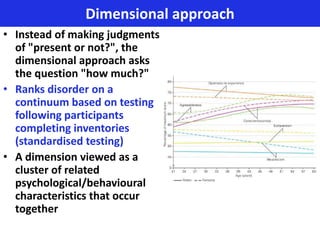
• Instead of making judgments
  of "present or not?", the
  dimensional approach asks
  the question "how much?"
• Ranks disorder on a
  continuum based on testing
  following participants
  completing inventories
  (standardised testing)
• A dimension viewed as a
  cluster of related
  psychological/behavioural
  characteristics that occur
  together
Dimensional approach
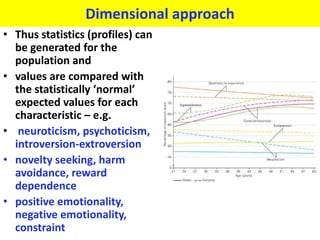
• Thus statistics (profiles) can
  be generated for the
  population and
• values are compared with
  the statistically ‘normal’
  expected values for each
  characteristic – e.g.
• neuroticism, psychoticism,
  introversion-extroversion
• novelty seeking, harm
  avoidance, reward
  dependence
• positive emotionality,
  negative emotionality,
  constraint
Grading & Transitional
• Patient is profiled by grading
  the severity of symptoms
  from a number of dimensions
  in comparison to the
  population e.g. anxiety,
  variations in mood, etc.
• Symptoms can be monitored
  over time (Transitional) – to
  determine the effectiveness
  of treatment.
Strengths
• generates richer data i.e. we get
  more detail of a case by case
  approach for individual patient’s
• A dimensional approach would
  be better able to capture the
  complexities of a person’s life
  that a categorical approach
  would miss.
• Classifies disorder on its severity
  (not just presence)
• Stigma’s from labeling are less
  likely to occur – i.e. ‘she is highly
  anxious’ (not she has ‘borderline
  personality disorder’
Weaknesses
• Complexity & lack of uniformity in mental health
  profession.
• Particularly given the number of dimensions that
  need to be rated.

Dimensional approach

  • 1.
    Dimensional Approach – to classification of mental disorder • Categorically classifying mental disorders focuses on the KIND of problem a person is experiencing. • A dimensional approach focuses on the EXTENT in which a person has a disorder. Many disorders (especially personality disorders) are simply normal traits gone too far.
  • 2.
    Dimensional Approach • Doesn’tplace people into diagnostic categories. • Places people in dimensions (sometimes seen as dimensions of personality) • Diagnosis, then, becomes not a process of deciding the presence or absence of a symptom or disorder, but rather, the degree to which particular characteristic is present.
  • 3.
    Dimensional approach • Insteadof making judgments of "present or not?", the dimensional approach asks the question "how much?" • Ranks disorder on a continuum based on testing following participants completing inventories (standardised testing) • A dimension viewed as a cluster of related psychological/behavioural characteristics that occur together
  • 4.
    Dimensional approach • Thusstatistics (profiles) can be generated for the population and • values are compared with the statistically ‘normal’ expected values for each characteristic – e.g. • neuroticism, psychoticism, introversion-extroversion • novelty seeking, harm avoidance, reward dependence • positive emotionality, negative emotionality, constraint
  • 5.
    Grading & Transitional •Patient is profiled by grading the severity of symptoms from a number of dimensions in comparison to the population e.g. anxiety, variations in mood, etc. • Symptoms can be monitored over time (Transitional) – to determine the effectiveness of treatment.
  • 6.
    Strengths • generates richerdata i.e. we get more detail of a case by case approach for individual patient’s • A dimensional approach would be better able to capture the complexities of a person’s life that a categorical approach would miss. • Classifies disorder on its severity (not just presence) • Stigma’s from labeling are less likely to occur – i.e. ‘she is highly anxious’ (not she has ‘borderline personality disorder’
  • 7.
    Weaknesses • Complexity &lack of uniformity in mental health profession. • Particularly given the number of dimensions that need to be rated.

Editor's Notes

  • #4 Ranks on a continuum via data from questionnaires, inventories
  • #5 Ranks on a continuum via data from questionnaires, inventories
  • #6 Ranks on a continuum via data from questionnaires, inventories
  • #7 Ranks on a continuum via data from questionnaires, inventories
  • #8 Ranks on a continuum via data from questionnaires, inventories