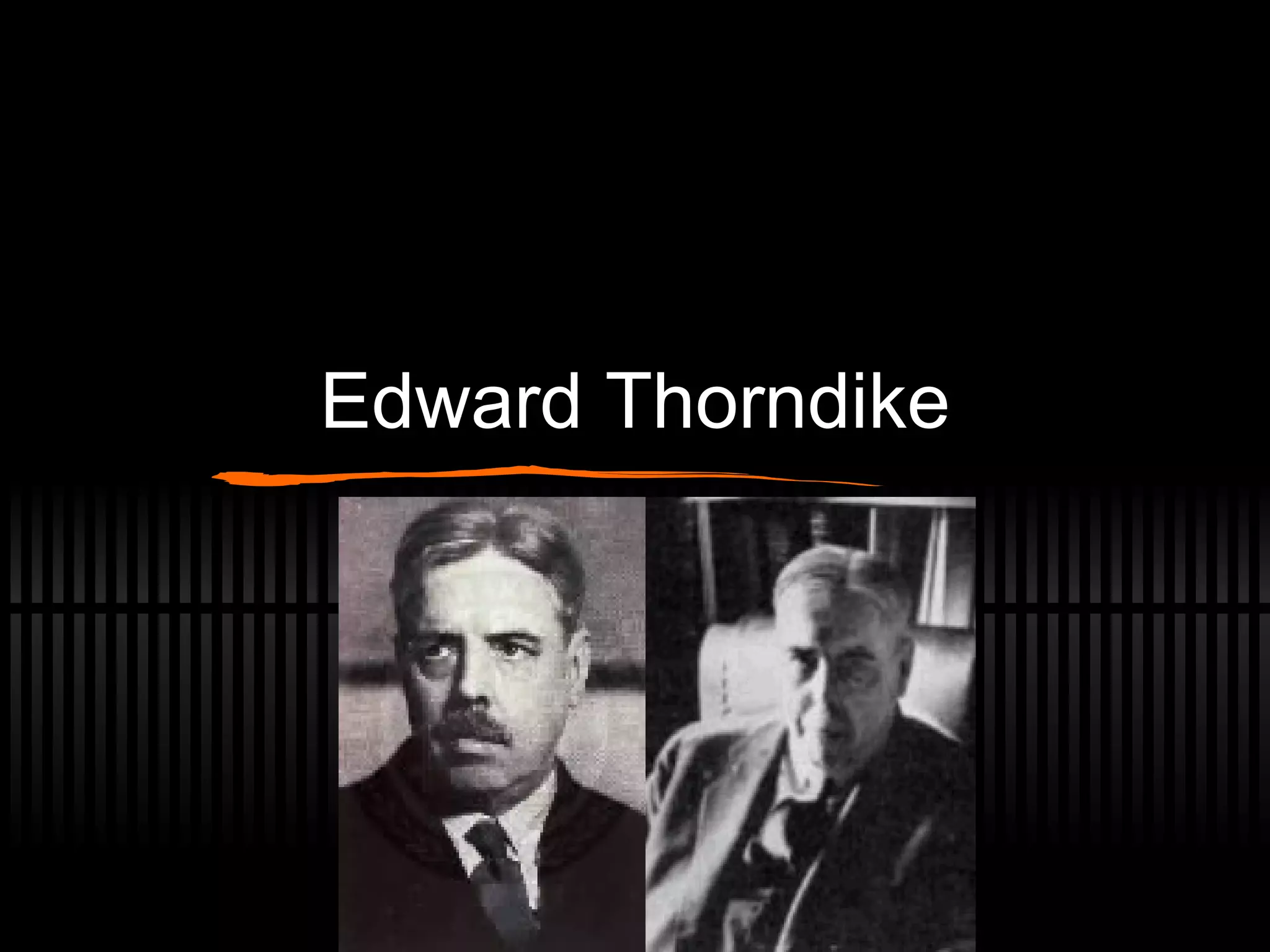
Edward Thorndike
Biography Born:  1874,  in Williamsburg, Massachusetts Died in  1949 ✞
Education Wesleyan University (1895) Harvard University (1897) - Worked with William James Columbia University (Ph.D., 1898) - Under James M. Cattell
Random Facts He wrote and published over 500 books. He studied animal intelligence, which he then applied to humans. Constructed a scale to measure children's handwriting. Constructed a table of word frequency.
Puzzle Boxes One of the most important researches Thorndike did, was animal research, in his self constructed “ puzzle boxes ”. These puzzle boxes are an example of  instrumental conditioning .
That means that… An animal makes some response -->  The animal is rewarded --> Then the response is learned. If it is NOT rewarded--> the response “disappears”
How it was done… The entire experiment was based on placing animals in his self constructed “puzzle boxes” In his experiment, cats were placed into these boxes, and could only escape by pressing a button or pulling a string.
Observations He observed that the animals would mostly success by “trial and error”  (that means trying random things until one of them works) After putting the same cat into the box several times, it would learn which button to press. After some time, the action of pressing the button was automatic.
Food… Thorndike used food outside as a  positive reinforcement . When he placed food outside of the puzzle box, he noticed that cats learned to escape the box faster than when no food was placed outside.
 
Theory… Learning is the result of associations forming between stimuli and responses.  Such associations or habits become strengthened or weakened by the nature and frequency. These can be strengthened by positive or negative reinforcement.
Theory… Thorndike's theory consists of three primary laws:  (1) law of effect - responses to a situation which are followed by a reward  will be strengthened and become a habit response to that situation.
Theory… (2) law of readiness - a series of responses can be chained together to be able to achieve a goal which will result in annoyance if blocked.
Theory… (3) law of exercise - connections become strengthened with practice and weakened when practice is discontinued.
Theory… The theory also suggests that to transfer learned behavior to other situations requires the presence of identical elements in the original and new learning situations. Thorndike also introduced the "spread of effect" idea. That means that rewards affect not only the connection that produced them but temporally adjacent connections as well.
Application Connectionism was meant to be a general theory of learning for animals and humans. Thorndike was especially interested in the application of his theory to education including mathematics spelling and reading,  measurement of intelligence and adult learning
Applying to real life… Imagine someone is playing a video-game. He presses all the buttons on the controller randomly, and his character does a cool move. The player will try to recreate this by trying again and again until  the action of pressing the same buttons will be automatic.
Criticism Critics of Thorndike found that the experimental situations he devised to be overly restrictive and his theories of learning to ignore the complexities of human behavior.
Strength Behavior is observed and no guessing is involved through comparative studies.
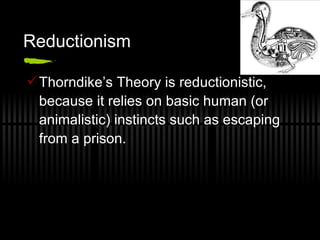
Reductionism Thorndike’s Theory is reductionistic, because it relies on basic human (or animalistic) instincts such as escaping from a prison.
Determinism…  Thorndike’s theory is determenistic because after learning the process, pressing the button is automatic and is not influenced by any miraculous events.

Thorndike General Overview

  • 1.
  • 2.
    Biography Born: 1874, in Williamsburg, Massachusetts Died in 1949 ✞
  • 3.
    Education Wesleyan University(1895) Harvard University (1897) - Worked with William James Columbia University (Ph.D., 1898) - Under James M. Cattell
  • 4.
    Random Facts Hewrote and published over 500 books. He studied animal intelligence, which he then applied to humans. Constructed a scale to measure children's handwriting. Constructed a table of word frequency.
  • 5.
    Puzzle Boxes Oneof the most important researches Thorndike did, was animal research, in his self constructed “ puzzle boxes ”. These puzzle boxes are an example of instrumental conditioning .
  • 6.
    That means that…An animal makes some response --> The animal is rewarded --> Then the response is learned. If it is NOT rewarded--> the response “disappears”
  • 7.
    How it wasdone… The entire experiment was based on placing animals in his self constructed “puzzle boxes” In his experiment, cats were placed into these boxes, and could only escape by pressing a button or pulling a string.
  • 8.
    Observations He observedthat the animals would mostly success by “trial and error” (that means trying random things until one of them works) After putting the same cat into the box several times, it would learn which button to press. After some time, the action of pressing the button was automatic.
  • 9.
    Food… Thorndike usedfood outside as a positive reinforcement . When he placed food outside of the puzzle box, he noticed that cats learned to escape the box faster than when no food was placed outside.
  • 10.
  • 11.
    Theory… Learning isthe result of associations forming between stimuli and responses. Such associations or habits become strengthened or weakened by the nature and frequency. These can be strengthened by positive or negative reinforcement.
  • 12.
    Theory… Thorndike's theoryconsists of three primary laws: (1) law of effect - responses to a situation which are followed by a reward will be strengthened and become a habit response to that situation.
  • 13.
    Theory… (2) lawof readiness - a series of responses can be chained together to be able to achieve a goal which will result in annoyance if blocked.
  • 14.
    Theory… (3) lawof exercise - connections become strengthened with practice and weakened when practice is discontinued.
  • 15.
    Theory… The theoryalso suggests that to transfer learned behavior to other situations requires the presence of identical elements in the original and new learning situations. Thorndike also introduced the "spread of effect" idea. That means that rewards affect not only the connection that produced them but temporally adjacent connections as well.
  • 16.
    Application Connectionism wasmeant to be a general theory of learning for animals and humans. Thorndike was especially interested in the application of his theory to education including mathematics spelling and reading, measurement of intelligence and adult learning
  • 17.
    Applying to reallife… Imagine someone is playing a video-game. He presses all the buttons on the controller randomly, and his character does a cool move. The player will try to recreate this by trying again and again until the action of pressing the same buttons will be automatic.
  • 18.
    Criticism Critics ofThorndike found that the experimental situations he devised to be overly restrictive and his theories of learning to ignore the complexities of human behavior.
  • 19.
    Strength Behavior isobserved and no guessing is involved through comparative studies.
  • 20.
    Reductionism Thorndike’s Theoryis reductionistic, because it relies on basic human (or animalistic) instincts such as escaping from a prison.
  • 21.
    Determinism… Thorndike’stheory is determenistic because after learning the process, pressing the button is automatic and is not influenced by any miraculous events.