Chapter 8
The Central Nervous System
Human
physiology
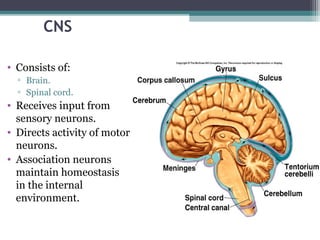
CNS
• Consists of:
▫ Brain.
▫ Spinal cord.
• Receives input from
sensory neurons.
• Directs activity of motor
neurons.
• Association neurons
maintain homeostasis
in the internal
environment.
Embryonic Development
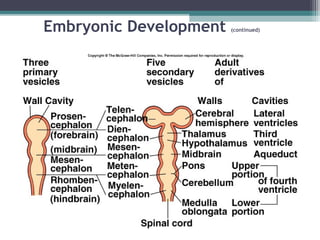
• Groove appears in ectoderm to fuse to form neural tube by
20th
day after conception. Neural tube eventually forms the
CNS.
• During 5th
week, modified:
▫ Forebrain: telencephalon and diencephalon.
▫ Midbrain: unchanged.
▫ Hindbrain: metencephalon and myelencephalon.
• Part of ectoderm where fusion occurs becomes neural crest.
▫ Neural crest forms ganglia of PNS.
Embryonic Development (continued)
• Telencephalon grows disproportionately
forming 2 the hemispheres of the cerebrum.
• Ventricles and central canal become filled with
cerebral spinal fluid (CSF).
• CNS composed of gray and white matter.
▫ Gray matter consists of neuron cell bodies and
dendrites.
▫ White matter (myelin) consists of axon tracts.
Cerebrum
• Only structure of the telencephalon.
• Largest portion of brain (80% mass).
• Responsible for higher mental functions.
• Corpus callosum:
▫ Major tract of axons that functionally interconnects
right and left cerebral hemispheres.
Cerebrum (continued)
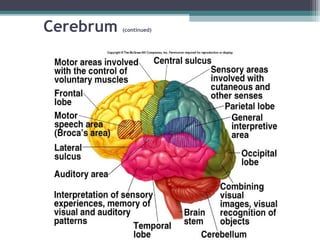
Cerebral Cortex
Characterized by numerous convolutions.
◦ Elevated folds: gyri.
◦ Depressed groves: sulci.
Frontal lobe:
◦ Anterior portion of each cerebral hemisphere.
◦ Precentral gyri:
 Contains upper motor neurons.
 Involved in motor control.
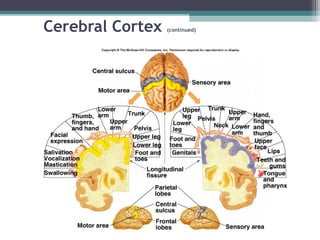
Body regions with the greatest number of motor
innervation are represented by largest areas of
motor cortex.
Cerebral Cortex (continued)
• Parietal lobe:
▫ Primary area responsible for perception of
somatesthetic sensation.
▫ Body regions with highest densities of receptors
are represented by largest areas of sensory
cortex.
• Temporal lobe:
▫ Contain auditory centers that receive sensory
fibers from cochlea.
▫ Interpretation and association of auditory and
visual information.
Cerebral Cortex (continued)
• Occipital Lobe:
▫ Primary area responsible for vision and
coordination of eye movements.
• Insula:
▫ Implicated in memory encoding.
▫ Integration of sensory information with visceral
responses.
▫ Coordinated cardiovascular response to stress.
Visualizing the Brain
• X-ray computed tomography (CT):
▫ Complex computer manipulations of data obtained from x-ray
absorption by tissues of different densities.
 Soft tissue.
• Positron-emission tomography (PET):
▫ Radioisotopes that emit positrons are injected into blood stream.
 Collision of positron and electron result in emission of gamma rays.
 Pinpoint brain cells that are most active.
▫ Brain metabolism, drug distribution.
• Magnetic resonance imaging (MRI):
▫ Protons (H+
) respond to magnetic field, which align the protons.
 Emit a radio-wave signal when stimulated.
 Brain function.
Electroencephalogram (EEG)
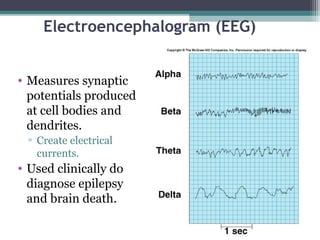
• Measures synaptic
potentials produced
at cell bodies and
dendrites.
▫ Create electrical
currents.
• Used clinically do
diagnose epilepsy
and brain death.
EEG Patterns
• Alpha:
▫ Recorded from parietal and occipital regions.
 Person is awake, relaxed, with eyes closed.
 10-12 cycles/sec.
• Beta:
▫ Strongest from frontal lobes near precentral gyrus.
 Produced by visual stimuli and mental activity.
 Evoked activity.
 13-25 cycles/sec.
• Theta:
▫ Emitted from temporal and occipital lobes.
 Common in newborn.
 Adult indicates severe emotional stress.
 5-8 cycles/sec.
• Delta:
▫ Emitted in a general pattern.
 Common during sleep and awake infant.
 In awake adult indicate brain damage.
 1-5 cycles/sec.
EEG Sleep Patterns
• 2 types of EEG patterns during sleep:
▫ REM (rapid eye movement):
 Dreams occur.
 Low-amplitude, high-frequency oscillations.
 Similar to wakefulness (beta waves).
▫ Non-Rem (resting):
 High-amplitude, low-frequency waves (delta
waves).
 Superimposed on these are sleep spindles:
 Waxing and waning bursts of 7-14 cycles/sec.
 Last for 1-3 sec.
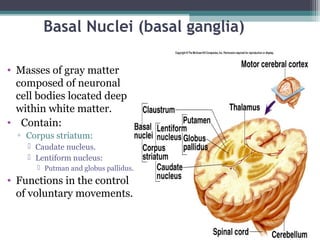
Basal Nuclei (basal ganglia)
• Masses of gray matter
composed of neuronal
cell bodies located deep
within white matter.
• Contain:
▫ Corpus striatum:
 Caudate nucleus.
 Lentiform nucleus:
 Putman and globus pallidus.
• Functions in the control
of voluntary movements.
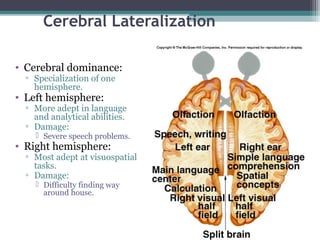
Cerebral Lateralization
• Cerebral dominance:
▫ Specialization of one
hemisphere.
• Left hemisphere:
▫ More adept in language
and analytical abilities.
▫ Damage:
 Severe speech problems.
• Right hemisphere:
▫ Most adept at visuospatial
tasks.
▫ Damage:
 Difficulty finding way
around house.
Language
• Broca’s area:
▫ Involves articulation of speech.
▫ In damage, comprehension of speech in unimpaired.
• Wernicke’s area:
▫ Involves language comprehension.
▫ In damage, language comprehension is destroyed, but speech
is rapid without any meaning.
• Angular gyrus:
▫ Center of integration of auditory, visual, and somatesthetic
information.
▫ Damage produces aphasias.
• Arcuate fasciculus:
▫ To speak intelligibly, words originating in Wernicke’s area
must be sent to Broca’s area.
 Broca’s area sends fibers to the motor cortex which directly
controls the musculature of speech.
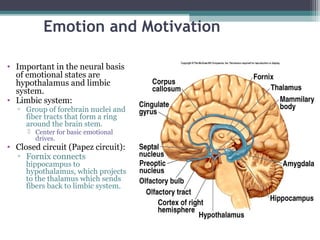
Emotion and Motivation
• Important in the neural basis
of emotional states are
hypothalamus and limbic
system.
• Limbic system:
▫ Group of forebrain nuclei and
fiber tracts that form a ring
around the brain stem.
 Center for basic emotional
drives.
• Closed circuit (Papez circuit):
▫ Fornix connects
hippocampus to
hypothalamus, which projects
to the thalamus which sends
fibers back to limbic system.
Emotion and Motivation (continued)
▫ Areas or the hypothalamus and limbic system are
involved in feelings and behaviors.
▫ Aggression:
 Amygdala and hypothalamus.
▫ Fear:
 Amygdala and hypothalamus.
▫ Feeding:
 Hypothalamus (feeding and satiety centers).
▫ Sexual drive and behavior:
 Hypothalamus and limbic system.
▫ Goal directed behavior (reward and punishment):
 Hypothalamus and frontal cortex.
Memory
• Short-term:
▫ Memory of recent events.
• Medial temporal lobe:
▫ Consolidates short term into long term
memory.
• Hippocampus is critical component of
memory.
• Acquisition of new information, facts and
events requires both the medial temporal lobe
and hippocampus.
Long-Term Memory
• Consolidation of short-term memory into long-term
memory.
▫ Requires activation of genes, leading to protein synthesis and
formation of new synaptic connections.
 Altered postsynaptic growth of dendritic spines in area of contact.
• Cerebral cortex stores factual information:
▫ Visual memories lateralized to left hemisphere.
▫ Visuospatial information lateralized to right hemisphere.
• Prefrontal lobes:
▫ Involved in performing exact mathematical calculations.
 Complex, problem-solving and planning activities.
Long-Term Potentiation
• Type of synaptic learning.
▫ Synapses that are 1st
stimulated at high frequency will
subsequently exhibit increased excitability.
• In hippocampus, glutamate is NT.
▫ Requires activation of the NMDA receptors for glutamate.
 Glutamate and glycine or D-serine binding and partial
depolarization are required for opening of channels for Ca2+
and
Na+
.
• May also involve presynaptic changes:
▫ Binding of glutamate to NMDA receptors and simultaneous
depolarization, open receptor channels for Ca2+
.
 Ca2+
causes long-term potentiation in postsynaptic neuron, release
of NO from postsynaptic neuron.
 NO acts as a retrograde messenger, causing release of NT.
Neuronal Stem Cells in Learning and
Memory
• Neural stem cells:
▫ Cells that both renew themselves through mitosis
and produce differentiated neurons and neuroglia.
• Hippocampus has been shown to contain
stem cells (required for long-term memory).
• Neurogenesis:
▫ Production of new neurons.
• Indirect evidence that links neuogenesis in
hippocampus with learning and memory.
Thalamus and Epithalamus
• Thalamus:
▫ Composes 4/5 of the diencephalon.
▫ Forms most of the walls of the 3rd
ventricle.
▫ Acts as relay center through which all sensory information
(except olfactory) passes to the cerebrum.
 Lateral geniculate nuclei:
 Relay visual information.
 Medial geniculate nuclei:
 Relay auditory information.
 Intralaminar nuclei:
 Activated by many sensory modalities.
 Projects to many areas.
▫ Promotes alertness and arousal from sleep.
• Epithalamus contains:
▫ Choroid plexus where CSF is formed.
▫ Pineal gland which secretes melatonin.
Hypothalamus
• Contains neural centers for hunger, thirst, and
body temperature.
• Contributes to the regulation of sleep,
wakefulness, emotions, sexual arousal, anger,
fear, pain, and pleasure.
• Stimulates hormonal release from anterior
pituitary.
• Produces ADH and oxytocin.
• Coordinates sympathetic and parasympathetic
reflexes.
Pituitary Gland
• Posterior pituitary:
▫ Stores and releases ADH (vasopressin) and oxytocin.
• Hypothalamus produces releasing and
inhibiting hormones that are transported to
anterior pituitary.
▫ Regulate secretions of anterior hormones.
• Anterior pituitary:
▫ Regulates secretion of hormones of other endocrine
glands.
Midbrain
• Contains:
▫ Corpora quadrigemina:
 Superior colliculi:
 Involved in visual reflexes.
 Inferior colliculi:
 Relay centers for auditory information.
▫ Cerebral peduncles:
 Composed of ascending and descending fiber tracts.
▫ Substantia nigra:
 Required for motor coordination.
▫ Red nucleus:
 Maintains connections with cerebrum and cerebellum.
 Involved in motor coordination.
Hindbrain
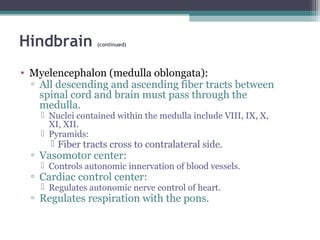
• Metencephalon:
▫ Pons:
 Surface fibers connect to cerebellum,
and deeper fibers are part of motor and
sensory tracts.
 Contains several nuclei associated with
cranial nerves V, VI, VII.
 Contains the apneustic and
pneumotaxic respiratory centerss.
▫ Cerebellum:
 Receives input from proprioceptors.
 Participates in coordination of
movement.
 Necessary for motor learning,
coordinating different joints during
movement, and limb movements.
Hindbrain (continued)
• Myelencephalon (medulla oblongata):
▫ All descending and ascending fiber tracts between
spinal cord and brain must pass through the
medulla.
 Nuclei contained within the medulla include VIII, IX, X,
XI, XII.
 Pyramids:
 Fiber tracts cross to contralateral side.
▫ Vasomotor center:
 Controls autonomic innervation of blood vessels.
▫ Cardiac control center:
 Regulates autonomic nerve control of heart.
▫ Regulates respiration with the pons.
Reticular Formation
• Reticular Formation:
▫ Complex network of nuclei and nerve fibers within
medulla, pons, midbrain, thalamus and
hypothalamus.
▫ Functions as the reticular activating system (RAS).
 Non specific arousal of cerebral cortex to incoming sensory
information.
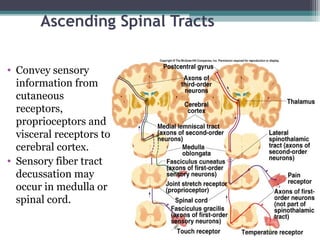
Ascending Spinal Tracts
• Convey sensory
information from
cutaneous
receptors,
proprioceptors and
visceral receptors to
cerebral cortex.
• Sensory fiber tract
decussation may
occur in medulla or
spinal cord.
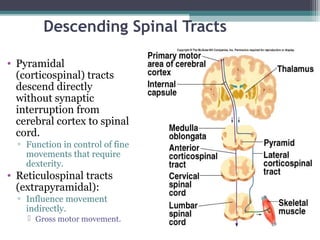
Descending Spinal Tracts
• Pyramidal
(corticospinal) tracts
descend directly
without synaptic
interruption from
cerebral cortex to spinal
cord.
▫ Function in control of fine
movements that require
dexterity.
• Reticulospinal tracts
(extrapyramidal):
▫ Influence movement
indirectly.
 Gross motor movement.
Cranial and Spinal Nerves
• Cranial nerves:
▫ 2 pairs arise from neuron cell bodies in forebrain.
▫ 10 pairs arise from the midbrain and hindbrain.
 Roman numerals refer to the order in which the nerves are
positioned from front of the brain to the back.
▫ Most are mixed nerves containing both sensory and motor
fibers.
• Spinal nerves:
▫ 31 pairs grouped into 8 cervical, 12 thoracic, 5 lumbar, 5
sacral, and l coccygeal.
▫ Mixed nerve that separates near the attachment of the nerve
to spinal cord.
 Produces 2 roots to each nerve.
 Dorsal root composed of sensory fibers.
 Ventral root composed of motor fibers.
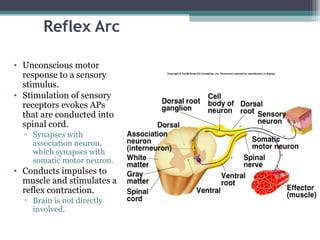
Reflex Arc
• Unconscious motor
response to a sensory
stimulus.
• Stimulation of sensory
receptors evokes APs
that are conducted into
spinal cord.
▫ Synapses with
association neuron,
which synapses with
somatic motor neuron.
• Conducts impulses to
muscle and stimulates a
reflex contraction.
▫ Brain is not directly
involved.

The central nervous system

  • 1.
    Chapter 8 The CentralNervous System Human physiology
  • 2.
    CNS • Consists of: ▫Brain. ▫ Spinal cord. • Receives input from sensory neurons. • Directs activity of motor neurons. • Association neurons maintain homeostasis in the internal environment.
  • 3.
    Embryonic Development • Grooveappears in ectoderm to fuse to form neural tube by 20th day after conception. Neural tube eventually forms the CNS. • During 5th week, modified: ▫ Forebrain: telencephalon and diencephalon. ▫ Midbrain: unchanged. ▫ Hindbrain: metencephalon and myelencephalon. • Part of ectoderm where fusion occurs becomes neural crest. ▫ Neural crest forms ganglia of PNS.
  • 4.
  • 5.
    Embryonic Development (continued) •Telencephalon grows disproportionately forming 2 the hemispheres of the cerebrum. • Ventricles and central canal become filled with cerebral spinal fluid (CSF). • CNS composed of gray and white matter. ▫ Gray matter consists of neuron cell bodies and dendrites. ▫ White matter (myelin) consists of axon tracts.
  • 6.
    Cerebrum • Only structureof the telencephalon. • Largest portion of brain (80% mass). • Responsible for higher mental functions. • Corpus callosum: ▫ Major tract of axons that functionally interconnects right and left cerebral hemispheres.
  • 7.
  • 8.
    Cerebral Cortex Characterized bynumerous convolutions. ◦ Elevated folds: gyri. ◦ Depressed groves: sulci. Frontal lobe: ◦ Anterior portion of each cerebral hemisphere. ◦ Precentral gyri:  Contains upper motor neurons.  Involved in motor control. Body regions with the greatest number of motor innervation are represented by largest areas of motor cortex.
  • 9.
  • 10.
    Cerebral Cortex (continued) •Parietal lobe: ▫ Primary area responsible for perception of somatesthetic sensation. ▫ Body regions with highest densities of receptors are represented by largest areas of sensory cortex. • Temporal lobe: ▫ Contain auditory centers that receive sensory fibers from cochlea. ▫ Interpretation and association of auditory and visual information.
  • 11.
    Cerebral Cortex (continued) •Occipital Lobe: ▫ Primary area responsible for vision and coordination of eye movements. • Insula: ▫ Implicated in memory encoding. ▫ Integration of sensory information with visceral responses. ▫ Coordinated cardiovascular response to stress.
  • 12.
    Visualizing the Brain •X-ray computed tomography (CT): ▫ Complex computer manipulations of data obtained from x-ray absorption by tissues of different densities.  Soft tissue. • Positron-emission tomography (PET): ▫ Radioisotopes that emit positrons are injected into blood stream.  Collision of positron and electron result in emission of gamma rays.  Pinpoint brain cells that are most active. ▫ Brain metabolism, drug distribution. • Magnetic resonance imaging (MRI): ▫ Protons (H+ ) respond to magnetic field, which align the protons.  Emit a radio-wave signal when stimulated.  Brain function.
  • 13.
    Electroencephalogram (EEG) • Measuressynaptic potentials produced at cell bodies and dendrites. ▫ Create electrical currents. • Used clinically do diagnose epilepsy and brain death.
  • 14.
    EEG Patterns • Alpha: ▫Recorded from parietal and occipital regions.  Person is awake, relaxed, with eyes closed.  10-12 cycles/sec. • Beta: ▫ Strongest from frontal lobes near precentral gyrus.  Produced by visual stimuli and mental activity.  Evoked activity.  13-25 cycles/sec. • Theta: ▫ Emitted from temporal and occipital lobes.  Common in newborn.  Adult indicates severe emotional stress.  5-8 cycles/sec. • Delta: ▫ Emitted in a general pattern.  Common during sleep and awake infant.  In awake adult indicate brain damage.  1-5 cycles/sec.
  • 15.
    EEG Sleep Patterns •2 types of EEG patterns during sleep: ▫ REM (rapid eye movement):  Dreams occur.  Low-amplitude, high-frequency oscillations.  Similar to wakefulness (beta waves). ▫ Non-Rem (resting):  High-amplitude, low-frequency waves (delta waves).  Superimposed on these are sleep spindles:  Waxing and waning bursts of 7-14 cycles/sec.  Last for 1-3 sec.
  • 16.
    Basal Nuclei (basalganglia) • Masses of gray matter composed of neuronal cell bodies located deep within white matter. • Contain: ▫ Corpus striatum:  Caudate nucleus.  Lentiform nucleus:  Putman and globus pallidus. • Functions in the control of voluntary movements.
  • 17.
    Cerebral Lateralization • Cerebraldominance: ▫ Specialization of one hemisphere. • Left hemisphere: ▫ More adept in language and analytical abilities. ▫ Damage:  Severe speech problems. • Right hemisphere: ▫ Most adept at visuospatial tasks. ▫ Damage:  Difficulty finding way around house.
  • 18.
    Language • Broca’s area: ▫Involves articulation of speech. ▫ In damage, comprehension of speech in unimpaired. • Wernicke’s area: ▫ Involves language comprehension. ▫ In damage, language comprehension is destroyed, but speech is rapid without any meaning. • Angular gyrus: ▫ Center of integration of auditory, visual, and somatesthetic information. ▫ Damage produces aphasias. • Arcuate fasciculus: ▫ To speak intelligibly, words originating in Wernicke’s area must be sent to Broca’s area.  Broca’s area sends fibers to the motor cortex which directly controls the musculature of speech.
  • 19.
    Emotion and Motivation •Important in the neural basis of emotional states are hypothalamus and limbic system. • Limbic system: ▫ Group of forebrain nuclei and fiber tracts that form a ring around the brain stem.  Center for basic emotional drives. • Closed circuit (Papez circuit): ▫ Fornix connects hippocampus to hypothalamus, which projects to the thalamus which sends fibers back to limbic system.
  • 20.
    Emotion and Motivation(continued) ▫ Areas or the hypothalamus and limbic system are involved in feelings and behaviors. ▫ Aggression:  Amygdala and hypothalamus. ▫ Fear:  Amygdala and hypothalamus. ▫ Feeding:  Hypothalamus (feeding and satiety centers). ▫ Sexual drive and behavior:  Hypothalamus and limbic system. ▫ Goal directed behavior (reward and punishment):  Hypothalamus and frontal cortex.
  • 21.
    Memory • Short-term: ▫ Memoryof recent events. • Medial temporal lobe: ▫ Consolidates short term into long term memory. • Hippocampus is critical component of memory. • Acquisition of new information, facts and events requires both the medial temporal lobe and hippocampus.
  • 22.
    Long-Term Memory • Consolidationof short-term memory into long-term memory. ▫ Requires activation of genes, leading to protein synthesis and formation of new synaptic connections.  Altered postsynaptic growth of dendritic spines in area of contact. • Cerebral cortex stores factual information: ▫ Visual memories lateralized to left hemisphere. ▫ Visuospatial information lateralized to right hemisphere. • Prefrontal lobes: ▫ Involved in performing exact mathematical calculations.  Complex, problem-solving and planning activities.
  • 23.
    Long-Term Potentiation • Typeof synaptic learning. ▫ Synapses that are 1st stimulated at high frequency will subsequently exhibit increased excitability. • In hippocampus, glutamate is NT. ▫ Requires activation of the NMDA receptors for glutamate.  Glutamate and glycine or D-serine binding and partial depolarization are required for opening of channels for Ca2+ and Na+ . • May also involve presynaptic changes: ▫ Binding of glutamate to NMDA receptors and simultaneous depolarization, open receptor channels for Ca2+ .  Ca2+ causes long-term potentiation in postsynaptic neuron, release of NO from postsynaptic neuron.  NO acts as a retrograde messenger, causing release of NT.
  • 24.
    Neuronal Stem Cellsin Learning and Memory • Neural stem cells: ▫ Cells that both renew themselves through mitosis and produce differentiated neurons and neuroglia. • Hippocampus has been shown to contain stem cells (required for long-term memory). • Neurogenesis: ▫ Production of new neurons. • Indirect evidence that links neuogenesis in hippocampus with learning and memory.
  • 25.
    Thalamus and Epithalamus •Thalamus: ▫ Composes 4/5 of the diencephalon. ▫ Forms most of the walls of the 3rd ventricle. ▫ Acts as relay center through which all sensory information (except olfactory) passes to the cerebrum.  Lateral geniculate nuclei:  Relay visual information.  Medial geniculate nuclei:  Relay auditory information.  Intralaminar nuclei:  Activated by many sensory modalities.  Projects to many areas. ▫ Promotes alertness and arousal from sleep. • Epithalamus contains: ▫ Choroid plexus where CSF is formed. ▫ Pineal gland which secretes melatonin.
  • 26.
    Hypothalamus • Contains neuralcenters for hunger, thirst, and body temperature. • Contributes to the regulation of sleep, wakefulness, emotions, sexual arousal, anger, fear, pain, and pleasure. • Stimulates hormonal release from anterior pituitary. • Produces ADH and oxytocin. • Coordinates sympathetic and parasympathetic reflexes.
  • 27.
    Pituitary Gland • Posteriorpituitary: ▫ Stores and releases ADH (vasopressin) and oxytocin. • Hypothalamus produces releasing and inhibiting hormones that are transported to anterior pituitary. ▫ Regulate secretions of anterior hormones. • Anterior pituitary: ▫ Regulates secretion of hormones of other endocrine glands.
  • 28.
    Midbrain • Contains: ▫ Corporaquadrigemina:  Superior colliculi:  Involved in visual reflexes.  Inferior colliculi:  Relay centers for auditory information. ▫ Cerebral peduncles:  Composed of ascending and descending fiber tracts. ▫ Substantia nigra:  Required for motor coordination. ▫ Red nucleus:  Maintains connections with cerebrum and cerebellum.  Involved in motor coordination.
  • 29.
    Hindbrain • Metencephalon: ▫ Pons: Surface fibers connect to cerebellum, and deeper fibers are part of motor and sensory tracts.  Contains several nuclei associated with cranial nerves V, VI, VII.  Contains the apneustic and pneumotaxic respiratory centerss. ▫ Cerebellum:  Receives input from proprioceptors.  Participates in coordination of movement.  Necessary for motor learning, coordinating different joints during movement, and limb movements.
  • 30.
    Hindbrain (continued) • Myelencephalon(medulla oblongata): ▫ All descending and ascending fiber tracts between spinal cord and brain must pass through the medulla.  Nuclei contained within the medulla include VIII, IX, X, XI, XII.  Pyramids:  Fiber tracts cross to contralateral side. ▫ Vasomotor center:  Controls autonomic innervation of blood vessels. ▫ Cardiac control center:  Regulates autonomic nerve control of heart. ▫ Regulates respiration with the pons.
  • 31.
    Reticular Formation • ReticularFormation: ▫ Complex network of nuclei and nerve fibers within medulla, pons, midbrain, thalamus and hypothalamus. ▫ Functions as the reticular activating system (RAS).  Non specific arousal of cerebral cortex to incoming sensory information.
  • 32.
    Ascending Spinal Tracts •Convey sensory information from cutaneous receptors, proprioceptors and visceral receptors to cerebral cortex. • Sensory fiber tract decussation may occur in medulla or spinal cord.
  • 33.
    Descending Spinal Tracts •Pyramidal (corticospinal) tracts descend directly without synaptic interruption from cerebral cortex to spinal cord. ▫ Function in control of fine movements that require dexterity. • Reticulospinal tracts (extrapyramidal): ▫ Influence movement indirectly.  Gross motor movement.
  • 34.
    Cranial and SpinalNerves • Cranial nerves: ▫ 2 pairs arise from neuron cell bodies in forebrain. ▫ 10 pairs arise from the midbrain and hindbrain.  Roman numerals refer to the order in which the nerves are positioned from front of the brain to the back. ▫ Most are mixed nerves containing both sensory and motor fibers. • Spinal nerves: ▫ 31 pairs grouped into 8 cervical, 12 thoracic, 5 lumbar, 5 sacral, and l coccygeal. ▫ Mixed nerve that separates near the attachment of the nerve to spinal cord.  Produces 2 roots to each nerve.  Dorsal root composed of sensory fibers.  Ventral root composed of motor fibers.
  • 35.
    Reflex Arc • Unconsciousmotor response to a sensory stimulus. • Stimulation of sensory receptors evokes APs that are conducted into spinal cord. ▫ Synapses with association neuron, which synapses with somatic motor neuron. • Conducts impulses to muscle and stimulates a reflex contraction. ▫ Brain is not directly involved.