BY GROUP 10
Nabanita Roy
Riya Paul
Rupsa Saha
Rupsa Sikdar
Sannibha Mitra
Contents
1. INTRODUCTION
2. STRUCTURE OF NERVOUS SYSTEM
3. THE NEURON
4. THREE TYPES OF NEURON
5. CENTRAL NERVOUS SYSTEM-
INTRO
6. CENTRAL NERVOUS SYSTEM (THE
BRAIN)
7. FOREBRAIN: CEREBRUM
8. HOW TO KEEP FOREBRAIN
HEALTHY
9. FOREBRAIN: THALAMUS &
HYPOTHALAMUS
10. MIDBRAIN/BRAINSTEM
11. HINDBRAIN & ITS PARTS
12. CENTRAL NERVOUS
SYSTEM (SPINAL
CORD)
13. FUNCTIONS OF SPINAL
CORD
14. PERIPHERAL NERVOUS
SYSTEM
15. SOMATIC NERVOUS
SYSTEM
16. AUTONOMIC
NERVOUS SYSTEM
Introduction
 Most complexed system in human body to
maintain homeostasis & it coordinates all the
activities of the organisms.
 Enables the body to respond and adapt to
changes that occur both inside & outside the
body.
 Oxford defines it that- the network of nerve
cells and fibre which transmits nerve
impulses between parts of the body.
Structure of nervous system
 The nervous system is divided into following parts:-
The Neuron
A neuron is a structured
& functional unit of the
nervous system and
unlike other cells,
neurons are regular in
shape, can conduct
electrochemical signals.
The path of electrical impulse:
Dendrite> Cell body> Axon> Synapse> Dendrite of next neuron
Three types of neuron
Sensory Neuron Carry impulses from inside and outside the body
to brain and spinal cord. The sensory neurons
convert signals from the external environment
into internal stimuli.
 Also called as Afferent Neuron
Inter Neuron Found within brain and spinal cord, process
incoming impulses and pass them on to motor
neurons.
Motor Neuron This is the most common type of neuron found
in CNS and transmits information from the
brain to the muscles of the body.
 Also called as Efferent Neuron
Central Nervous System
 The main processing center of brain that consist of brain and spinal cord.
 It controls most of the functions of body and mind.
Why it is named CNS ?? ----- Answer is because the brain integrates the received
information and coordinates and influences the activity of all parts of the bodies.
Central Nervous System
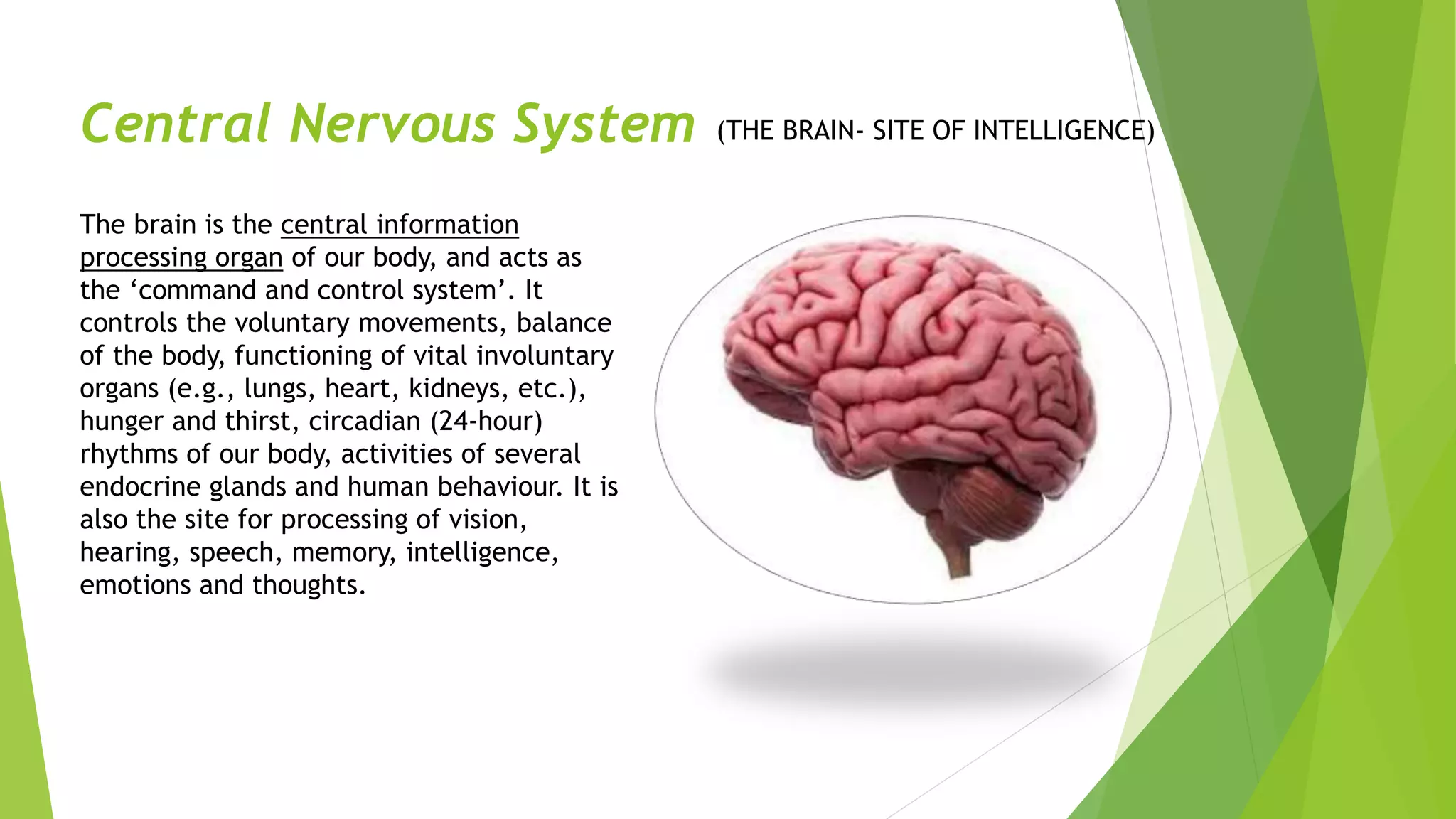
The brain is the central information
processing organ of our body, and acts as
the ‘command and control system’. It
controls the voluntary movements, balance
of the body, functioning of vital involuntary
organs (e.g., lungs, heart, kidneys, etc.),
hunger and thirst, circadian (24-hour)
rhythms of our body, activities of several
endocrine glands and human behaviour. It is
also the site for processing of vision,
hearing, speech, memory, intelligence,
emotions and thoughts.
(THE BRAIN- SITE OF INTELLIGENCE)
The human brain is well protected inside the
skull. Inside the skull, the brain is covered by
cranial meninges.
It consists of 3 layers:-
 Outer layer- Dura matter
 Middle layer- Arachnoid
 Inner layer- pia matter
Mainly brain is divided into 3 portions:-
 Fore brain
 Mid brain
 Hind brain
Forebrain Cerebrum:-
 Largest part of the brain
 Divided by a cleft into right and left cerebral
hemispheres, connected by a nerve fibre known as
corpus callosum.
 Each lobe is covered by outer covering of grey matter
known as cortex and an inner part made up of white
matter.
 Each hemisphere has frontal, parietal, temporal and
occipital lobes.
 Functions:-
o Memory
o Judgement
o Thought
Cerebrum
Thalamus
Hypothalamus
The spaces or canals in the middle region of the cerebrum are called
ventricles which contain a watery fluid flowing throughout the brain and
spinal cord called cerebrospinal fluid (CSF).
The cerebrospinal fluid
can be withdrawn for
diagnosis and relief of
pressure from brain.
This is called spinal
puncture or lumber
puncture.
Tips to keep Cerebrum healthy
Some of the practices which helps to keep
the main part, i.e., THE CEREBRUM HEALTHY
1. Get mental stimulation
2. Get physical exercise
3. Improve your diet
4. Improve your blood pressure and sugar
5. Avoid tobacco and alcohol
6. Care for your emotions and build social
networks.
Thalamus:-
It is the large mass of grey matter
which is situated below the cerebrum.
It is the major coordinating center for
sensory and motor signaling. It is
responsible for transmitting motor
information for movement and
coordination. Thalamus does not
secrete any hormone.
Hypothalamus:-
It is composed of a number of nuclei
and it locates below the thalamus, at
the base of brain. It is the major
center for regulation of body temp,
thirst, hunger, sexual behavior,
controls mood and synthesis of
vasopressin. It secretes hormones.
Midbrain
Location: between the hypothalamus of the forebrain & pons of the hindbrain. It is
the smallest and central part of the brain.
The dorsal portion of the midbrain consist of four small lobes, called corpora
quadrigemina. A canal called cerebral aqueduct passes through the midbrain.
Three major regions make up the BRAIN STEM;
Mid brain, Pons and Medulla oblongata
Brain stem forms the connections between the
brain and spinal cord.
(Pons and medulla is given on next slide under Hindbrain)
Brainstem
Hindbrain
Pons:-
Pons is the bridge of the brain. It lies between midbrain and
medulla oblongata. It contains nerve fibres, which connect
the cerebellum and cerebrum with the rest of the brain.
Cerebellum:-
It is located beneath the posterior part of cerebrum. The
main function is to maintain the balance, posture and
coordination of voluntary movements and muscle tones.
Medulla Oblongata:-
The medulla is the part that continues as spinal cord. The
medulla contains centres which controls respiration,
cardiovascular reflexes and gastric secretions.
Pons
Cerebellum
Medulla
Oblongata
Central Nervous System
 Spinal cord is the major part of CNS. It is a long pipe like structure
arising from medulla oblongata and extends till 2nd lumbar
vertebrae. The nerve fibres runs through the vertebral column of
the backbone. It forms a vital link between the brain and the body.
 Length: 40cm long and 2cm wide appx.
 Parts: Divided into 5 different parts namely, sacral, lumbar,
thoracic, cervical & coccygeal.
 Several spinal nerves emerge out of each segment
 Protection: It is protected by vertebral column. It also gets three
sets of coverings called meninges.
 It have 3 layers, namely dura matter, arachnoid matter and pia
matter.
(SPINAL CORD)
Function/Role of Spinal Cord
 Forms a connecting link between the brain and
peripheral nervous system
 Provide structural support and builds a body posture
 Facilitates flexible movements
 Communicates messages from the brain to the
different parts of the body
Peripheral Nervous System
The peripheral nervous system comprises the network of nerves connected to the brain and the spinal
cord. It is the part of the nervous system outside the brain and the spinal cord.
PNS is divided into following parts:-
PERIPHERAL
NERVOUS SYSTEM
AUTONOMIC
NERVOUS SYSTEM
PARASYMPATHETIC
NERVOUS SYSTEM
SYMPATHETIC
NERVOUS SYSTEM
SOMATIC
NERVOUS SYSTEM
SPINAL NERVES
CRANIAL NERVES
Somatic Nervous System
 Main function: to transfer impulses from CNS to skeletal
muscles. (voluntary organs)
 It consists of
o Cranial nerves are 12 pairs and they emerge from the
brain. Some of the examples of cranial nerves are optic,
olfactory, etc.
o Spinal nerves are 31 pairs of spinal nerves and emerge
from the spinal cords into dorsal and ventral roots.
Autonomic Nervous System
 The autonomic nervous system relays impulses from the
central nervous system to the involuntary organs and
smooth muscles of the body.
 It is divided into two parts –
o The sympathetic nervous system consists of nerves
arising from the spinal cord between the neck and waist
region. It prepares the body for violent actions against
abnormal conditions and is generally stimulated by
adrenaline.
o The parasympathetic nervous system is located
anterior in the head and neck and posterior in the sacral
region. It is mainly involved in re-establishment of
normal conditions when violent action is over.
Functions of PNS
1.It regulates the
internal homeostasis.
Connects the brain and
the spinal cord to the
rest of the body and the
external environment.
1.It can regulate the
strength of muscle
contractility.
1.It controls the release
of secretions from most
exocrine glands.
FUNCTIONS
THANK YOU
Sources:
Paramedics 6-in-1 Handbook, GD Modgil
Biology Class 11, NCERT
www.google.com
www.slideshare.com
Special thanks to Prof. Mr. Prashant Karn
to guide us in making this presentation
TAKE CARE OF YOUR
NERVOUS SYSTEM
THE END

Nervous System Latest Presentation

  • 1.
    BY GROUP 10 NabanitaRoy Riya Paul Rupsa Saha Rupsa Sikdar Sannibha Mitra
  • 2.
    Contents 1. INTRODUCTION 2. STRUCTUREOF NERVOUS SYSTEM 3. THE NEURON 4. THREE TYPES OF NEURON 5. CENTRAL NERVOUS SYSTEM- INTRO 6. CENTRAL NERVOUS SYSTEM (THE BRAIN) 7. FOREBRAIN: CEREBRUM 8. HOW TO KEEP FOREBRAIN HEALTHY 9. FOREBRAIN: THALAMUS & HYPOTHALAMUS 10. MIDBRAIN/BRAINSTEM 11. HINDBRAIN & ITS PARTS 12. CENTRAL NERVOUS SYSTEM (SPINAL CORD) 13. FUNCTIONS OF SPINAL CORD 14. PERIPHERAL NERVOUS SYSTEM 15. SOMATIC NERVOUS SYSTEM 16. AUTONOMIC NERVOUS SYSTEM
  • 3.
    Introduction  Most complexedsystem in human body to maintain homeostasis & it coordinates all the activities of the organisms.  Enables the body to respond and adapt to changes that occur both inside & outside the body.  Oxford defines it that- the network of nerve cells and fibre which transmits nerve impulses between parts of the body.
  • 4.
    Structure of nervoussystem  The nervous system is divided into following parts:-
  • 5.
    The Neuron A neuronis a structured & functional unit of the nervous system and unlike other cells, neurons are regular in shape, can conduct electrochemical signals. The path of electrical impulse: Dendrite> Cell body> Axon> Synapse> Dendrite of next neuron
  • 6.
    Three types ofneuron Sensory Neuron Carry impulses from inside and outside the body to brain and spinal cord. The sensory neurons convert signals from the external environment into internal stimuli.  Also called as Afferent Neuron Inter Neuron Found within brain and spinal cord, process incoming impulses and pass them on to motor neurons. Motor Neuron This is the most common type of neuron found in CNS and transmits information from the brain to the muscles of the body.  Also called as Efferent Neuron
  • 8.
    Central Nervous System The main processing center of brain that consist of brain and spinal cord.  It controls most of the functions of body and mind. Why it is named CNS ?? ----- Answer is because the brain integrates the received information and coordinates and influences the activity of all parts of the bodies.
  • 9.
    Central Nervous System Thebrain is the central information processing organ of our body, and acts as the ‘command and control system’. It controls the voluntary movements, balance of the body, functioning of vital involuntary organs (e.g., lungs, heart, kidneys, etc.), hunger and thirst, circadian (24-hour) rhythms of our body, activities of several endocrine glands and human behaviour. It is also the site for processing of vision, hearing, speech, memory, intelligence, emotions and thoughts. (THE BRAIN- SITE OF INTELLIGENCE)
  • 10.
    The human brainis well protected inside the skull. Inside the skull, the brain is covered by cranial meninges. It consists of 3 layers:-  Outer layer- Dura matter  Middle layer- Arachnoid  Inner layer- pia matter Mainly brain is divided into 3 portions:-  Fore brain  Mid brain  Hind brain
  • 11.
    Forebrain Cerebrum:-  Largestpart of the brain  Divided by a cleft into right and left cerebral hemispheres, connected by a nerve fibre known as corpus callosum.  Each lobe is covered by outer covering of grey matter known as cortex and an inner part made up of white matter.  Each hemisphere has frontal, parietal, temporal and occipital lobes.  Functions:- o Memory o Judgement o Thought Cerebrum Thalamus Hypothalamus
  • 12.
    The spaces orcanals in the middle region of the cerebrum are called ventricles which contain a watery fluid flowing throughout the brain and spinal cord called cerebrospinal fluid (CSF). The cerebrospinal fluid can be withdrawn for diagnosis and relief of pressure from brain. This is called spinal puncture or lumber puncture.
  • 13.
    Tips to keepCerebrum healthy Some of the practices which helps to keep the main part, i.e., THE CEREBRUM HEALTHY 1. Get mental stimulation 2. Get physical exercise 3. Improve your diet 4. Improve your blood pressure and sugar 5. Avoid tobacco and alcohol 6. Care for your emotions and build social networks.
  • 14.
    Thalamus:- It is thelarge mass of grey matter which is situated below the cerebrum. It is the major coordinating center for sensory and motor signaling. It is responsible for transmitting motor information for movement and coordination. Thalamus does not secrete any hormone.
  • 15.
    Hypothalamus:- It is composedof a number of nuclei and it locates below the thalamus, at the base of brain. It is the major center for regulation of body temp, thirst, hunger, sexual behavior, controls mood and synthesis of vasopressin. It secretes hormones.
  • 16.
    Midbrain Location: between thehypothalamus of the forebrain & pons of the hindbrain. It is the smallest and central part of the brain. The dorsal portion of the midbrain consist of four small lobes, called corpora quadrigemina. A canal called cerebral aqueduct passes through the midbrain. Three major regions make up the BRAIN STEM; Mid brain, Pons and Medulla oblongata Brain stem forms the connections between the brain and spinal cord. (Pons and medulla is given on next slide under Hindbrain) Brainstem
  • 17.
    Hindbrain Pons:- Pons is thebridge of the brain. It lies between midbrain and medulla oblongata. It contains nerve fibres, which connect the cerebellum and cerebrum with the rest of the brain. Cerebellum:- It is located beneath the posterior part of cerebrum. The main function is to maintain the balance, posture and coordination of voluntary movements and muscle tones. Medulla Oblongata:- The medulla is the part that continues as spinal cord. The medulla contains centres which controls respiration, cardiovascular reflexes and gastric secretions. Pons Cerebellum Medulla Oblongata
  • 18.
    Central Nervous System Spinal cord is the major part of CNS. It is a long pipe like structure arising from medulla oblongata and extends till 2nd lumbar vertebrae. The nerve fibres runs through the vertebral column of the backbone. It forms a vital link between the brain and the body.  Length: 40cm long and 2cm wide appx.  Parts: Divided into 5 different parts namely, sacral, lumbar, thoracic, cervical & coccygeal.  Several spinal nerves emerge out of each segment  Protection: It is protected by vertebral column. It also gets three sets of coverings called meninges.  It have 3 layers, namely dura matter, arachnoid matter and pia matter. (SPINAL CORD)
  • 19.
    Function/Role of SpinalCord  Forms a connecting link between the brain and peripheral nervous system  Provide structural support and builds a body posture  Facilitates flexible movements  Communicates messages from the brain to the different parts of the body
  • 20.
    Peripheral Nervous System Theperipheral nervous system comprises the network of nerves connected to the brain and the spinal cord. It is the part of the nervous system outside the brain and the spinal cord. PNS is divided into following parts:- PERIPHERAL NERVOUS SYSTEM AUTONOMIC NERVOUS SYSTEM PARASYMPATHETIC NERVOUS SYSTEM SYMPATHETIC NERVOUS SYSTEM SOMATIC NERVOUS SYSTEM SPINAL NERVES CRANIAL NERVES
  • 21.
    Somatic Nervous System Main function: to transfer impulses from CNS to skeletal muscles. (voluntary organs)  It consists of o Cranial nerves are 12 pairs and they emerge from the brain. Some of the examples of cranial nerves are optic, olfactory, etc. o Spinal nerves are 31 pairs of spinal nerves and emerge from the spinal cords into dorsal and ventral roots.
  • 22.
    Autonomic Nervous System The autonomic nervous system relays impulses from the central nervous system to the involuntary organs and smooth muscles of the body.  It is divided into two parts – o The sympathetic nervous system consists of nerves arising from the spinal cord between the neck and waist region. It prepares the body for violent actions against abnormal conditions and is generally stimulated by adrenaline. o The parasympathetic nervous system is located anterior in the head and neck and posterior in the sacral region. It is mainly involved in re-establishment of normal conditions when violent action is over.
  • 23.
    Functions of PNS 1.Itregulates the internal homeostasis. Connects the brain and the spinal cord to the rest of the body and the external environment. 1.It can regulate the strength of muscle contractility. 1.It controls the release of secretions from most exocrine glands. FUNCTIONS
  • 24.
    THANK YOU Sources: Paramedics 6-in-1Handbook, GD Modgil Biology Class 11, NCERT www.google.com www.slideshare.com Special thanks to Prof. Mr. Prashant Karn to guide us in making this presentation
  • 25.
    TAKE CARE OFYOUR NERVOUS SYSTEM THE END