The Nervous System:
Neurons and Synapses
Human
physiology
Nervous System
• 2 types of cells in the nervous system:
▫ Neurons.
▫ Supporting cells.
• Nervous system is divided into:
▫ Central nervous system (CNS):
 Brain.
 Spinal cord.
▫ Peripheral nervous system (PNS):
 Cranial nerves.
 Spinal nerves.
Neurons
• Basic structural and functional units of the
nervous system.
▫ Cannot divide by mitosis.
• Respond to physical and chemical stimuli.
• Produce and conduct electrochemical impulses.
• Release chemical regulators.
• Nerve:
▫ Bundle of axons located outside CNS.
 Most composed of both motor and sensory fibers.
Neurons (continued)
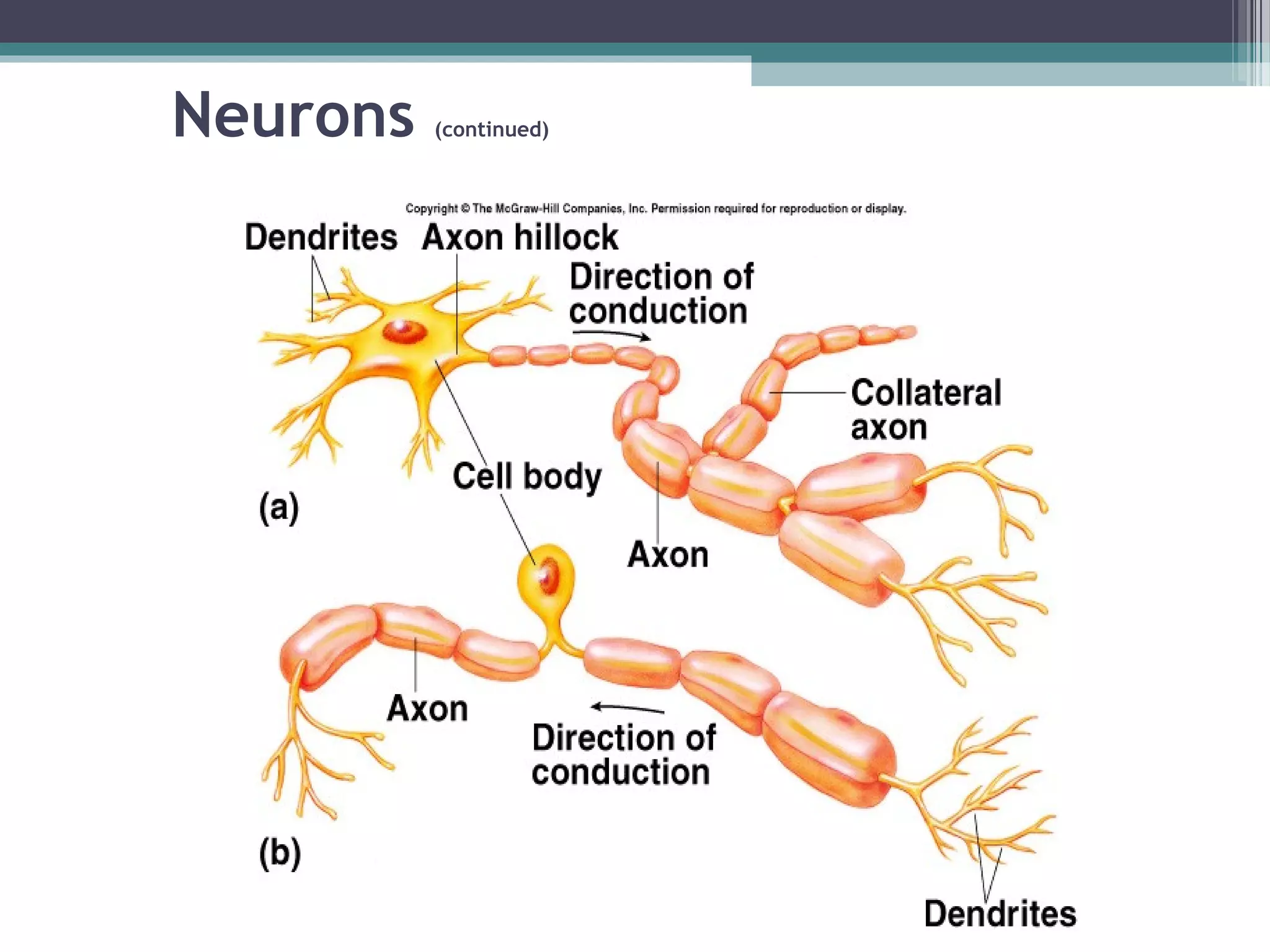
Cell body (perikaryon):
◦ “Nutrition center.”
◦ Cell bodies within CNS clustered into nuclei, and in PNS in ganglia.
Dendrites:
◦ Provide receptive area.
◦ Transmit electrical impulses to cell body.
Axon:
◦ Conducts impulses away from cell body.
◦ Axoplasmic flow:
 Proteins and other molecules are transported by rhythmic contractions to
nerve endings.
◦ Axonal transport:
 Employs microtubules for transport.
 May occur in orthograde or retrograde direction.
Neurons (continued)
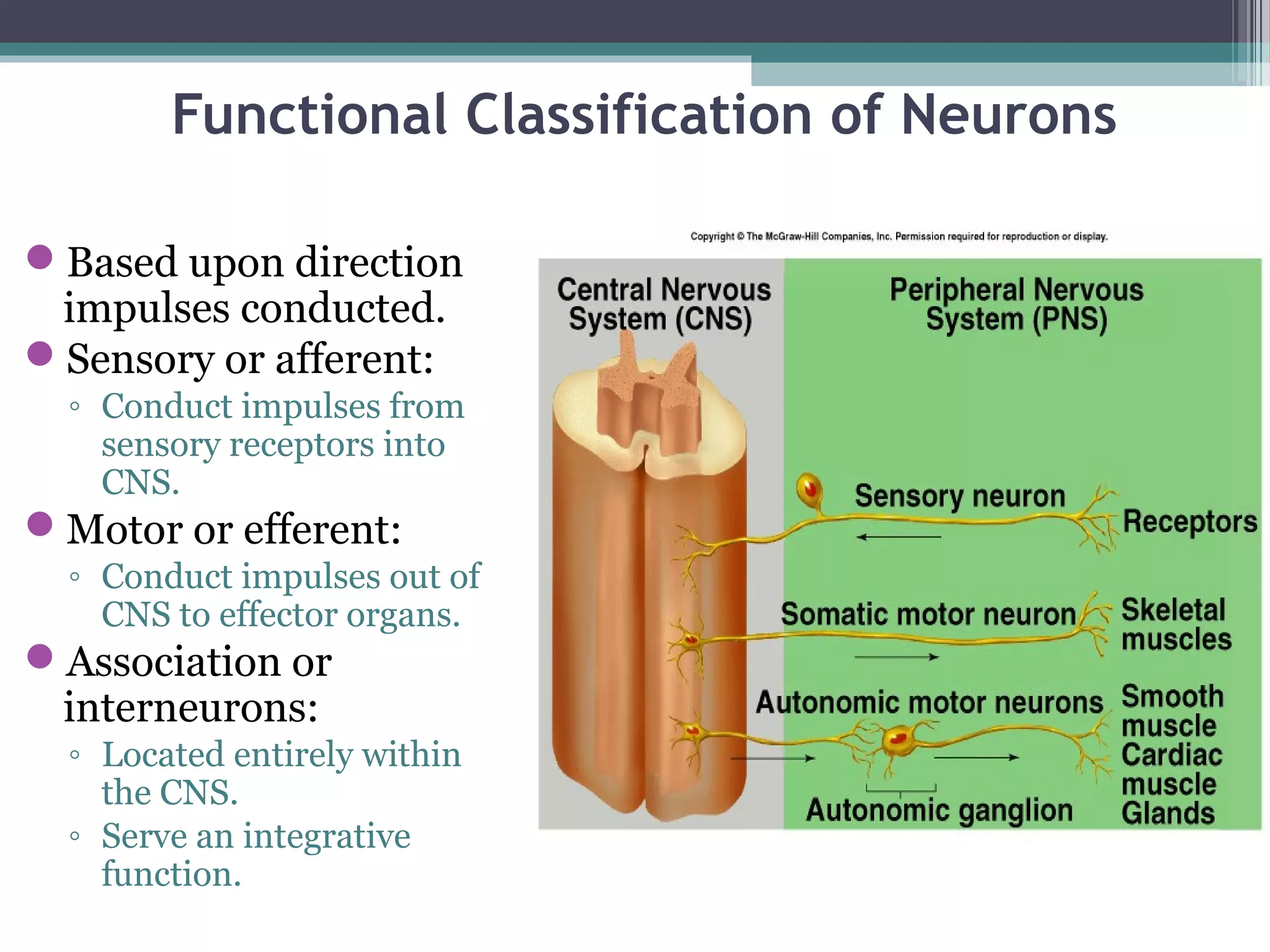
Functional Classification of Neurons
Based upon direction
impulses conducted.
Sensory or afferent:
◦ Conduct impulses from
sensory receptors into
CNS.
Motor or efferent:
◦ Conduct impulses out of
CNS to effector organs.
Association or
interneurons:
◦ Located entirely within
the CNS.
◦ Serve an integrative
function.
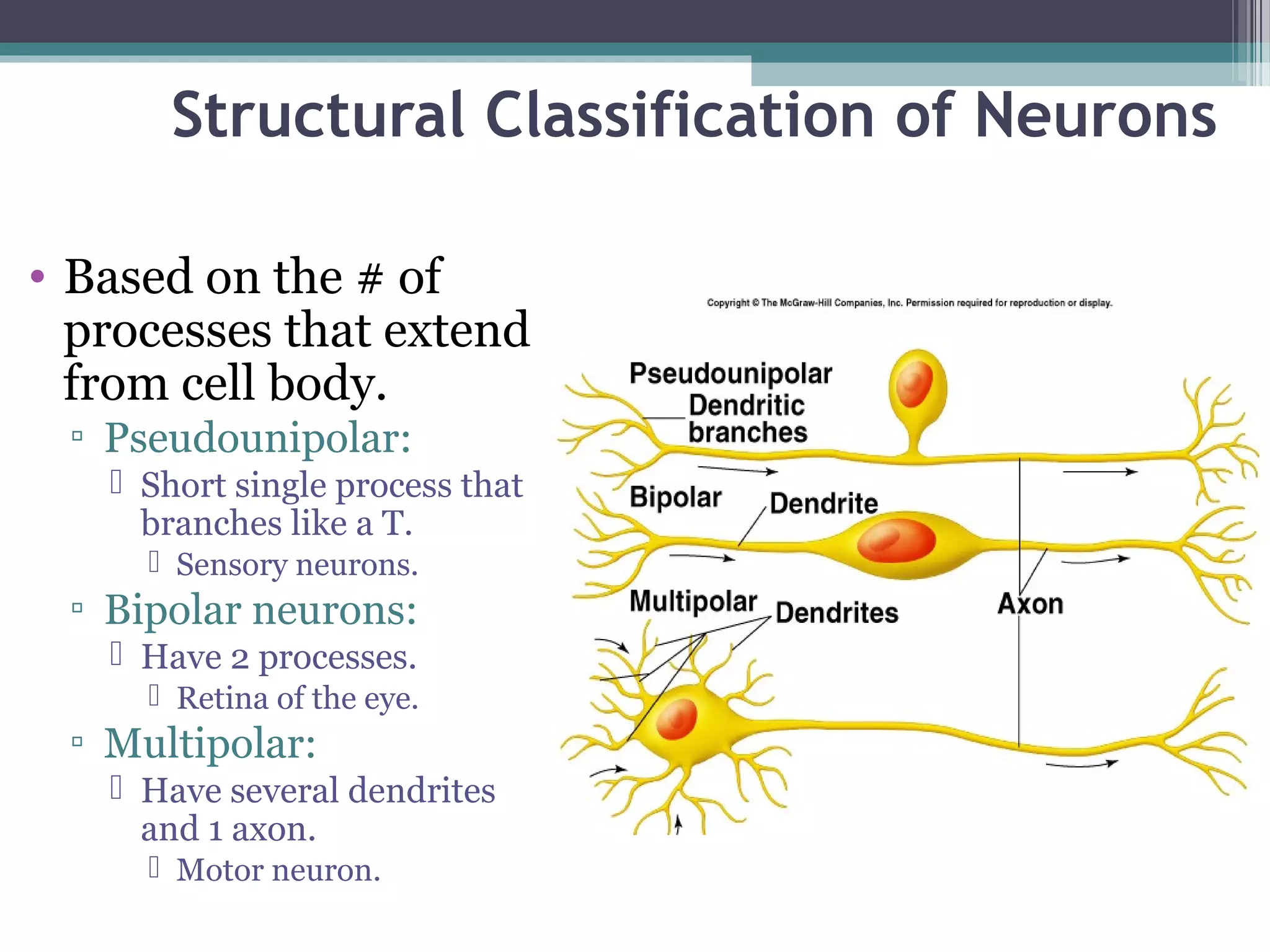
Structural Classification of Neurons
• Based on the # of
processes that extend
from cell body.
▫ Pseudounipolar:
 Short single process that
branches like a T.
 Sensory neurons.
▫ Bipolar neurons:
 Have 2 processes.
 Retina of the eye.
▫ Multipolar:
 Have several dendrites
and 1 axon.
 Motor neuron.
PNS Supporting Cells• Schwaan cells:
▫ Successive wrapping of the cell membrane.
▫ Outer surface encased in glycoprotein basement
membrane.
▫ Provide insulation.
• Nodes of Ranvier:
▫ Unmyelinated areas between adjacent Schwaan
cells that produce nerve impulses.
• Satellite cells:
▫ Support neuron cell bodies within ganglia.
CNS Supporting Cells
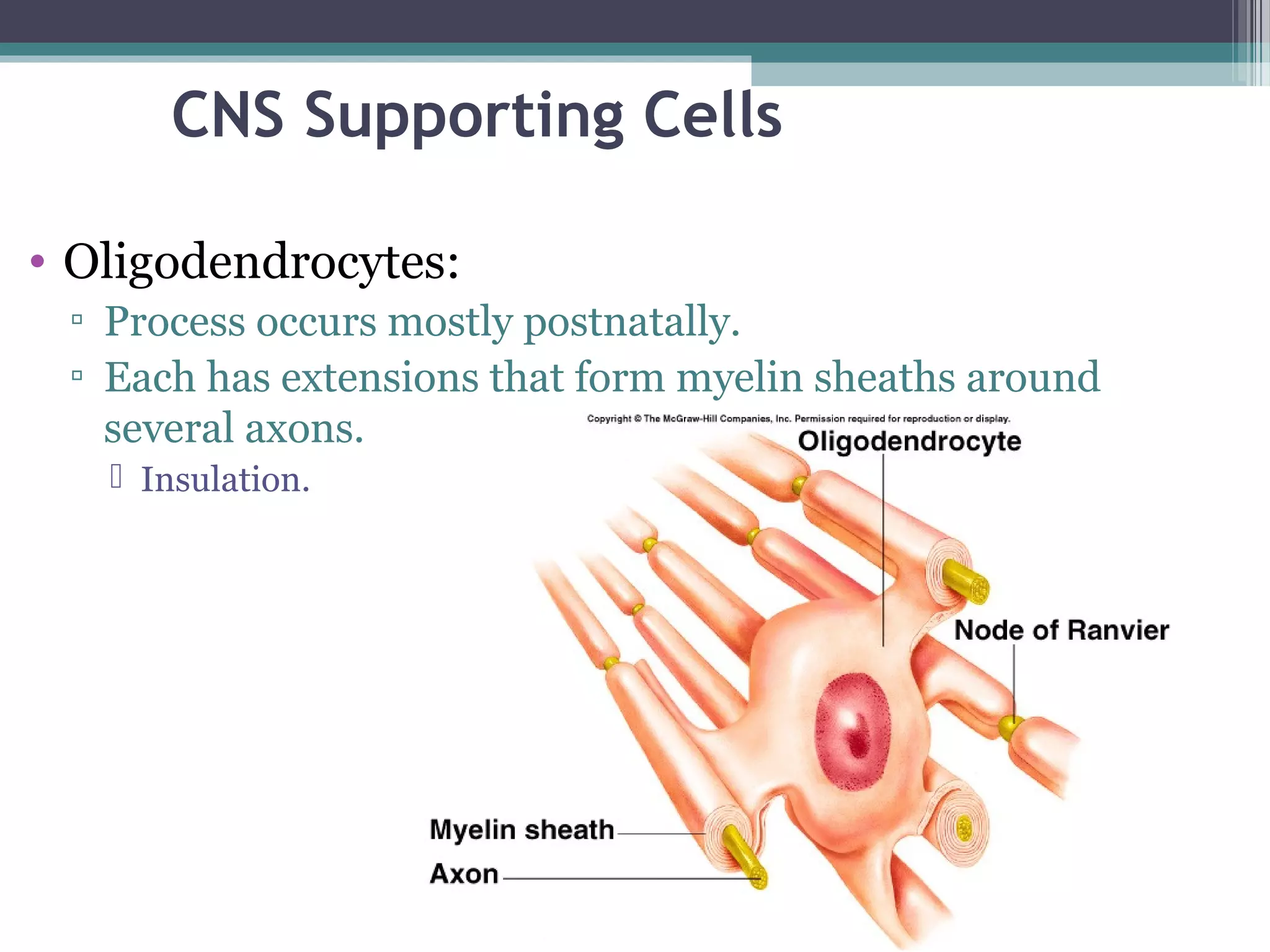
• Oligodendrocytes:
▫ Process occurs mostly postnatally.
▫ Each has extensions that form myelin sheaths around
several axons.
 Insulation.
Nerve Regeneration
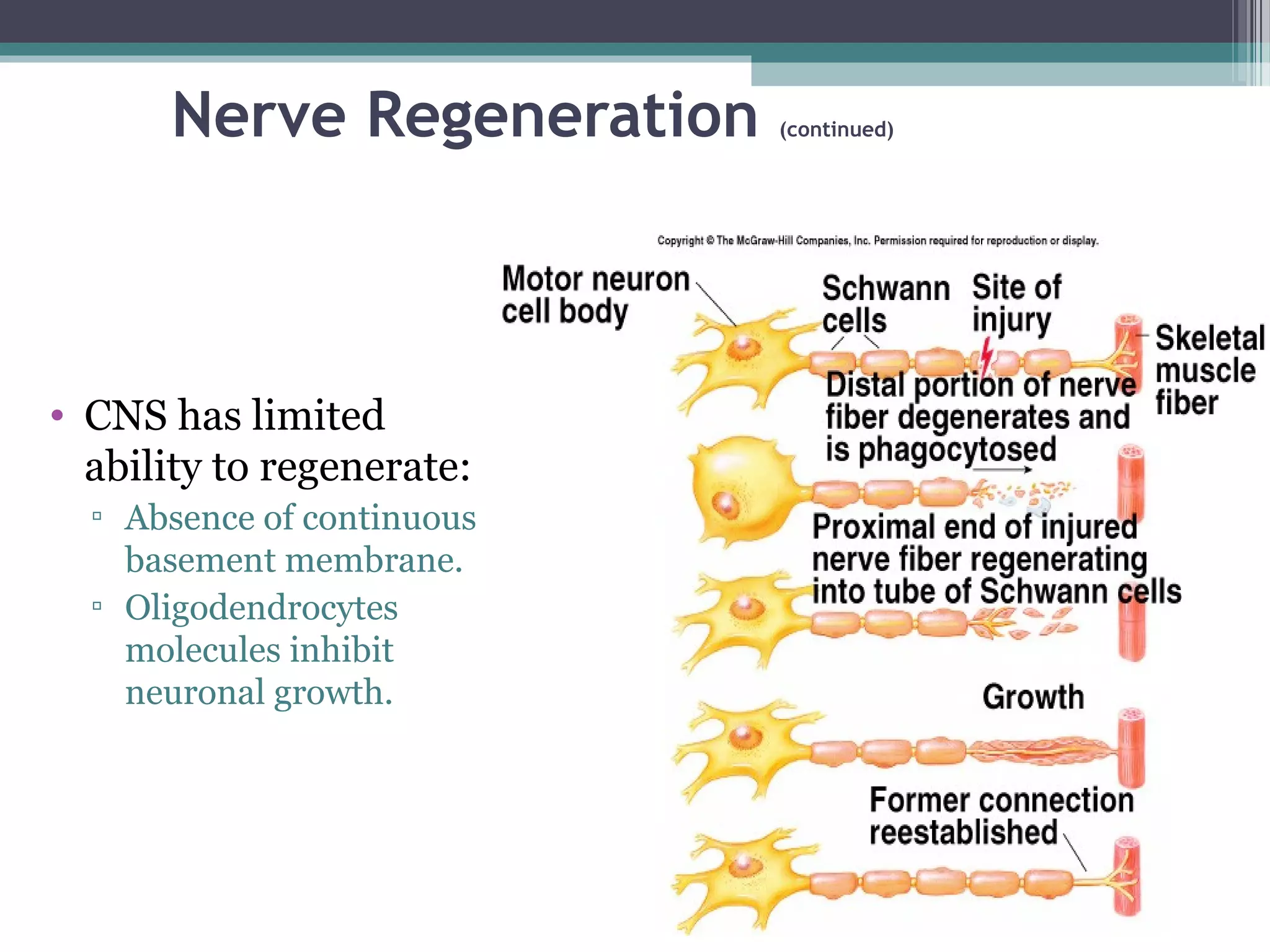
• Schwann cells:
▫ Act as phagocytes, as the distal neuronal
portion degenerates.
▫ Surrounded by basement membrane, form
regeneration tube:
 Serve as guide for axon.
 Send out chemicals that attract the growing axon.
 Axon tip connected to cell body begins to grow
towards destination.
Nerve Regeneration (continued)
• CNS has limited
ability to regenerate:
▫ Absence of continuous
basement membrane.
▫ Oligodendrocytes
molecules inhibit
neuronal growth.
Neurotrophins
• Promote neuron growth.
• Nerve growth factors include:
▫ Nerve growth factor (NGF), brain-derived
neurotrophic factor (BDNF), glial-derived
neurotrophic factor (GDNF), neurotrophin-3, and
neurotrophin-4/5.
• Fetus:
▫ Embryonic development of sensory neurons and
sympathetic ganglia (NGF and neurotrophin-3).
Neurotrophins (continued)
• Adult:
▫ Maintenance of sympathetic ganglia (NGF).
▫ Mature sensory neurons need for regeneration.
▫ Required to maintain spinal neurons (GDNF).
▫ Sustain neurons that use dopamine (GDNF).
• Myelin-associated inhibitory proteins:
▫ Inhibit axon regeneration.
CNS Supporting Cells (continued)
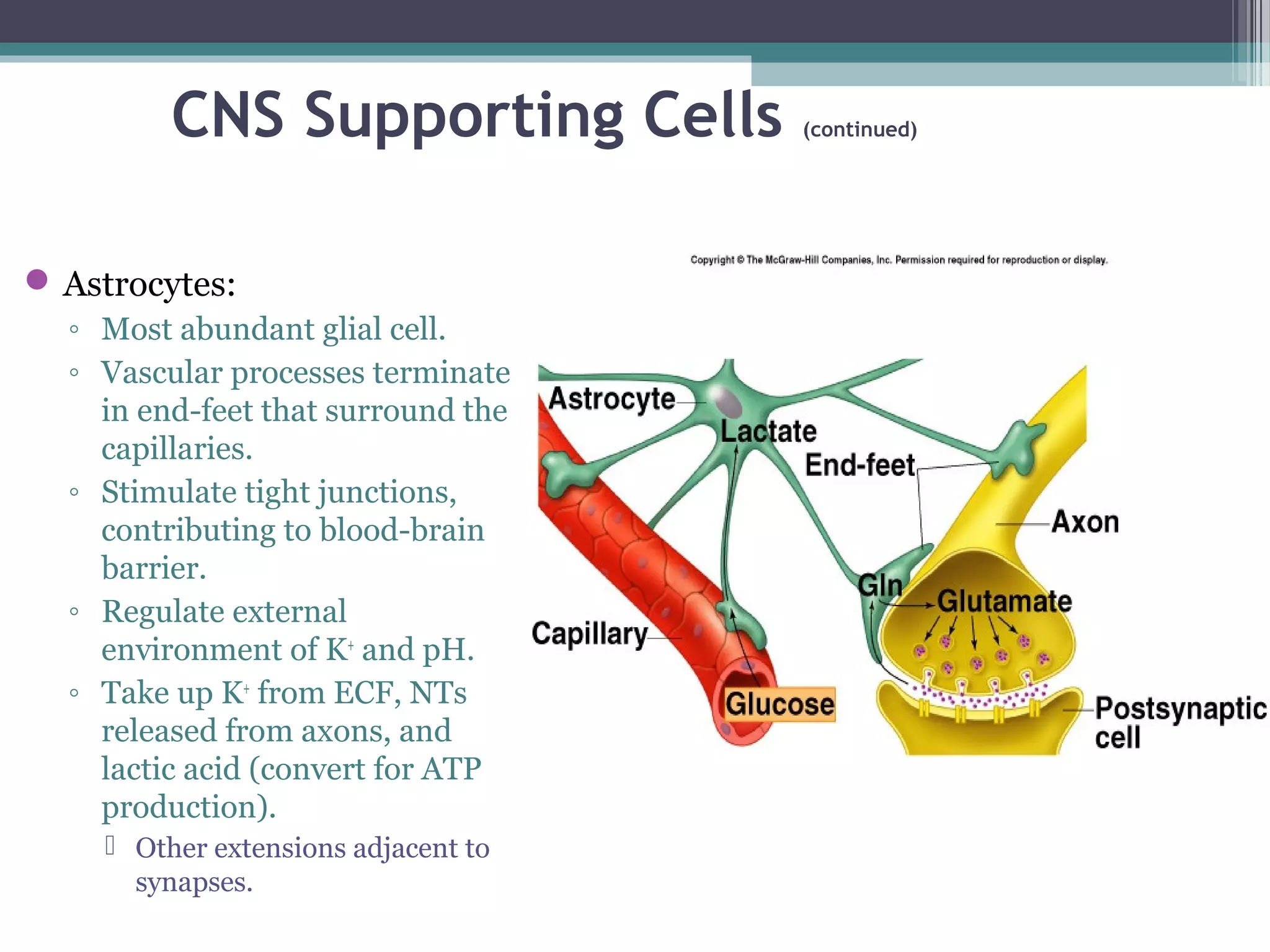
Astrocytes:
◦ Most abundant glial cell.
◦ Vascular processes terminate
in end-feet that surround the
capillaries.
◦ Stimulate tight junctions,
contributing to blood-brain
barrier.
◦ Regulate external
environment of K+
and pH.
◦ Take up K+
from ECF, NTs
released from axons, and
lactic acid (convert for ATP
production).
 Other extensions adjacent to
synapses.
CNS Supporting Cells (continued)
• Microglia:
▫ Phagocytes, migratory.
• Ependymal cells:
▫ Secrete CSF.
▫ Line ventricles.
▫ Function as neural stem cells.
▫ Can divide and progeny differentiate.
Blood-Brain Barrier
• Capillaries in brain do not have pores between
adjacent endothelial cells.
▫ Joined by tight junctions.
• Molecules within brain capillaries moved
selectively through endothelial cells by:
▫ Diffusion.
▫ Active transport.
▫ Endocytosis.
▫ Exocytosis.
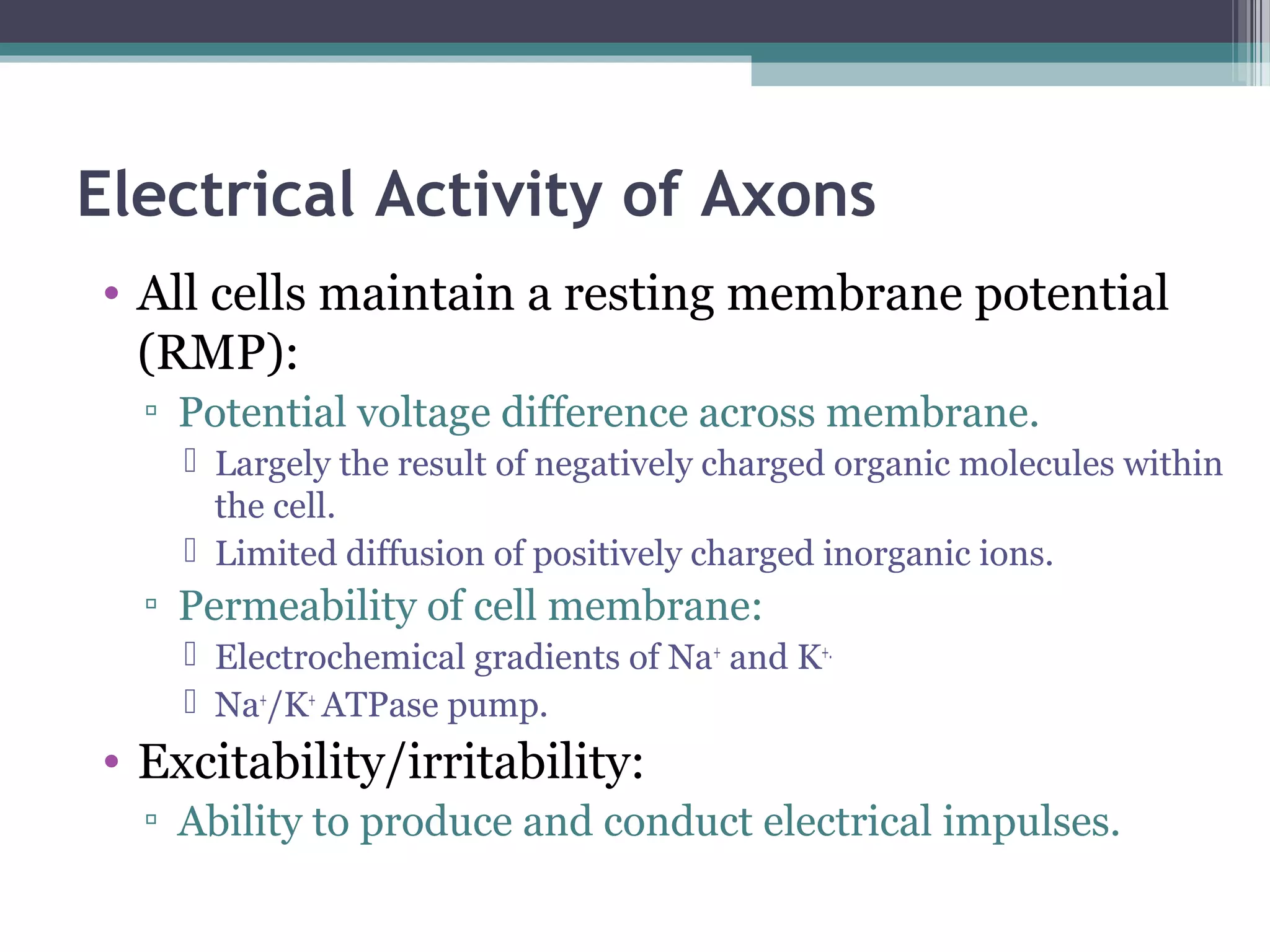
Electrical Activity of Axons
• All cells maintain a resting membrane potential
(RMP):
▫ Potential voltage difference across membrane.
 Largely the result of negatively charged organic molecules within
the cell.
 Limited diffusion of positively charged inorganic ions.
▫ Permeability of cell membrane:
 Electrochemical gradients of Na+
and K+.
 Na+
/K+
ATPase pump.
• Excitability/irritability:
▫ Ability to produce and conduct electrical impulses.
Electrical Activity of Axons (continued)
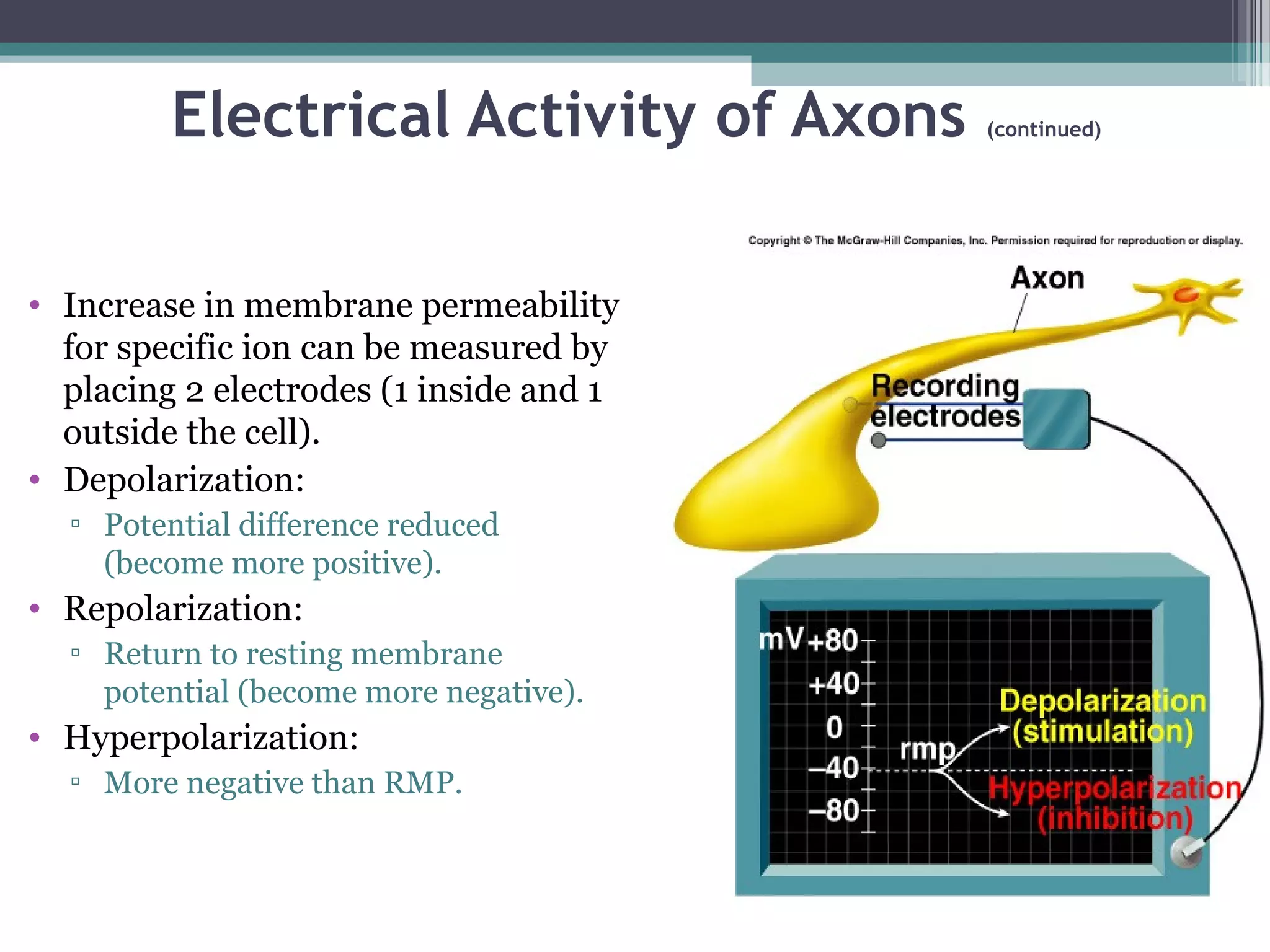
• Increase in membrane permeability
for specific ion can be measured by
placing 2 electrodes (1 inside and 1
outside the cell).
• Depolarization:
▫ Potential difference reduced
(become more positive).
• Repolarization:
▫ Return to resting membrane
potential (become more negative).
• Hyperpolarization:
▫ More negative than RMP.
Ion Gating in Axons
• Changes in membrane potential caused by ion flow through
ion channels.
• Voltage gated (VG) channels open in response to change in
membrane potential.
▫ Gated channels are part of proteins that comprise the channel.
 Can be open or closed in response to change.
▫ 2 types of channels for K+
:
 1 always open.
 1 closed in resting cell.
▫ Channel for Na+
:
 Always closed in resting cells.
 Some Na+
does leak into the cells.
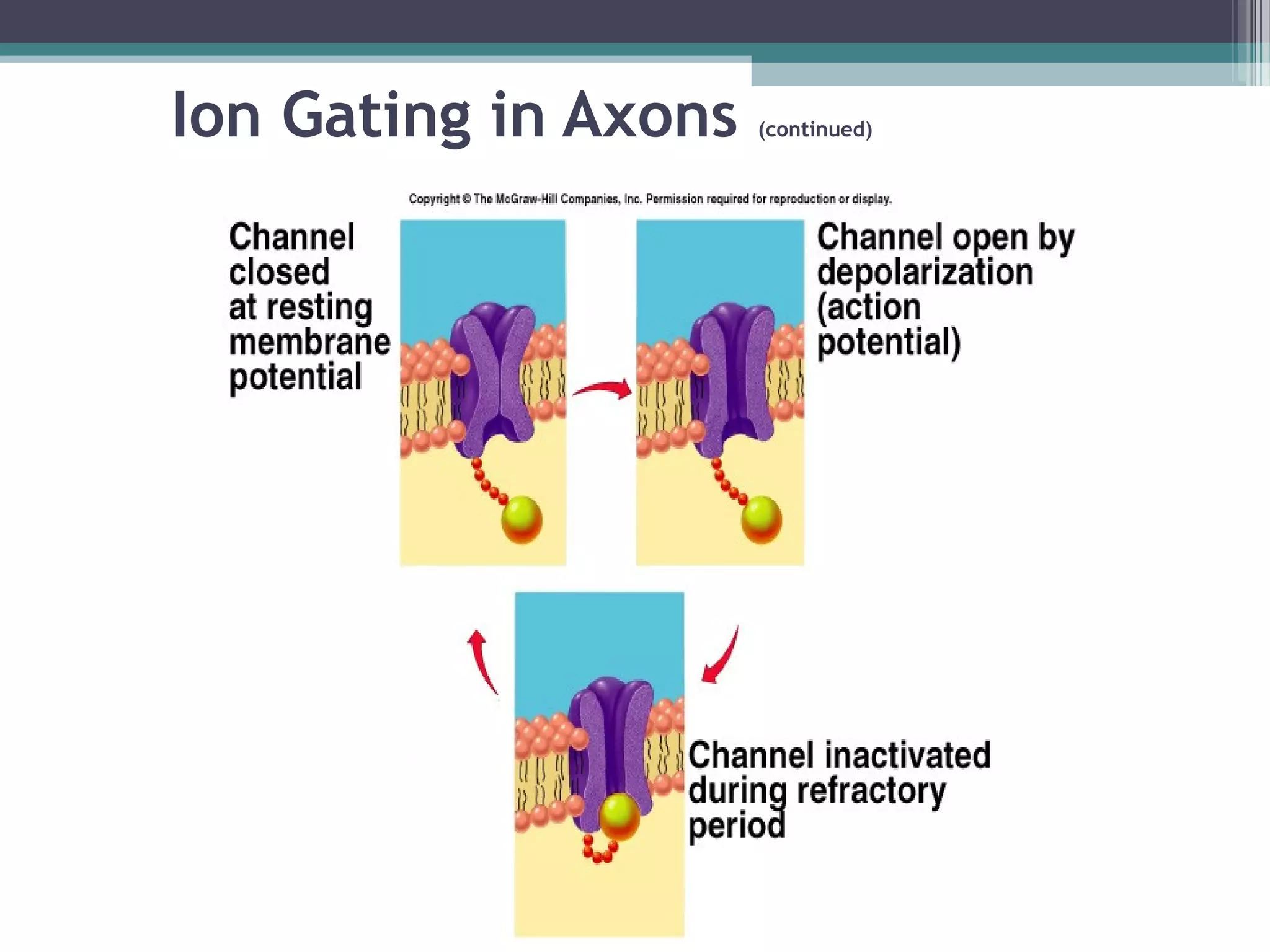
Ion Gating in Axons (continued)
Action Potentials (APs)
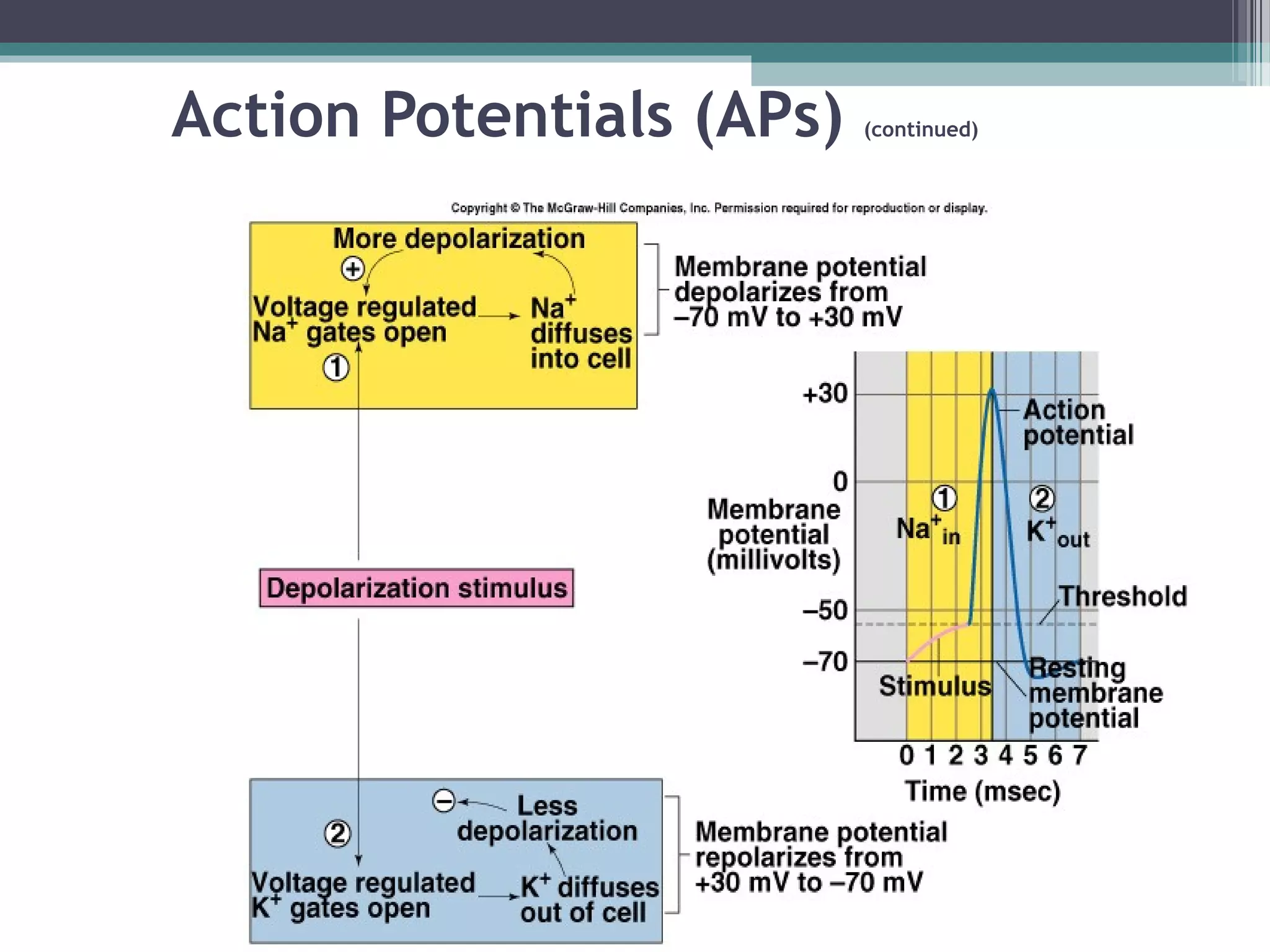
• Stimulus causes depolarization to threshold.
• VG Na+
channels open.
▫ Electrochemical gradient inward.
 + feedback loop.
▫ Rapid reversal in membrane potential from –70 to +
30 mV.
▫ VG Na+
channels become inactivated.
• VG K+
channels open.
▫ Electrochemical gradient outward.
▫ - feedback loop.
▫ Restore original RMP.
Action Potentials (APs) (continued)
Membrane Permeabilites
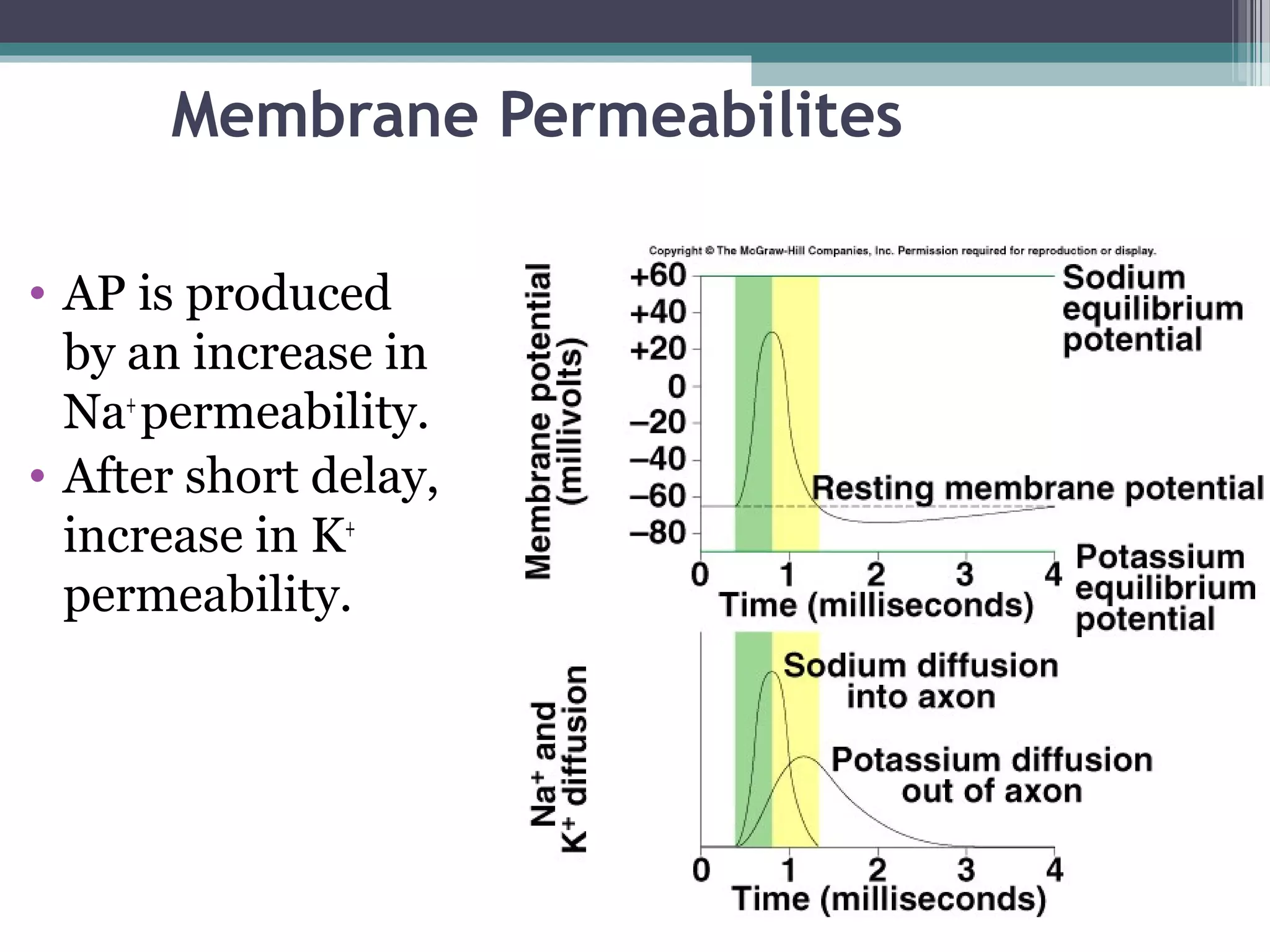
• AP is produced
by an increase in
Na+
permeability.
• After short delay,
increase in K+
permeability.
Action Potentials (APs) (continued)
• Depolarization and repolarization occur via diffusion,
do not require active transport.
▫ Once AP completed, Na+
/K+
ATPase pump extrudes Na+
, and
recovers K+
.
• All or none:
▫ When threshold reached, maximum potential change occurs.
▫ Amplitude does not normally become more positive than + 30
mV because VG Na+
channels close quickly and VG K+
channels
open.
▫ Duration is the same, only open for a fixed period of time.
• Coding for Stimulus Intensity:
▫ Increased frequency of AP indicates greater stimulus strength.
• Recruitment:
▫ Stronger stimuli can activate more axons with a higher
threshold.
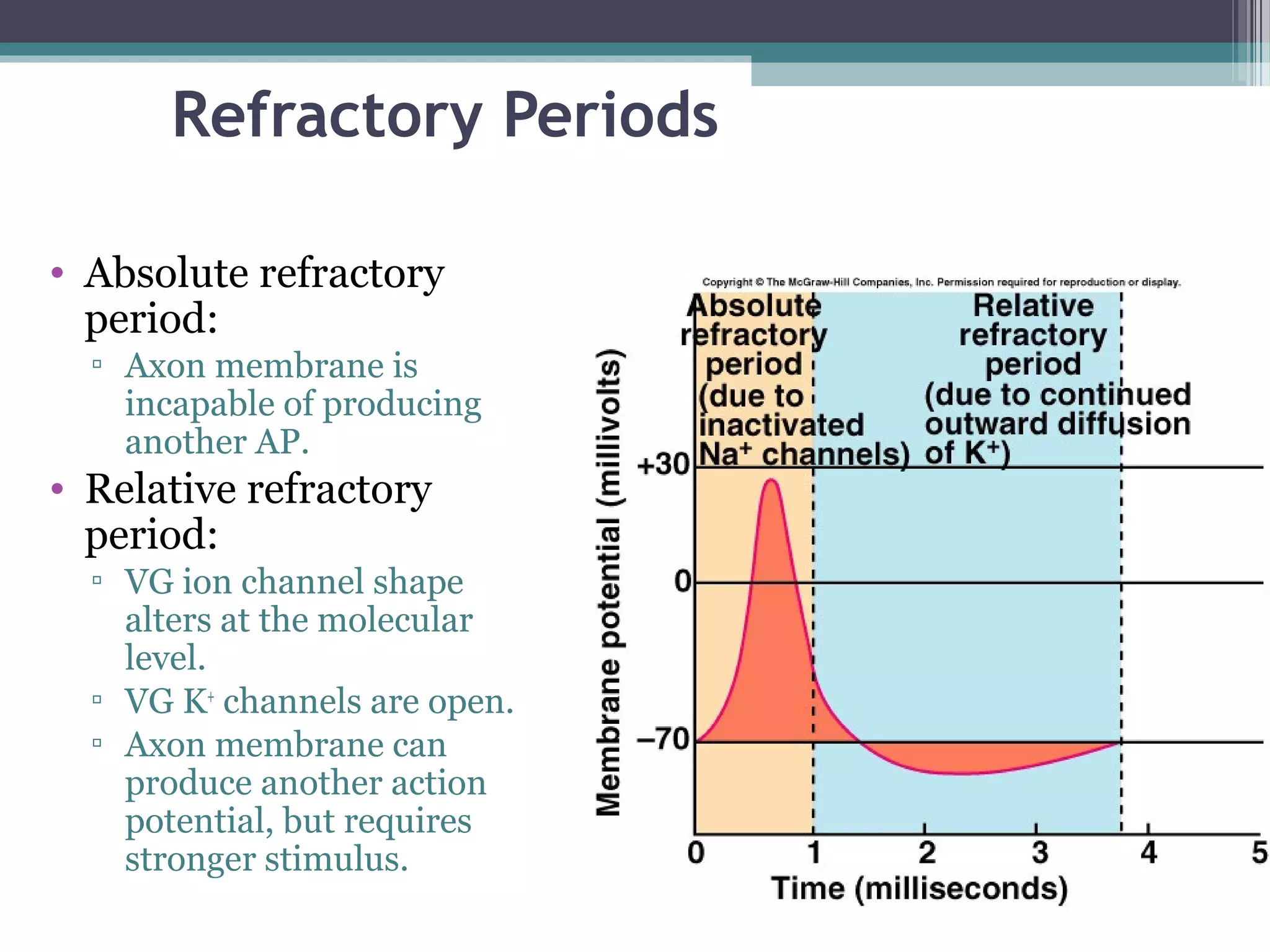
Refractory Periods
• Absolute refractory
period:
▫ Axon membrane is
incapable of producing
another AP.
• Relative refractory
period:
▫ VG ion channel shape
alters at the molecular
level.
▫ VG K+
channels are open.
▫ Axon membrane can
produce another action
potential, but requires
stronger stimulus.
Cable Properties of Neurons
• Ability of neuron to transmit charge through
cytoplasm.
• Axon cable properties are poor:
▫ High internal resistance.
▫ Many charges leak out of the axon through
membrane.
• An AP does not travel down the entire axon.
• Each AP is a stimulus to produce another AP
in the next region of membrane with VG
channels.
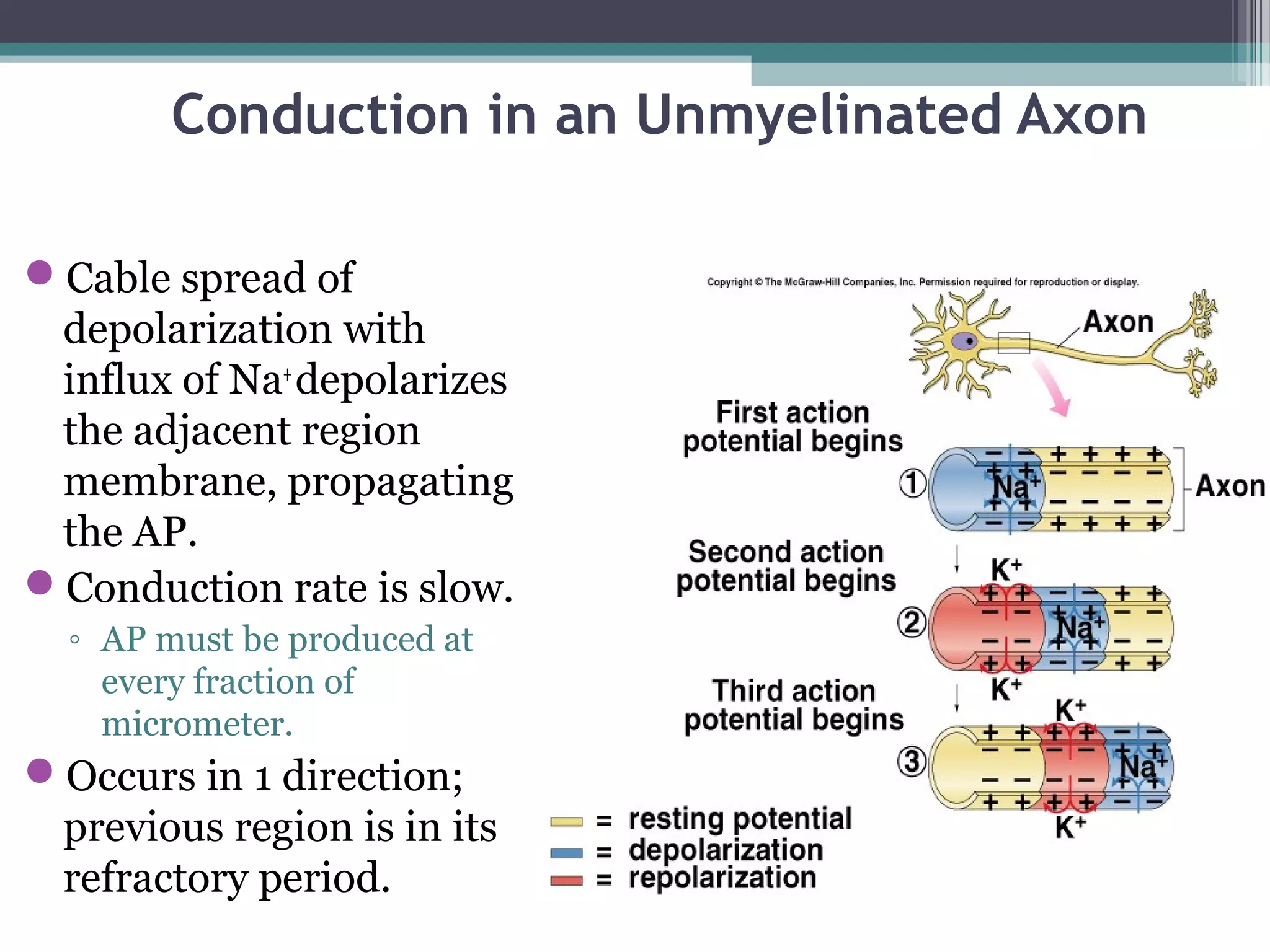
Conduction in an Unmyelinated Axon
Cable spread of
depolarization with
influx of Na+
depolarizes
the adjacent region
membrane, propagating
the AP.
Conduction rate is slow.
◦ AP must be produced at
every fraction of
micrometer.
Occurs in 1 direction;
previous region is in its
refractory period.
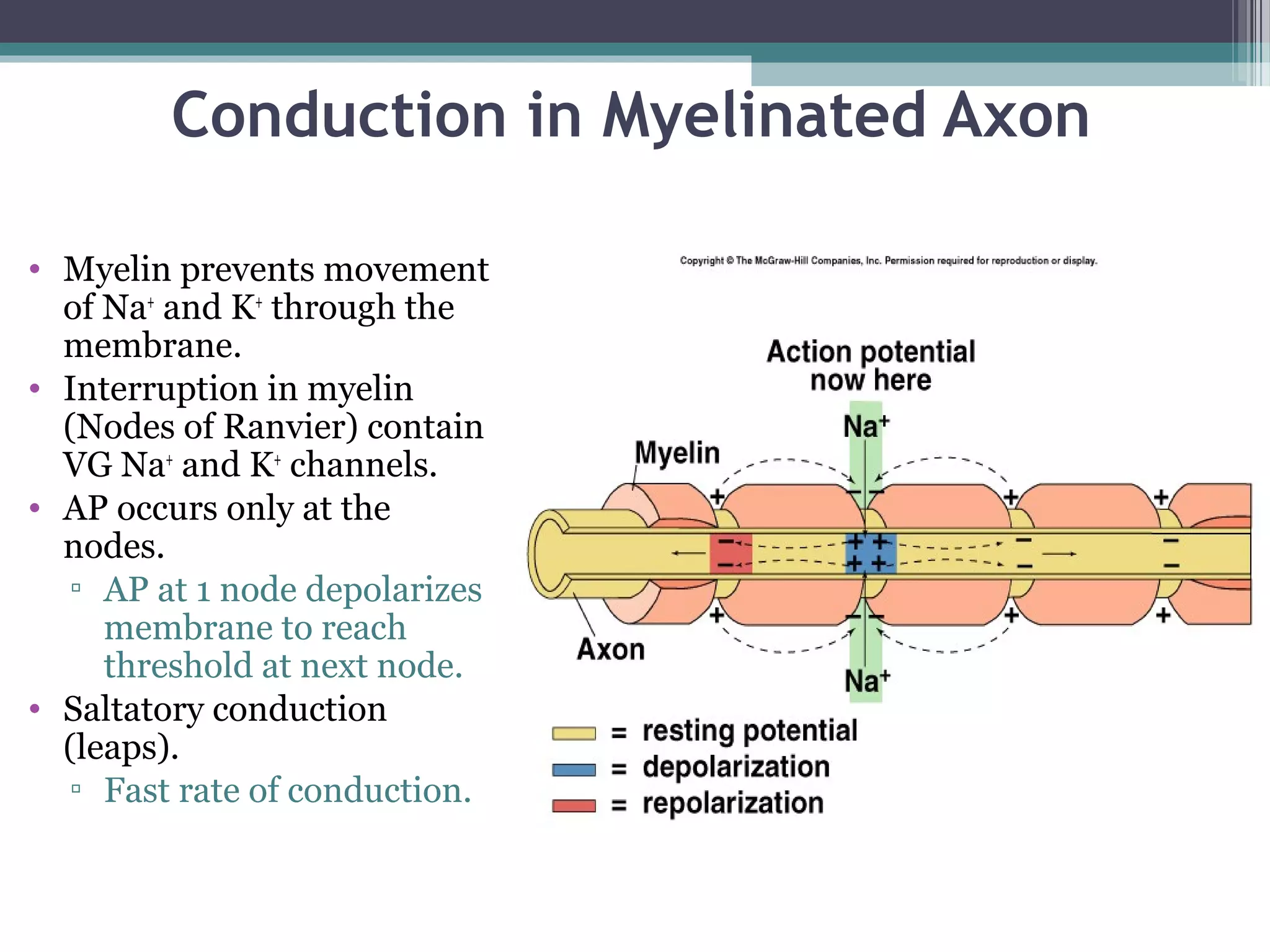
Conduction in Myelinated Axon
• Myelin prevents movement
of Na+
and K+
through the
membrane.
• Interruption in myelin
(Nodes of Ranvier) contain
VG Na+
and K+
channels.
• AP occurs only at the
nodes.
▫ AP at 1 node depolarizes
membrane to reach
threshold at next node.
• Saltatory conduction
(leaps).
▫ Fast rate of conduction.
Synapse
• Functional connection between a neuron and
another neuron or effector cell.
• Transmission in one direction only.
• Axon of first (presynaptic) to second
(postsynaptic) neuron.
• Synaptic transmission is through a chemical
gated channel.
• Presynaptic terminal (bouton) releases a
neurotransmitter (NT).
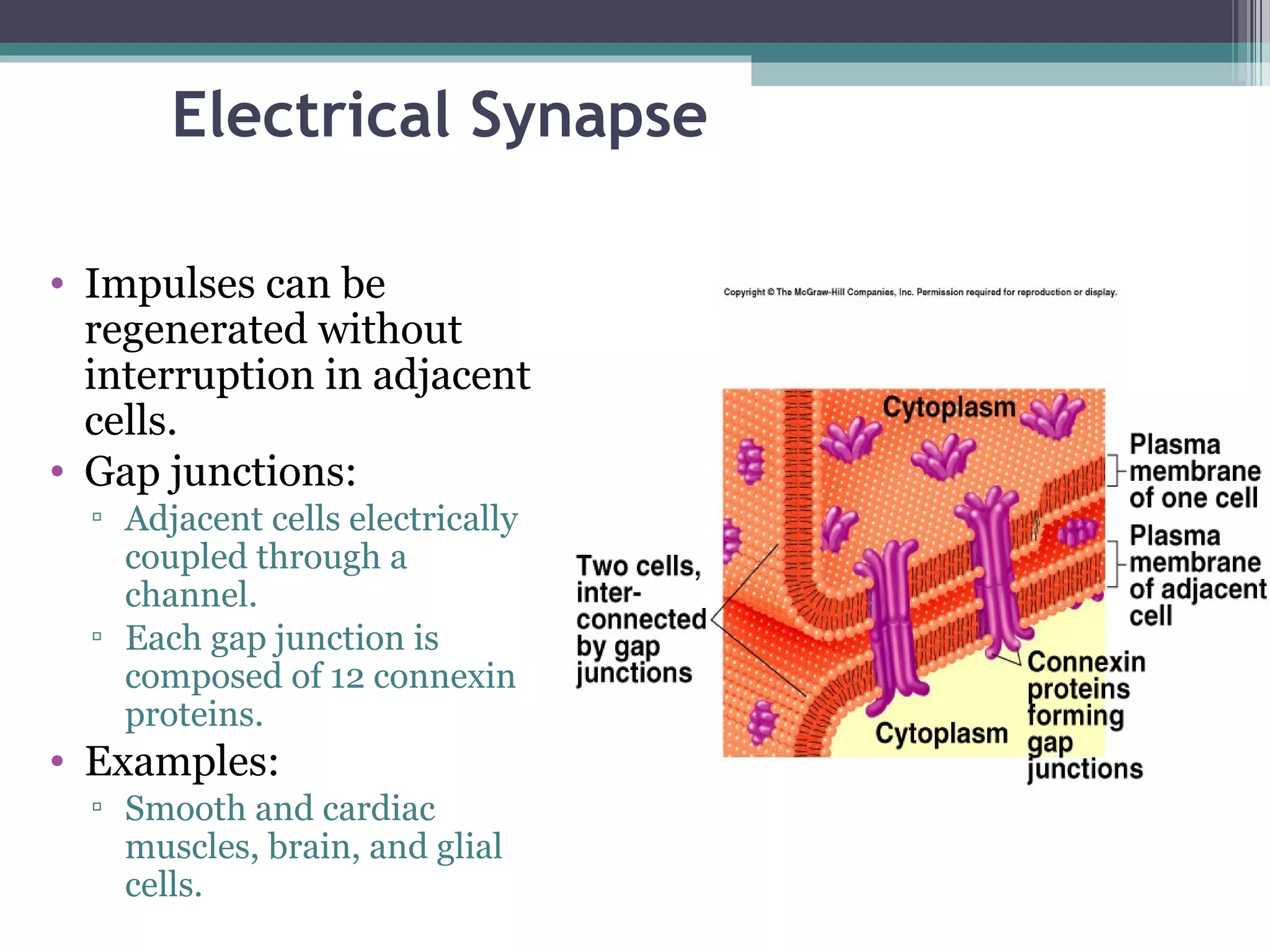
Electrical Synapse
• Impulses can be
regenerated without
interruption in adjacent
cells.
• Gap junctions:
▫ Adjacent cells electrically
coupled through a
channel.
▫ Each gap junction is
composed of 12 connexin
proteins.
• Examples:
▫ Smooth and cardiac
muscles, brain, and glial
cells.
Chemical Synapse
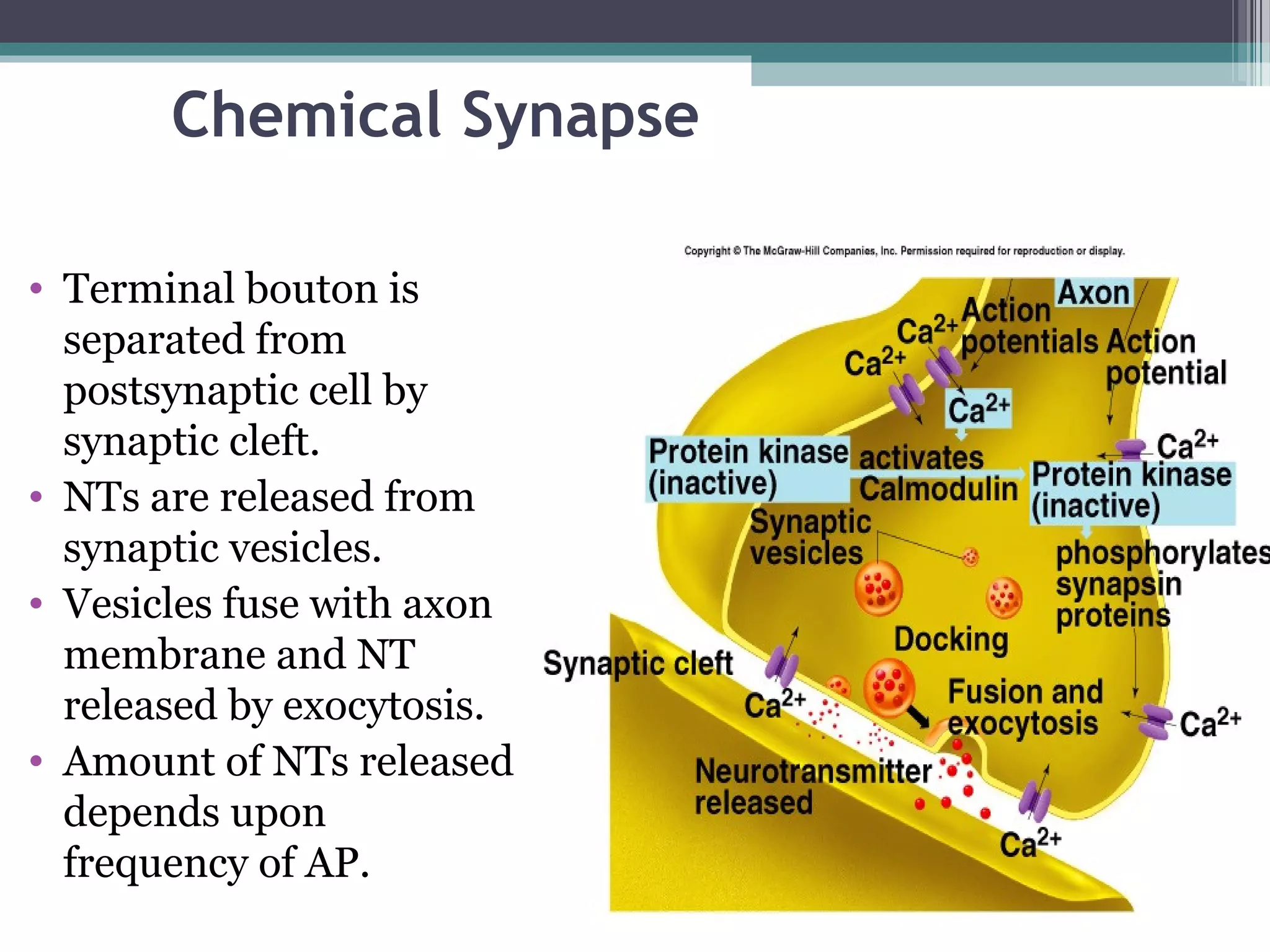
• Terminal bouton is
separated from
postsynaptic cell by
synaptic cleft.
• NTs are released from
synaptic vesicles.
• Vesicles fuse with axon
membrane and NT
released by exocytosis.
• Amount of NTs released
depends upon
frequency of AP.
Synaptic Transmission
NT release is rapid because many vesicles
form fusion-complexes at “docking site.”
AP travels down axon to bouton.
VG Ca2+
channels open.
◦ Ca2+
enters bouton down concentration gradient.
◦ Inward diffusion triggers rapid fusion of synaptic
vesicles and release of NTs.
Ca2+
activates calmodulin, which activates
protein kinase.
Protein kinase phosphorylates synapsins.
◦ Synapsins aid in the fusion of synaptic vesicles.
Synaptic Transmission (continued)
• NTs are released and diffuse across synaptic
cleft.
• NT (ligand) binds to specific receptor proteins
in postsynaptic cell membrane.
• Chemically-regulated gated ion channels
open.
▫ EPSP: depolarization.
▫ IPSP: hyperpolarization.
• Neurotransmitter inactivated to end
transmission.
Chemical Synapses
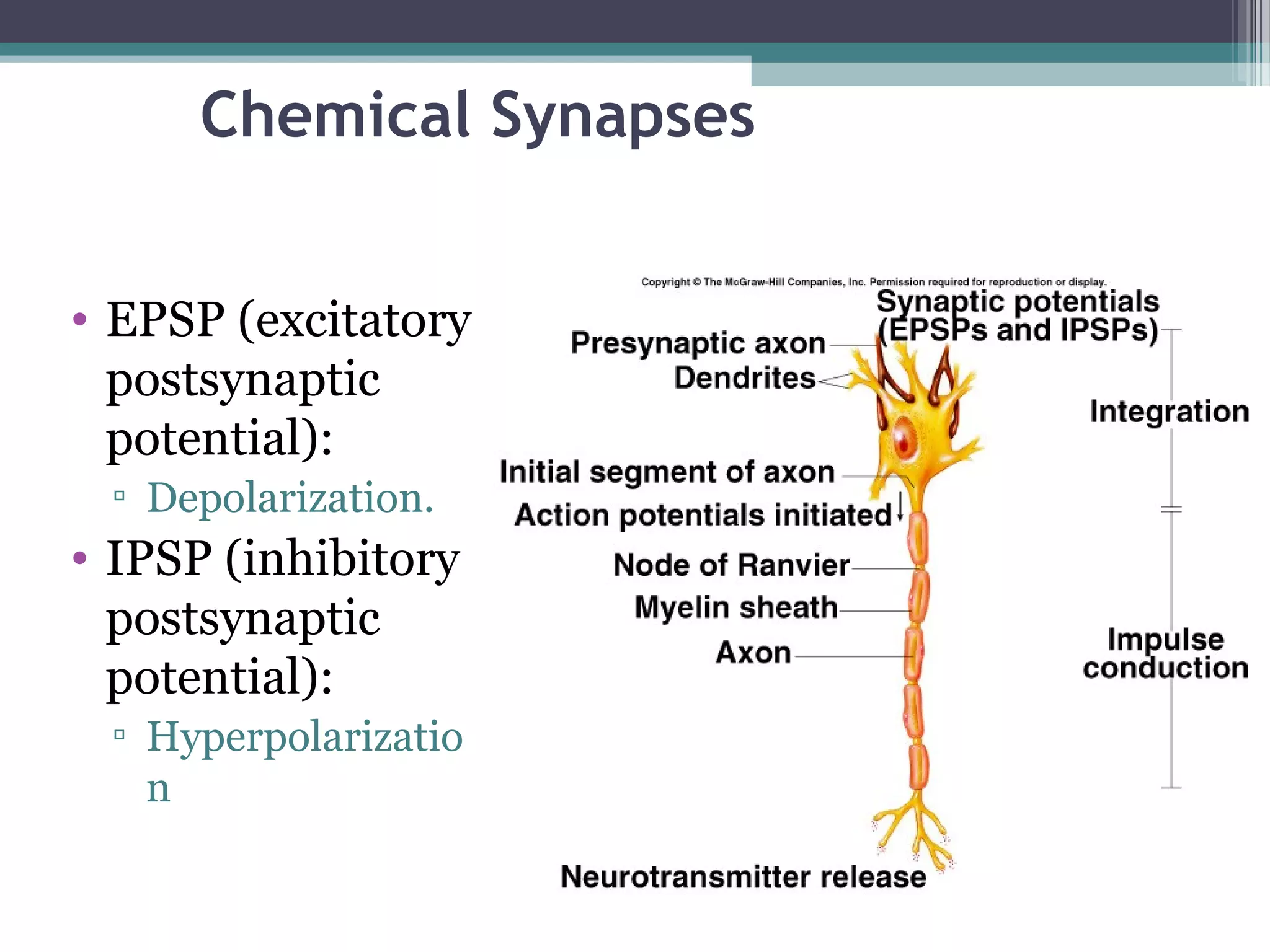
• EPSP (excitatory
postsynaptic
potential):
▫ Depolarization.
• IPSP (inhibitory
postsynaptic
potential):
▫ Hyperpolarizatio
n
Acetylcholine (ACh) as NT
• ACh is both an excitatory and inhibitory NT,
depending on organ involved.
▫ Causes the opening of chemical gated ion channels.
• Nicotinic ACh receptors:
▫ Found in autonomic ganglia and skeletal muscle
fibers.
• Muscarinic ACh receptors:
▫ Found in the plasma membrane of smooth and cardiac
muscle cells, and in cells of particular glands.
Ligand-Operated ACh Channels
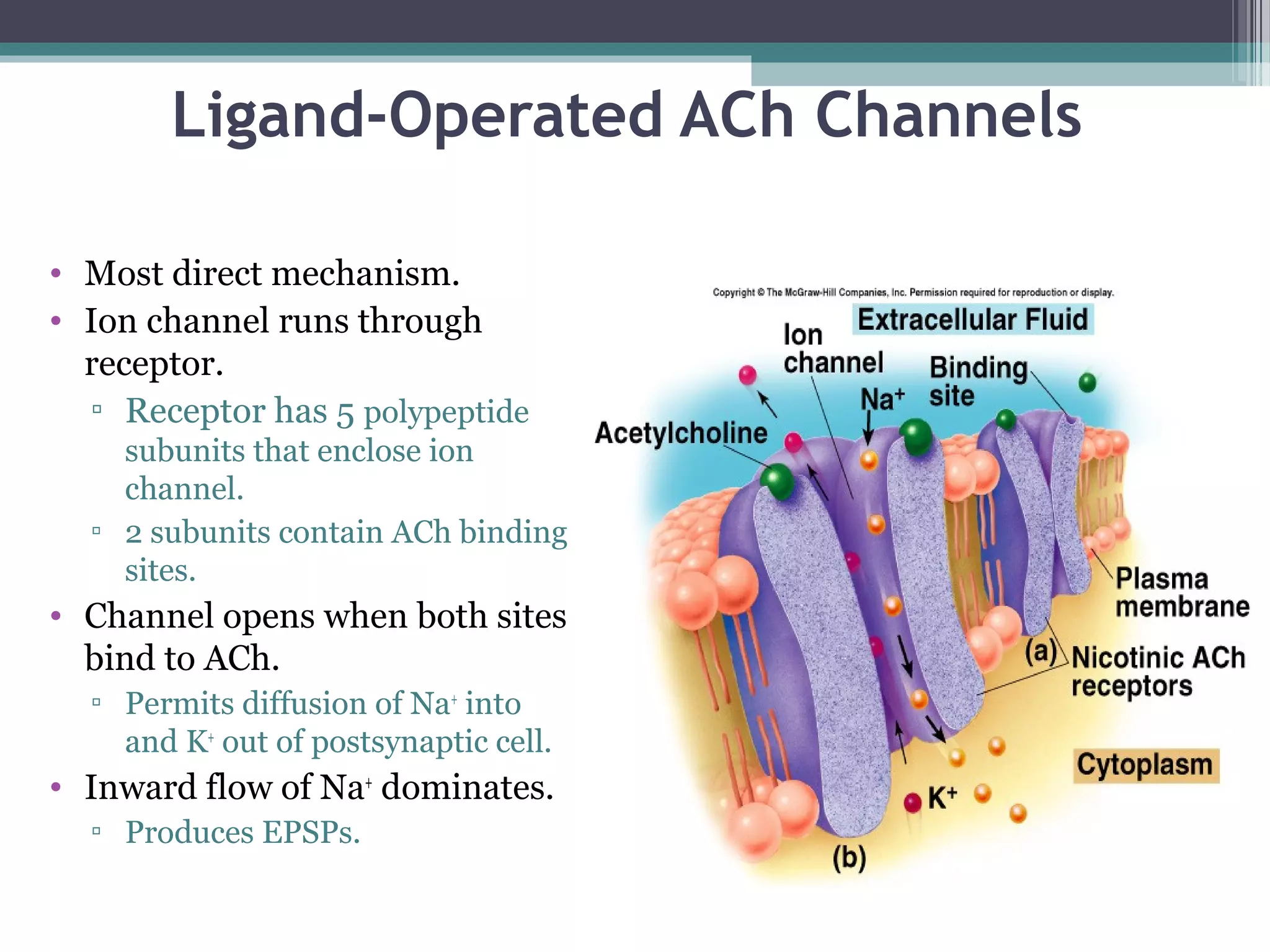
• Most direct mechanism.
• Ion channel runs through
receptor.
▫ Receptor has 5 polypeptide
subunits that enclose ion
channel.
▫ 2 subunits contain ACh binding
sites.
• Channel opens when both sites
bind to ACh.
▫ Permits diffusion of Na+
into
and K+
out of postsynaptic cell.
• Inward flow of Na+
dominates.
▫ Produces EPSPs.
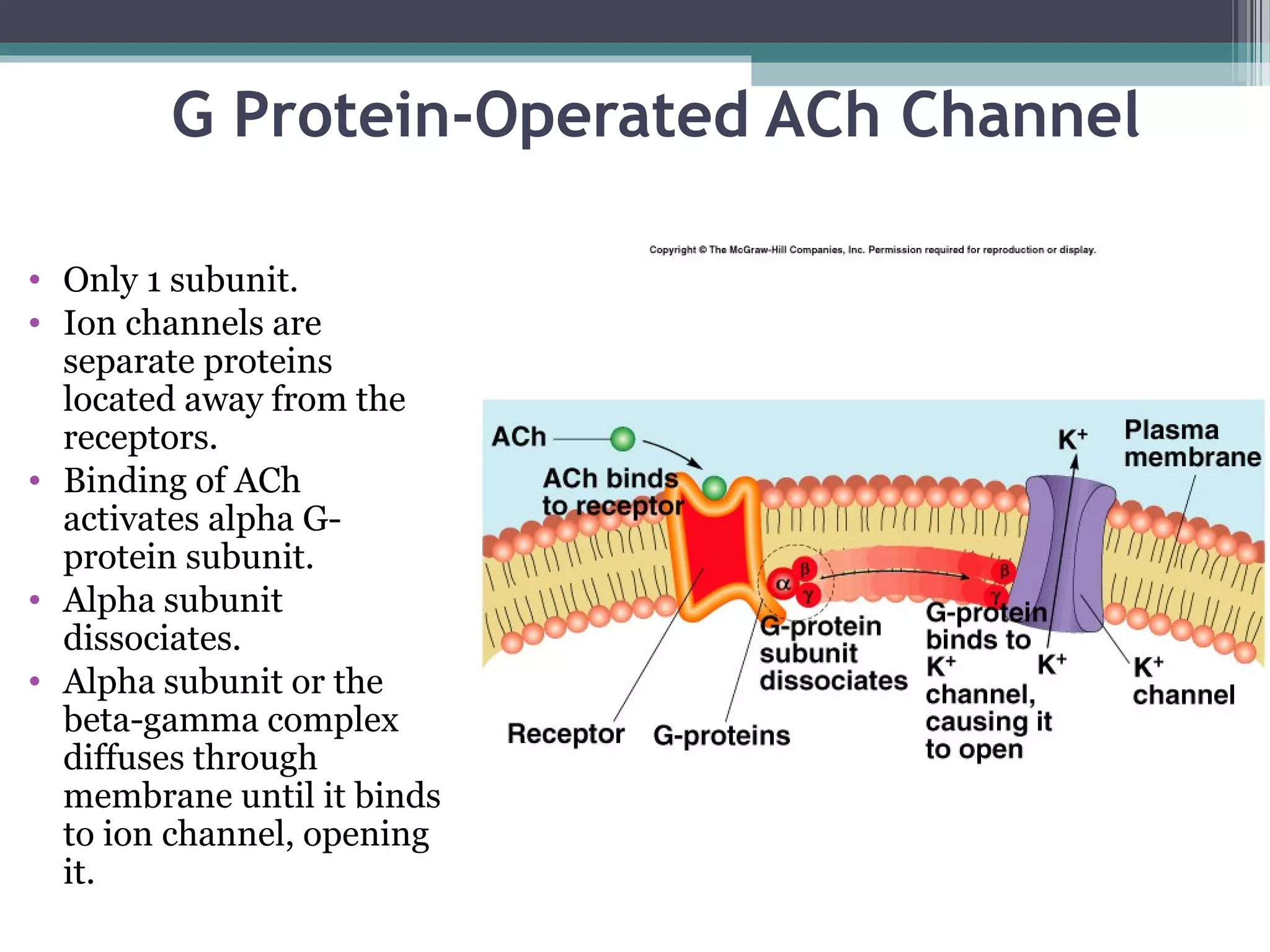
G Protein-Operated ACh Channel
• Only 1 subunit.
• Ion channels are
separate proteins
located away from the
receptors.
• Binding of ACh
activates alpha G-
protein subunit.
• Alpha subunit
dissociates.
• Alpha subunit or the
beta-gamma complex
diffuses through
membrane until it binds
to ion channel, opening
it.
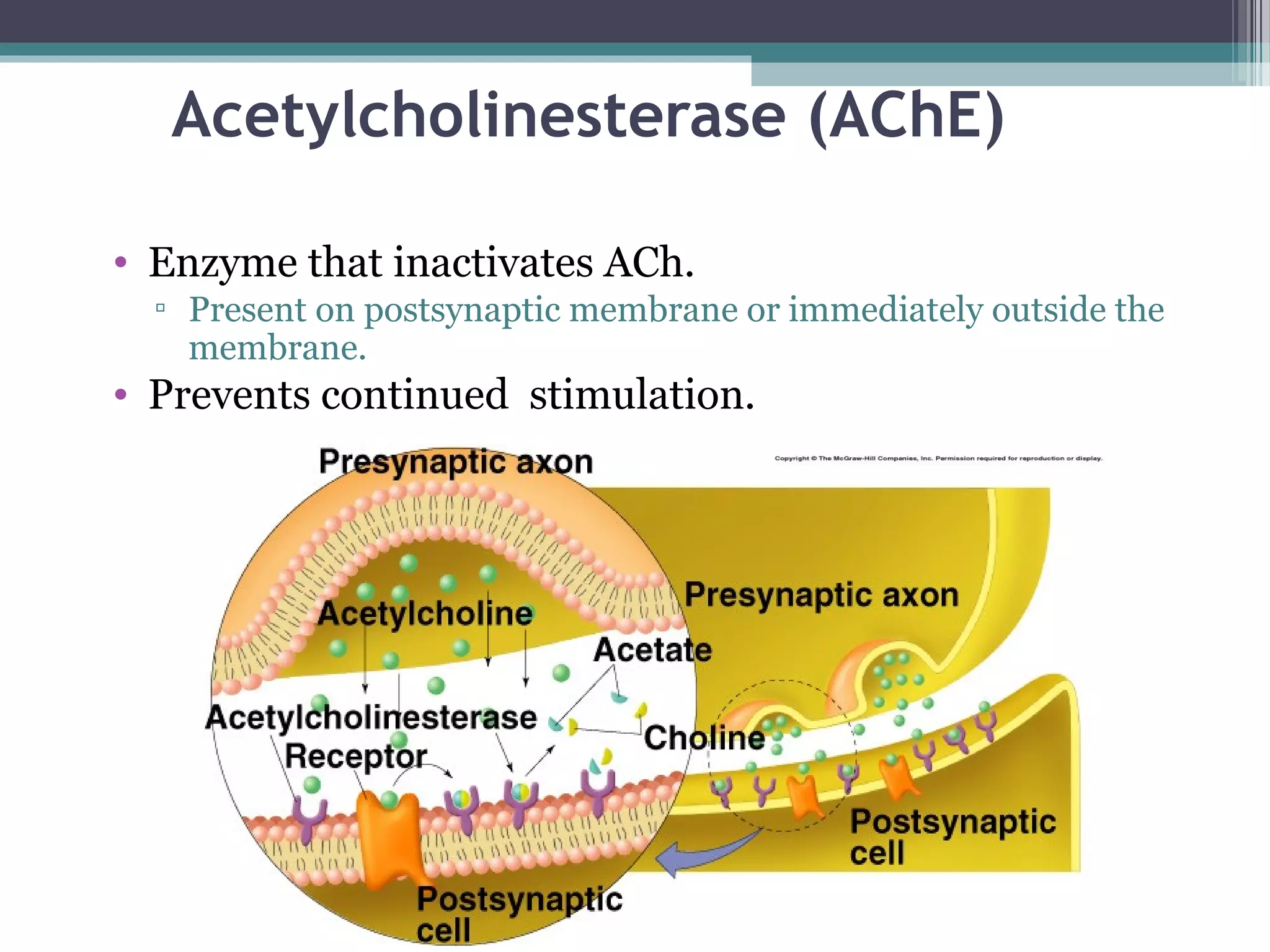
Acetylcholinesterase (AChE)
• Enzyme that inactivates ACh.
▫ Present on postsynaptic membrane or immediately outside the
membrane.
• Prevents continued stimulation.
ACh in CNS
• Cholinergic neurons:
▫ Use ACh as NT.
▫ Axon bouton synapses with dendrites or cell body of
another neuron.
• First VG channels are located at axon hillock.
• EPSPs spread by cable properties to initial
segment of axon.
• Gradations in strength of EPSPs above
threshold determine frequency of APs
produced at axon hillock.
ACh in PNS
• Somatic motor neurons synapse with skeletal
muscle fibers.
▫ Release ACh from boutons.
▫ Produces end-plate potential (EPSPs).
• Depolarization opens VG channels adjacent to
end plate.
Monoamines as NT
• Monoamine NTs:
▫ Epinephrine.
▫ Norepinephrine.
▫ Serotonin.
▫ Dopamine.
• Released by exocytosis from presynaptic
vesicles.
• Diffuse across the synaptic cleft.
• Interact with specific receptors in
postsynaptic membrane.
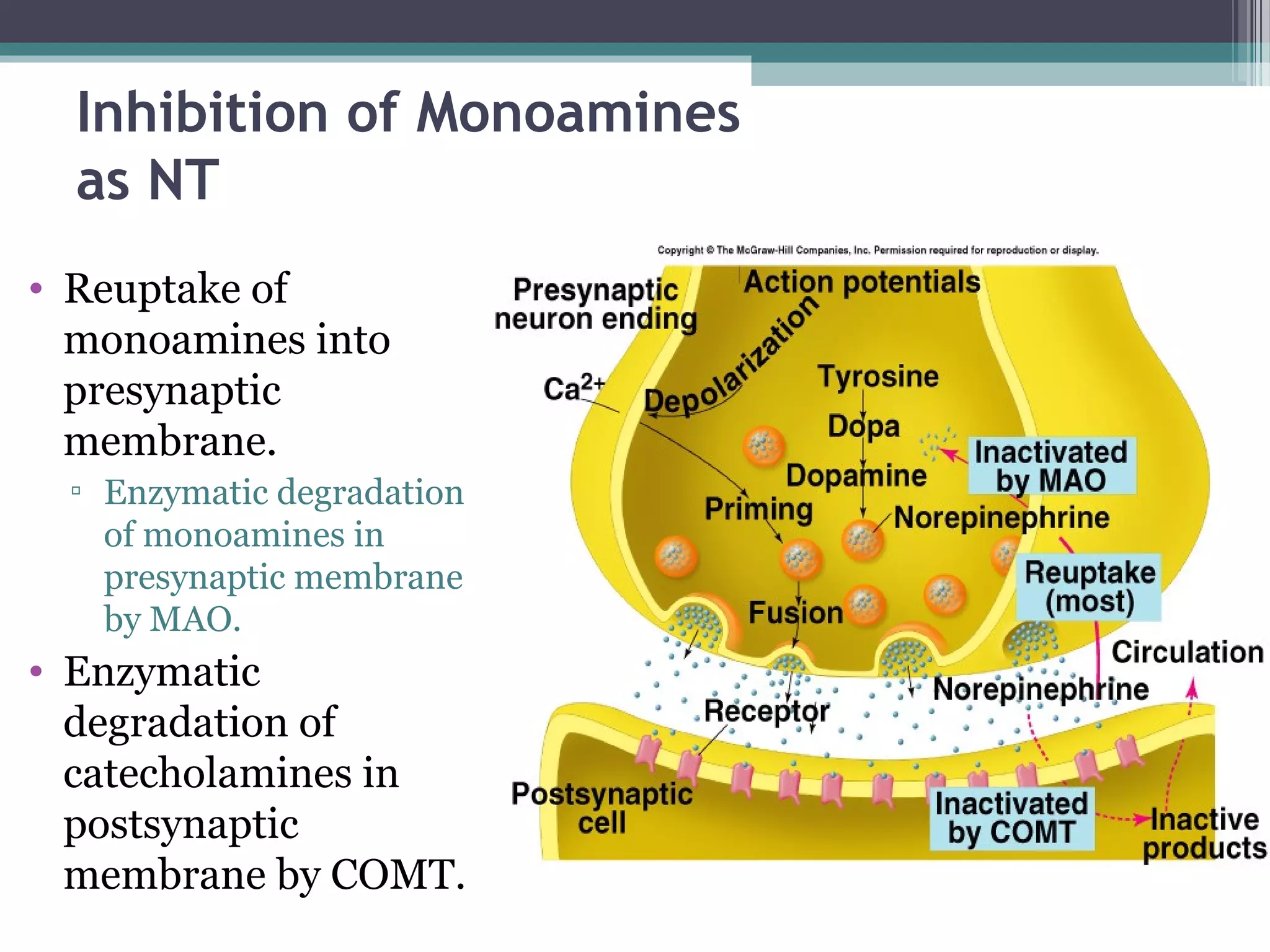
Inhibition of Monoamines
as NT
• Reuptake of
monoamines into
presynaptic
membrane.
▫ Enzymatic degradation
of monoamines in
presynaptic membrane
by MAO.
• Enzymatic
degradation of
catecholamines in
postsynaptic
membrane by COMT.
Mechanism of Action
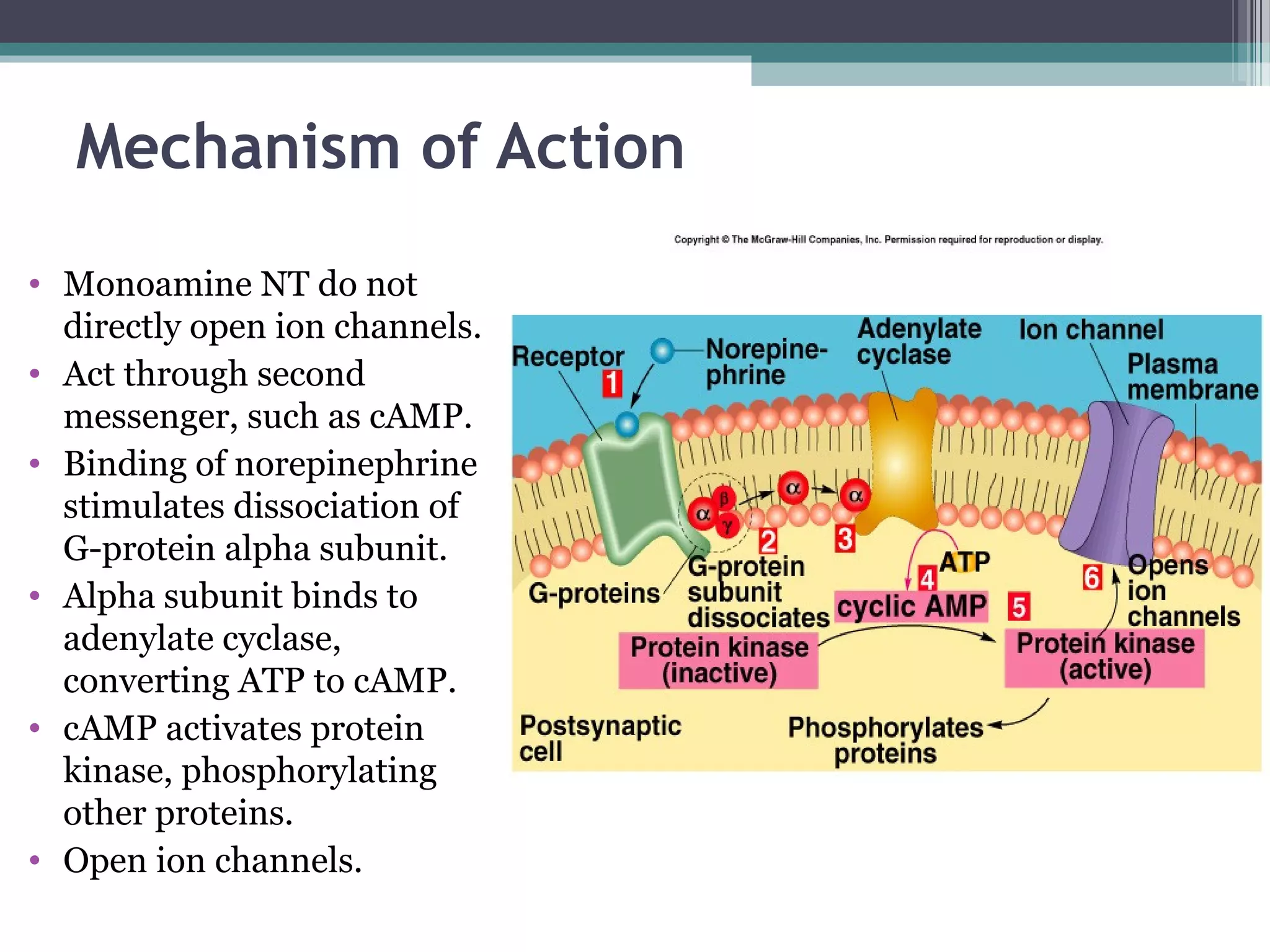
• Monoamine NT do not
directly open ion channels.
• Act through second
messenger, such as cAMP.
• Binding of norepinephrine
stimulates dissociation of
G-protein alpha subunit.
• Alpha subunit binds to
adenylate cyclase,
converting ATP to cAMP.
• cAMP activates protein
kinase, phosphorylating
other proteins.
• Open ion channels.
Serotonin as NT
• NT (derived from L-tryptophan) for neurons
with cell bodies in raphe nuclei.
• Regulation of mood, behavior, appetite, and
cerebral circulation.
• SSRIs (serotonin-specific reuptake
inhibitors):
▫ Inhibit reuptake and destruction of serotonin,
prolonging the action of NT.
▫ Used as an antidepressant.
 Reduces appetite, treatment for anxiety, treatment for
migraine headaches.
Dopamine an NT
• NT for neurons with cell bodies in midbrain.
• Axons project into:
▫ Nigrostriatal dopamine system:
 Nuerons in substantia nigra send fibers to corpus straitum.
 Initiation of skeletal muscle movement.
 Parkinson’s disease: degeneration of neurons in substantia
nigra.
▫ Mesolimbic dopamine system:
 Neurons originate in midbrain, send axons to limbic
system.
 Involved in behavior and reward.
 Addictive drugs:
 Promote activity in nucleus accumbens.
Norepinephrine (NE) as NT
• NT in both PNS and CNS.
• PNS:
▫ Smooth muscles, cardiac muscle and glands.
 Increase in blood pressure, constriction of arteries.
• CNS:
▫ General behavior.
Amino Acids as NT
• Glutamic acid and aspartic acid:
▫ Major excitatory NTs in CNS.
• Glutamic acid:
▫ NMDA receptor involved in memory storage.
• Glycine:
▫ Inhibitory, produces IPSPs.
▫ Opening of Cl-
channels in postsynaptic membrane.
 Hyperpolarization.
▫ Helps control skeletal movements.
• GABA (gamma-aminobutyric acid):
▫ Most prevalent NT in brain.
▫ Inhibitory, produces IPSPs.
 Hyperpolarizes postsynaptic membrane.
 Motor functions in cerebellum.
Polypeptides as NT
• CCK:
▫ Promote satiety following meals.
• Substance P:
▫ Major NT in sensations of pain.
• Synaptic plasticity (neuromodulating effects):
▫ Neurons can release classical NT or the
polypeptide NT.
Polypeptides as NT
Endogenous opiods:
◦ Brain produces its own analgesic endogenous morphine-like
compounds, blocking the release of substance P.
◦ Beta-endorphin, enkephalins, dynorphin.
Neuropeptide Y:
◦ Most abundant neuropeptide in brain.
◦ Inhibits glutamate in hippocampus.
◦ Powerful stimulator of appetite.
NO:
◦ Exerts its effects by stimulation of cGMP.
◦ Macrophages release NO to helps kill bacteria.
◦ Involved in memory and learning.
◦ Smooth muscle relaxation.
Endogenous Cannabinoids, Carbon
Monoxide
• Endocannabinoids:
▫ Bind to the same receptor as THC.
▫ Act as analgesics.
▫ Function as retrograde NT.
• Carbon monoxide:
▫ Stimulate production of cGMP within neurons.
▫ Promotes odor adaptation in olfactory neurons.
▫ May be involved in neuroendocrine regulation in
hypothalamus.
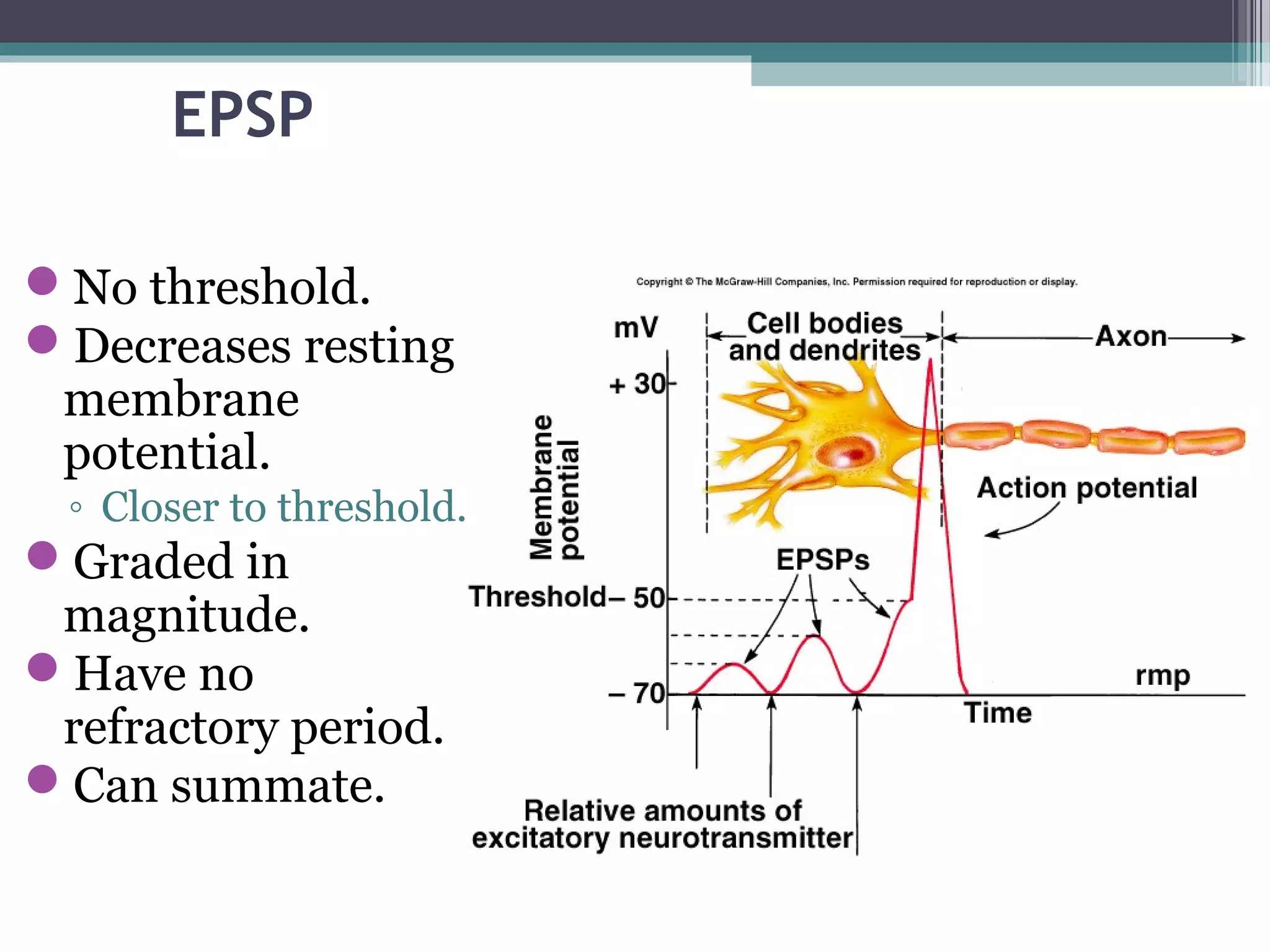
EPSP
No threshold.
Decreases resting
membrane
potential.
◦ Closer to threshold.
Graded in
magnitude.
Have no
refractory period.
Can summate.
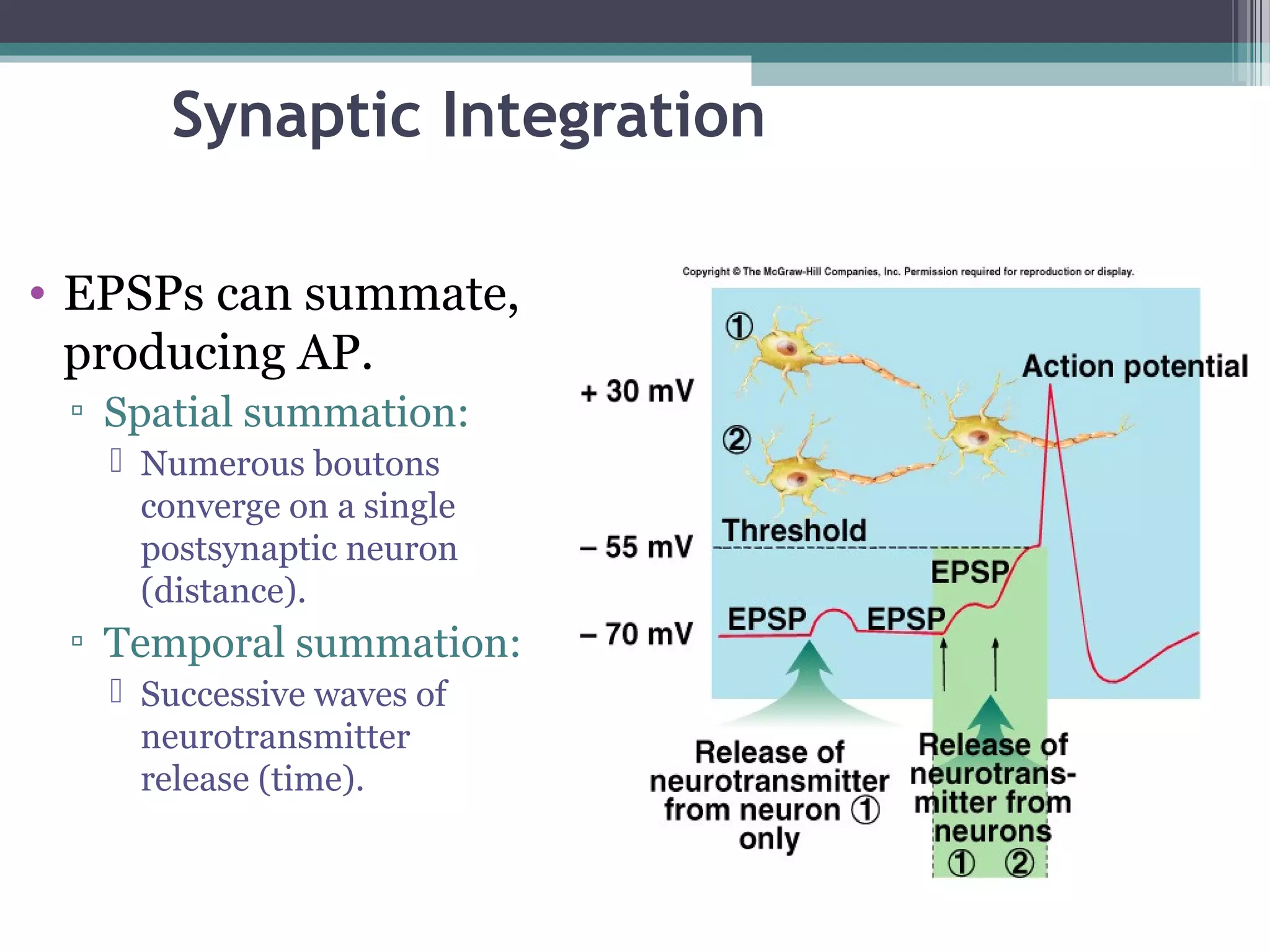
Synaptic Integration
• EPSPs can summate,
producing AP.
▫ Spatial summation:
 Numerous boutons
converge on a single
postsynaptic neuron
(distance).
▫ Temporal summation:
 Successive waves of
neurotransmitter
release (time).
Long-Term Potentiation
• May favor transmission along frequently used
neural pathways.
• Neuron is stimulated at high frequency,
enhancing excitability of synapse.
▫ Improves efficacy of synaptic transmission.
• Neural pathways in hippocampus use
glutamate, which activates NMDA receptors.
▫ Involved in memory and learning.
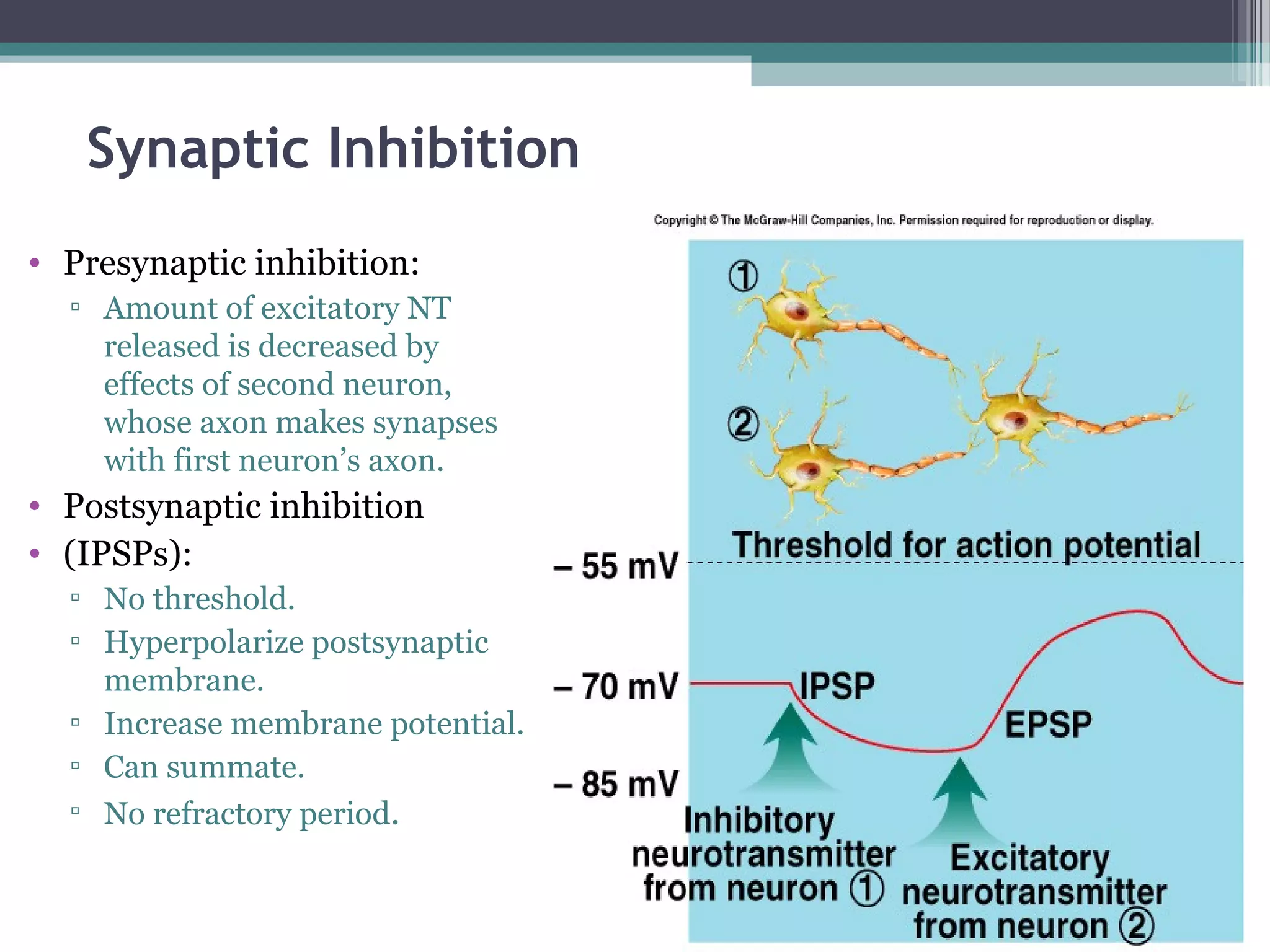
Synaptic Inhibition
• Presynaptic inhibition:
▫ Amount of excitatory NT
released is decreased by
effects of second neuron,
whose axon makes synapses
with first neuron’s axon.
• Postsynaptic inhibition
• (IPSPs):
▫ No threshold.
▫ Hyperpolarize postsynaptic
membrane.
▫ Increase membrane potential.
▫ Can summate.
▫ No refractory period.

The nervous system neurons and synapses

  • 1.
    The Nervous System: Neuronsand Synapses Human physiology
  • 2.
    Nervous System • 2types of cells in the nervous system: ▫ Neurons. ▫ Supporting cells. • Nervous system is divided into: ▫ Central nervous system (CNS):  Brain.  Spinal cord. ▫ Peripheral nervous system (PNS):  Cranial nerves.  Spinal nerves.
  • 3.
    Neurons • Basic structuraland functional units of the nervous system. ▫ Cannot divide by mitosis. • Respond to physical and chemical stimuli. • Produce and conduct electrochemical impulses. • Release chemical regulators. • Nerve: ▫ Bundle of axons located outside CNS.  Most composed of both motor and sensory fibers.
  • 4.
    Neurons (continued) Cell body(perikaryon): ◦ “Nutrition center.” ◦ Cell bodies within CNS clustered into nuclei, and in PNS in ganglia. Dendrites: ◦ Provide receptive area. ◦ Transmit electrical impulses to cell body. Axon: ◦ Conducts impulses away from cell body. ◦ Axoplasmic flow:  Proteins and other molecules are transported by rhythmic contractions to nerve endings. ◦ Axonal transport:  Employs microtubules for transport.  May occur in orthograde or retrograde direction.
  • 5.
  • 6.
    Functional Classification ofNeurons Based upon direction impulses conducted. Sensory or afferent: ◦ Conduct impulses from sensory receptors into CNS. Motor or efferent: ◦ Conduct impulses out of CNS to effector organs. Association or interneurons: ◦ Located entirely within the CNS. ◦ Serve an integrative function.
  • 7.
    Structural Classification ofNeurons • Based on the # of processes that extend from cell body. ▫ Pseudounipolar:  Short single process that branches like a T.  Sensory neurons. ▫ Bipolar neurons:  Have 2 processes.  Retina of the eye. ▫ Multipolar:  Have several dendrites and 1 axon.  Motor neuron.
  • 8.
    PNS Supporting Cells•Schwaan cells: ▫ Successive wrapping of the cell membrane. ▫ Outer surface encased in glycoprotein basement membrane. ▫ Provide insulation. • Nodes of Ranvier: ▫ Unmyelinated areas between adjacent Schwaan cells that produce nerve impulses. • Satellite cells: ▫ Support neuron cell bodies within ganglia.
  • 9.
    CNS Supporting Cells •Oligodendrocytes: ▫ Process occurs mostly postnatally. ▫ Each has extensions that form myelin sheaths around several axons.  Insulation.
  • 10.
    Nerve Regeneration • Schwanncells: ▫ Act as phagocytes, as the distal neuronal portion degenerates. ▫ Surrounded by basement membrane, form regeneration tube:  Serve as guide for axon.  Send out chemicals that attract the growing axon.  Axon tip connected to cell body begins to grow towards destination.
  • 11.
    Nerve Regeneration (continued) •CNS has limited ability to regenerate: ▫ Absence of continuous basement membrane. ▫ Oligodendrocytes molecules inhibit neuronal growth.
  • 12.
    Neurotrophins • Promote neurongrowth. • Nerve growth factors include: ▫ Nerve growth factor (NGF), brain-derived neurotrophic factor (BDNF), glial-derived neurotrophic factor (GDNF), neurotrophin-3, and neurotrophin-4/5. • Fetus: ▫ Embryonic development of sensory neurons and sympathetic ganglia (NGF and neurotrophin-3).
  • 13.
    Neurotrophins (continued) • Adult: ▫Maintenance of sympathetic ganglia (NGF). ▫ Mature sensory neurons need for regeneration. ▫ Required to maintain spinal neurons (GDNF). ▫ Sustain neurons that use dopamine (GDNF). • Myelin-associated inhibitory proteins: ▫ Inhibit axon regeneration.
  • 14.
    CNS Supporting Cells(continued) Astrocytes: ◦ Most abundant glial cell. ◦ Vascular processes terminate in end-feet that surround the capillaries. ◦ Stimulate tight junctions, contributing to blood-brain barrier. ◦ Regulate external environment of K+ and pH. ◦ Take up K+ from ECF, NTs released from axons, and lactic acid (convert for ATP production).  Other extensions adjacent to synapses.
  • 15.
    CNS Supporting Cells(continued) • Microglia: ▫ Phagocytes, migratory. • Ependymal cells: ▫ Secrete CSF. ▫ Line ventricles. ▫ Function as neural stem cells. ▫ Can divide and progeny differentiate.
  • 16.
    Blood-Brain Barrier • Capillariesin brain do not have pores between adjacent endothelial cells. ▫ Joined by tight junctions. • Molecules within brain capillaries moved selectively through endothelial cells by: ▫ Diffusion. ▫ Active transport. ▫ Endocytosis. ▫ Exocytosis.
  • 17.
    Electrical Activity ofAxons • All cells maintain a resting membrane potential (RMP): ▫ Potential voltage difference across membrane.  Largely the result of negatively charged organic molecules within the cell.  Limited diffusion of positively charged inorganic ions. ▫ Permeability of cell membrane:  Electrochemical gradients of Na+ and K+.  Na+ /K+ ATPase pump. • Excitability/irritability: ▫ Ability to produce and conduct electrical impulses.
  • 18.
    Electrical Activity ofAxons (continued) • Increase in membrane permeability for specific ion can be measured by placing 2 electrodes (1 inside and 1 outside the cell). • Depolarization: ▫ Potential difference reduced (become more positive). • Repolarization: ▫ Return to resting membrane potential (become more negative). • Hyperpolarization: ▫ More negative than RMP.
  • 19.
    Ion Gating inAxons • Changes in membrane potential caused by ion flow through ion channels. • Voltage gated (VG) channels open in response to change in membrane potential. ▫ Gated channels are part of proteins that comprise the channel.  Can be open or closed in response to change. ▫ 2 types of channels for K+ :  1 always open.  1 closed in resting cell. ▫ Channel for Na+ :  Always closed in resting cells.  Some Na+ does leak into the cells.
  • 20.
    Ion Gating inAxons (continued)
  • 21.
    Action Potentials (APs) •Stimulus causes depolarization to threshold. • VG Na+ channels open. ▫ Electrochemical gradient inward.  + feedback loop. ▫ Rapid reversal in membrane potential from –70 to + 30 mV. ▫ VG Na+ channels become inactivated. • VG K+ channels open. ▫ Electrochemical gradient outward. ▫ - feedback loop. ▫ Restore original RMP.
  • 22.
  • 23.
    Membrane Permeabilites • APis produced by an increase in Na+ permeability. • After short delay, increase in K+ permeability.
  • 24.
    Action Potentials (APs)(continued) • Depolarization and repolarization occur via diffusion, do not require active transport. ▫ Once AP completed, Na+ /K+ ATPase pump extrudes Na+ , and recovers K+ . • All or none: ▫ When threshold reached, maximum potential change occurs. ▫ Amplitude does not normally become more positive than + 30 mV because VG Na+ channels close quickly and VG K+ channels open. ▫ Duration is the same, only open for a fixed period of time. • Coding for Stimulus Intensity: ▫ Increased frequency of AP indicates greater stimulus strength. • Recruitment: ▫ Stronger stimuli can activate more axons with a higher threshold.
  • 25.
    Refractory Periods • Absoluterefractory period: ▫ Axon membrane is incapable of producing another AP. • Relative refractory period: ▫ VG ion channel shape alters at the molecular level. ▫ VG K+ channels are open. ▫ Axon membrane can produce another action potential, but requires stronger stimulus.
  • 26.
    Cable Properties ofNeurons • Ability of neuron to transmit charge through cytoplasm. • Axon cable properties are poor: ▫ High internal resistance. ▫ Many charges leak out of the axon through membrane. • An AP does not travel down the entire axon. • Each AP is a stimulus to produce another AP in the next region of membrane with VG channels.
  • 27.
    Conduction in anUnmyelinated Axon Cable spread of depolarization with influx of Na+ depolarizes the adjacent region membrane, propagating the AP. Conduction rate is slow. ◦ AP must be produced at every fraction of micrometer. Occurs in 1 direction; previous region is in its refractory period.
  • 28.
    Conduction in MyelinatedAxon • Myelin prevents movement of Na+ and K+ through the membrane. • Interruption in myelin (Nodes of Ranvier) contain VG Na+ and K+ channels. • AP occurs only at the nodes. ▫ AP at 1 node depolarizes membrane to reach threshold at next node. • Saltatory conduction (leaps). ▫ Fast rate of conduction.
  • 29.
    Synapse • Functional connectionbetween a neuron and another neuron or effector cell. • Transmission in one direction only. • Axon of first (presynaptic) to second (postsynaptic) neuron. • Synaptic transmission is through a chemical gated channel. • Presynaptic terminal (bouton) releases a neurotransmitter (NT).
  • 30.
    Electrical Synapse • Impulsescan be regenerated without interruption in adjacent cells. • Gap junctions: ▫ Adjacent cells electrically coupled through a channel. ▫ Each gap junction is composed of 12 connexin proteins. • Examples: ▫ Smooth and cardiac muscles, brain, and glial cells.
  • 31.
    Chemical Synapse • Terminalbouton is separated from postsynaptic cell by synaptic cleft. • NTs are released from synaptic vesicles. • Vesicles fuse with axon membrane and NT released by exocytosis. • Amount of NTs released depends upon frequency of AP.
  • 32.
    Synaptic Transmission NT releaseis rapid because many vesicles form fusion-complexes at “docking site.” AP travels down axon to bouton. VG Ca2+ channels open. ◦ Ca2+ enters bouton down concentration gradient. ◦ Inward diffusion triggers rapid fusion of synaptic vesicles and release of NTs. Ca2+ activates calmodulin, which activates protein kinase. Protein kinase phosphorylates synapsins. ◦ Synapsins aid in the fusion of synaptic vesicles.
  • 33.
    Synaptic Transmission (continued) •NTs are released and diffuse across synaptic cleft. • NT (ligand) binds to specific receptor proteins in postsynaptic cell membrane. • Chemically-regulated gated ion channels open. ▫ EPSP: depolarization. ▫ IPSP: hyperpolarization. • Neurotransmitter inactivated to end transmission.
  • 34.
    Chemical Synapses • EPSP(excitatory postsynaptic potential): ▫ Depolarization. • IPSP (inhibitory postsynaptic potential): ▫ Hyperpolarizatio n
  • 35.
    Acetylcholine (ACh) asNT • ACh is both an excitatory and inhibitory NT, depending on organ involved. ▫ Causes the opening of chemical gated ion channels. • Nicotinic ACh receptors: ▫ Found in autonomic ganglia and skeletal muscle fibers. • Muscarinic ACh receptors: ▫ Found in the plasma membrane of smooth and cardiac muscle cells, and in cells of particular glands.
  • 36.
    Ligand-Operated ACh Channels •Most direct mechanism. • Ion channel runs through receptor. ▫ Receptor has 5 polypeptide subunits that enclose ion channel. ▫ 2 subunits contain ACh binding sites. • Channel opens when both sites bind to ACh. ▫ Permits diffusion of Na+ into and K+ out of postsynaptic cell. • Inward flow of Na+ dominates. ▫ Produces EPSPs.
  • 37.
    G Protein-Operated AChChannel • Only 1 subunit. • Ion channels are separate proteins located away from the receptors. • Binding of ACh activates alpha G- protein subunit. • Alpha subunit dissociates. • Alpha subunit or the beta-gamma complex diffuses through membrane until it binds to ion channel, opening it.
  • 38.
    Acetylcholinesterase (AChE) • Enzymethat inactivates ACh. ▫ Present on postsynaptic membrane or immediately outside the membrane. • Prevents continued stimulation.
  • 39.
    ACh in CNS •Cholinergic neurons: ▫ Use ACh as NT. ▫ Axon bouton synapses with dendrites or cell body of another neuron. • First VG channels are located at axon hillock. • EPSPs spread by cable properties to initial segment of axon. • Gradations in strength of EPSPs above threshold determine frequency of APs produced at axon hillock.
  • 40.
    ACh in PNS •Somatic motor neurons synapse with skeletal muscle fibers. ▫ Release ACh from boutons. ▫ Produces end-plate potential (EPSPs). • Depolarization opens VG channels adjacent to end plate.
  • 41.
    Monoamines as NT •Monoamine NTs: ▫ Epinephrine. ▫ Norepinephrine. ▫ Serotonin. ▫ Dopamine. • Released by exocytosis from presynaptic vesicles. • Diffuse across the synaptic cleft. • Interact with specific receptors in postsynaptic membrane.
  • 42.
    Inhibition of Monoamines asNT • Reuptake of monoamines into presynaptic membrane. ▫ Enzymatic degradation of monoamines in presynaptic membrane by MAO. • Enzymatic degradation of catecholamines in postsynaptic membrane by COMT.
  • 43.
    Mechanism of Action •Monoamine NT do not directly open ion channels. • Act through second messenger, such as cAMP. • Binding of norepinephrine stimulates dissociation of G-protein alpha subunit. • Alpha subunit binds to adenylate cyclase, converting ATP to cAMP. • cAMP activates protein kinase, phosphorylating other proteins. • Open ion channels.
  • 44.
    Serotonin as NT •NT (derived from L-tryptophan) for neurons with cell bodies in raphe nuclei. • Regulation of mood, behavior, appetite, and cerebral circulation. • SSRIs (serotonin-specific reuptake inhibitors): ▫ Inhibit reuptake and destruction of serotonin, prolonging the action of NT. ▫ Used as an antidepressant.  Reduces appetite, treatment for anxiety, treatment for migraine headaches.
  • 45.
    Dopamine an NT •NT for neurons with cell bodies in midbrain. • Axons project into: ▫ Nigrostriatal dopamine system:  Nuerons in substantia nigra send fibers to corpus straitum.  Initiation of skeletal muscle movement.  Parkinson’s disease: degeneration of neurons in substantia nigra. ▫ Mesolimbic dopamine system:  Neurons originate in midbrain, send axons to limbic system.  Involved in behavior and reward.  Addictive drugs:  Promote activity in nucleus accumbens.
  • 46.
    Norepinephrine (NE) asNT • NT in both PNS and CNS. • PNS: ▫ Smooth muscles, cardiac muscle and glands.  Increase in blood pressure, constriction of arteries. • CNS: ▫ General behavior.
  • 47.
    Amino Acids asNT • Glutamic acid and aspartic acid: ▫ Major excitatory NTs in CNS. • Glutamic acid: ▫ NMDA receptor involved in memory storage. • Glycine: ▫ Inhibitory, produces IPSPs. ▫ Opening of Cl- channels in postsynaptic membrane.  Hyperpolarization. ▫ Helps control skeletal movements. • GABA (gamma-aminobutyric acid): ▫ Most prevalent NT in brain. ▫ Inhibitory, produces IPSPs.  Hyperpolarizes postsynaptic membrane.  Motor functions in cerebellum.
  • 48.
    Polypeptides as NT •CCK: ▫ Promote satiety following meals. • Substance P: ▫ Major NT in sensations of pain. • Synaptic plasticity (neuromodulating effects): ▫ Neurons can release classical NT or the polypeptide NT.
  • 49.
    Polypeptides as NT Endogenousopiods: ◦ Brain produces its own analgesic endogenous morphine-like compounds, blocking the release of substance P. ◦ Beta-endorphin, enkephalins, dynorphin. Neuropeptide Y: ◦ Most abundant neuropeptide in brain. ◦ Inhibits glutamate in hippocampus. ◦ Powerful stimulator of appetite. NO: ◦ Exerts its effects by stimulation of cGMP. ◦ Macrophages release NO to helps kill bacteria. ◦ Involved in memory and learning. ◦ Smooth muscle relaxation.
  • 50.
    Endogenous Cannabinoids, Carbon Monoxide •Endocannabinoids: ▫ Bind to the same receptor as THC. ▫ Act as analgesics. ▫ Function as retrograde NT. • Carbon monoxide: ▫ Stimulate production of cGMP within neurons. ▫ Promotes odor adaptation in olfactory neurons. ▫ May be involved in neuroendocrine regulation in hypothalamus.
  • 51.
    EPSP No threshold. Decreases resting membrane potential. ◦Closer to threshold. Graded in magnitude. Have no refractory period. Can summate.
  • 52.
    Synaptic Integration • EPSPscan summate, producing AP. ▫ Spatial summation:  Numerous boutons converge on a single postsynaptic neuron (distance). ▫ Temporal summation:  Successive waves of neurotransmitter release (time).
  • 53.
    Long-Term Potentiation • Mayfavor transmission along frequently used neural pathways. • Neuron is stimulated at high frequency, enhancing excitability of synapse. ▫ Improves efficacy of synaptic transmission. • Neural pathways in hippocampus use glutamate, which activates NMDA receptors. ▫ Involved in memory and learning.
  • 54.
    Synaptic Inhibition • Presynapticinhibition: ▫ Amount of excitatory NT released is decreased by effects of second neuron, whose axon makes synapses with first neuron’s axon. • Postsynaptic inhibition • (IPSPs): ▫ No threshold. ▫ Hyperpolarize postsynaptic membrane. ▫ Increase membrane potential. ▫ Can summate. ▫ No refractory period.