HYPOTHALAMUS

      Dr Saadiyah
Department of Physiology
         DIMC
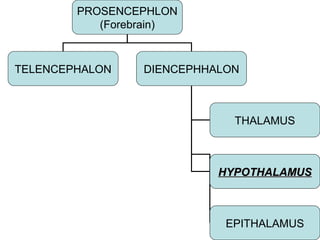
PROSENCEPHLON
           (Forebrain)


TELENCEPHALON    DIENCEPHHALON


                             THALAMUS


                           HYPOTHALAMUS


                            EPITHALAMUS
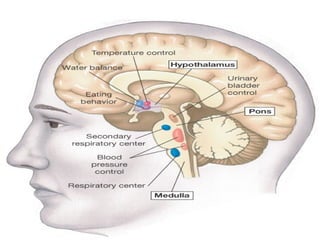
HYPOTHALAMUS
• Located inferior to thalamus
• Very small size; few cubic centimeters
• Comprises less than 1% of human brain
• Almost every part of ANS & CNS communicate
  with it
• Act on three major systems: ANS, Endocrine &
  limbic system
• An integrative center essential for survival &
  reproduction of organism
Regulates:
•   Blood pressure
•   Heart rate
•   Electrolyte composition
•   Body temperature
•   Body water
•   Feeding
•   Endocrine hormone secretion by anterior pituitary
•   Uterine contractility
•   Milk ejaction
•   Reproduction
•   Emergency responses to stress
• Divided into following regions:

Anterior (Supraoptic)
Preoptic
Middle (tuberal)
Posterior (mammillary)
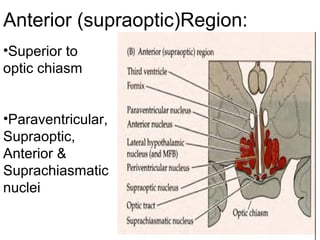
Anterior (supraoptic)Region:
•Superior to
optic chiasm


•Paraventricular,
Supraoptic,
Anterior &
Suprachiasmatic
nuclei
Anterior (supraoptic)Region:
• Vasopressin & oxytocin
• Circadian rhythm
• Temperature
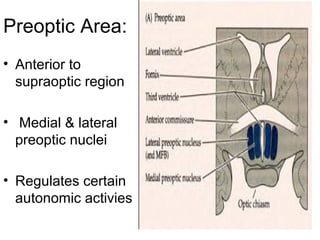
Preoptic Area:
• Anterior to
  supraoptic region

• Medial & lateral
  preoptic nuclei

• Regulates certain
  autonomic activies
Preoptic area:
•   Temperature
•   Blood pressure
•   Reproduction
•   Drinking
•   Feeding
•   Hormone (thyrotropin)
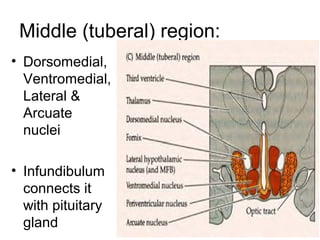
Middle (tuberal) region:
• Dorsomedial,
  Ventromedial,
  Lateral &
  Arcuate
  nuclei

• Infundibulum
  connects it
  with pituitary
  gland
Middle (tuberal) region:
•   Satiety center (VMN)
•   Hunger center (Lat)
•   Thirst center (Lat)
•   Neuroendocrine control
•   GI stimulation
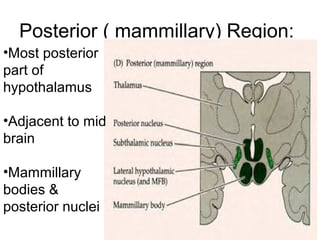
Posterior ( mammillary) Region:
•Most posterior
part of
hypothalamus

•Adjacent to mid
brain

•Mammillary
bodies &
posterior nuclei
• Temperature control
• Relay station for sense of smell
• Feeding reflex
Mammillary bodies:
• Two small rounded projections.
• Are component of limbic system
• Limbic system: Emotional Brain
Ring of structures on the inner border of
  cerebrum
Plays primary role in range of emotions
  including pain, pleasure, affection & anger.
Also involved in olfaction & memory
MEDIAL ZONE
•   Preoptic (part)
•   Anterior
•   Suprachiasmatic (part)
•   Parventricular
•   Dorsomedial
•   Ventromedial
•   Arcuate
•   Posterior
LATERAL ZONE
•   Preoptic (part)
•   Suprachiasmatic (part)
•   Supraoptic
•   Lateral
Cardiovascular Regulation
• Stimulation in posterior & lateral
  hypothalamus INC arterial pressure &
  heart rate

• Stimulation in preoptic area DEC arterial
  pressure & heart rate
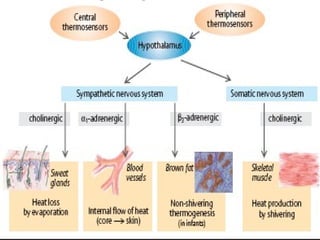
BODY TEMP. REGULATION
• Anterior portion of hypothalamus
  especially Preoptic area is concerned

• Inc in temp of blood flowing through this
  area inc activity of temp sensitive neurons
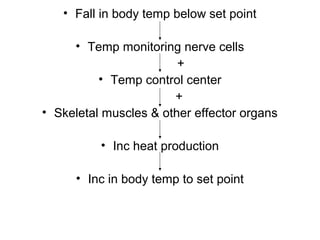
• Fall in body temp below set point

     • Temp monitoring nerve cells
                        +
          • Temp control center
                       +
• Skeletal muscles & other effector organs

          • Inc heat production

      • Inc in body temp to set point
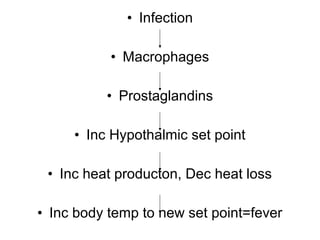
• Infection

           • Macrophages

          • Prostaglandins

     • Inc Hypothalmic set point

 • Inc heat producton, Dec heat loss

• Inc body temp to new set point=fever
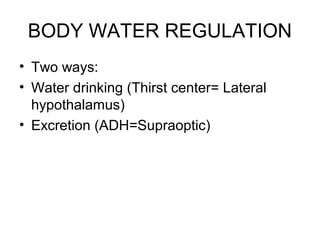
BODY WATER REGULATION
• Two ways:
• Water drinking (Thirst center= Lateral
  hypothalamus)
• Excretion (ADH=Supraoptic)
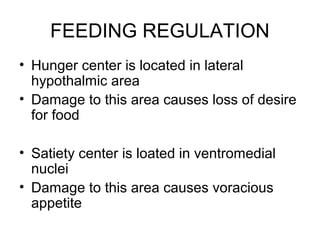
FEEDING REGULATION
• Hunger center is located in lateral
  hypothalmic area
• Damage to this area causes loss of desire
  for food

• Satiety center is loated in ventromedial
  nuclei
• Damage to this area causes voracious
  appetite
ENDOCRINE REGULATION
•   Thyrotropin releasing hormone
•   Corticotropin releasing hormone
•   Growth hormone releasing hormone
•   Growth hormone inhibitory hormone
    (somatostatin)
•   Gonadotropin releasing hormone
•   Dopamine/ Prolactin inhibiting factor
•   ADH
•   Oxytocin
Hypothalamic Control of the
           Anterior Pituitary
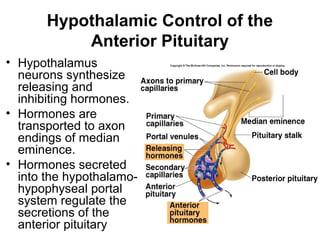
• Hypothalamus
  neurons synthesize
  releasing and
  inhibiting hormones.
• Hormones are
  transported to axon
  endings of median
  eminence.
• Hormones secreted
  into the hypothalamo-
  hypophyseal portal
  system regulate the
  secretions of the
  anterior pituitary
Hypothalamic Control of Posterior
           Pituitary
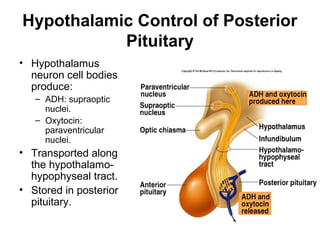
• Hypothalamus
  neuron cell bodies
  produce:
   – ADH: supraoptic
     nuclei.
   – Oxytocin:
     paraventricular
     nuclei.
• Transported along
  the hypothalamo-
  hypophyseal tract.
• Stored in posterior
  pituitary.
EMOTIONAL CONTROL
• Stimulation in Lateral hypothalamus inc
  general activity, sometimes leading to
  overt rage & fighting

• Stimulation in Ventromedial nucleus
  causes opposite effects-------Tranquility
REGULATION OF CIRCADIAN
         RHYTHMS
• Supachiasmatic nucleus establishes
  patterns of awakening & sleep
• Receives input from retina
• Sends output to other hypothalmic nuclei,
  reticular formation & pineal gland
Circumventricular Organs
• Parts of diencephalon, called CVO b/c
  they lie in walls of 3rd & 4th ventricals.
• Component: Hpothalamus, pineal &
  pituitary gland.
• Monitor chemical changes in blood b/c
  lack a blood brain barrier
• Thought to be the site of entry of HIV into
  brain

Hypothalamus

  • 1.
    HYPOTHALAMUS Dr Saadiyah Department of Physiology DIMC
  • 3.
    PROSENCEPHLON (Forebrain) TELENCEPHALON DIENCEPHHALON THALAMUS HYPOTHALAMUS EPITHALAMUS
  • 4.
    HYPOTHALAMUS • Located inferiorto thalamus • Very small size; few cubic centimeters • Comprises less than 1% of human brain • Almost every part of ANS & CNS communicate with it • Act on three major systems: ANS, Endocrine & limbic system • An integrative center essential for survival & reproduction of organism
  • 5.
    Regulates: • Blood pressure • Heart rate • Electrolyte composition • Body temperature • Body water • Feeding • Endocrine hormone secretion by anterior pituitary • Uterine contractility • Milk ejaction • Reproduction • Emergency responses to stress
  • 6.
    • Divided intofollowing regions: Anterior (Supraoptic) Preoptic Middle (tuberal) Posterior (mammillary)
  • 7.
    Anterior (supraoptic)Region: •Superior to opticchiasm •Paraventricular, Supraoptic, Anterior & Suprachiasmatic nuclei
  • 8.
    Anterior (supraoptic)Region: • Vasopressin& oxytocin • Circadian rhythm • Temperature
  • 9.
    Preoptic Area: • Anteriorto supraoptic region • Medial & lateral preoptic nuclei • Regulates certain autonomic activies
  • 10.
    Preoptic area: • Temperature • Blood pressure • Reproduction • Drinking • Feeding • Hormone (thyrotropin)
  • 11.
    Middle (tuberal) region: •Dorsomedial, Ventromedial, Lateral & Arcuate nuclei • Infundibulum connects it with pituitary gland
  • 12.
    Middle (tuberal) region: • Satiety center (VMN) • Hunger center (Lat) • Thirst center (Lat) • Neuroendocrine control • GI stimulation
  • 13.
    Posterior ( mammillary)Region: •Most posterior part of hypothalamus •Adjacent to mid brain •Mammillary bodies & posterior nuclei
  • 14.
    • Temperature control •Relay station for sense of smell • Feeding reflex
  • 15.
    Mammillary bodies: • Twosmall rounded projections. • Are component of limbic system • Limbic system: Emotional Brain Ring of structures on the inner border of cerebrum Plays primary role in range of emotions including pain, pleasure, affection & anger. Also involved in olfaction & memory
  • 16.
    MEDIAL ZONE • Preoptic (part) • Anterior • Suprachiasmatic (part) • Parventricular • Dorsomedial • Ventromedial • Arcuate • Posterior
  • 17.
    LATERAL ZONE • Preoptic (part) • Suprachiasmatic (part) • Supraoptic • Lateral
  • 18.
    Cardiovascular Regulation • Stimulationin posterior & lateral hypothalamus INC arterial pressure & heart rate • Stimulation in preoptic area DEC arterial pressure & heart rate
  • 19.
    BODY TEMP. REGULATION •Anterior portion of hypothalamus especially Preoptic area is concerned • Inc in temp of blood flowing through this area inc activity of temp sensitive neurons
  • 20.
    • Fall inbody temp below set point • Temp monitoring nerve cells + • Temp control center + • Skeletal muscles & other effector organs • Inc heat production • Inc in body temp to set point
  • 22.
    • Infection • Macrophages • Prostaglandins • Inc Hypothalmic set point • Inc heat producton, Dec heat loss • Inc body temp to new set point=fever
  • 23.
    BODY WATER REGULATION •Two ways: • Water drinking (Thirst center= Lateral hypothalamus) • Excretion (ADH=Supraoptic)
  • 24.
    FEEDING REGULATION • Hungercenter is located in lateral hypothalmic area • Damage to this area causes loss of desire for food • Satiety center is loated in ventromedial nuclei • Damage to this area causes voracious appetite
  • 25.
    ENDOCRINE REGULATION • Thyrotropin releasing hormone • Corticotropin releasing hormone • Growth hormone releasing hormone • Growth hormone inhibitory hormone (somatostatin) • Gonadotropin releasing hormone • Dopamine/ Prolactin inhibiting factor • ADH • Oxytocin
  • 26.
    Hypothalamic Control ofthe Anterior Pituitary • Hypothalamus neurons synthesize releasing and inhibiting hormones. • Hormones are transported to axon endings of median eminence. • Hormones secreted into the hypothalamo- hypophyseal portal system regulate the secretions of the anterior pituitary
  • 27.
    Hypothalamic Control ofPosterior Pituitary • Hypothalamus neuron cell bodies produce: – ADH: supraoptic nuclei. – Oxytocin: paraventricular nuclei. • Transported along the hypothalamo- hypophyseal tract. • Stored in posterior pituitary.
  • 28.
    EMOTIONAL CONTROL • Stimulationin Lateral hypothalamus inc general activity, sometimes leading to overt rage & fighting • Stimulation in Ventromedial nucleus causes opposite effects-------Tranquility
  • 29.
    REGULATION OF CIRCADIAN RHYTHMS • Supachiasmatic nucleus establishes patterns of awakening & sleep • Receives input from retina • Sends output to other hypothalmic nuclei, reticular formation & pineal gland
  • 30.
    Circumventricular Organs • Partsof diencephalon, called CVO b/c they lie in walls of 3rd & 4th ventricals. • Component: Hpothalamus, pineal & pituitary gland. • Monitor chemical changes in blood b/c lack a blood brain barrier • Thought to be the site of entry of HIV into brain