Nervous System
Your brain, spinal cord, nerves, and you
03/01/15 1.5
Today’s Warmup
• Scientists have recently developed a
new brain scan that shows the
specific parts of a middle-school
student’s brain… both male and
female…
• Be prepared to be amazed!
• (Note: Neither brain shown actual size…)
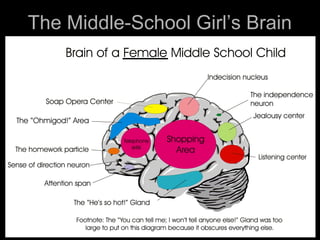
The Middle-School Girl’s Brain
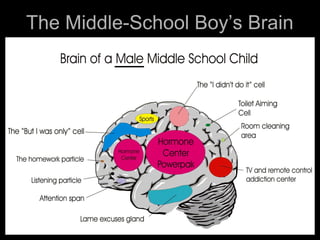
The Middle-School Boy’s Brain
Today’s Objectives
• 5 Senses Thought Questions…
• Nervous System
– Structures
– Functions
• Central and Peripheral nervous system
• Somatic and Autonomic nerves
• Reflexes
• Reaction Time Lab Activity
• Nervous System BrainPop
5 Senses Thought Questions
• Your senses: sight, hearing, smell, touch,
and taste are directly connected to your
nervous system, and all are important…
• Which of these 5 would you be most willing
to give up? Why
• Which of these 5 would you be least willing
to give up? Why
• Rank them from 1 to 5 (with 1 most
important to you)
Vocabulary to Know
• Homeostasis
– The regulation of steady, life-maintaining
conditions inside an organism, despite
changes in its environment… (keeping
the body in balance)
– Examples: body temperature, blood-
sugar concentration, water/salt
concentration
Vocabulary to Know
• Stimulus
– Any change (inside or outside the body)
that brings about a response
– Examples: bright light causes you to
squint, a hot object causes you to pull
back, dust causes you to sneeze
Major Structures of the Nervous System
• Brain- the main control center
• Spinal Cord- the main highway
• Nerves (Neurons)- the signal carriers
Major Function of the Nervous System
• Sensory Input- gathering information about the
world around you via your senses
• Integration- the interpretation and understanding
of the signals sent from the senses; the brain “makes
sense” of those signals
• Motor Output- the brain sends a response out
Nervous System
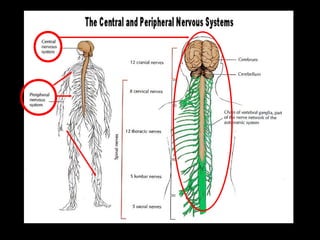
• The nervous system can be divided
into two main segments
• Central Nervous System (CNS)
• Peripheral Nervous System (PNS)
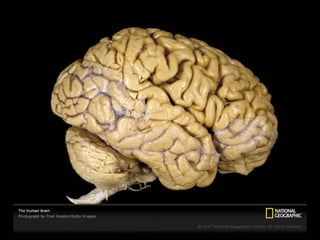
Central Nervous System- The Brain
• Coordinates body activities
• Made up of approximately 100 billion
neurons (nerve cells)
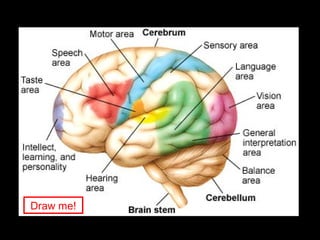
• Divided into four major parts-
–the cerebrum
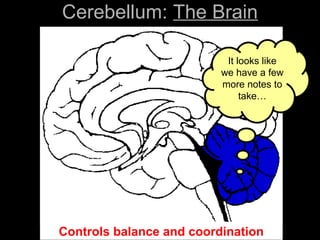
–the cerebellum
–the brain stem
–the thalamus and hypothalamus
Draw me!
Who am I?
What is the
meaning of life?
What’s for
lunch?
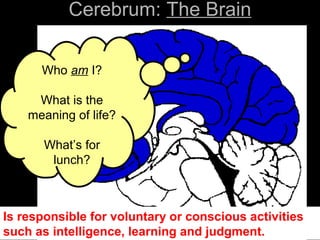
Cerebrum: The Brain
Is responsible for voluntary or conscious activities
such as intelligence, learning and judgment.
It looks like
we have a few
more notes to
take…
Cerebellum: The Brain
Controls balance and coordination
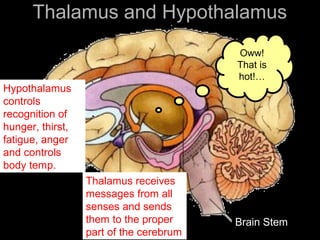
Thalamus and Hypothalamus
Oww!
That is
hot!…
Brain Stem
Thalamus receives
messages from all
senses and sends
them to the proper
part of the cerebrum
Hypothalamus
controls
recognition of
hunger, thirst,
fatigue, anger
and controls
body temp.
Breathe in…
Breathe out…
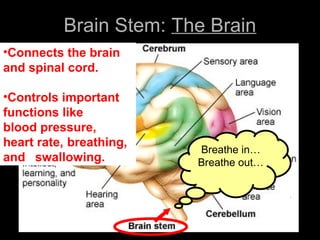
Brain Stem: The Brain
•Connects the brain
and spinal cord.
•Controls important
functions like
blood pressure,
heart rate, breathing,
and swallowing.
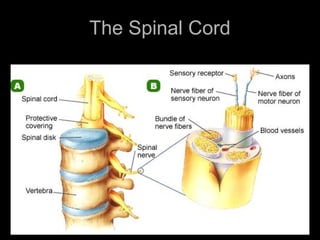
• The “main cable”
• Extension of the brain stem
• Bundles of neurons that carry
impulses from all parts of the body to
the brain and from the brain to all
parts of your body
Central Nervous System-The Spinal Cord
Research
Visit the
Glencoe
Science
Web site at
tx.science.glencoe.com
for more
information
about the
nervous
system.
Make a
brochure
outlining
recent
medical
advances.
The
Peripheral
Nervous
System
Your brain
and spinal
cord are
connected
to the rest
of your
body by the
peripheral
nervous
system.
The PNS is
made up of
12 pairs of
nerves from
your brain
called
cranial
nerves, and
31 pairs
from your
spinal cord
called
spinal
nerves.
Spinal
nerves are
made up of
bundles of
sensory
and motor
neurons
bound
together by
connective
tissue. For
this reason,
a single
spinal
nerve can
have
impulses
going to
and from
the brain at
the same
time. Some
nerves
contain
only
sensory
neurons,
and some
contain
only motor
neurons,
but most
nerves
contain
both types
of neurons.
Somatic
and
Autonomic
Systems
The
peripheral
nervous
system has
two major
divisions.
The
somatic
system
controls
voluntary
actions. It
is made up
of the
cranial and
spinal
nerves that
go from the
central
nervous
system to
your
skeletal
muscles.
The
autonomic
system
controls
involuntary
actions-
those not
under
conscious
control-
such as
your heart
rate,
breathing,
digestion,
and
glandular
functions.
These two
divisions,
along with
the central
nervous
system,
make up
your body's
nervous
system.
The Spinal Cord
Peripheral Nervous System
• Connects body to brain & spinal cord
– Bundles of nerves throughout the body
– Sensory neurons receive information and
send impulses to the brain or spinal cord
– Motor neurons conduct impulses from
the brain or spinal cord to muscles or
glands throughout your body
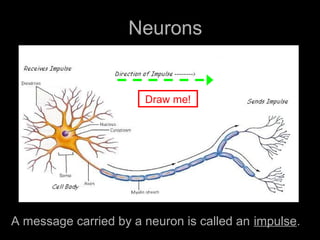
Neurons
A message carried by a neuron is called an impulse.
Draw me!
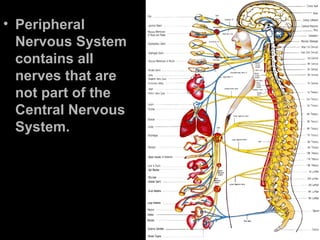
• Peripheral
Nervous System
contains all
nerves that are
not part of the
Central Nervous
System.
Peripheral Nervous System
• Two divisions:
–Somatic = Controls voluntary actions-
like raising your arm/hand to answer a
question
–Autonomic = Controls involuntary
actions-those not under conscious
control-such as your heart rate,
breathing, and digestion
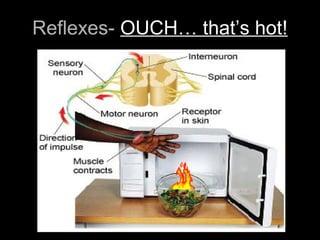
Reflexes
• Involuntary, automatic response to a
stimulus
• Involves a simple nerve pathway
called a reflex arc- to the spinal cord
and straight back
• Very fast response!
Reflexes- OUCH… that’s hot!
Reaction Time Lab Activity
Materials: Meter stick, partner
Objective: To determine your reaction time with your
right and left hand. Then determine which hand has
the fastest reaction time.
• Work with lab partner- Each person will do 3 trials with
the left and 3 trials with the right hand
• Person 1: Place your arm on the table with your hand
hanging off the edge; fingers 1 inch (2.5 cm) apart
Reaction Time Lab Activity
• Person 2: The end of the meter stick should be at the
top of the index finger. Say, “Ready,” and pause a few
seconds. Drop meter stick without a warning or signal.
• Catch the ruler and check the distance by reading the
level at the bottom of the index finger.
• Record your results in your journal.
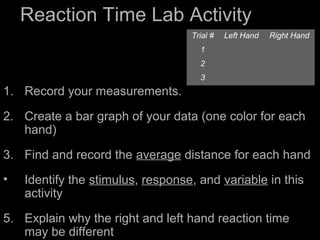
Reaction Time Lab Activity
1. Record your measurements.
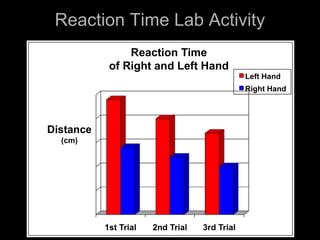
2. Create a bar graph of your data (one color for each
hand)
3. Find and record the average distance for each hand
• Identify the stimulus, response, and variable in this
activity
5. Explain why the right and left hand reaction time
may be different
Trial # Left Hand Right Hand
1
2
3
Reaction Time Lab Activity

Nervous System

  • 1.
    Nervous System Your brain,spinal cord, nerves, and you 03/01/15 1.5
  • 2.
    Today’s Warmup • Scientistshave recently developed a new brain scan that shows the specific parts of a middle-school student’s brain… both male and female… • Be prepared to be amazed! • (Note: Neither brain shown actual size…)
  • 3.
  • 4.
  • 5.
    Today’s Objectives • 5Senses Thought Questions… • Nervous System – Structures – Functions • Central and Peripheral nervous system • Somatic and Autonomic nerves • Reflexes • Reaction Time Lab Activity • Nervous System BrainPop
  • 6.
    5 Senses ThoughtQuestions • Your senses: sight, hearing, smell, touch, and taste are directly connected to your nervous system, and all are important… • Which of these 5 would you be most willing to give up? Why • Which of these 5 would you be least willing to give up? Why • Rank them from 1 to 5 (with 1 most important to you)
  • 7.
    Vocabulary to Know •Homeostasis – The regulation of steady, life-maintaining conditions inside an organism, despite changes in its environment… (keeping the body in balance) – Examples: body temperature, blood- sugar concentration, water/salt concentration
  • 8.
    Vocabulary to Know •Stimulus – Any change (inside or outside the body) that brings about a response – Examples: bright light causes you to squint, a hot object causes you to pull back, dust causes you to sneeze
  • 9.
    Major Structures ofthe Nervous System • Brain- the main control center • Spinal Cord- the main highway • Nerves (Neurons)- the signal carriers
  • 10.
    Major Function ofthe Nervous System • Sensory Input- gathering information about the world around you via your senses • Integration- the interpretation and understanding of the signals sent from the senses; the brain “makes sense” of those signals • Motor Output- the brain sends a response out
  • 11.
    Nervous System • Thenervous system can be divided into two main segments • Central Nervous System (CNS) • Peripheral Nervous System (PNS)
  • 13.
    Central Nervous System-The Brain • Coordinates body activities • Made up of approximately 100 billion neurons (nerve cells) • Divided into four major parts- –the cerebrum –the cerebellum –the brain stem –the thalamus and hypothalamus
  • 15.
  • 16.
    Who am I? Whatis the meaning of life? What’s for lunch? Cerebrum: The Brain Is responsible for voluntary or conscious activities such as intelligence, learning and judgment.
  • 17.
    It looks like wehave a few more notes to take… Cerebellum: The Brain Controls balance and coordination
  • 18.
    Thalamus and Hypothalamus Oww! Thatis hot!… Brain Stem Thalamus receives messages from all senses and sends them to the proper part of the cerebrum Hypothalamus controls recognition of hunger, thirst, fatigue, anger and controls body temp.
  • 19.
    Breathe in… Breathe out… BrainStem: The Brain •Connects the brain and spinal cord. •Controls important functions like blood pressure, heart rate, breathing, and swallowing.
  • 20.
    • The “maincable” • Extension of the brain stem • Bundles of neurons that carry impulses from all parts of the body to the brain and from the brain to all parts of your body Central Nervous System-The Spinal Cord
  • 21.
    Research Visit the Glencoe Science Web siteat tx.science.glencoe.com for more information about the nervous system. Make a brochure outlining recent medical advances. The Peripheral Nervous System Your brain and spinal cord are connected to the rest of your body by the peripheral nervous system. The PNS is made up of 12 pairs of nerves from your brain called cranial nerves, and 31 pairs from your spinal cord called spinal nerves. Spinal nerves are made up of bundles of sensory and motor neurons bound together by connective tissue. For this reason, a single spinal nerve can have impulses going to and from the brain at the same time. Some nerves contain only sensory neurons, and some contain only motor neurons, but most nerves contain both types of neurons. Somatic and Autonomic Systems The peripheral nervous system has two major divisions. The somatic system controls voluntary actions. It is made up of the cranial and spinal nerves that go from the central nervous system to your skeletal muscles. The autonomic system controls involuntary actions- those not under conscious control- such as your heart rate, breathing, digestion, and glandular functions. These two divisions, along with the central nervous system, make up your body's nervous system. The Spinal Cord
  • 22.
    Peripheral Nervous System •Connects body to brain & spinal cord – Bundles of nerves throughout the body – Sensory neurons receive information and send impulses to the brain or spinal cord – Motor neurons conduct impulses from the brain or spinal cord to muscles or glands throughout your body
  • 23.
    Neurons A message carriedby a neuron is called an impulse. Draw me!
  • 24.
    • Peripheral Nervous System containsall nerves that are not part of the Central Nervous System.
  • 25.
    Peripheral Nervous System •Two divisions: –Somatic = Controls voluntary actions- like raising your arm/hand to answer a question –Autonomic = Controls involuntary actions-those not under conscious control-such as your heart rate, breathing, and digestion
  • 26.
    Reflexes • Involuntary, automaticresponse to a stimulus • Involves a simple nerve pathway called a reflex arc- to the spinal cord and straight back • Very fast response!
  • 27.
  • 28.
    Reaction Time LabActivity Materials: Meter stick, partner Objective: To determine your reaction time with your right and left hand. Then determine which hand has the fastest reaction time. • Work with lab partner- Each person will do 3 trials with the left and 3 trials with the right hand • Person 1: Place your arm on the table with your hand hanging off the edge; fingers 1 inch (2.5 cm) apart
  • 29.
    Reaction Time LabActivity • Person 2: The end of the meter stick should be at the top of the index finger. Say, “Ready,” and pause a few seconds. Drop meter stick without a warning or signal. • Catch the ruler and check the distance by reading the level at the bottom of the index finger. • Record your results in your journal.
  • 30.
    Reaction Time LabActivity 1. Record your measurements. 2. Create a bar graph of your data (one color for each hand) 3. Find and record the average distance for each hand • Identify the stimulus, response, and variable in this activity 5. Explain why the right and left hand reaction time may be different Trial # Left Hand Right Hand 1 2 3
  • 31.