Nervous 3Autonomic Nervous SystemMcKinley and O’LaughlinChapter 18
IntroductionWhat part of the vertebrate nervous system innervates smooth and cardiac muscle and glandular tissues and governs involuntary, vital functions?
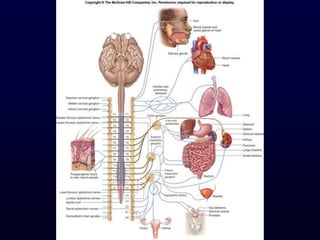
The ANS affects the following:heart ratedigestionrespiration rate salivation perspiration diameter of the pupils micturition (urination) sexual arousal
Whereas most of its actions are involuntary, some actions of the ANS, such as breathing, work in tandem with the conscious mind.
The ANS is:Purely motor (though some references include visceral sensory as an arm of the ANS)A functional, not anatomical, divisionOpposite is the somatic nervous systemMostly working beyond our conscious awareness
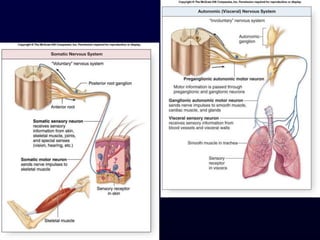
Autonomic vs. SomaticIf we follow a nerve impulse from the CNS to an effector within the SNS, how many motor neurons would be involved?If we follow a nerve impulse from the CNS to an effector within the ANS, how many motor neurons would be involved?
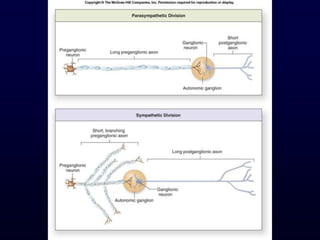
Autonomic vs. SomaticA motor neuron within the ANS that lies between the CNS and a ganglion is what type of neuron?Pre-ganglionic - myelinatedA motor neuron within the ANS that lies between a ganglion  and an effector is what type of neuron?Ganglionic - unmyelinated
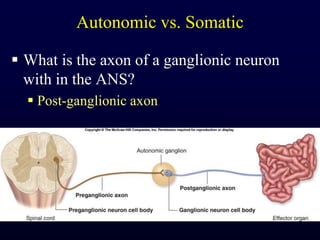
Autonomic vs. SomaticWhat is the axon of a ganglionic neuron with in the ANS?Post-ganglionic axon
ANS DivisionsWhat are the 2 divisions of the ANS?Sympathetic divisionParasympathetic division
ANS DivisionsWhat division of the ANS is primarily concerned with conserving energy and replenishing nutrient stores and has been nicknamed the “rest-and-digest” division?Parasympathetic division
ANS DivisionsWhat division of the ANS is primarily concerned with preparing the body for emergencies and is often referred to as the “fight-or-flight” division?Sympathetic division
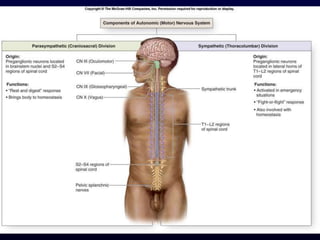
The parasympathetic division is sometimes referred to as “craniosacral” because the nerves arise from the brain stem (mainly vagus) & sacral regionThe sympathetic division is sometimes referred to as “thoracolumbar” because of the sympathetic neurons in the spinal nerves of these regions.
Parasympathetic DivisionWhat is another term for the parasympathetic division?_________ division
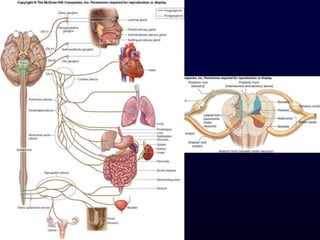
Parasympathetic DivisionWhere are the cell bodies of the preganglionic neurons for the parasympathetic division located?BrainstemS2-S4 (lateral gray matter of spinal cord)
Parasympathetic DivisionWhere are the ganglia of the parasympathetic division found?Terminal ganglia - close to target organIntramural ganglia - within wall of target organ
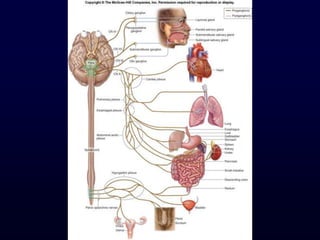
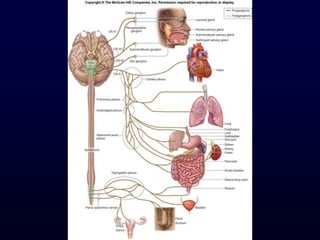
Parasympathetic DivisionWhat cranial nerves carry parasympathetic fibers?III OculomotorVII FacialIX GlossopharyngealX Vagus
Parasympathetic DivisionThe parasympathetic division innervates what structures through the oculomotor nerve?Ciliary musclePupillary constrictor of irisDilator controlled by sympathetic division
Parasympathetic DivisionThe parasympathetic division innervates what structures through the facial nerve?Submandibular and sublingual glandsLacrimal glandGlands of nasal cavity, mouth, and palate
Parasympathetic DivisionThe parasympathetic division innervates what structures through the glossopharyngeal nerve?Parotid gland
Parasympathetic DivisionThe parasympathetic division innervates what structures through the vagus nerve?Thoracic and abdominal organs
Parasympathetic DivisionWhat specific regions of the spinal cord house the cell bodies of the parasympathetic division of the ANS?Lateral horns
Parasympathetic DivisionWhat nerves carry fibers of the parasympathetic division of the ANS through the pelvis?Pelvic splanchnic nervesWhat does ‘splanchnic’ mean?Visceral
Parasympathetic EffectsIncrease saliva productionConstrict pupilsConstrict airwaysProduce tearsIncrease GI motilityContract bladderErect penis/clitoris
Sympathetic DivisionWhat is another term for the sympathetic division?_____________ divisionFrom what regions of the CNS does the sympathetic division arise?T1-L2 (lateral horns of spinal cord)
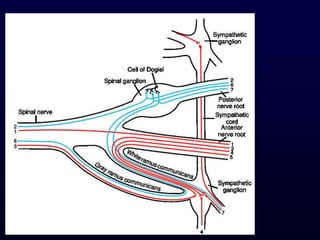
Sympathetic DivisionWhat part of spinal nerves do the preganglionic sympathetic axons travel within as they leave the lateral horn of the spinal cord?Anterior root
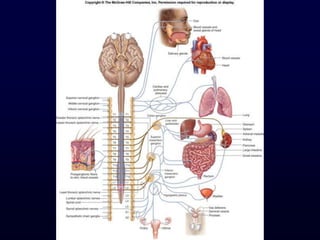
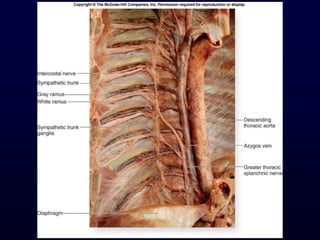
Sympathetic DivisionWhat sympathetic ganglia lie on the left and right sides of the vertebral column from T1-L2?Sympathetic trunk gangliaParavertebral gangliaWhat structure of the sympathetic division has the appearance of a pearl necklace?Sympathetic trunk (ganglia and axons)
Sympathetic DivisionWhat clusters of ganglia of the sympathetic division of the ANS lie within the neck?Cervical gangliaWhat are the connections between spinal nerves and the sympathetic trunks?Rami communicantes
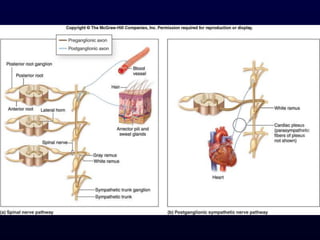
Sympathetic DivisionWhat structures carry preganglionic sympathetic axons from the T1-L2 spinal nerves to the sympathetic trunk?White ramiWhat structures carry postganglionic sympathetic axons from the sympathetic trunk to the spinal nerves?Gray rami
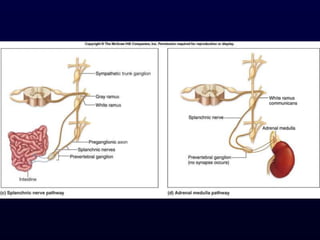
Sympathetic DivisionWhat structures are composed of preganglionic axons that do not synapse in a sympathetic trunk ganglion?Splanchnic nervesSplanchnic nerves of the sympathetic division of the ANS terminate in what structures?Prevertebral (collateral) ganglia
Sympathetic DivisionWhat structures are singular rather than paired, are anterior to the vertebral column, and are located only in the abdominal cavity?Prevertebral ganglia
Sympathetic DivisionList the 3 prevertebral gangliaCeliacSuperior mesentericInferior mesenteric
Sympathetic PathwaysWhat pathway is a postganglionic axon within if it travels through a gray ramus that is at the same level as the ganglionic neuron to innervate blood vessels or arrector pili muscles or sweat glands?Spinal nerve pathway
Sympathetic PathwaysWhat pathway is a postganglionic axon within if the preganglionic neuron synapses with a ganglionic neuron in a sympathetic trunk ganglion, but the postganglionic axon does not leave the trunk via a gray ramus, but instead extends away from the sympathetic trunk ganglion and goes directly to the effector organ?Postganglionic sympathetic nerve pathway
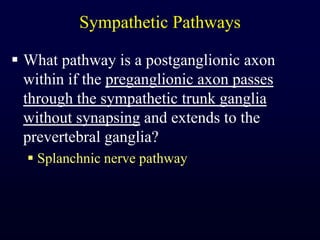
Sympathetic PathwaysWhat pathway is a postganglionic axon within if the preganglionic axon passes through the sympathetic trunk ganglia without synapsing and extends to the prevertebral ganglia?Splanchnic nerve pathway
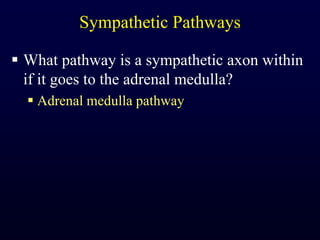
Sympathetic PathwaysWhat pathway is a sympathetic axon within if it goes to the adrenal medulla?Adrenal medulla pathway
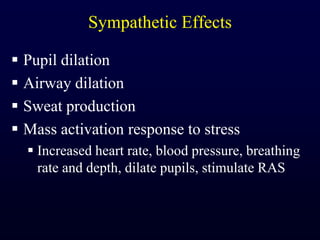
Sympathetic EffectsPupil dilationAirway dilationSweat productionMass activation response to stressIncreased heart rate, blood pressure, breathing rate and depth, dilate pupils, stimulate RAS
Autonomic Nervous SystemUsually both divisions of the ANS innervate organs. Where does this dual innervation not occur?Cutaneous regionIncludes peripheral blood vesselsSympathetic only
Autonomic PlexusesWhat are collections of sympathetic postganglionic axons, parasympathetic preganglionic axons, and some visceral sensory axons?Autonomic plexuses
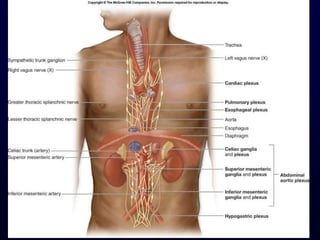
Autonomic PlexusesList the 5 autonomic plexusesCardiac plexusEsophageal plexusPulmonary plexusAbdominal plexusHypogastric plexus
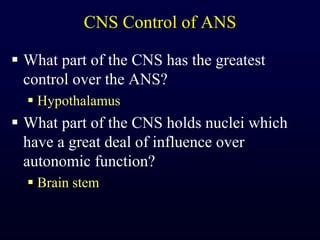
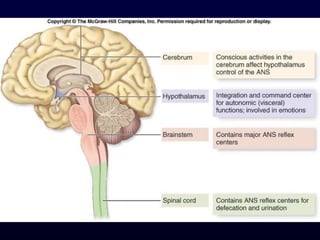
CNS Control of ANSWhat part of the CNS has the greatest control over the ANS?HypothalamusWhat part of the CNS holds nuclei which have a great deal of influence over autonomic function?Brain stem
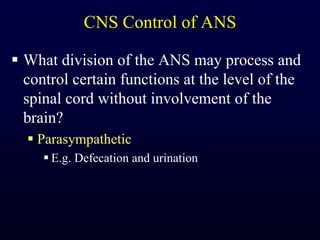
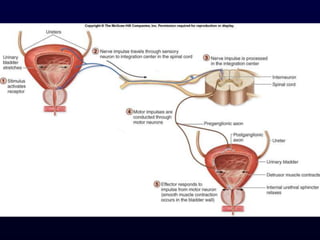
CNS Control of ANSWhat division of the ANS may process and control certain functions at the level of the spinal cord without involvement of the brain?ParasympatheticE.g. Defecation and urination
How does the parasympathetic reflex for urination relate to potty training?
The End of Autonomic Nervous System 

Autonomic Nervous System

  • 1.
    Nervous 3Autonomic NervousSystemMcKinley and O’LaughlinChapter 18
  • 2.
    IntroductionWhat part ofthe vertebrate nervous system innervates smooth and cardiac muscle and glandular tissues and governs involuntary, vital functions?
  • 3.
    The ANS affectsthe following:heart ratedigestionrespiration rate salivation perspiration diameter of the pupils micturition (urination) sexual arousal
  • 4.
    Whereas most ofits actions are involuntary, some actions of the ANS, such as breathing, work in tandem with the conscious mind.
  • 5.
    The ANS is:Purelymotor (though some references include visceral sensory as an arm of the ANS)A functional, not anatomical, divisionOpposite is the somatic nervous systemMostly working beyond our conscious awareness
  • 6.
    Autonomic vs. SomaticIfwe follow a nerve impulse from the CNS to an effector within the SNS, how many motor neurons would be involved?If we follow a nerve impulse from the CNS to an effector within the ANS, how many motor neurons would be involved?
  • 8.
    Autonomic vs. SomaticAmotor neuron within the ANS that lies between the CNS and a ganglion is what type of neuron?Pre-ganglionic - myelinatedA motor neuron within the ANS that lies between a ganglion and an effector is what type of neuron?Ganglionic - unmyelinated
  • 9.
    Autonomic vs. SomaticWhatis the axon of a ganglionic neuron with in the ANS?Post-ganglionic axon
  • 10.
    ANS DivisionsWhat arethe 2 divisions of the ANS?Sympathetic divisionParasympathetic division
  • 11.
    ANS DivisionsWhat divisionof the ANS is primarily concerned with conserving energy and replenishing nutrient stores and has been nicknamed the “rest-and-digest” division?Parasympathetic division
  • 12.
    ANS DivisionsWhat divisionof the ANS is primarily concerned with preparing the body for emergencies and is often referred to as the “fight-or-flight” division?Sympathetic division
  • 13.
    The parasympathetic divisionis sometimes referred to as “craniosacral” because the nerves arise from the brain stem (mainly vagus) & sacral regionThe sympathetic division is sometimes referred to as “thoracolumbar” because of the sympathetic neurons in the spinal nerves of these regions.
  • 16.
    Parasympathetic DivisionWhat isanother term for the parasympathetic division?_________ division
  • 17.
    Parasympathetic DivisionWhere arethe cell bodies of the preganglionic neurons for the parasympathetic division located?BrainstemS2-S4 (lateral gray matter of spinal cord)
  • 18.
    Parasympathetic DivisionWhere arethe ganglia of the parasympathetic division found?Terminal ganglia - close to target organIntramural ganglia - within wall of target organ
  • 20.
    Parasympathetic DivisionWhat cranialnerves carry parasympathetic fibers?III OculomotorVII FacialIX GlossopharyngealX Vagus
  • 21.
    Parasympathetic DivisionThe parasympatheticdivision innervates what structures through the oculomotor nerve?Ciliary musclePupillary constrictor of irisDilator controlled by sympathetic division
  • 22.
    Parasympathetic DivisionThe parasympatheticdivision innervates what structures through the facial nerve?Submandibular and sublingual glandsLacrimal glandGlands of nasal cavity, mouth, and palate
  • 23.
    Parasympathetic DivisionThe parasympatheticdivision innervates what structures through the glossopharyngeal nerve?Parotid gland
  • 24.
    Parasympathetic DivisionThe parasympatheticdivision innervates what structures through the vagus nerve?Thoracic and abdominal organs
  • 26.
    Parasympathetic DivisionWhat specificregions of the spinal cord house the cell bodies of the parasympathetic division of the ANS?Lateral horns
  • 27.
    Parasympathetic DivisionWhat nervescarry fibers of the parasympathetic division of the ANS through the pelvis?Pelvic splanchnic nervesWhat does ‘splanchnic’ mean?Visceral
  • 29.
    Parasympathetic EffectsIncrease salivaproductionConstrict pupilsConstrict airwaysProduce tearsIncrease GI motilityContract bladderErect penis/clitoris
  • 30.
    Sympathetic DivisionWhat isanother term for the sympathetic division?_____________ divisionFrom what regions of the CNS does the sympathetic division arise?T1-L2 (lateral horns of spinal cord)
  • 31.
    Sympathetic DivisionWhat partof spinal nerves do the preganglionic sympathetic axons travel within as they leave the lateral horn of the spinal cord?Anterior root
  • 32.
    Sympathetic DivisionWhat sympatheticganglia lie on the left and right sides of the vertebral column from T1-L2?Sympathetic trunk gangliaParavertebral gangliaWhat structure of the sympathetic division has the appearance of a pearl necklace?Sympathetic trunk (ganglia and axons)
  • 33.
    Sympathetic DivisionWhat clustersof ganglia of the sympathetic division of the ANS lie within the neck?Cervical gangliaWhat are the connections between spinal nerves and the sympathetic trunks?Rami communicantes
  • 35.
    Sympathetic DivisionWhat structurescarry preganglionic sympathetic axons from the T1-L2 spinal nerves to the sympathetic trunk?White ramiWhat structures carry postganglionic sympathetic axons from the sympathetic trunk to the spinal nerves?Gray rami
  • 38.
    Sympathetic DivisionWhat structuresare composed of preganglionic axons that do not synapse in a sympathetic trunk ganglion?Splanchnic nervesSplanchnic nerves of the sympathetic division of the ANS terminate in what structures?Prevertebral (collateral) ganglia
  • 39.
    Sympathetic DivisionWhat structuresare singular rather than paired, are anterior to the vertebral column, and are located only in the abdominal cavity?Prevertebral ganglia
  • 40.
    Sympathetic DivisionList the3 prevertebral gangliaCeliacSuperior mesentericInferior mesenteric
  • 42.
    Sympathetic PathwaysWhat pathwayis a postganglionic axon within if it travels through a gray ramus that is at the same level as the ganglionic neuron to innervate blood vessels or arrector pili muscles or sweat glands?Spinal nerve pathway
  • 43.
    Sympathetic PathwaysWhat pathwayis a postganglionic axon within if the preganglionic neuron synapses with a ganglionic neuron in a sympathetic trunk ganglion, but the postganglionic axon does not leave the trunk via a gray ramus, but instead extends away from the sympathetic trunk ganglion and goes directly to the effector organ?Postganglionic sympathetic nerve pathway
  • 45.
    Sympathetic PathwaysWhat pathwayis a postganglionic axon within if the preganglionic axon passes through the sympathetic trunk ganglia without synapsing and extends to the prevertebral ganglia?Splanchnic nerve pathway
  • 46.
    Sympathetic PathwaysWhat pathwayis a sympathetic axon within if it goes to the adrenal medulla?Adrenal medulla pathway
  • 48.
    Sympathetic EffectsPupil dilationAirwaydilationSweat productionMass activation response to stressIncreased heart rate, blood pressure, breathing rate and depth, dilate pupils, stimulate RAS
  • 49.
    Autonomic Nervous SystemUsuallyboth divisions of the ANS innervate organs. Where does this dual innervation not occur?Cutaneous regionIncludes peripheral blood vesselsSympathetic only
  • 50.
    Autonomic PlexusesWhat arecollections of sympathetic postganglionic axons, parasympathetic preganglionic axons, and some visceral sensory axons?Autonomic plexuses
  • 51.
    Autonomic PlexusesList the5 autonomic plexusesCardiac plexusEsophageal plexusPulmonary plexusAbdominal plexusHypogastric plexus
  • 53.
    CNS Control ofANSWhat part of the CNS has the greatest control over the ANS?HypothalamusWhat part of the CNS holds nuclei which have a great deal of influence over autonomic function?Brain stem
  • 55.
    CNS Control ofANSWhat division of the ANS may process and control certain functions at the level of the spinal cord without involvement of the brain?ParasympatheticE.g. Defecation and urination
  • 57.
    How does theparasympathetic reflex for urination relate to potty training?
  • 58.
    The End ofAutonomic Nervous System 