Endocrine Glands:
Secretion and Action of Hormones
Human
physiolog
y
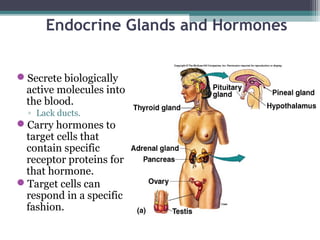
Endocrine Glands and Hormones
Secrete biologically
active molecules into
the blood.
◦ Lack ducts.
Carry hormones to
target cells that
contain specific
receptor proteins for
that hormone.
Target cells can
respond in a specific
fashion.
Endocrine Glands and Hormones
(continued)
• Neurohormone:
▫ Specialized neurons that secrete chemicals into the
blood rather than synaptic cleft.
 Chemical secreted is called neurohormone.
• Hormones:
▫ Affect metabolism of target organs.
 Help regulate total body metabolism, growth, and
reproduction.
Chemical Classification of Hormones
• Amines:
▫ Hormones derived from tyrosine and tryptophan.
 NE, Epi, T4.
• Polypeptides and proteins:
▫ Polypeptides:
 Chains of < 100 amino acids in length.
 ADH.
▫ Protein hormones:
 Polypeptide chains with > 100 amino acids.
 Growth hormone.
Chemical Classification of
Hormones (continued)
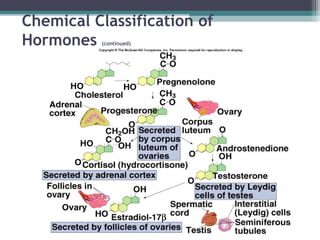
• Lipids derived from cholesterol.
▫ Are lipophilic hormones.
 Testosterone.
 Estradiol.
 Cortisol.
 Progesterone.
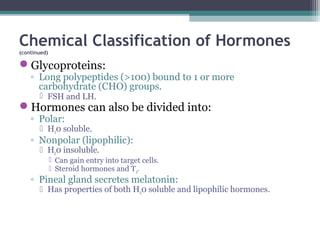
Chemical Classification of
Hormones (continued)
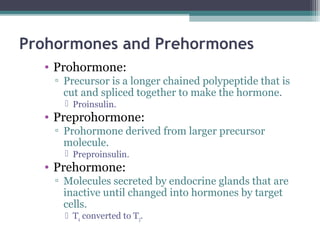
Chemical Classification of Hormones
(continued)
Glycoproteins:
◦ Long polypeptides (>100) bound to 1 or more
carbohydrate (CHO) groups.
 FSH and LH.
Hormones can also be divided into:
◦ Polar:
 H20 soluble.
◦ Nonpolar (lipophilic):
 H20 insoluble.
 Can gain entry into target cells.
 Steroid hormones and T4.
◦ Pineal gland secretes melatonin:
 Has properties of both H20 soluble and lipophilic hormones.
Prohormones and Prehormones
• Prohormone:
▫ Precursor is a longer chained polypeptide that is
cut and spliced together to make the hormone.
 Proinsulin.
• Preprohormone:
▫ Prohormone derived from larger precursor
molecule.
 Preproinsulin.
• Prehormone:
▫ Molecules secreted by endocrine glands that are
inactive until changed into hormones by target
cells.
 T4 converted to T3.
Common Aspects of Neural and Endocrine
Regulation
• APs are chemical events produced by diffusion of ions
through neuron plasma membrane.
• Action of some hormones are accompanied by ion
diffusion and electrical changes in the target cell.
▫ Nerve axon boutons release NTs.
▫ Some chemicals are secreted as hormones, and also are NTs.
• In order for either a NT or hormone to function in
physiological regulation:
▫ Target cell must have specific receptor proteins.
▫ Combination of the regulatory molecule with its receptor
proteins must cause a specific sequence of changes.
▫ There must be a mechanism to quickly turn off the action of a
regulator.
Hormonal Interactions
• Synergistic:
▫ Two hormones work together to produce a
result.
▫ Additive:
 Each hormone separately produces response,
together at same concentrations stimulate even
greater effect.
 NE and Epi.
▫ Complementary:
 Each hormone stimulates different step in the
process.
 FSH and testosterone.
Hormonal Interactions (continued)
▫ Permissive effects:
 Hormone enhances the responsiveness of a
target organ to second hormone.
 Increases the activity of a second hormone.
▫ Prior exposure of uterus to estrogen induces formation of
receptors for progesterone.
▫ Antagonistic effects:
 Action of one hormone antagonizes the effects of
another.
 Insulin and glucagon.
Effects of [Hormone] on Tissue
Response
• [Hormone] in blood reflects the rate of
secretion.
• Half-life:
▫ Time required for the blood [hormone] to be reduced
to ½ reference level.
 Minutes to days.
• Normal tissue responses are produced only
when [hormone] are present within
physiological range.
• Varying [hormone] within normal,
physiological range can affect the
responsiveness of target cells.
Effects of [Hormone] on Tissue
Response (continued)
• Priming effect (upregulation):
▫ Increase number of receptors formed on target
cells in response to particular hormone.
▫ Greater response by the target cell.
• Desensitization (downregulation):
▫ Prolonged exposure to high [polypeptide
hormone].
 Subsequent exposure to the same [hormone] produces less
response.
 Decrease in number of receptors on target cells.
▫ Insulin in adipose cells.
▫ Pulsatile secretion may prevent downregulation.
Mechanisms of Hormone Action
• Hormones of same chemical class have similar
mechanisms of action.
▫ Similarities include:
 Location of cellular receptor proteins depends on
the chemical nature of the hormone.
 Events that occur in the target cells.
• To respond to a hormone:
▫ Target cell must have specific receptors for that
hormone (specificity).
 Hormones exhibit:
 Affinity (bind to receptors with high bond strength).
 Saturation (low capacity of receptors).
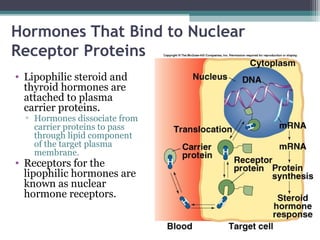
Hormones That Bind to Nuclear
Receptor Proteins
• Lipophilic steroid and
thyroid hormones are
attached to plasma
carrier proteins.
▫ Hormones dissociate from
carrier proteins to pass
through lipid component
of the target plasma
membrane.
• Receptors for the
lipophilic hormones are
known as nuclear
hormone receptors.
Nuclear Hormone Receptors
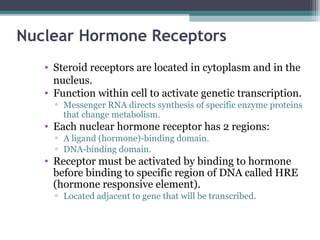
• Steroid receptors are located in cytoplasm and in the
nucleus.
• Function within cell to activate genetic transcription.
▫ Messenger RNA directs synthesis of specific enzyme proteins
that change metabolism.
• Each nuclear hormone receptor has 2 regions:
▫ A ligand (hormone)-binding domain.
▫ DNA-binding domain.
• Receptor must be activated by binding to hormone
before binding to specific region of DNA called HRE
(hormone responsive element).
▫ Located adjacent to gene that will be transcribed.
Mechanisms of Steroid Hormone
Action
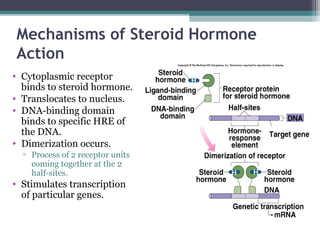
• Cytoplasmic receptor
binds to steroid hormone.
• Translocates to nucleus.
• DNA-binding domain
binds to specific HRE of
the DNA.
• Dimerization occurs.
▫ Process of 2 receptor units
coming together at the 2
half-sites.
• Stimulates transcription
of particular genes.
Mechanism of Thyroid Hormone Action
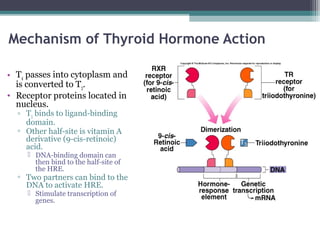
• T4 passes into cytoplasm and
is converted to T3.
• Receptor proteins located in
nucleus.
▫ T3 binds to ligand-binding
domain.
▫ Other half-site is vitamin A
derivative (9-cis-retinoic)
acid.
 DNA-binding domain can
then bind to the half-site of
the HRE.
▫ Two partners can bind to the
DNA to activate HRE.
 Stimulate transcription of
genes.
Hormones That Use 2nd
Messengers
• Hormones cannot pass through plasma
membrane use 2nd
messengers.
▫ Catecholamine, polypeptide, and glycoprotein
hormones bind to receptor proteins on the
target plasma membrane.
• Actions are mediated by 2nd
messengers
(signal-transduction mechanisms).
▫ Extracellular hormones are transduced into
intracellular 2nd
messengers.
Adenylate Cyclase-cAMP
• Polypeptide or glycoprotein hormone binds to
receptor protein causing dissociation of a
subunit of G-protein.
• G-protein subunit binds to and activates
adenylate cyclase.
• ATP cAMP + PPi
• cAMP attaches to inhibitory subunit of
protein kinase.
• Inhibitory subunit dissociates and activates
protein kinase.
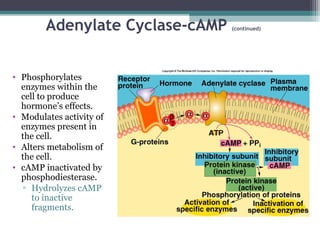
Adenylate Cyclase-cAMP (continued)
• Phosphorylates
enzymes within the
cell to produce
hormone’s effects.
• Modulates activity of
enzymes present in
the cell.
• Alters metabolism of
the cell.
• cAMP inactivated by
phosphodiesterase.
▫ Hydrolyzes cAMP
to inactive
fragments.
Phospholipase-C-Ca2+
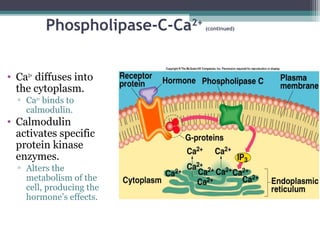
• Binding of Epi to α-adrenergic receptor in
plasma membrane activates a G-protein
intermediate, phospholipase C.
▫ Phospholipase C splits phospholipid into IP3
and DAG.
 Both derivatives serve as 2nd
messengers.
• IP3 diffuses through cytoplasm to ER.
▫ Binding of IP3 to receptor protein in ER causes
Ca2+
channels to open.
Phospholipase-C-Ca2+
(continued)
• Ca2+
diffuses into
the cytoplasm.
▫ Ca2+
binds to
calmodulin.
• Calmodulin
activates specific
protein kinase
enzymes.
▫ Alters the
metabolism of the
cell, producing the
hormone’s effects.
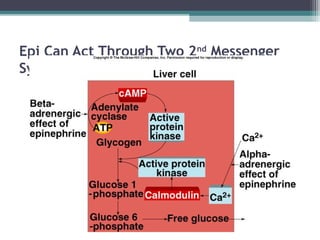
Epi Can Act Through Two 2nd
Messenger
Systems
Tyrosine Kinase
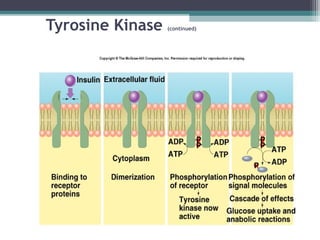
• Insulin receptor consists of 2 units that dimerize
when they bind with insulin.
▫ Insulin binds to ligand–binding site on plasma
membrane, activating enzymatic site in the cytoplasm.
• Autophosphorylation occurs, increasing tyrosine
kinase activity.
• Activates signaling molecules.
▫ Stimulate glycogen, fat and protein synthesis.
▫ Stimulate insertion of GLUT-4 carrier proteins.
Tyrosine Kinase (continued)
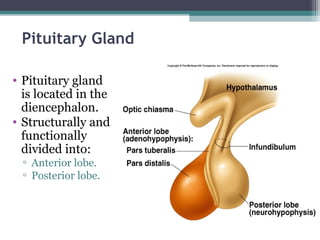
Pituitary Gland
• Pituitary gland
is located in the
diencephalon.
• Structurally and
functionally
divided into:
▫ Anterior lobe.
▫ Posterior lobe.
Pituitary Gland (continued)
• Anterior pituitary:
▫ Master gland (adenohypophysis).
▫ Derived from a pouch of epithelial tissue that
migrates upward from the mouth.
 Consists of 2 parts:
 Pars distalis: anterior pituitary.
 Pars tuberalis: thin extension in contact with the infundibulum.
• Posterior pituitary(neurohypophysis):
▫ Formed by downgrowth of the brain during fetal
development.
▫ Is in contact with the infundibulum.
 Nerve fibers extend through the infundibulum.
Pituitary Hormones
• Anterior
Pituitary:
▫ Trophic effects:
 High blood
[hormone] causes
target organ to
hypertrophy.
 Low blood
[hormone] causes
target organ to
atrophy.
Pituitary Hormones (continued)
• Posterior pituitary:
▫ Stores and releases 2 hormones that are
produced in the hypothalamus:
 Antidiuretic hormone (ADH/vasopressin):
 Promotes the retention of H20 by the kidneys.
▫ Less H20 is excreted in the urine.
 Oxytocin:
 Stimulates contractions of the uterus during parturition.
 Stimulates contractions of the mammary gland alveoli.
▫ Milk-ejection reflex.
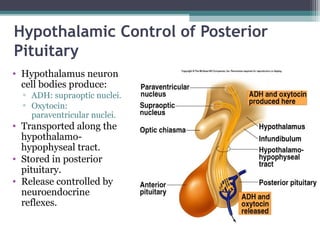
Hypothalamic Control of Posterior
Pituitary
• Hypothalamus neuron
cell bodies produce:
▫ ADH: supraoptic nuclei.
▫ Oxytocin:
paraventricular nuclei.
• Transported along the
hypothalamo-
hypophyseal tract.
• Stored in posterior
pituitary.
• Release controlled by
neuroendocrine
reflexes.
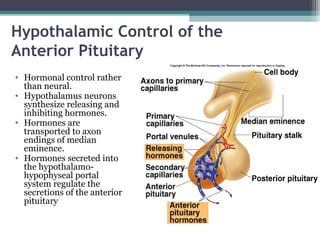
Hypothalamic Control of the
Anterior Pituitary
• Hormonal control rather
than neural.
• Hypothalamus neurons
synthesize releasing and
inhibiting hormones.
• Hormones are
transported to axon
endings of median
eminence.
• Hormones secreted into
the hypothalamo-
hypophyseal portal
system regulate the
secretions of the anterior
pituitary
Feedback Control of the Anterior
Pituitary
• Anterior pituitary and hypothalamic
secretions are controlled by the target organs
they regulate.
▫ Secretions are controlled by negative feedback
inhibition by target gland hormones.
• Negative feedback at 2 levels:
▫ The target gland hormone can act on the
hypothalamus and inhibit secretion of releasing
hormones.
▫ The target gland hormone can act on the anterior
pituitary and inhibit response to the releasing
hormone.
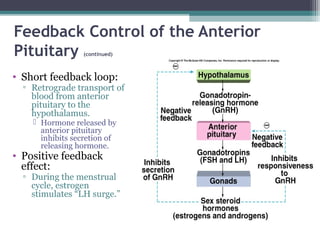
Feedback Control of the Anterior
Pituitary (continued)
• Short feedback loop:
▫ Retrograde transport of
blood from anterior
pituitary to the
hypothalamus.
 Hormone released by
anterior pituitary
inhibits secretion of
releasing hormone.
• Positive feedback
effect:
▫ During the menstrual
cycle, estrogen
stimulates “LH surge.”
Higher Brain Function and Pituitary
Secretion
• Axis:
▫ Relationship between anterior pituitary and a
particular target gland.
 Pituitary-gonad axis.
• Hypothalamus receives input from higher brain
centers.
▫ Psychological stress affects:
 Circadian rhythms.
 Menstrual cycle.
Adrenal Glands
• Paired organs that cap the kidneys.
• Each gland consists of an outer cortex and inner
medulla.
• Adrenal medulla:
▫ Derived from embryonic neural crest ectoderm
(same tissue that produces the sympathetic
ganglia).
▫ Synthesizes and secretes:
 Catecholamines (mainly Epi but some NE).
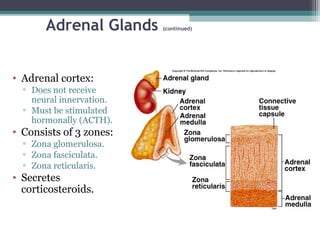
Adrenal Glands (continued)
• Adrenal cortex:
▫ Does not receive
neural innervation.
▫ Must be stimulated
hormonally (ACTH).
• Consists of 3 zones:
▫ Zona glomerulosa.
▫ Zona fasciculata.
▫ Zona reticularis.
• Secretes
corticosteroids.
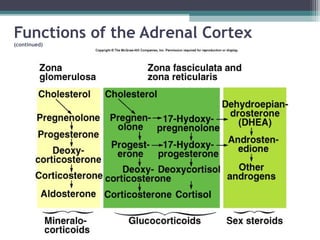
Functions of the Adrenal Cortex
• Zona glomerulosa:
▫ Mineralcorticoids (aldosterone):
 Stimulate kidneys to reabsorb Na+
and secrete
K+
.
• Zona fasciculata:
▫ Glucocorticoids (cortisol):
 Inhibit glucose utilization and stimulate
gluconeogenesis.
• Zona reticularis (DHEA):
▫ Sex steroids:
 Supplement sex steroids.
Functions of the Adrenal Cortex
(continued)
Functions of the Adrenal Medulla
• Innervated by preganglionic sympathetic axons.
▫ Increase respiratory rate.
▫ Increase HR and cardiac output.
▫ Vasoconstrict blood vessels, thus increasing
venous return.
▫ Stimulate glycogenolysis.
▫ Stimulate lipolysis.
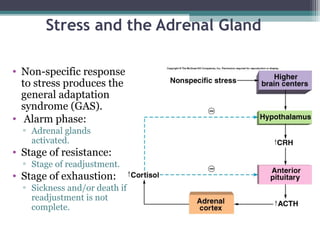
Stress and the Adrenal Gland
• Non-specific response
to stress produces the
general adaptation
syndrome (GAS).
• Alarm phase:
▫ Adrenal glands
activated.
• Stage of resistance:
▫ Stage of readjustment.
• Stage of exhaustion:
▫ Sickness and/or death if
readjustment is not
complete.
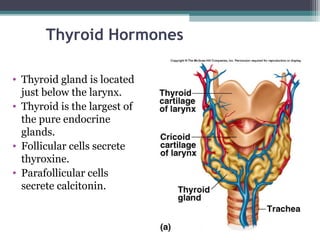
Thyroid Hormones
• Thyroid gland is located
just below the larynx.
• Thyroid is the largest of
the pure endocrine
glands.
• Follicular cells secrete
thyroxine.
• Parafollicular cells
secrete calcitonin.
Production of Thyroid Hormones
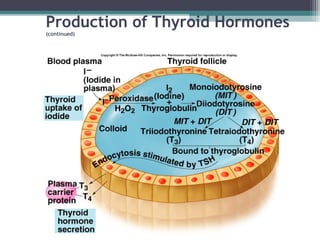
• Iodide (I-
) actively transported into the
follicle and secreted into the colloid.
• Oxidized to iodine (Io
).
• Iodine attached to tyrosine within
thyroglobulin chain.
▫ Attachment of 1 iodine produces monoiodotyrosine
(MIT).
▫ Attachment of 2 iodines produces diiodotyrosine
(DIT).
• MIT and DIT or 2 DIT molecules coupled
together.
Production of Thyroid Hormones
(continued)
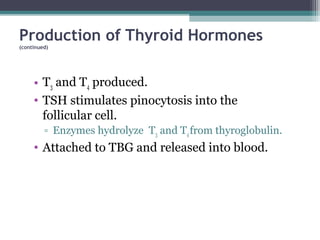
• T3 and T4 produced.
• TSH stimulates pinocytosis into the
follicular cell.
▫ Enzymes hydrolyze T3 and T4from thyroglobulin.
• Attached to TBG and released into blood.
Production of Thyroid Hormones
(continued)
Actions of T3
• Stimulates protein synthesis.
• Promotes maturation of nervous system.
• Stimulates rate of cellular respiration by:
▫ Production of uncoupling proteins.
▫ Increase active transport by Na+
/K+
pumps.
▫ Lower cellular [ATP].
• Increases metabolic heat.
• Increases metabolic rate.
▫ Stimulates increased consumption of glucose, fatty
acids and other molecules.
Diseases of the Thyroid
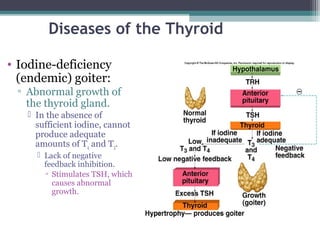
• Iodine-deficiency
(endemic) goiter:
▫ Abnormal growth of
the thyroid gland.
 In the absence of
sufficient iodine, cannot
produce adequate
amounts of T4 and T3.
 Lack of negative
feedback inhibition.
▫ Stimulates TSH, which
causes abnormal
growth.
Diseases of the Thyroid (continued)
[Iodine-deficiency (endemic) goiter—continued]
▫ Adult myxedema:
 Accumulation of mucoproteins and fluid in subcutaneous tissue.
▫ Symptoms:
 Decreased metabolic rate.
 Weight gain.
 Decreased ability to adapt to cold.
 Lethargy.
• Grave’s disease:
▫ Autoimmune disorder:
 Exerts TSH-like effects on thyroid.
 Not affected by negative feedback.
• Cretinism:
▫ Hypothyroid from end of 1st
trimester to 6 months postnatally.
 Severe mental retardation.
Parathyroid Glands
• Embedded in the lateral
lobes of the thyroid gland.
• Parathyroid hormone
(PTH):
▫ Only hormone secreted by
the parathyroid glands.
• Single most important
hormone in the control of
blood [Ca2+
].
• Stimulated by decreased
blood [Ca2+
].
• Promotes rise in blood [Ca2+
]
by acting on bones, kidney
and intestines.
Pancreatic Islets (Islets of
Langerhans)
• Alpha cells secrete glucagon.
▫ Stimulus is decrease in blood
[glucose].
▫ Stimulates glycogenolysis
and lipolysis.
▫ Stimulates conversion of
fatty acids to ketones.
• Beta cells secrete insulin.
▫ Stimulus is increase in blood
[glucose].
▫ Promotes entry of glucose
into cells.
▫ Converts glucose to glycogen
and fat.
▫ Aids entry of amino acids
into cells.
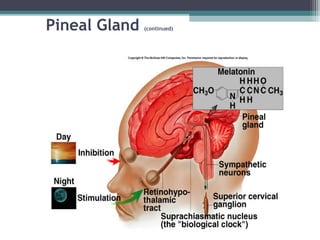
Pineal Gland
• Secretes melatonin:
▫ Production stimulated by the suprachiasmatic nucleus (SCN)
in hypothalamus.
 SCN is primary center for circadian rhythms.
 Light/dark changes required to synchronize.
 Melatonin secretion increases with darkness and peaks in middle
of night.
▫ May inhibit GnRH.
▫ May function in the onset of puberty (controversial).
Pineal Gland (continued)
Thymus
• Site of production of T cells (thymus-dependent
cells), which are lymphocytes.
▫ Lymphocytes are involved in cell-mediated immunity.
• Secretes hormones that are believed to stimulate
T cells after leave thymus.
▫ Thymus gland size is large in newborns and children.
• Regresses after puberty and becomes infiltrated
with strands of fibrous tissue.
Gonads and Placenta
• Gonads (testes and ovaries):
▫ Secrete sex hormones.
 Testosterone.
 Estradiol 17-β.
 After menopause, produces estrone.
 Progesterone.
• Placenta:
▫ Secretes large amounts of estriol, progesterone,
hCG, hCS.
Autocrine and Paracrine Regulation
• Autocrine:
▫ Produced and act within the same tissue of an organ.
 All autocrine regulators control gene expression in target cells.
• Paracrine:
▫ Produced within one tissue and regulate a different tissue of
the same organ.
• Cytokines (lymphokines):
▫ Regulate different cells (interleukins) .
• Growth factors:
▫ Promote growth and cell division in any organ.
• Neutrophins:
▫ Guide regenerating peripheral neurons.
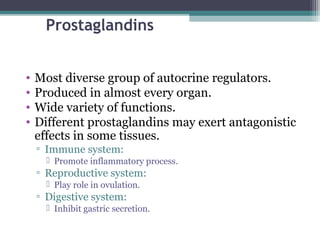
Prostaglandins
• Most diverse group of autocrine regulators.
• Produced in almost every organ.
• Wide variety of functions.
• Different prostaglandins may exert antagonistic
effects in some tissues.
▫ Immune system:
 Promote inflammatory process.
▫ Reproductive system:
 Play role in ovulation.
▫ Digestive system:
 Inhibit gastric secretion.
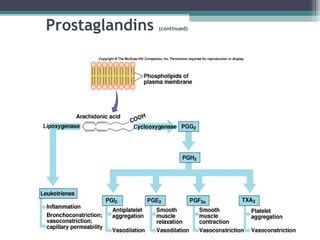
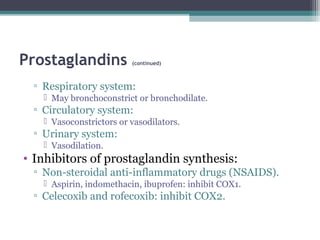
Prostaglandins (continued)
▫ Respiratory system:
 May bronchoconstrict or bronchodilate.
▫ Circulatory system:
 Vasoconstrictors or vasodilators.
▫ Urinary system:
 Vasodilation.
• Inhibitors of prostaglandin synthesis:
▫ Non-steroidal anti-inflammatory drugs (NSAIDS).
 Aspirin, indomethacin, ibuprofen: inhibit COX1.
▫ Celecoxib and rofecoxib: inhibit COX2.

Endocrine glands

  • 1.
    Endocrine Glands: Secretion andAction of Hormones Human physiolog y
  • 2.
    Endocrine Glands andHormones Secrete biologically active molecules into the blood. ◦ Lack ducts. Carry hormones to target cells that contain specific receptor proteins for that hormone. Target cells can respond in a specific fashion.
  • 3.
    Endocrine Glands andHormones (continued) • Neurohormone: ▫ Specialized neurons that secrete chemicals into the blood rather than synaptic cleft.  Chemical secreted is called neurohormone. • Hormones: ▫ Affect metabolism of target organs.  Help regulate total body metabolism, growth, and reproduction.
  • 4.
    Chemical Classification ofHormones • Amines: ▫ Hormones derived from tyrosine and tryptophan.  NE, Epi, T4. • Polypeptides and proteins: ▫ Polypeptides:  Chains of < 100 amino acids in length.  ADH. ▫ Protein hormones:  Polypeptide chains with > 100 amino acids.  Growth hormone.
  • 5.
    Chemical Classification of Hormones(continued) • Lipids derived from cholesterol. ▫ Are lipophilic hormones.  Testosterone.  Estradiol.  Cortisol.  Progesterone.
  • 6.
  • 7.
    Chemical Classification ofHormones (continued) Glycoproteins: ◦ Long polypeptides (>100) bound to 1 or more carbohydrate (CHO) groups.  FSH and LH. Hormones can also be divided into: ◦ Polar:  H20 soluble. ◦ Nonpolar (lipophilic):  H20 insoluble.  Can gain entry into target cells.  Steroid hormones and T4. ◦ Pineal gland secretes melatonin:  Has properties of both H20 soluble and lipophilic hormones.
  • 8.
    Prohormones and Prehormones •Prohormone: ▫ Precursor is a longer chained polypeptide that is cut and spliced together to make the hormone.  Proinsulin. • Preprohormone: ▫ Prohormone derived from larger precursor molecule.  Preproinsulin. • Prehormone: ▫ Molecules secreted by endocrine glands that are inactive until changed into hormones by target cells.  T4 converted to T3.
  • 9.
    Common Aspects ofNeural and Endocrine Regulation • APs are chemical events produced by diffusion of ions through neuron plasma membrane. • Action of some hormones are accompanied by ion diffusion and electrical changes in the target cell. ▫ Nerve axon boutons release NTs. ▫ Some chemicals are secreted as hormones, and also are NTs. • In order for either a NT or hormone to function in physiological regulation: ▫ Target cell must have specific receptor proteins. ▫ Combination of the regulatory molecule with its receptor proteins must cause a specific sequence of changes. ▫ There must be a mechanism to quickly turn off the action of a regulator.
  • 10.
    Hormonal Interactions • Synergistic: ▫Two hormones work together to produce a result. ▫ Additive:  Each hormone separately produces response, together at same concentrations stimulate even greater effect.  NE and Epi. ▫ Complementary:  Each hormone stimulates different step in the process.  FSH and testosterone.
  • 11.
    Hormonal Interactions (continued) ▫Permissive effects:  Hormone enhances the responsiveness of a target organ to second hormone.  Increases the activity of a second hormone. ▫ Prior exposure of uterus to estrogen induces formation of receptors for progesterone. ▫ Antagonistic effects:  Action of one hormone antagonizes the effects of another.  Insulin and glucagon.
  • 12.
    Effects of [Hormone]on Tissue Response • [Hormone] in blood reflects the rate of secretion. • Half-life: ▫ Time required for the blood [hormone] to be reduced to ½ reference level.  Minutes to days. • Normal tissue responses are produced only when [hormone] are present within physiological range. • Varying [hormone] within normal, physiological range can affect the responsiveness of target cells.
  • 13.
    Effects of [Hormone]on Tissue Response (continued) • Priming effect (upregulation): ▫ Increase number of receptors formed on target cells in response to particular hormone. ▫ Greater response by the target cell. • Desensitization (downregulation): ▫ Prolonged exposure to high [polypeptide hormone].  Subsequent exposure to the same [hormone] produces less response.  Decrease in number of receptors on target cells. ▫ Insulin in adipose cells. ▫ Pulsatile secretion may prevent downregulation.
  • 14.
    Mechanisms of HormoneAction • Hormones of same chemical class have similar mechanisms of action. ▫ Similarities include:  Location of cellular receptor proteins depends on the chemical nature of the hormone.  Events that occur in the target cells. • To respond to a hormone: ▫ Target cell must have specific receptors for that hormone (specificity).  Hormones exhibit:  Affinity (bind to receptors with high bond strength).  Saturation (low capacity of receptors).
  • 15.
    Hormones That Bindto Nuclear Receptor Proteins • Lipophilic steroid and thyroid hormones are attached to plasma carrier proteins. ▫ Hormones dissociate from carrier proteins to pass through lipid component of the target plasma membrane. • Receptors for the lipophilic hormones are known as nuclear hormone receptors.
  • 16.
    Nuclear Hormone Receptors •Steroid receptors are located in cytoplasm and in the nucleus. • Function within cell to activate genetic transcription. ▫ Messenger RNA directs synthesis of specific enzyme proteins that change metabolism. • Each nuclear hormone receptor has 2 regions: ▫ A ligand (hormone)-binding domain. ▫ DNA-binding domain. • Receptor must be activated by binding to hormone before binding to specific region of DNA called HRE (hormone responsive element). ▫ Located adjacent to gene that will be transcribed.
  • 17.
    Mechanisms of SteroidHormone Action • Cytoplasmic receptor binds to steroid hormone. • Translocates to nucleus. • DNA-binding domain binds to specific HRE of the DNA. • Dimerization occurs. ▫ Process of 2 receptor units coming together at the 2 half-sites. • Stimulates transcription of particular genes.
  • 18.
    Mechanism of ThyroidHormone Action • T4 passes into cytoplasm and is converted to T3. • Receptor proteins located in nucleus. ▫ T3 binds to ligand-binding domain. ▫ Other half-site is vitamin A derivative (9-cis-retinoic) acid.  DNA-binding domain can then bind to the half-site of the HRE. ▫ Two partners can bind to the DNA to activate HRE.  Stimulate transcription of genes.
  • 19.
    Hormones That Use2nd Messengers • Hormones cannot pass through plasma membrane use 2nd messengers. ▫ Catecholamine, polypeptide, and glycoprotein hormones bind to receptor proteins on the target plasma membrane. • Actions are mediated by 2nd messengers (signal-transduction mechanisms). ▫ Extracellular hormones are transduced into intracellular 2nd messengers.
  • 20.
    Adenylate Cyclase-cAMP • Polypeptideor glycoprotein hormone binds to receptor protein causing dissociation of a subunit of G-protein. • G-protein subunit binds to and activates adenylate cyclase. • ATP cAMP + PPi • cAMP attaches to inhibitory subunit of protein kinase. • Inhibitory subunit dissociates and activates protein kinase.
  • 21.
    Adenylate Cyclase-cAMP (continued) •Phosphorylates enzymes within the cell to produce hormone’s effects. • Modulates activity of enzymes present in the cell. • Alters metabolism of the cell. • cAMP inactivated by phosphodiesterase. ▫ Hydrolyzes cAMP to inactive fragments.
  • 22.
    Phospholipase-C-Ca2+ • Binding ofEpi to α-adrenergic receptor in plasma membrane activates a G-protein intermediate, phospholipase C. ▫ Phospholipase C splits phospholipid into IP3 and DAG.  Both derivatives serve as 2nd messengers. • IP3 diffuses through cytoplasm to ER. ▫ Binding of IP3 to receptor protein in ER causes Ca2+ channels to open.
  • 23.
    Phospholipase-C-Ca2+ (continued) • Ca2+ diffuses into thecytoplasm. ▫ Ca2+ binds to calmodulin. • Calmodulin activates specific protein kinase enzymes. ▫ Alters the metabolism of the cell, producing the hormone’s effects.
  • 24.
    Epi Can ActThrough Two 2nd Messenger Systems
  • 25.
    Tyrosine Kinase • Insulinreceptor consists of 2 units that dimerize when they bind with insulin. ▫ Insulin binds to ligand–binding site on plasma membrane, activating enzymatic site in the cytoplasm. • Autophosphorylation occurs, increasing tyrosine kinase activity. • Activates signaling molecules. ▫ Stimulate glycogen, fat and protein synthesis. ▫ Stimulate insertion of GLUT-4 carrier proteins.
  • 26.
  • 27.
    Pituitary Gland • Pituitarygland is located in the diencephalon. • Structurally and functionally divided into: ▫ Anterior lobe. ▫ Posterior lobe.
  • 28.
    Pituitary Gland (continued) •Anterior pituitary: ▫ Master gland (adenohypophysis). ▫ Derived from a pouch of epithelial tissue that migrates upward from the mouth.  Consists of 2 parts:  Pars distalis: anterior pituitary.  Pars tuberalis: thin extension in contact with the infundibulum. • Posterior pituitary(neurohypophysis): ▫ Formed by downgrowth of the brain during fetal development. ▫ Is in contact with the infundibulum.  Nerve fibers extend through the infundibulum.
  • 29.
    Pituitary Hormones • Anterior Pituitary: ▫Trophic effects:  High blood [hormone] causes target organ to hypertrophy.  Low blood [hormone] causes target organ to atrophy.
  • 30.
    Pituitary Hormones (continued) •Posterior pituitary: ▫ Stores and releases 2 hormones that are produced in the hypothalamus:  Antidiuretic hormone (ADH/vasopressin):  Promotes the retention of H20 by the kidneys. ▫ Less H20 is excreted in the urine.  Oxytocin:  Stimulates contractions of the uterus during parturition.  Stimulates contractions of the mammary gland alveoli. ▫ Milk-ejection reflex.
  • 31.
    Hypothalamic Control ofPosterior Pituitary • Hypothalamus neuron cell bodies produce: ▫ ADH: supraoptic nuclei. ▫ Oxytocin: paraventricular nuclei. • Transported along the hypothalamo- hypophyseal tract. • Stored in posterior pituitary. • Release controlled by neuroendocrine reflexes.
  • 32.
    Hypothalamic Control ofthe Anterior Pituitary • Hormonal control rather than neural. • Hypothalamus neurons synthesize releasing and inhibiting hormones. • Hormones are transported to axon endings of median eminence. • Hormones secreted into the hypothalamo- hypophyseal portal system regulate the secretions of the anterior pituitary
  • 33.
    Feedback Control ofthe Anterior Pituitary • Anterior pituitary and hypothalamic secretions are controlled by the target organs they regulate. ▫ Secretions are controlled by negative feedback inhibition by target gland hormones. • Negative feedback at 2 levels: ▫ The target gland hormone can act on the hypothalamus and inhibit secretion of releasing hormones. ▫ The target gland hormone can act on the anterior pituitary and inhibit response to the releasing hormone.
  • 34.
    Feedback Control ofthe Anterior Pituitary (continued) • Short feedback loop: ▫ Retrograde transport of blood from anterior pituitary to the hypothalamus.  Hormone released by anterior pituitary inhibits secretion of releasing hormone. • Positive feedback effect: ▫ During the menstrual cycle, estrogen stimulates “LH surge.”
  • 35.
    Higher Brain Functionand Pituitary Secretion • Axis: ▫ Relationship between anterior pituitary and a particular target gland.  Pituitary-gonad axis. • Hypothalamus receives input from higher brain centers. ▫ Psychological stress affects:  Circadian rhythms.  Menstrual cycle.
  • 36.
    Adrenal Glands • Pairedorgans that cap the kidneys. • Each gland consists of an outer cortex and inner medulla. • Adrenal medulla: ▫ Derived from embryonic neural crest ectoderm (same tissue that produces the sympathetic ganglia). ▫ Synthesizes and secretes:  Catecholamines (mainly Epi but some NE).
  • 37.
    Adrenal Glands (continued) •Adrenal cortex: ▫ Does not receive neural innervation. ▫ Must be stimulated hormonally (ACTH). • Consists of 3 zones: ▫ Zona glomerulosa. ▫ Zona fasciculata. ▫ Zona reticularis. • Secretes corticosteroids.
  • 38.
    Functions of theAdrenal Cortex • Zona glomerulosa: ▫ Mineralcorticoids (aldosterone):  Stimulate kidneys to reabsorb Na+ and secrete K+ . • Zona fasciculata: ▫ Glucocorticoids (cortisol):  Inhibit glucose utilization and stimulate gluconeogenesis. • Zona reticularis (DHEA): ▫ Sex steroids:  Supplement sex steroids.
  • 39.
    Functions of theAdrenal Cortex (continued)
  • 40.
    Functions of theAdrenal Medulla • Innervated by preganglionic sympathetic axons. ▫ Increase respiratory rate. ▫ Increase HR and cardiac output. ▫ Vasoconstrict blood vessels, thus increasing venous return. ▫ Stimulate glycogenolysis. ▫ Stimulate lipolysis.
  • 41.
    Stress and theAdrenal Gland • Non-specific response to stress produces the general adaptation syndrome (GAS). • Alarm phase: ▫ Adrenal glands activated. • Stage of resistance: ▫ Stage of readjustment. • Stage of exhaustion: ▫ Sickness and/or death if readjustment is not complete.
  • 42.
    Thyroid Hormones • Thyroidgland is located just below the larynx. • Thyroid is the largest of the pure endocrine glands. • Follicular cells secrete thyroxine. • Parafollicular cells secrete calcitonin.
  • 43.
    Production of ThyroidHormones • Iodide (I- ) actively transported into the follicle and secreted into the colloid. • Oxidized to iodine (Io ). • Iodine attached to tyrosine within thyroglobulin chain. ▫ Attachment of 1 iodine produces monoiodotyrosine (MIT). ▫ Attachment of 2 iodines produces diiodotyrosine (DIT). • MIT and DIT or 2 DIT molecules coupled together.
  • 44.
    Production of ThyroidHormones (continued) • T3 and T4 produced. • TSH stimulates pinocytosis into the follicular cell. ▫ Enzymes hydrolyze T3 and T4from thyroglobulin. • Attached to TBG and released into blood.
  • 45.
    Production of ThyroidHormones (continued)
  • 46.
    Actions of T3 •Stimulates protein synthesis. • Promotes maturation of nervous system. • Stimulates rate of cellular respiration by: ▫ Production of uncoupling proteins. ▫ Increase active transport by Na+ /K+ pumps. ▫ Lower cellular [ATP]. • Increases metabolic heat. • Increases metabolic rate. ▫ Stimulates increased consumption of glucose, fatty acids and other molecules.
  • 47.
    Diseases of theThyroid • Iodine-deficiency (endemic) goiter: ▫ Abnormal growth of the thyroid gland.  In the absence of sufficient iodine, cannot produce adequate amounts of T4 and T3.  Lack of negative feedback inhibition. ▫ Stimulates TSH, which causes abnormal growth.
  • 48.
    Diseases of theThyroid (continued) [Iodine-deficiency (endemic) goiter—continued] ▫ Adult myxedema:  Accumulation of mucoproteins and fluid in subcutaneous tissue. ▫ Symptoms:  Decreased metabolic rate.  Weight gain.  Decreased ability to adapt to cold.  Lethargy. • Grave’s disease: ▫ Autoimmune disorder:  Exerts TSH-like effects on thyroid.  Not affected by negative feedback. • Cretinism: ▫ Hypothyroid from end of 1st trimester to 6 months postnatally.  Severe mental retardation.
  • 49.
    Parathyroid Glands • Embeddedin the lateral lobes of the thyroid gland. • Parathyroid hormone (PTH): ▫ Only hormone secreted by the parathyroid glands. • Single most important hormone in the control of blood [Ca2+ ]. • Stimulated by decreased blood [Ca2+ ]. • Promotes rise in blood [Ca2+ ] by acting on bones, kidney and intestines.
  • 50.
    Pancreatic Islets (Isletsof Langerhans) • Alpha cells secrete glucagon. ▫ Stimulus is decrease in blood [glucose]. ▫ Stimulates glycogenolysis and lipolysis. ▫ Stimulates conversion of fatty acids to ketones. • Beta cells secrete insulin. ▫ Stimulus is increase in blood [glucose]. ▫ Promotes entry of glucose into cells. ▫ Converts glucose to glycogen and fat. ▫ Aids entry of amino acids into cells.
  • 51.
    Pineal Gland • Secretesmelatonin: ▫ Production stimulated by the suprachiasmatic nucleus (SCN) in hypothalamus.  SCN is primary center for circadian rhythms.  Light/dark changes required to synchronize.  Melatonin secretion increases with darkness and peaks in middle of night. ▫ May inhibit GnRH. ▫ May function in the onset of puberty (controversial).
  • 52.
  • 53.
    Thymus • Site ofproduction of T cells (thymus-dependent cells), which are lymphocytes. ▫ Lymphocytes are involved in cell-mediated immunity. • Secretes hormones that are believed to stimulate T cells after leave thymus. ▫ Thymus gland size is large in newborns and children. • Regresses after puberty and becomes infiltrated with strands of fibrous tissue.
  • 54.
    Gonads and Placenta •Gonads (testes and ovaries): ▫ Secrete sex hormones.  Testosterone.  Estradiol 17-β.  After menopause, produces estrone.  Progesterone. • Placenta: ▫ Secretes large amounts of estriol, progesterone, hCG, hCS.
  • 55.
    Autocrine and ParacrineRegulation • Autocrine: ▫ Produced and act within the same tissue of an organ.  All autocrine regulators control gene expression in target cells. • Paracrine: ▫ Produced within one tissue and regulate a different tissue of the same organ. • Cytokines (lymphokines): ▫ Regulate different cells (interleukins) . • Growth factors: ▫ Promote growth and cell division in any organ. • Neutrophins: ▫ Guide regenerating peripheral neurons.
  • 56.
    Prostaglandins • Most diversegroup of autocrine regulators. • Produced in almost every organ. • Wide variety of functions. • Different prostaglandins may exert antagonistic effects in some tissues. ▫ Immune system:  Promote inflammatory process. ▫ Reproductive system:  Play role in ovulation. ▫ Digestive system:  Inhibit gastric secretion.
  • 57.
  • 58.
    Prostaglandins (continued) ▫ Respiratorysystem:  May bronchoconstrict or bronchodilate. ▫ Circulatory system:  Vasoconstrictors or vasodilators. ▫ Urinary system:  Vasodilation. • Inhibitors of prostaglandin synthesis: ▫ Non-steroidal anti-inflammatory drugs (NSAIDS).  Aspirin, indomethacin, ibuprofen: inhibit COX1. ▫ Celecoxib and rofecoxib: inhibit COX2.