SYPHILIS
• Infectious disease due to Treponema pallidum
of great chronicity, systemic from the onset
and capable of affecting all organs with florid
manifestations as well as years of latency.
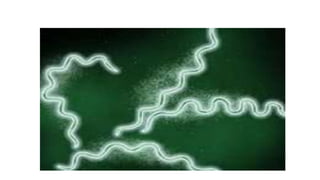
TREPONEMA PALLIDUM
• Coiled, slender, regular spiral org.
• 6-15 m in length, 0.25 m width
• 8-24 coils
• Axial bundle & spirally wound filaments
• Movt. of locomotion & change of shape
• Seen by dark ground, phase contrast or
electron microscope or silver impregnation
CLASSIFICATION
ACQUIRED SYPHILIS
• EARLY INFECTIOUS- Primary, Secondary,
Recurrent & Early Latent
• LATE NON-INFECTIOUS-
Late latent & Tertiary
• Cardiovascular & Neurosyphilis
CLASSIFICATION
• CONGENITAL SYPHILIS
• Early- 1st 2 yrs of life
• Late-2nd year onwards
• Stigmata- Scars & deformities
CLINICAL FEATURES
• PRIMARY SYPHILIS
• IP - 10-90d
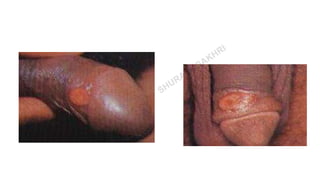
• Round ,regular,clearly defined ulcer with dull red
clean looking granulation tissue
• Characteristically painless ulcer with indurated
base
• Manipulation produces serous exudate which
contains treponemes
• Discrete,painless firm & rubbery LNE
• Often B/L
• 1o stage absent in syphilis d’ emblee
• Males- coronal sulcus, glans, prepuce, ext urinary
meatus, shaft of penis
• Female- labia, fourchette, clitoris or near urethral
orifice
• Diagnosis- DGI
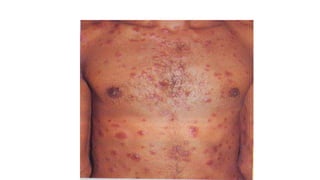
SECONDARY SYPHILIS
• Occur 6-8wks after start of primary
• Constitutional symptoms +/-
• Cut lesions- any generalised eruption except
vesicle or bulla; widespread symmetrical
• Types- Macular Papulosquamous
Papular Pustular
Mucous membrane lesions-mucous patch,
snail track ulcer, syphilitic laryngitis genital
mucous erosions
Lymphadenitis,
Uveitis & chorioretinitis
Hepatitis
Arthritis, bursitis
Neuro &cardio involvement
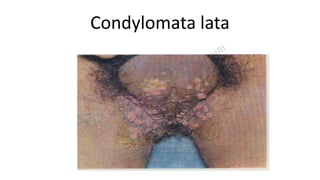
Condylomata lata
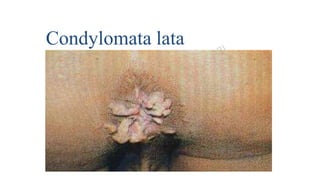
Condylomata lata
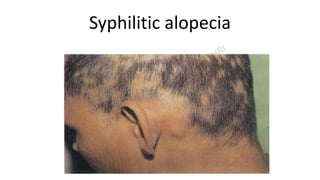
Syphilitic alopecia
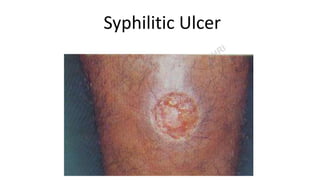
Syphilitic Ulcer
DIAGNOSIS
• DGI
• VDRL- +7-14d after chancre
• FTA-ABS- earliest to be positive
• TPI +ve if >50% immobilised
EARLY LATENT SYPHILIS
• No clinical evidence
• But blood tests are +ve
• Infectious
• CSF negative
• Confirm by doing VDRL + TPHA
RELAPSE
• CLINICAL-sec. Appearance of lesions like 2o
syphilitis
Chancre redux
• SEROLOGICAL-Blood becomes +ve or rising
titre
LATE LATENT SYPHILIS
• After 2nd yr syphilis enters late stage
• No clinical signs/symptoms
• Non-Infectious
• Diag based +ve blood tests
• Examine CSF to R/O neurosyphilis
TERTIARY SYPHILIS
 3-10 yrs after primary
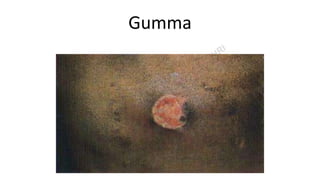
 Characteristic lesions are called GUMMA
CUTANEOUS-
Nodular
Squamous or psoriasiform
Subcutaneous gummata
Gumma
Mucous membrane gumma
• LOCALISED
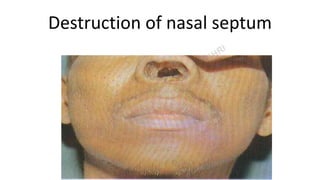
nasal septum-deformity soft
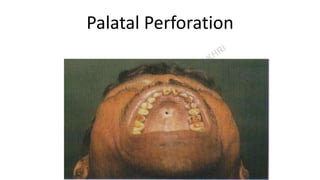
palate-perforation
pharynx&larynx-deformity&stenosis
• DIFFUSE-tongue
-fissures, leukoplakia, smooth glazed areas
Palatal Perforation
Destruction of nasal septum
Tertiary Syphilis
BONES- 5-20yrs later
• Syphilitic osteomyelitis
• Osteosclerotic-sabre tibia
• Osteolytic-esp skull,nasal septum&hard palate
 worm eaten skull
Cartilage,muscle,joints
VISCERA
• Liver-hepar lobatum
• Testes-billiard ball testes
• Stomach,intestine,lung,spleen
CARDIOVASCULAR SYPHILIS
SYPHILIS OF GREAT VESSELS
o Uncomplicated aortitis- bruit de tabourka(S2),
Linear calcification of ascending aorta
o Coronary ostial stenosis-angina pectoris
o Aortic regurgitaion d/t dialatation of aortic
ring +/- involvement of cusps
• ANEURYSM
o Ascending aorta-m/c; aneurysm of signs
o Arch of aorta- aneurysm of symptoms
o Descending thoracic aorta- aneurysm of no
symptoms and no signs
o Abdominal aorta
o Other sites raraely
• Syphilis of heart
Diffuse myocarditis
Gumma of myocardium
• Syphilis of medium sized arteries
NEUROSYPHILIS
• Asymptomatic
No neurological signs or symptoms
Changes in CSF
Blood reagin +ve
• Symptomatic
Symptomatic Neurosyphilis
• MENINGEALheadache,nausea, vomiting,
stiff neck,cranial nerve palsies, hydrocephalus
• VASCULAR
MCA ,ACA,PCA,basilar, cerebellar
• MENINGOVASCULAR
• GUMMA
• PARENCHYMATOUS- GPI
GENERAL PARALYSIS OF INSANE
• Period of onset-insidious,congestive attack or brain
storm
• Period of full development-psychosis. Grandiose /
deteriorated&demented
• Period of decline-dementia
• Dysarthria
• Impairment of handwriting
• Trombone tremor- on protrusion of tongue
• Mild spastic paraplegia
SYPHILIS OF SPINAL CORD
• Motor > Sensory tracts
• Meningeal-Dorsolumbar, cervical, syphilitic
amyotrophy
• Vascular-spinal shock-paraplegia in
flexion,loss of pain &temp on opp side
• GUMMA
• PARENCHYMATOUS-TABES DORSALIS
TABES DORSALIS
• LIGHTENING PAINS
• ATAXIA
• PARAESTHESIAE
• BOWEL & BLADDER DISTURBANCES
• IMPOTENCE
• CRISES-gastric,rectal,renal,vesical,laryngeal
• VISUAL FAILURE
DIAGNOSIS
• CSF study
• VDRL more specific
• TPHA/ FTA-ABS more sensitive but less
specific
CONGENITAL SY
• EARLY,LATE& STIGMATA
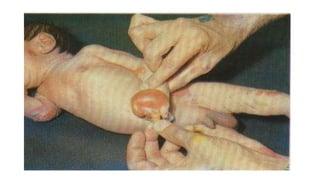
EARLY CONG. SY
• Appear before 2y age, Infectious
• Cutaneous-Bullae/vesicles on palms &soles,supf
desquamation, petechiae, papulosquamous
lesions
• Mucosal-rhinitis/Snuffles, mucous patches
• Bone osteochondritis, osteitis, periostitis
• HSM, Jaundice, LNP
• Anemia, thrombocytopenia, leukocytosis
LATE CONG. SY
• After 2y age, Non infectious
• Cardiovascular syphilis
• Interstitial Keratitis
• 8th nerve deafness
• Reccurent arthropathy, Clutton’s joints
• Asymptomatic neurosyphilis
STIGMATA
• STIGMATA OF EARLY LESIONS- saddle nose,
bulldog facies, hutchinsons teeth,moons or
mulberry molars, rhagades, pepper and salt
fundus
• STIGMATA OF LATE LESIONS-ghost vessels in
cornea, perforations in nose & palate, frontal
bossing, sabre shin, nerve deafness, optic atrophy
TREATMENT
PRIMARY&SECONDARY
INJ. BENZATHINE PENICILLIN 2.4 MILLION
UNITS IM IN SINGLE DOSE
LATENT SYPHILIS, GUMMA
&CARDIOVASCULAR
BENZATHINE PENICILLIN G 2.4 MILLION
UNITS IM 3 DOSES 1 WEEK APART
NEURO SYPHILIS
• AQUEOUS CRYSTALLINE PENICILLIN 18-24
MILLION UNITS /DAY
• GIVEN AS
• 3-4 MILLION UNITS IV EVERY 4HOURS OR
• CONTINUOUS INFUSION FOR 10-14 DAYS
THANK YOU

Syphilis

  • 1.
  • 2.
    • Infectious diseasedue to Treponema pallidum of great chronicity, systemic from the onset and capable of affecting all organs with florid manifestations as well as years of latency.
  • 3.
    TREPONEMA PALLIDUM • Coiled,slender, regular spiral org. • 6-15 m in length, 0.25 m width • 8-24 coils • Axial bundle & spirally wound filaments • Movt. of locomotion & change of shape • Seen by dark ground, phase contrast or electron microscope or silver impregnation
  • 5.
    CLASSIFICATION ACQUIRED SYPHILIS • EARLYINFECTIOUS- Primary, Secondary, Recurrent & Early Latent • LATE NON-INFECTIOUS- Late latent & Tertiary • Cardiovascular & Neurosyphilis
  • 6.
    CLASSIFICATION • CONGENITAL SYPHILIS •Early- 1st 2 yrs of life • Late-2nd year onwards • Stigmata- Scars & deformities
  • 7.
    CLINICAL FEATURES • PRIMARYSYPHILIS • IP - 10-90d • Round ,regular,clearly defined ulcer with dull red clean looking granulation tissue • Characteristically painless ulcer with indurated base • Manipulation produces serous exudate which contains treponemes
  • 9.
    • Discrete,painless firm& rubbery LNE • Often B/L • 1o stage absent in syphilis d’ emblee • Males- coronal sulcus, glans, prepuce, ext urinary meatus, shaft of penis • Female- labia, fourchette, clitoris or near urethral orifice • Diagnosis- DGI
  • 10.
    SECONDARY SYPHILIS • Occur6-8wks after start of primary • Constitutional symptoms +/- • Cut lesions- any generalised eruption except vesicle or bulla; widespread symmetrical • Types- Macular Papulosquamous Papular Pustular
  • 12.
    Mucous membrane lesions-mucouspatch, snail track ulcer, syphilitic laryngitis genital mucous erosions Lymphadenitis, Uveitis & chorioretinitis Hepatitis Arthritis, bursitis Neuro &cardio involvement
  • 13.
  • 14.
  • 15.
  • 16.
  • 17.
    DIAGNOSIS • DGI • VDRL-+7-14d after chancre • FTA-ABS- earliest to be positive • TPI +ve if >50% immobilised
  • 18.
    EARLY LATENT SYPHILIS •No clinical evidence • But blood tests are +ve • Infectious • CSF negative • Confirm by doing VDRL + TPHA
  • 19.
    RELAPSE • CLINICAL-sec. Appearanceof lesions like 2o syphilitis Chancre redux • SEROLOGICAL-Blood becomes +ve or rising titre
  • 20.
    LATE LATENT SYPHILIS •After 2nd yr syphilis enters late stage • No clinical signs/symptoms • Non-Infectious • Diag based +ve blood tests • Examine CSF to R/O neurosyphilis
  • 21.
    TERTIARY SYPHILIS  3-10yrs after primary  Characteristic lesions are called GUMMA CUTANEOUS- Nodular Squamous or psoriasiform Subcutaneous gummata
  • 22.
  • 23.
    Mucous membrane gumma •LOCALISED nasal septum-deformity soft palate-perforation pharynx&larynx-deformity&stenosis • DIFFUSE-tongue -fissures, leukoplakia, smooth glazed areas
  • 24.
  • 25.
  • 26.
    Tertiary Syphilis BONES- 5-20yrslater • Syphilitic osteomyelitis • Osteosclerotic-sabre tibia • Osteolytic-esp skull,nasal septum&hard palate  worm eaten skull Cartilage,muscle,joints
  • 27.
    VISCERA • Liver-hepar lobatum •Testes-billiard ball testes • Stomach,intestine,lung,spleen
  • 28.
    CARDIOVASCULAR SYPHILIS SYPHILIS OFGREAT VESSELS o Uncomplicated aortitis- bruit de tabourka(S2), Linear calcification of ascending aorta o Coronary ostial stenosis-angina pectoris o Aortic regurgitaion d/t dialatation of aortic ring +/- involvement of cusps
  • 29.
    • ANEURYSM o Ascendingaorta-m/c; aneurysm of signs o Arch of aorta- aneurysm of symptoms o Descending thoracic aorta- aneurysm of no symptoms and no signs o Abdominal aorta o Other sites raraely
  • 30.
    • Syphilis ofheart Diffuse myocarditis Gumma of myocardium • Syphilis of medium sized arteries
  • 31.
    NEUROSYPHILIS • Asymptomatic No neurologicalsigns or symptoms Changes in CSF Blood reagin +ve • Symptomatic
  • 32.
    Symptomatic Neurosyphilis • MENINGEALheadache,nausea,vomiting, stiff neck,cranial nerve palsies, hydrocephalus • VASCULAR MCA ,ACA,PCA,basilar, cerebellar • MENINGOVASCULAR • GUMMA • PARENCHYMATOUS- GPI
  • 33.
    GENERAL PARALYSIS OFINSANE • Period of onset-insidious,congestive attack or brain storm • Period of full development-psychosis. Grandiose / deteriorated&demented • Period of decline-dementia • Dysarthria • Impairment of handwriting • Trombone tremor- on protrusion of tongue • Mild spastic paraplegia
  • 34.
    SYPHILIS OF SPINALCORD • Motor > Sensory tracts • Meningeal-Dorsolumbar, cervical, syphilitic amyotrophy • Vascular-spinal shock-paraplegia in flexion,loss of pain &temp on opp side • GUMMA • PARENCHYMATOUS-TABES DORSALIS
  • 35.
    TABES DORSALIS • LIGHTENINGPAINS • ATAXIA • PARAESTHESIAE • BOWEL & BLADDER DISTURBANCES • IMPOTENCE • CRISES-gastric,rectal,renal,vesical,laryngeal • VISUAL FAILURE
  • 36.
    DIAGNOSIS • CSF study •VDRL more specific • TPHA/ FTA-ABS more sensitive but less specific
  • 37.
  • 38.
    EARLY CONG. SY •Appear before 2y age, Infectious • Cutaneous-Bullae/vesicles on palms &soles,supf desquamation, petechiae, papulosquamous lesions • Mucosal-rhinitis/Snuffles, mucous patches • Bone osteochondritis, osteitis, periostitis • HSM, Jaundice, LNP • Anemia, thrombocytopenia, leukocytosis
  • 40.
    LATE CONG. SY •After 2y age, Non infectious • Cardiovascular syphilis • Interstitial Keratitis • 8th nerve deafness • Reccurent arthropathy, Clutton’s joints • Asymptomatic neurosyphilis
  • 41.
    STIGMATA • STIGMATA OFEARLY LESIONS- saddle nose, bulldog facies, hutchinsons teeth,moons or mulberry molars, rhagades, pepper and salt fundus • STIGMATA OF LATE LESIONS-ghost vessels in cornea, perforations in nose & palate, frontal bossing, sabre shin, nerve deafness, optic atrophy
  • 42.
    TREATMENT PRIMARY&SECONDARY INJ. BENZATHINE PENICILLIN2.4 MILLION UNITS IM IN SINGLE DOSE LATENT SYPHILIS, GUMMA &CARDIOVASCULAR BENZATHINE PENICILLIN G 2.4 MILLION UNITS IM 3 DOSES 1 WEEK APART
  • 43.
    NEURO SYPHILIS • AQUEOUSCRYSTALLINE PENICILLIN 18-24 MILLION UNITS /DAY • GIVEN AS • 3-4 MILLION UNITS IV EVERY 4HOURS OR • CONTINUOUS INFUSION FOR 10-14 DAYS
  • 44.