Meningococcus
Gram Negative cocci
Attribution-NonCommercial-ShareAlike 4.0 International (CC BY-NC-SA 4.0)
For B.Sc Optometry Students
Neisseria meningitidis
• Infection with N. meningitidis has two presentations:
• Meningococcemia: characterized by skin lesions
• Acute bacterial meningitis
• Fulminant disease (with or without meningitis) is characterized by multisystem
involvement and high mortality.
• It has been reported to be transmitted through oral sex and cause urethritis in men
• About 10% of adults are carriers of the bacteria in their nasopharynx
• It is an exclusive human pathogen
• It is a main cause of epidemic bacterial meningitis that occur across Africa and Asia
Meningitis Belt
The highest number of cases and the highest burden of disease occur in sub-Saharan Africa in
an area that is referred to as the meningitis belt. Epidemics occur in seasonal cycles between
the end of November and the end of June and decline rapidly with the arrival of the rainy
season. occurs in epidemic cycles which last between 8 to 15 years.
The mechanisms that cause these cycles are not well understood
Source: WHO Report on Global Surveillance of Epidemic-prone Infectious Diseases - Meningococcal disease
Meningitis Belt
Epidemic cycles, meningococcal disease
for selected African countries,1996-1999
Source: WHO Report on Global Surveillance of Epidemic-prone Infectious Diseases - Meningococcal disease
Structure and Characteristics
• gram-negative, oxidase-positive, aerobes, diplococcus
• A polysaccharide capsule is present
• Arranged in pairs, Oval or spherical (cocci shaped)
• They can ferment glucose and maltose
• 0.6 to 0.8 micro meter in size
Classification
• Meningococcal capsular polysaccharides provide the basis for grouping these
organisms.
• Twelve serogroups have been identified (A, B, C, H, I, K, L, X, Y, Z, 29E, and W135).
• The most important serogroups associated with disease in humans are A, B, C, Y, and
W135
Pathogenesis
Natural habitat and reservoir
• N.meningitidis is a part of the normal non-pathogenic flora in the nasopharynx,
urinal canal and anal canal
• It colonizes and infects only humans, and has never been isolated from other animals
• 5% to 10 % of adults are asymptomatic carriers
• Infection is by aspiration of infective particles, which attach to epithelial cells of the
nasopharyngeal and oropharyngeal mucosa, cross the mucosal barrier, and enter
the bloodstream.
• If not cleared blood-borne bacteria may enter the central nervous system and cause
meningitis
Pathogenesis
Virulence factors
• Lipooligosaccharide (LOS) is a component of the outer membrane of N. meningitidis. This
acts as an endotoxin and is responsible for septic shock and hemorrhage due to the
destruction of red blood cells
• Polysaccharide capsule which prevents host phagocytosis and aids in evasion of the host
immune response
• Fimbriae mediate attachment of the bacterium to the epithelial cells of the nasopharynx
• It infects the cell by sticking to it mainly with long thin extensions called pili and the
surface-exposed proteins Opa and Opc
• Ig A protease: an enzyme that cleaves IgA class antibodies and thus allows the bacteria to
evade a subclass of the humoral immune system.
Pathogenesis Inhalation of contaminated droplets
Adherence of organism to
nasopharyngeal mucosa
Local invasion and spread from
nasopharynx to meninges through
blood stream
In meninges organisms are internalised
into phagocytic cells
They replicate and migrate to
subepithelial spaces with incubation
period of 3 to 4 years
Diseases caused
• Bacteremia or meningococcal disease
• Meningitis
• Arthritis
• Pericarditis
• Conus medullaris syndrome*
• Pneumonia
• Urethritis
* a type of incomplete spinal cord injury that is less likely to cause paralysis than many other
types of spinal cord injuries. Instead, the most common symptoms include: Severe back pain.
Signs and symptoms
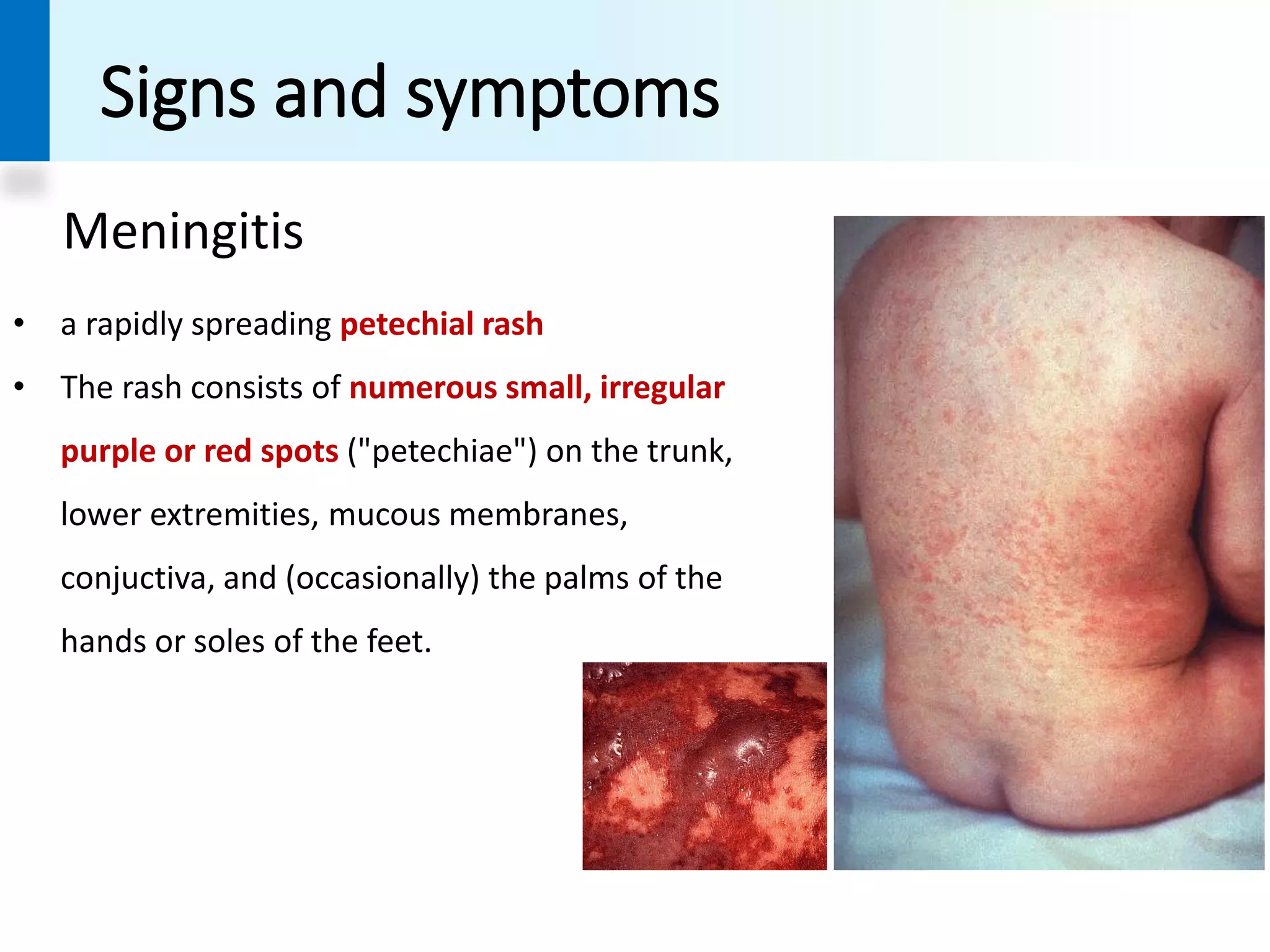
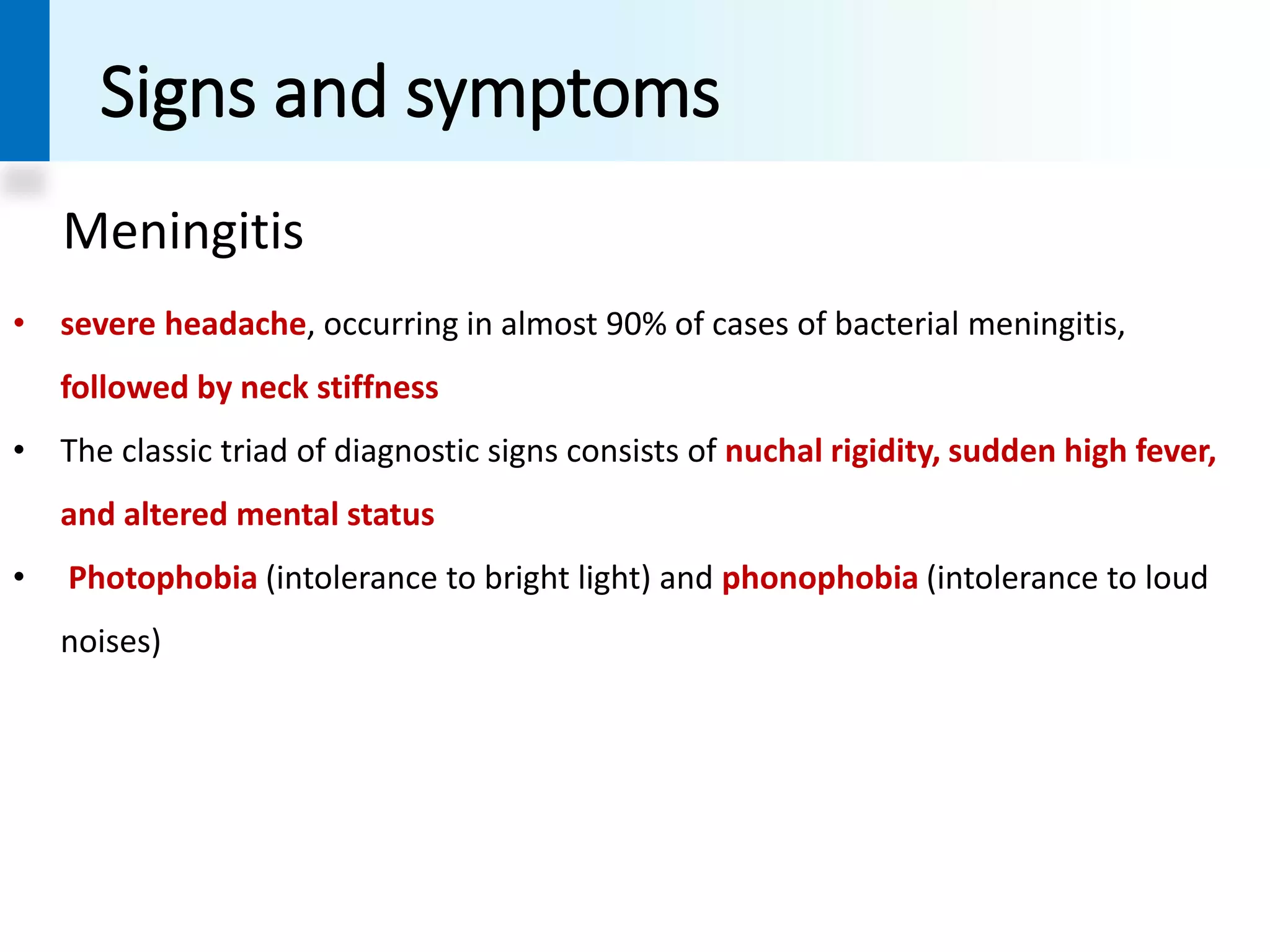
• a rapidly spreading petechial rash
• The rash consists of numerous small, irregular
purple or red spots ("petechiae") on the trunk,
lower extremities, mucous membranes,
conjuctiva, and (occasionally) the palms of the
hands or soles of the feet.
Meningitis
Signs and symptoms
• severe headache, occurring in almost 90% of cases of bacterial meningitis,
followed by neck stiffness
• The classic triad of diagnostic signs consists of nuchal rigidity, sudden high fever,
and altered mental status
• Photophobia (intolerance to bright light) and phonophobia (intolerance to loud
noises)
Meningitis
Signs and symptoms
Children >1 year and adults
• Neck stiffness
• Headache
• Nausea and vomiting
• Neck and/or back pain
• Fever and chills
• Increased sensitivity to light
• Irritability, confusion
Infants
• Refusing feeds
• Increased irritability
• Sleeping all the time
• Fever
• Bulging fontanelle (soft spot on the top
of the head)
• Inconsolable crying
• Epileptic fits (seizures)
Meningitis
Signs and symptoms
• Disseminated intravascular coagulation: inappropriate cloatting of blood vessel
causing ischemic tissue damage
• DIC can cause ischemic tissue damage when upstream thrombi obstruct blood
flow and haemorrhage because clotting factors are exhausted.
• Small bleeds into the skin cause the characteristic petechial rash, which appears
with a star-like shape.
• This is due to the release of toxins into the blood that break down the walls of
blood vessels.
• A rash can develop under the skin due to blood leakage that may leave red or
brownish pinprick spots, which can develop into purple bruising
Meningococcal disease
Signs and symptoms
Signs on the skin
• Petechiae that do not disappear when
pressure is applied to the skin occur in 50-
75% of cases.
• A blanching or maculopapular rash may also
occur. Not all patients have skin signs.
• Rash may progress to larger red patches or
purple lesions (similar to bruises).
• Most often found on the trunk and
extremities but may progress to involve any
part of the body.
• In severe cases lesions may burst and lead
to necrosis.
Other signs and symptoms
• Acute fever and chills
• Headache
• Neck stiffness
• Low back and thigh pain
• Nausea and vomiting
• Confusion or unconsciousness
• Epileptic fits (seizures)
• Collapse from septic shock
Meningococcal Disease
Signs and symptoms
Meningococcal disease
Diagnosis
• The most characteristic manifestation of meningococcemia is the skin rash,
which is essential for its recognition
• Petechiae are the most common type of skin lesion
• Ill-defined pink lesions sparsely distributed over the body.
• Samples: specimens of blood, cerebrospinal fluid, and nasopharyngeal
secretions should be collected before administration of any antimicrobial
agents and examined for the presence of N. meningitidis.
Diagnosis
Examination of CSF:
• Increased Pressure
• Turbid
• The collected CSF is divided into 3 portions (for microscopy, for biochemical
tests and for culture)
Diagnosis
Microscopy
• Gram stained smear of CSF deposit commonly shows Gram negative
intracellular diplococci.
• White cell count increases to several thousand per cubic mm with 90-99%
PMNs.
Biochemical tests:
• Glucose is markedly diminished
• CSF protein is markedly raised
Culture:
• Inoculated into chocloate agar
• Incubated at 37c in 5-10% Carbondioxide and high humidity
• After 24 hours bacterial colonies appear
• The organism is tested for biochemical and agglutinationreaction
Diagnosis
• Nasopharyngeal specimens must be obtained from the posterior
nasopharyngeal wall behind the soft palate and then should be inoculated
onto a selective medium such as Thayer-Martin medium and processed as
above.
• Blood culture is positive in over 40% cases of meningiococcal meningitis
• Other Cultures: Nasopharyngeal swab, Skin lesions, Joint fluid, Tracheal
aspirate, Urethral discharge, Serology, Petechial lesions
Diagnosis
Detection of antigen
For Detection of Meningiococcal DNA
• Polymerase Chain Reaction (PCR)
For detection of soluble polysaccharide antigen
• Counter current immunoelectrophoresis (CIEP)
• Latex agglutination test
Prophylaxis
• Chemoprophylaxis
• Rifampicin
• Minocycline
• Ciprofloxacin
• Vaccination:
• A vaccine containing capsular polysaccharide of serotypes A and C : for
infants below 2 years
• A quadrivalent vaacine constituted by polysaccharides of serotypes A,C,Y
and W-135 : for children and adults
• conjugate vaccine: polysaccharide antigen is conjugated to diptheria toxoid
Treatment
• Persons with confirmed N. meningitidis infection should be hospitalized
immediately for treatment with antibiotics.
• Because meningococcal disease can disseminate very rapidly
• a single dose of intramuscular antibiotic is often given at the earliest possible
opportunity, even before hospitalization
• cephalosporin antibiotics (i.e. cefotaxime, ceftriaxone) is used for confirmed
disease
• Empirical treatment should also be considered if collection of CSF for
laboratory testing, cannot be done within 30 minutes of admission to hospital

Meningococci

  • 1.
    Meningococcus Gram Negative cocci Attribution-NonCommercial-ShareAlike4.0 International (CC BY-NC-SA 4.0) For B.Sc Optometry Students
  • 2.
    Neisseria meningitidis • Infectionwith N. meningitidis has two presentations: • Meningococcemia: characterized by skin lesions • Acute bacterial meningitis • Fulminant disease (with or without meningitis) is characterized by multisystem involvement and high mortality. • It has been reported to be transmitted through oral sex and cause urethritis in men • About 10% of adults are carriers of the bacteria in their nasopharynx • It is an exclusive human pathogen • It is a main cause of epidemic bacterial meningitis that occur across Africa and Asia
  • 3.
    Meningitis Belt The highestnumber of cases and the highest burden of disease occur in sub-Saharan Africa in an area that is referred to as the meningitis belt. Epidemics occur in seasonal cycles between the end of November and the end of June and decline rapidly with the arrival of the rainy season. occurs in epidemic cycles which last between 8 to 15 years. The mechanisms that cause these cycles are not well understood Source: WHO Report on Global Surveillance of Epidemic-prone Infectious Diseases - Meningococcal disease
  • 4.
    Meningitis Belt Epidemic cycles,meningococcal disease for selected African countries,1996-1999 Source: WHO Report on Global Surveillance of Epidemic-prone Infectious Diseases - Meningococcal disease
  • 5.
    Structure and Characteristics •gram-negative, oxidase-positive, aerobes, diplococcus • A polysaccharide capsule is present • Arranged in pairs, Oval or spherical (cocci shaped) • They can ferment glucose and maltose • 0.6 to 0.8 micro meter in size
  • 6.
    Classification • Meningococcal capsularpolysaccharides provide the basis for grouping these organisms. • Twelve serogroups have been identified (A, B, C, H, I, K, L, X, Y, Z, 29E, and W135). • The most important serogroups associated with disease in humans are A, B, C, Y, and W135
  • 7.
    Pathogenesis Natural habitat andreservoir • N.meningitidis is a part of the normal non-pathogenic flora in the nasopharynx, urinal canal and anal canal • It colonizes and infects only humans, and has never been isolated from other animals • 5% to 10 % of adults are asymptomatic carriers • Infection is by aspiration of infective particles, which attach to epithelial cells of the nasopharyngeal and oropharyngeal mucosa, cross the mucosal barrier, and enter the bloodstream. • If not cleared blood-borne bacteria may enter the central nervous system and cause meningitis
  • 8.
    Pathogenesis Virulence factors • Lipooligosaccharide(LOS) is a component of the outer membrane of N. meningitidis. This acts as an endotoxin and is responsible for septic shock and hemorrhage due to the destruction of red blood cells • Polysaccharide capsule which prevents host phagocytosis and aids in evasion of the host immune response • Fimbriae mediate attachment of the bacterium to the epithelial cells of the nasopharynx • It infects the cell by sticking to it mainly with long thin extensions called pili and the surface-exposed proteins Opa and Opc • Ig A protease: an enzyme that cleaves IgA class antibodies and thus allows the bacteria to evade a subclass of the humoral immune system.
  • 9.
    Pathogenesis Inhalation ofcontaminated droplets Adherence of organism to nasopharyngeal mucosa Local invasion and spread from nasopharynx to meninges through blood stream In meninges organisms are internalised into phagocytic cells They replicate and migrate to subepithelial spaces with incubation period of 3 to 4 years
  • 10.
    Diseases caused • Bacteremiaor meningococcal disease • Meningitis • Arthritis • Pericarditis • Conus medullaris syndrome* • Pneumonia • Urethritis * a type of incomplete spinal cord injury that is less likely to cause paralysis than many other types of spinal cord injuries. Instead, the most common symptoms include: Severe back pain.
  • 11.
    Signs and symptoms •a rapidly spreading petechial rash • The rash consists of numerous small, irregular purple or red spots ("petechiae") on the trunk, lower extremities, mucous membranes, conjuctiva, and (occasionally) the palms of the hands or soles of the feet. Meningitis
  • 12.
    Signs and symptoms •severe headache, occurring in almost 90% of cases of bacterial meningitis, followed by neck stiffness • The classic triad of diagnostic signs consists of nuchal rigidity, sudden high fever, and altered mental status • Photophobia (intolerance to bright light) and phonophobia (intolerance to loud noises) Meningitis
  • 13.
    Signs and symptoms Children>1 year and adults • Neck stiffness • Headache • Nausea and vomiting • Neck and/or back pain • Fever and chills • Increased sensitivity to light • Irritability, confusion Infants • Refusing feeds • Increased irritability • Sleeping all the time • Fever • Bulging fontanelle (soft spot on the top of the head) • Inconsolable crying • Epileptic fits (seizures) Meningitis
  • 14.
    Signs and symptoms •Disseminated intravascular coagulation: inappropriate cloatting of blood vessel causing ischemic tissue damage • DIC can cause ischemic tissue damage when upstream thrombi obstruct blood flow and haemorrhage because clotting factors are exhausted. • Small bleeds into the skin cause the characteristic petechial rash, which appears with a star-like shape. • This is due to the release of toxins into the blood that break down the walls of blood vessels. • A rash can develop under the skin due to blood leakage that may leave red or brownish pinprick spots, which can develop into purple bruising Meningococcal disease
  • 15.
    Signs and symptoms Signson the skin • Petechiae that do not disappear when pressure is applied to the skin occur in 50- 75% of cases. • A blanching or maculopapular rash may also occur. Not all patients have skin signs. • Rash may progress to larger red patches or purple lesions (similar to bruises). • Most often found on the trunk and extremities but may progress to involve any part of the body. • In severe cases lesions may burst and lead to necrosis. Other signs and symptoms • Acute fever and chills • Headache • Neck stiffness • Low back and thigh pain • Nausea and vomiting • Confusion or unconsciousness • Epileptic fits (seizures) • Collapse from septic shock Meningococcal Disease
  • 16.
  • 17.
    Diagnosis • The mostcharacteristic manifestation of meningococcemia is the skin rash, which is essential for its recognition • Petechiae are the most common type of skin lesion • Ill-defined pink lesions sparsely distributed over the body. • Samples: specimens of blood, cerebrospinal fluid, and nasopharyngeal secretions should be collected before administration of any antimicrobial agents and examined for the presence of N. meningitidis.
  • 18.
    Diagnosis Examination of CSF: •Increased Pressure • Turbid • The collected CSF is divided into 3 portions (for microscopy, for biochemical tests and for culture)
  • 19.
    Diagnosis Microscopy • Gram stainedsmear of CSF deposit commonly shows Gram negative intracellular diplococci. • White cell count increases to several thousand per cubic mm with 90-99% PMNs. Biochemical tests: • Glucose is markedly diminished • CSF protein is markedly raised Culture: • Inoculated into chocloate agar • Incubated at 37c in 5-10% Carbondioxide and high humidity • After 24 hours bacterial colonies appear • The organism is tested for biochemical and agglutinationreaction
  • 20.
    Diagnosis • Nasopharyngeal specimensmust be obtained from the posterior nasopharyngeal wall behind the soft palate and then should be inoculated onto a selective medium such as Thayer-Martin medium and processed as above. • Blood culture is positive in over 40% cases of meningiococcal meningitis • Other Cultures: Nasopharyngeal swab, Skin lesions, Joint fluid, Tracheal aspirate, Urethral discharge, Serology, Petechial lesions
  • 21.
    Diagnosis Detection of antigen ForDetection of Meningiococcal DNA • Polymerase Chain Reaction (PCR) For detection of soluble polysaccharide antigen • Counter current immunoelectrophoresis (CIEP) • Latex agglutination test
  • 22.
    Prophylaxis • Chemoprophylaxis • Rifampicin •Minocycline • Ciprofloxacin • Vaccination: • A vaccine containing capsular polysaccharide of serotypes A and C : for infants below 2 years • A quadrivalent vaacine constituted by polysaccharides of serotypes A,C,Y and W-135 : for children and adults • conjugate vaccine: polysaccharide antigen is conjugated to diptheria toxoid
  • 23.
    Treatment • Persons withconfirmed N. meningitidis infection should be hospitalized immediately for treatment with antibiotics. • Because meningococcal disease can disseminate very rapidly • a single dose of intramuscular antibiotic is often given at the earliest possible opportunity, even before hospitalization • cephalosporin antibiotics (i.e. cefotaxime, ceftriaxone) is used for confirmed disease • Empirical treatment should also be considered if collection of CSF for laboratory testing, cannot be done within 30 minutes of admission to hospital