 SYPHILIS
 AQUIRED SYPHILIS
-PRIMARY
-SECONDARY
-TERTIARY
 EARLY,LATE AND LATENT SYPHILIS
 DIAGNOSIS
 CONGENITAL SYPHILIS
 TREATMENT
 DENTAL TREATMENT FOR PATIENT WITH
SYPHILIS
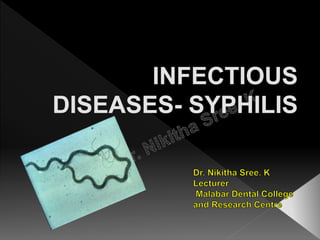
 Syphilis is a chronic infectious systemic disease with a
number of stages and with intervening periods of clinical
remission, and is caused by Treponema pallidum.
 It occurs almost by venereal contact.
 In over crowded living infection also occurs by non-
venereal routes.
There are two types of syphilis
-Acquired syphilis
-Congenital syphilis
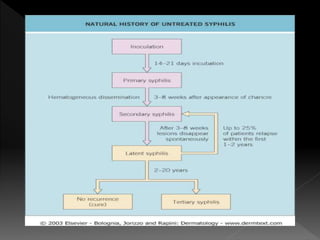
 Acquired by sexual contact in adult life.
 Classified according to the type of lesion and course of
the disease-
- primary
- secondary
- tertiary
 Atypical and malignant progression of tertiary neuro
syphilis in HIV infected individuals are sometimes
referred to as ‘quaternary syphilis’.
PRIMARY SYPHILIS
 Initial manifestation is the chancre,a slightly raised,
ulcerated,firm plaque,which is usually round and
indurated with rolled raised edges.
 Begin as papule and then ulcerates. Size vary from
5mm to cm in diameter.
 Painless unless super infected.
 Chancre may occur with in 3-4 weeks after
exposure and disappears without therapy after
about 10 days.
 Indurated ulcer and enlarged nontender regional
lymph glands -classic sign of primary syphilis.
ORAL MANIFESTATION
 Chancre on the lips, oralmucosa, tongue, softpalate,
tonsilar area, pharyngeal region.
 Intra oral chancres are usualy slightly painful and
covered with a grayish white film.
 Extra oral portions of lip chancres are more typical
brown crusted appearance.
SECONDARY SYPHILIS
 Organism proliferare and spread from primary focus
through blood stream.
 Appear within 3-6 weeks after the primary lesion.
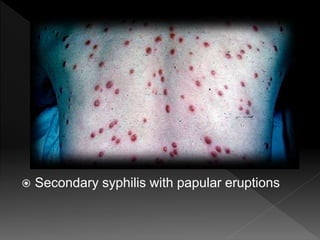
 Lesion appears on skin as fine macular or papular
rash,sometimes accompanied by alopecia.
 Mucous patch,split papule and condyloma latum are the
three possible lesions on moist skin areas and on
mucous membranes.
 Mucous patches- small, smooth , erythematous
areas or superficial grayish white erosions
found on the mucous membranes.
 Found on vulva,penis or oral cavity.
 On the palate and tonsil it described as “snail-
track ulcers”.
 Condyloma latum describes grayish,moist,
flat-topped, extra large papules, sometimes
coalescing into plaques, found on vulva,
anus, scrotum, thighs, axilla, and other
intertriginous areas.
 Papules on skin folds appear as double and
called as split papule.
 Secondary syphilis with papular eruptions
ORAL MANIFESTATIONS
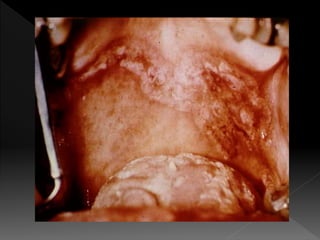
 Mucous patches-found on tongue,buccal
mucosa,tonsilar , pharyngeal regions, lips and
gingiva.
-Most highly infectious.
-On tongue it appear as raised in the early lesion with
partial loss of lingual papilla.
-Often painless. Painful when they develop on
movable tissue or on exposed surface
-Trauma results in raw bleeding surface.
 Papules- split papules are raised papular
lesions
 Develop on dorsum of tongue, commissures of
the lips
 And develop a fissure that seperates upper lip
portion of papule from lower lip.
 Condylomata lata- occur on skin as well as on
the mucosa.
 Flat, silver gray, wart like
 Painless papules
 Sometimes with ulcerated surface.
TERTIARY SYPHILIS
 Occur at any age from the third year up to the
patient’s life.
 One third develop benign or gummatous form,
 one third cardiovascular form and
 one third neurosyphilis
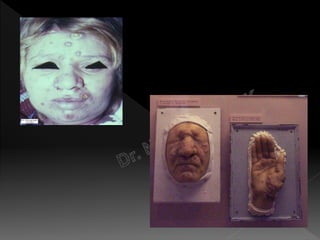
 Gumma- is due to a chronic destructive
granulomatous process which occurs.
 It is the result of hypersensitivity reaction
between host and treponema.
 Cerebral gumma may produce symptoms
suggestive of brain tumor.
 NEUROSYPHILIS-
 Occurs due to obliteration of small vessel arteries
involving vasa vasorum of aorta and other large vessels
of the central nervous system.
 Manifested as tabes dorsalis and geneal paresis.
 TABES DORSALIS-
 Syphilitic involvement dorsal column of spinal code and
dorsal root ganglion.
 Patient loses the positional sense of his lower
extremities and
-Walks with a characteristics slapping step
-Accompanied by burning or pricking sensations
of the extremities,
- Paresthesias or actual anaesthesia of the part.
 Positive Romberg's sign-
- person is unable to stand erect unaided with
his eyes closed.
 Tabetic crises
–short, shooting knife like pains may be
experienced on abdominal region, which result
from involvement dorsal root ganglion
 Charcot’s joint- trophic changes consist of deep
perforating ulcers and painless destruction of larger
joints.
 GENERAL PARESIS-
 syphilitic involvement of cerebral tissue.
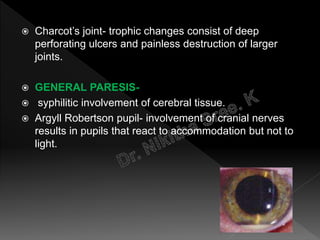
 Argyll Robertson pupil- involvement of cranial nerves
results in pupils that react to accommodation but not to
light.
 Personality changes are often the first manifestation-
-increased irritability
-fatigue
-mental sluggishness
-carelessness in personal habits
 There is loss of fine muscular coordination indicated by
inability to perform delicate task with the hands
 CARDIOSYPHILIS-
 affects particularly the aorta or aortic valve.
 Obliteration of vasa vasorum of the aorta and its
larger branches as the result of syphilis leads to
medial necrosis and destruction of elastic
tissues in the walls of the large blood vessels
Aortitis,aortic regurgitation,anneurysm formation in the
proximal aorta, or narrowing of the ostia of the
coronary arteries may result from these changes
ORAL MANIFISTATIONS
 Oral lesions occurs most frequently on the
palate and the tongue.
 Gummatous destruction of palatal bone results
in perforation of palate.
 Even manifestate as solitary, deep, punched out
oral mucosal ulceration with serious
complication.
 Numerous small healed gummata in the tongue resulted
in a series of nodules or scars in the deeper areas of
the organ,giving the tongue an ‘upholstered’ or tufted
appearance.
 Diffuse luetic involvement of this organ
results in complete atrophy papillary coating called bald
tongue , also referred to as interstitial glossitis.
 Leukoplakia was frequently associated with this luetic
glossitis.
 Severe neuralgic pains of the head and neck may occur
in tabes dorsalis and must be differentiated from
neuralgic pain secondary to dental or pharyngeal
disease.
 Loss of taste and spontaneous necrosis of the alveolar
process .
 Parasthesia may occur in lips, tongue, and the cheeks.
 Painless ulceration of the palate and the nasal septum .
 Spontaneous death of dental pulp in the absence of
recognizable precipitating factors and altered pulp test
responses.
 Patients with damaged aortic valve secondary to luetic
involvement is still occasionally seen and should be
given antibiotic prophylaxis before dental inorder to
prevent bacterial endocarditis.
 On the basis of infectivity related to time, syphilis is also
classified into early and late stages.
EARLY SYPHILIS
 defined as syphilis one year or less after infection.
 infectious stage.
 either symptomatic (with lesions)or latent.
LATE SYPHILIS
 syphilis of more than one year’s durations.
 It is not infectious and patient is probably immune to
reinfection.
 It may be symptomatic –cardiovascular or neurosyphilis
or gummatous lesion or asymptomatic.
LATENT SYPHILIS
 It is also divided into early latent and late latent syphilis.
Early latent syphilis –
 Defined by united State Public Health Services as less
than one year after infection.
 Clinically symptomless with a positive serologic
reaction.
 And a history consistent with primary or secondary
syphilis, or sexual contact with a partner with early
syphilis and no history of treatment.
 Patient are potentially infective.
Late latent syphilis-
 More than one year after infection.
 And future adverse consequences effect the patient but
not the patient’s contact.
 Dark field Microscopy
 VDRL, RPR
 FTA-ABS, MHA-TP
 Direct Fluorescent Antibody (DFA)
 The Venereal Disease Research Laboratory test is
positive in 50% to 70% of primary cases.
 The Fluorescent treponemal antibody absorption and
microhemagglutination assay for T.pallidum(MHA-TP)
tests are positive in 70% to 98% .
 Diagnosis of secondary syphilis should be suspected on
the basis of symptpms or signs and may confirmed by
blood test.
 98% to 100% of both reagin and treponemal tests are
positive during this stage.
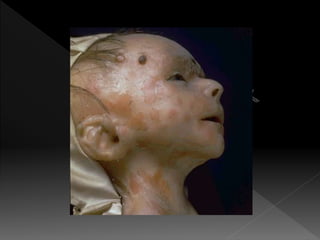
 It is related to transplacental infection .
 Time of development of lesion is after 18 weeks gestation.
CLINICAL FEATURES
 Manifestation within first 2 years of life.
 Rhinitis and chronic nasal discharge with a maculopapular
eruption,other mucocutaneous lesions,and loss of weight.
 These lesions include
- bullae,
- vesicles , and
- superficial desquamation with cracking and scaling of
reddened soles and palms,
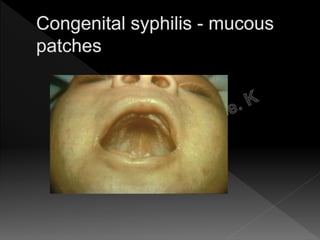
-petechiae, and mucous patches and -condyloma
latum.
 Osteitis , Anemia and number of disorder involving the
visceral organs may also occur.
 Late manifestation develop after 2 years of age and
include
- interstitial keratitis and
-vascularization of the cornea ,
-8th nerve deafness ,
-arthropathy,
-signs of congenital neurosyphilis ,and
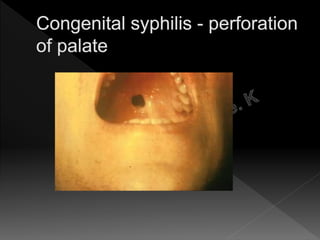
-gummatous destructions of palate and nasal septum.
 Unexplained nerve deafness , and retinal and corneal
damage noted later in life , in a child born to syphilitic
mother
ORAL AND FACIAL MANIFESTATIONS
 It include postrhagadic scarring about the mouth
,changes in teeth and other dental abnormalities.
Postrhagadic scarring and syphilitic rhagades:
 Linear lesion found around the oral and anal orifices
 Results from a diffuse luetic involvement of skin in
these areas from the third to the seventh week after
birth.
 Lesion first appear as red or copper coloured linear
areas covered with a soft crust.
 Rhagades are frequent on lower lips because of
thinness of the epithelium covering this structure and
greater mobility.
 Frequently there is diminished colouring of the lip and
the mucocutaneous border is indistinct.
Changes in dentition:
 Primary dentition is rarely effected,since fetal luetic
infection occuring during the formation of these teeth
usually results in abortion.
 Hutchinson’s triad – includes the characteristic defect
hypoplasia of permanent incisors and first molars ,
-8th nerve deafness ,
-interstitial keratitis
 Dental hypoplasia - effects permanent incisors ,
cuspids ,and first molar .
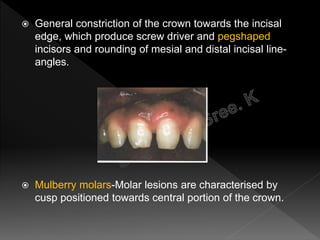
 General constriction of the crown towards the incisal
edge, which produce screw driver and pegshaped
incisors and rounding of mesial and distal incisal line-
angles.
 Mulberry molars-Molar lesions are characterised by
cusp positioned towards central portion of the crown.
 Characteristic notching of the incisal edge of the
permanent incisors -demonstrated by means of a
radiographic examination before the eruption of
this tooth.
 Mesio-distal diameter and the size of this tooth
are usually smaller than adjacent second molar
Dentofacial changes:(syphilitic stigmata)
-malocclusion
-open bite
An abnormal facies :
-frontal bossing
-saddle nose
- poorly developed premaxilla.
 Identification of T.pallidum by 1.microscopy
2. fluorescent antibody or other special
stains in specimens of lesion
3. autopsy
 Detection of IgM antitreponemal antibody in
cord serum –active infection
 Benzathine pencillin-2.4 million units IM
 Aqeous crystalline pencillin
 Tetracycline-500mg orally 4 times a day for 15 days.
 Erythromycin-500mg by mouth 4 times a day for 15 days.
 FOLLOW UP-followed with repeated physical examination
and repeated VDRL test.
 Differentiate the oral iesions from solitary
ulcers,nodules of lip,tongue&fauces,
licheniod lesions &unexplained areas of
mucositis
 Evaluation of lesion should always be done with
gloves when performing examination&treatment
 Burket's Oral Medicine- Greenberg , Glick,
Ship
 Textbook of Oral Medicine - Anil Govindrao
Ghom
 Textbook of Oral Medicine,Oral diagnosis
and Oral Radiology- Ravikiran Ongole,
Praveen B N
THANK YOU

Syphilis

  • 2.
     SYPHILIS  AQUIREDSYPHILIS -PRIMARY -SECONDARY -TERTIARY  EARLY,LATE AND LATENT SYPHILIS  DIAGNOSIS  CONGENITAL SYPHILIS  TREATMENT  DENTAL TREATMENT FOR PATIENT WITH SYPHILIS
  • 3.
     Syphilis isa chronic infectious systemic disease with a number of stages and with intervening periods of clinical remission, and is caused by Treponema pallidum.  It occurs almost by venereal contact.  In over crowded living infection also occurs by non- venereal routes.
  • 4.
    There are twotypes of syphilis -Acquired syphilis -Congenital syphilis
  • 5.
     Acquired bysexual contact in adult life.  Classified according to the type of lesion and course of the disease- - primary - secondary - tertiary  Atypical and malignant progression of tertiary neuro syphilis in HIV infected individuals are sometimes referred to as ‘quaternary syphilis’.
  • 7.
    PRIMARY SYPHILIS  Initialmanifestation is the chancre,a slightly raised, ulcerated,firm plaque,which is usually round and indurated with rolled raised edges.  Begin as papule and then ulcerates. Size vary from 5mm to cm in diameter.  Painless unless super infected.  Chancre may occur with in 3-4 weeks after exposure and disappears without therapy after about 10 days.
  • 8.
     Indurated ulcerand enlarged nontender regional lymph glands -classic sign of primary syphilis. ORAL MANIFESTATION  Chancre on the lips, oralmucosa, tongue, softpalate, tonsilar area, pharyngeal region.  Intra oral chancres are usualy slightly painful and covered with a grayish white film.  Extra oral portions of lip chancres are more typical brown crusted appearance.
  • 10.
    SECONDARY SYPHILIS  Organismproliferare and spread from primary focus through blood stream.  Appear within 3-6 weeks after the primary lesion.  Lesion appears on skin as fine macular or papular rash,sometimes accompanied by alopecia.  Mucous patch,split papule and condyloma latum are the three possible lesions on moist skin areas and on mucous membranes.
  • 12.
     Mucous patches-small, smooth , erythematous areas or superficial grayish white erosions found on the mucous membranes.  Found on vulva,penis or oral cavity.  On the palate and tonsil it described as “snail- track ulcers”.
  • 13.
     Condyloma latumdescribes grayish,moist, flat-topped, extra large papules, sometimes coalescing into plaques, found on vulva, anus, scrotum, thighs, axilla, and other intertriginous areas.  Papules on skin folds appear as double and called as split papule.
  • 14.
     Secondary syphiliswith papular eruptions
  • 15.
    ORAL MANIFESTATIONS  Mucouspatches-found on tongue,buccal mucosa,tonsilar , pharyngeal regions, lips and gingiva. -Most highly infectious. -On tongue it appear as raised in the early lesion with partial loss of lingual papilla. -Often painless. Painful when they develop on movable tissue or on exposed surface -Trauma results in raw bleeding surface.
  • 17.
     Papules- splitpapules are raised papular lesions  Develop on dorsum of tongue, commissures of the lips  And develop a fissure that seperates upper lip portion of papule from lower lip.
  • 18.
     Condylomata lata-occur on skin as well as on the mucosa.  Flat, silver gray, wart like  Painless papules  Sometimes with ulcerated surface.
  • 19.
    TERTIARY SYPHILIS  Occurat any age from the third year up to the patient’s life.  One third develop benign or gummatous form,  one third cardiovascular form and  one third neurosyphilis
  • 20.
     Gumma- isdue to a chronic destructive granulomatous process which occurs.  It is the result of hypersensitivity reaction between host and treponema.  Cerebral gumma may produce symptoms suggestive of brain tumor.
  • 22.
     NEUROSYPHILIS-  Occursdue to obliteration of small vessel arteries involving vasa vasorum of aorta and other large vessels of the central nervous system.  Manifested as tabes dorsalis and geneal paresis.  TABES DORSALIS-  Syphilitic involvement dorsal column of spinal code and dorsal root ganglion.
  • 23.
     Patient losesthe positional sense of his lower extremities and -Walks with a characteristics slapping step -Accompanied by burning or pricking sensations of the extremities, - Paresthesias or actual anaesthesia of the part.
  • 25.
     Positive Romberg'ssign- - person is unable to stand erect unaided with his eyes closed.  Tabetic crises –short, shooting knife like pains may be experienced on abdominal region, which result from involvement dorsal root ganglion
  • 26.
     Charcot’s joint-trophic changes consist of deep perforating ulcers and painless destruction of larger joints.  GENERAL PARESIS-  syphilitic involvement of cerebral tissue.  Argyll Robertson pupil- involvement of cranial nerves results in pupils that react to accommodation but not to light.
  • 27.
     Personality changesare often the first manifestation- -increased irritability -fatigue -mental sluggishness -carelessness in personal habits  There is loss of fine muscular coordination indicated by inability to perform delicate task with the hands
  • 28.
     CARDIOSYPHILIS-  affectsparticularly the aorta or aortic valve.  Obliteration of vasa vasorum of the aorta and its larger branches as the result of syphilis leads to medial necrosis and destruction of elastic tissues in the walls of the large blood vessels
  • 29.
    Aortitis,aortic regurgitation,anneurysm formationin the proximal aorta, or narrowing of the ostia of the coronary arteries may result from these changes
  • 30.
    ORAL MANIFISTATIONS  Orallesions occurs most frequently on the palate and the tongue.  Gummatous destruction of palatal bone results in perforation of palate.  Even manifestate as solitary, deep, punched out oral mucosal ulceration with serious complication.
  • 31.
     Numerous smallhealed gummata in the tongue resulted in a series of nodules or scars in the deeper areas of the organ,giving the tongue an ‘upholstered’ or tufted appearance.  Diffuse luetic involvement of this organ results in complete atrophy papillary coating called bald tongue , also referred to as interstitial glossitis.
  • 32.
     Leukoplakia wasfrequently associated with this luetic glossitis.  Severe neuralgic pains of the head and neck may occur in tabes dorsalis and must be differentiated from neuralgic pain secondary to dental or pharyngeal disease.  Loss of taste and spontaneous necrosis of the alveolar process .
  • 33.
     Parasthesia mayoccur in lips, tongue, and the cheeks.  Painless ulceration of the palate and the nasal septum .  Spontaneous death of dental pulp in the absence of recognizable precipitating factors and altered pulp test responses.  Patients with damaged aortic valve secondary to luetic involvement is still occasionally seen and should be given antibiotic prophylaxis before dental inorder to prevent bacterial endocarditis.
  • 34.
     On thebasis of infectivity related to time, syphilis is also classified into early and late stages. EARLY SYPHILIS  defined as syphilis one year or less after infection.  infectious stage.  either symptomatic (with lesions)or latent.
  • 35.
    LATE SYPHILIS  syphilisof more than one year’s durations.  It is not infectious and patient is probably immune to reinfection.  It may be symptomatic –cardiovascular or neurosyphilis or gummatous lesion or asymptomatic. LATENT SYPHILIS  It is also divided into early latent and late latent syphilis. Early latent syphilis –  Defined by united State Public Health Services as less than one year after infection.
  • 36.
     Clinically symptomlesswith a positive serologic reaction.  And a history consistent with primary or secondary syphilis, or sexual contact with a partner with early syphilis and no history of treatment.  Patient are potentially infective. Late latent syphilis-  More than one year after infection.  And future adverse consequences effect the patient but not the patient’s contact.
  • 37.
     Dark fieldMicroscopy  VDRL, RPR  FTA-ABS, MHA-TP  Direct Fluorescent Antibody (DFA)
  • 38.
     The VenerealDisease Research Laboratory test is positive in 50% to 70% of primary cases.  The Fluorescent treponemal antibody absorption and microhemagglutination assay for T.pallidum(MHA-TP) tests are positive in 70% to 98% .  Diagnosis of secondary syphilis should be suspected on the basis of symptpms or signs and may confirmed by blood test.  98% to 100% of both reagin and treponemal tests are positive during this stage.
  • 39.
     It isrelated to transplacental infection .  Time of development of lesion is after 18 weeks gestation. CLINICAL FEATURES  Manifestation within first 2 years of life.  Rhinitis and chronic nasal discharge with a maculopapular eruption,other mucocutaneous lesions,and loss of weight.
  • 41.
     These lesionsinclude - bullae, - vesicles , and - superficial desquamation with cracking and scaling of reddened soles and palms, -petechiae, and mucous patches and -condyloma latum.  Osteitis , Anemia and number of disorder involving the visceral organs may also occur.
  • 42.
     Late manifestationdevelop after 2 years of age and include - interstitial keratitis and -vascularization of the cornea , -8th nerve deafness , -arthropathy, -signs of congenital neurosyphilis ,and -gummatous destructions of palate and nasal septum.  Unexplained nerve deafness , and retinal and corneal damage noted later in life , in a child born to syphilitic mother
  • 44.
    ORAL AND FACIALMANIFESTATIONS  It include postrhagadic scarring about the mouth ,changes in teeth and other dental abnormalities. Postrhagadic scarring and syphilitic rhagades:  Linear lesion found around the oral and anal orifices  Results from a diffuse luetic involvement of skin in these areas from the third to the seventh week after birth.
  • 46.
     Lesion firstappear as red or copper coloured linear areas covered with a soft crust.  Rhagades are frequent on lower lips because of thinness of the epithelium covering this structure and greater mobility.  Frequently there is diminished colouring of the lip and the mucocutaneous border is indistinct.
  • 47.
    Changes in dentition: Primary dentition is rarely effected,since fetal luetic infection occuring during the formation of these teeth usually results in abortion.  Hutchinson’s triad – includes the characteristic defect hypoplasia of permanent incisors and first molars , -8th nerve deafness , -interstitial keratitis  Dental hypoplasia - effects permanent incisors , cuspids ,and first molar .
  • 49.
     General constrictionof the crown towards the incisal edge, which produce screw driver and pegshaped incisors and rounding of mesial and distal incisal line- angles.  Mulberry molars-Molar lesions are characterised by cusp positioned towards central portion of the crown.
  • 50.
     Characteristic notchingof the incisal edge of the permanent incisors -demonstrated by means of a radiographic examination before the eruption of this tooth.  Mesio-distal diameter and the size of this tooth are usually smaller than adjacent second molar
  • 51.
    Dentofacial changes:(syphilitic stigmata) -malocclusion -openbite An abnormal facies : -frontal bossing -saddle nose - poorly developed premaxilla.
  • 52.
     Identification ofT.pallidum by 1.microscopy 2. fluorescent antibody or other special stains in specimens of lesion 3. autopsy  Detection of IgM antitreponemal antibody in cord serum –active infection
  • 53.
     Benzathine pencillin-2.4million units IM  Aqeous crystalline pencillin  Tetracycline-500mg orally 4 times a day for 15 days.  Erythromycin-500mg by mouth 4 times a day for 15 days.  FOLLOW UP-followed with repeated physical examination and repeated VDRL test.
  • 54.
     Differentiate theoral iesions from solitary ulcers,nodules of lip,tongue&fauces, licheniod lesions &unexplained areas of mucositis  Evaluation of lesion should always be done with gloves when performing examination&treatment
  • 55.
     Burket's OralMedicine- Greenberg , Glick, Ship  Textbook of Oral Medicine - Anil Govindrao Ghom  Textbook of Oral Medicine,Oral diagnosis and Oral Radiology- Ravikiran Ongole, Praveen B N
  • 56.