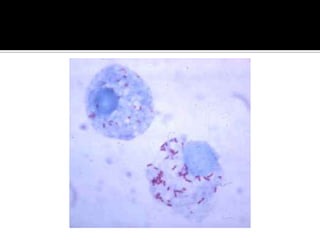
   Group of bacteria that are fastidious, obligate
    intracellular pathogens
   They are pleomorphic & coccobacillary
   The organisms will not show up on Gram
    stain, but can be seen when either Gimenez or
    Giemsa stains are used
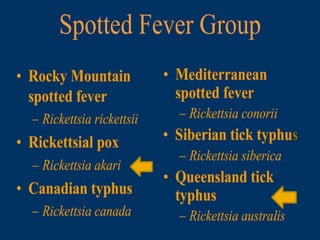
   Spotted Fever Group
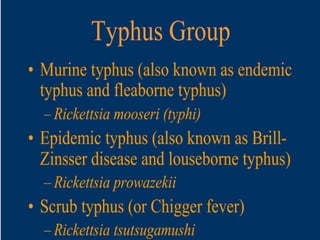
   Typhus Group
   Transitional group
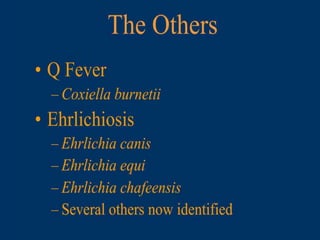
   The Others
   The outer membrane protein A (ompA) gene
    is present in spotted fever but not typhus
    group organisms
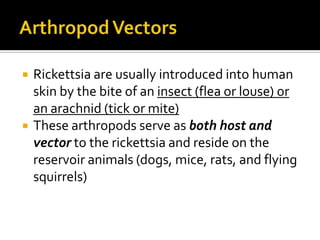
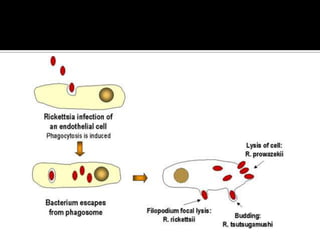
   Rickettsia are usually introduced into human
    skin by the bite of an insect (flea or louse) or
    an arachnid (tick or mite)
   These arthropods serve as both host and
    vector to the rickettsia and reside on the
    reservoir animals (dogs, mice, rats, and flying
    squirrels)
   Two of the rickettsial diseases are unique in
    that humans may acquire them by direct
    inhalation
   Q fever (Coxiella burnetii)
   Epidemic typhus (Rickettsia prowazekii)
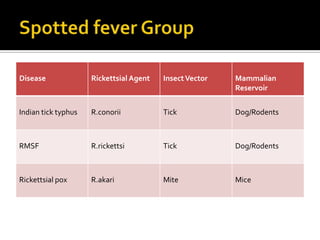
Disease              Rickettsial Agent   Insect Vector   Mammalian
                                                         Reservoir


Indian tick typhus   R.conorii           Tick            Dog/Rodents


RMSF                 R.rickettsi         Tick            Dog/Rodents


Rickettsial pox      R.akari             Mite            Mice
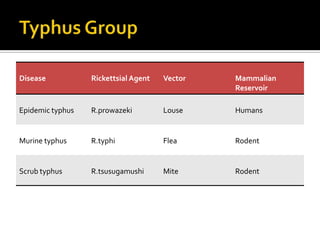
Disease           Rickettsial Agent   Vector   Mammalian
                                               Reservoir

Epidemic typhus   R.prowazeki         Louse    Humans


Murine typhus     R.typhi             Flea     Rodent


Scrub typhus      R.tsusugamushi      Mite     Rodent
   very similar for all infections regardless of
    species
   Vasculitis caused by the invasion and
    multiplication of the organism in the
    endothelial and smooth muscle cells of the
    blood vessels
   Thrombosis, occlusion, and necrosis of blood
    vessel walls
   Thrombocytopenia with hemorrhage
   Massive capillary leakage into the interstitial
    spaces results in edema, hypovolemia,
    hypotension, and adult respiratory distress
    syndrome (ARDS)
   Encephalitis, myocarditis, & nephritis are the
    common clinical consequences
   Hyponatremia is due to ADH response
   Rocky Mountain spotted fever
   Murine (Endemic) typhus
   Epidemic typhus
   Q fever
   IP: 2 to 14 days
   H/o exposure to tick/ close contact with pets/
    Endemic area/ similar illness in family
   Initial Non-specific symptoms – Calf muscle
    pain and tenderness are more common in
    children.
   Gastro-intestinal symptoms are more
    commonly associated
   Skin rash: 2-4 days after onset of illness.
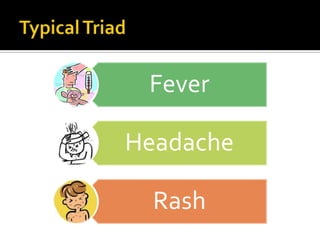
Fever

Headache

  Rash
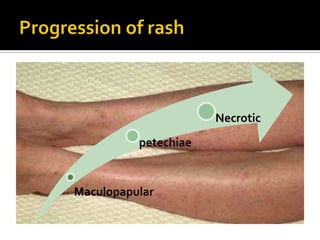
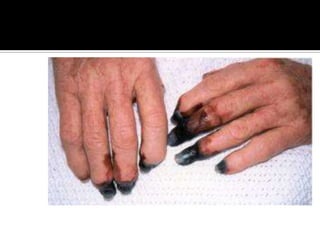
Necrotic
          petechiae


Maculopapular
   Rocky Mountain spotted Fever:
     -Rash typically appears on 4th day as
    blanching maculopapular lesions on the
    extremities
   Louse borne or Epidemic typhus:
     -Rash first appears in axillary folds then
    involving the trunk and extremities.
     - Brill-Zinsser disease
 Murine (fleaborne or endemic) typhus:
  - Relatively mild illness with less
  complications
  -Rash is non-purpuric,non-confluent,less
  extensive
  -History of a flea bite and the presence of
rats in the house support the diagnosis but
this is only reported 30% of the time.
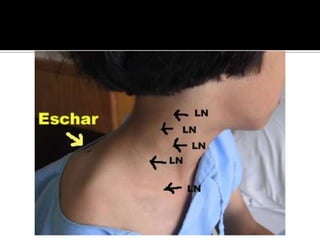
   Scrub typhus:
     -Occurs mostly in Asian countries
     -characterised by painless eschar and
    “satellite lymphadenopathy”

   Rickettsial pox:
    -best known because of its association with a
    varicelliform rash.
   Usually does not affect children
   No vector is involved
   Presents as both acute or chronic forms
   Endocarditis in chronic variety
   Bioterrorist threat?
   Low or normal WBC count; in the late stages
    there is leucocytosis
   Anemia, thrombocytopenia and elevated
    serum transaminases
   Hyponatremia
   CSF analysis is usually normal; rarely
    mononuclear plecytosis (<300 cells/micro L)
   Serological evidence of infection usually not
    occur earlier than second week of illness.
   Gold standard test
   IgM titre >1:64
   IgG titres >1:64 but <1:125 suggests
    previous infection
   A single titer is neither sensitive (patients can
    die before seroconversion) nor specific (an
    elevated titer can represent prior infection)

   ELISA – available in India and is the preferred
    diagnosis at present
   Slide agglutination test
   Tests the presence of antigenic cross-
    reactivity between Rickettsia spp. and certain
    serotypes of non-motile Proteus spp.,
   suffers from poor sensitivity and specificity,
    with a recent study showing an overall
    sensitivity as low as 33% and specificity of
    46%.
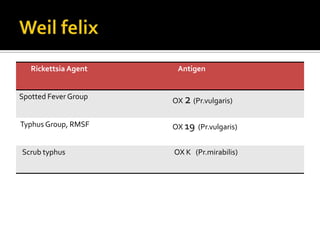
Rickettsia Agent    Antigen


Spotted Fever Group
                      OX 2 (Pr.vulgaris)

Typhus Group, RMSF    OX 19 (Pr.vulgaris)


Scrub typhus          OX K (Pr.mirabilis)
   Complement fixation
   Latex agglutination
   Microagglutination
   Immunoperoxidase assay
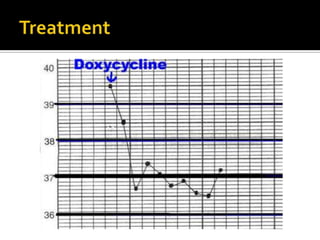
   Drug of choice for all ages –
    Doxycycline(4 mg/kg/day divided every 12 hr
    PO or IV, maximum 200 mg/day)

   Chloramphenicol – Allergy to Doxycycline,
    Pregnant women (50-100 mg/kg/day divided
    6th hourly, max 3 g/day)

   Continued for minimum of 5-7 days and for
    atleast 3 days until patient is afebrile.
   Azithromycin, Clarithromycin
   Fluoroquinolones
   Rifampicin

    -Found to be more effective in typhus groups.
   Patient coming from endemic area.
   H/O contact-pets/ h/o tick bite.
   Classical triad
   Rash without coryza.
   hepatosplenomegaly,edema,gangrene,anemia,thrombocyto
    penia
   Fever,rash,altered sensorium, convulsions
   PUO and not responding to routine antibiotics
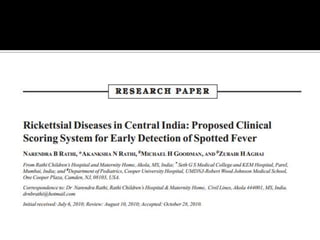
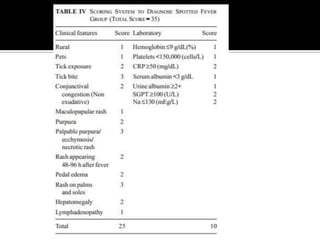
   When applied to the patients presenting with
    fever of unknown source, a clinical score of
    14 or more on the proposed scoring system
    has very high sensitivity and specificity for
    the diagnosis of spotted fever group of
    rickettsial diseases.
Rickettsial infections

Rickettsial infections

  • 2.
    Group of bacteria that are fastidious, obligate intracellular pathogens  They are pleomorphic & coccobacillary  The organisms will not show up on Gram stain, but can be seen when either Gimenez or Giemsa stains are used
  • 4.
    Spotted Fever Group  Typhus Group  Transitional group  The Others  The outer membrane protein A (ompA) gene is present in spotted fever but not typhus group organisms
  • 8.
    Rickettsia are usually introduced into human skin by the bite of an insect (flea or louse) or an arachnid (tick or mite)  These arthropods serve as both host and vector to the rickettsia and reside on the reservoir animals (dogs, mice, rats, and flying squirrels)
  • 9.
    Two of the rickettsial diseases are unique in that humans may acquire them by direct inhalation  Q fever (Coxiella burnetii)  Epidemic typhus (Rickettsia prowazekii)
  • 10.
    Disease Rickettsial Agent Insect Vector Mammalian Reservoir Indian tick typhus R.conorii Tick Dog/Rodents RMSF R.rickettsi Tick Dog/Rodents Rickettsial pox R.akari Mite Mice
  • 11.
    Disease Rickettsial Agent Vector Mammalian Reservoir Epidemic typhus R.prowazeki Louse Humans Murine typhus R.typhi Flea Rodent Scrub typhus R.tsusugamushi Mite Rodent
  • 12.
    very similar for all infections regardless of species  Vasculitis caused by the invasion and multiplication of the organism in the endothelial and smooth muscle cells of the blood vessels
  • 14.
    Thrombosis, occlusion, and necrosis of blood vessel walls  Thrombocytopenia with hemorrhage  Massive capillary leakage into the interstitial spaces results in edema, hypovolemia, hypotension, and adult respiratory distress syndrome (ARDS)  Encephalitis, myocarditis, & nephritis are the common clinical consequences  Hyponatremia is due to ADH response
  • 15.
    Rocky Mountain spotted fever  Murine (Endemic) typhus  Epidemic typhus  Q fever
  • 16.
    IP: 2 to 14 days  H/o exposure to tick/ close contact with pets/ Endemic area/ similar illness in family
  • 17.
    Initial Non-specific symptoms – Calf muscle pain and tenderness are more common in children.  Gastro-intestinal symptoms are more commonly associated  Skin rash: 2-4 days after onset of illness.
  • 18.
  • 19.
    Necrotic petechiae Maculopapular
  • 22.
    Rocky Mountain spotted Fever: -Rash typically appears on 4th day as blanching maculopapular lesions on the extremities  Louse borne or Epidemic typhus: -Rash first appears in axillary folds then involving the trunk and extremities. - Brill-Zinsser disease
  • 23.
     Murine (fleaborneor endemic) typhus: - Relatively mild illness with less complications -Rash is non-purpuric,non-confluent,less extensive -History of a flea bite and the presence of rats in the house support the diagnosis but this is only reported 30% of the time.
  • 24.
    Scrub typhus: -Occurs mostly in Asian countries -characterised by painless eschar and “satellite lymphadenopathy”  Rickettsial pox: -best known because of its association with a varicelliform rash.
  • 25.
    Usually does not affect children  No vector is involved  Presents as both acute or chronic forms  Endocarditis in chronic variety  Bioterrorist threat?
  • 26.
    Low or normal WBC count; in the late stages there is leucocytosis  Anemia, thrombocytopenia and elevated serum transaminases  Hyponatremia  CSF analysis is usually normal; rarely mononuclear plecytosis (<300 cells/micro L)
  • 27.
    Serological evidence of infection usually not occur earlier than second week of illness.
  • 28.
    Gold standard test  IgM titre >1:64  IgG titres >1:64 but <1:125 suggests previous infection  A single titer is neither sensitive (patients can die before seroconversion) nor specific (an elevated titer can represent prior infection)  ELISA – available in India and is the preferred diagnosis at present
  • 29.
    Slide agglutination test  Tests the presence of antigenic cross- reactivity between Rickettsia spp. and certain serotypes of non-motile Proteus spp.,  suffers from poor sensitivity and specificity, with a recent study showing an overall sensitivity as low as 33% and specificity of 46%.
  • 30.
    Rickettsia Agent Antigen Spotted Fever Group OX 2 (Pr.vulgaris) Typhus Group, RMSF OX 19 (Pr.vulgaris) Scrub typhus OX K (Pr.mirabilis)
  • 31.
    Complement fixation  Latex agglutination  Microagglutination  Immunoperoxidase assay
  • 33.
    Drug of choice for all ages – Doxycycline(4 mg/kg/day divided every 12 hr PO or IV, maximum 200 mg/day)  Chloramphenicol – Allergy to Doxycycline, Pregnant women (50-100 mg/kg/day divided 6th hourly, max 3 g/day)  Continued for minimum of 5-7 days and for atleast 3 days until patient is afebrile.
  • 34.
    Azithromycin, Clarithromycin  Fluoroquinolones  Rifampicin -Found to be more effective in typhus groups.
  • 35.
    Patient coming from endemic area.  H/O contact-pets/ h/o tick bite.  Classical triad  Rash without coryza.  hepatosplenomegaly,edema,gangrene,anemia,thrombocyto penia  Fever,rash,altered sensorium, convulsions  PUO and not responding to routine antibiotics
  • 38.
    When applied to the patients presenting with fever of unknown source, a clinical score of 14 or more on the proposed scoring system has very high sensitivity and specificity for the diagnosis of spotted fever group of rickettsial diseases.