Syphilis: Clinical Aspects,
Epidemiology, and Control
Taxonomy
 Domain: Bacteria
 Phylum: Spirochaetes
 Order: Spirochetales
 Family: Spirochaetaceae
 Genus: Treponema
 Species: pallidum
 A Bacterial Infection
that can be chronic and
systemic
 Infectious During
Specific Time Frames
related to Stage
 Sexually Transmitted
(oral, vaginal, anal)
 Curable
Syphilis is:
The mode of transmission can be:
 Sexual, which is the most important mode of
infection.
 Sexual perversion ( homosexual and orogenital
contacts ).
 Accidental inoculation.
 Through contaminated blood.
 Transplacental infection, from an infected mother
to the fetus.
 During delivery as the baby passes through an
infected canal.
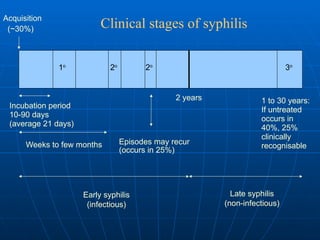
Clinical stages of syphilis
2 years
Acquisition
(~30%)
1o
2o
2o
Early syphilis
(infectious)
Late syphilis
(non-infectious)
3o
Incubation period
10-90 days
(average 21 days)
Weeks to few months Episodes may recur
(occurs in 25%)
1 to 30 years:
If untreated
occurs in
40%, 25%
clinically
recognisable
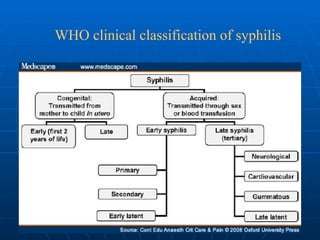
WHO clinical classification of syphilis
Primary Syphilis
Chancre:
Appears 10-90 days after
infection
Typically single, painless,
clean-based lesion with
rolled edges
Primary Syphilis
Chancre, Tongue
Secondary Syphilis
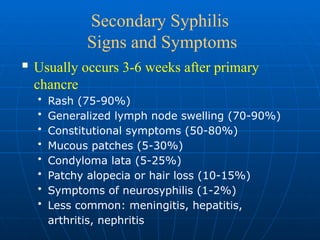
Signs and Symptoms
 Usually occurs 3-6 weeks after primary
chancre
• Rash (75-90%)
• Generalized lymph node swelling (70-90%)
• Constitutional symptoms (50-80%)
• Mucous patches (5-30%)
• Condyloma lata (5-25%)
• Patchy alopecia or hair loss (10-15%)
• Symptoms of neurosyphilis (1-2%)
• Less common: meningitis, hepatitis,
arthritis, nephritis
Macular
Rashes of Secondary
Syphilis
Palmar
Papular
Secondary Syphilis Macular
Eruptions
 Exanthematic erythema 6-8 weeks after
chancre, extends rapidly, may last hours to
months
 Round indistinct, slightly scaling ham-colored
macules
 Pain, burning absent, pruritus may be present
 Generalized shotty adenopathy
Rash of Secondary Syphilis
Macular

Rash of Secondary Syphilis
Secondary Syphilis
Papular Eruptions
 Arise later than macular, raw-ham, round, 2-
5mm or more in diameter, slightly raised,
smooth or thick scale
 Face and flexures of arms and legs, trunk
 Palmar and plantar yellowish-red spots
 Ollendorf’s sign; papule tender to touch of a
blunt probe
Palmer/Plantar Rash of Secondary Syphilis
Maculo-papular
Papulo-squamous
Pustular
Condyloma lata
wart-like lesions in moist
intertriginous areas.
• Sessile
• don’t bleed easily.
• D.D.: Condyloma
accuminata:
 Pedunculated
 Bleed easily.
 All of these lesions teem
with treponemes and are
highly contagious.
Secondary Syphilis
Mucous Membrane
 Present in 1/3 of secondary syphilis
 Most common is “syphilitic sore throat”
 Diffuse pharyngitis, hoarseness
 Tongue; patches of desquamation of papillae
 Ulcerations of tongue and lips in late stages
SECONDARY SYPHILIS
 Mucous patches are oral lesions found on the lips, cheeks,
tongue, palate, tonsils these are oval or circular, slightly
raised patches, covered by a grayish sodden membrane .
Superficial ulcers in the form of “ snail-track” are occasionally
seen.
Mouth
Mucocutaneous Lesions of Secondary Syphilis
Generalized lymphadenopathy
 Discrete.
 Rubbery.
 Not tender.
Secondary Syphilis
Moth-Eaten Alopecia (Hair Loss)
Less Common
Retinitis
Systemic Manifestations:
 Malaise
 Anorexia
 Headache
 Sore throat
 Arthralgia
 Low grade fever
 Nephrotic syndrome.
Secondary Syphilis
Diagnosis
 Nontreponemal serologic tests for syphilis are
strongly reactive (seronegativity rarely in
AIDS)
 Spirochetes on darkfield exam
Secondary Syphilis
Ddx “Great Imitator”
 Pityriasis rosea
 Drug eruptions
(pruitic)
 Lichen planus;
Wickham’s striae,
Koebner’s, pruitic
 Psoriasis; no
adenopathy
 Sarcoidosis; need
serology and silver
staining of biopsy
 Infectious
mononucleosis, false
pos RPR
 Geographic tongue
 Aphthous stomatitis
TERTIARY SYPHILS
is a no contagious but highly destructive phase
of syphilis which may take many years to
develop; it may manifest itself in several
forms:
 Gummas
 Neuro-syphilis
 Cardiovascular Syphilis
Gummas
 It develops in 15% of
untreated cases within 1-10
years after infection.
 highly destructive tertiary
syphilitic lesions that usually
occur in skin and bones but
may also occur in other
tissues.
 Slowly progressive, painless,
dull red nodule or plaque.
 Breakdown into ulcer with
wash-leather floor.
 Regional Ln are not enlarged.
 Not infectious.
Gummas in tertiary
syphilis
Neurosyphils
 in which there are no
symptoms of CNS
involvement but the CSF is
abnormal:
• Elevated lymphocytes
• Elevated protein.
• Positive CSF VDRL tests
• Approximately 20% of these
patients progress to
symptomatic neurosyphilis
 Symptoms of neurosyphilis:
• 8% of untreated
cases.
• 5-35 years after
infection.
 Invasion of the CNS occurs
early when generalized
dissemination occurs (2°
syphilis).
Asymptomatic Symptomatic
Diagnostic Tests
Diagnostic Tests for Syphilis
 Darkfield / DFA-TP
 PCR
 VDRL/RPR
 FTA-abs / TP-PA (MHA-TP)
 EIA
T. pallidum on Darkfield
Syphilis Serology
 Non-treponemal
tests
• VDRL (Venereal
Disease Research
Laboratory)
• RPR (Rapid Plasma
Reagin)
• TRUST (Toluidine Red
Unheated Serum
Test)
• USR (Unheated
Serum Reagin)
 Treponemal tests
• TP-PA (Treponema
Pallidum Particle
Agglutination)
• FTA-abs (Fluorescent
Treponemal Antibody
-Absorbed)
• EIA (Enzyme
Immunoassay)
Non-Treponemal Tests
u VDRL and RPR are most commonly
used
 Detect Abs against cardiolipin-
lecithin-cholesterol antigens; not
specific for T. pallidum
Uses of Non-Treponemal Tests
 Screening
 Evaluation of patients with
symptoms or possible re-infection
 Follow-up assessment after
treatment
Non-Treponemal Tests
Advantages
u Rapid & inexpensive compared to
treponemal tests
u Easy to perform
u Quantitative (can be titered)
u Used to follow response to therapy
u Can evaluate possible reinfection
Treponemal Tests
u Specific for T. pallidum
u Measure antibody (IgM & IgG) directed
against T. pallidum antigens by particulate
agglutination (TP-PA) or
immunofluorescence (FTA-abs)
u May remain positive after treatment
u More sensitive and specific than non-trep.
tests
u More expensive and labor intensive
u Can not quantitate…not useful for following
response to treatment
Non-Treponemal Tests
Disadvantages
u Biological false positive reactions
(BFPs)
u Viral illnesses including HIV, recent
immunizations, IDU, autoimmune and
chronic diseases
u False negative reactions
u Prozone effect
u Early primary and late latent stages
Serologic Pitfalls
in the Diagnosis of Syphilis
 Negative nontreponemal test may occur
early in primary or late in tertiary -
check FTA-ABS or TP-PA
 Prozone phenomenon: false negative
due to lack of agglutination with high
antibody levels
 Serofast: persistent, low-level positive
titer after adequate treatment
CONGENITAL SYPHILIS
Early congenital syphilis:
 occur before the age of 1 year;
 occur in children from 1 to 4 year.
• a) late syphilitic ophtalmopathy (involvement of
the eyes);
Late congenital syphilis:
 b) other forms of the late congenital syphilis
(involvement of the skin, mucous membrane,
nervous system, latent syphilis).
Diagnosis of congenital syphilis
 Mothers anamnesis
 Examination of placenta and umbilical cord
 Assessment of typical characteristics of congenital
syphilis in different growing group
 Treponema pallidum can be demonstrated in a smear
from skin lesions with moist surface.
 Assessment of eye ground
 An X-ray examination of the long bones
 Clinical assessment of parents.
Possible results of pregnancy, according to
the time of affection of pregnant:
 Abortion ( pregnant affected by syphilis before pregnancy or
during first month of pregnancy)
 Stillbirth ( pregnant affected by syphilis during 4 -5 month of
pregnancy)
 Birth of child with congenital syphilis ( pregnant affected by
syphilis during 6 -7 month of pregnancy)
 If pregnant affected by syphilis during last 1,5-2 month of
pregnancy, fetus can affected from mother in delivery
during passing through an infected canal
Congenital syphilis:
of children before the age of 1 year
 Syphilitic pemphigus
 Diffuse infiltration
 Syphilitic rhinitis
 Osteochondritis
 Syphilitic chorioretinitis
Syphilis of placenta
 Placenta is edematous,
pale, greasy and bulky.
 Weight of placenta is 800-
900 g (500g in normal).
 Placenta is more than one-
fourth of fetal body weight
( more than one- fifth in
normal).
 Treponema pallidum can
be demonstrated in a
smear from placenta
( that’s why it is very
contagious).
Syphilis of fetus
 Maceration of fetus.
 Sometimes dead.
 Little weight.
 Enlargement of liver and spleen.
 Lungs are enlarged, thick, grey-yellow in their color
(“Pneumonia Alba”).
Syphilitic pemphigus
 Present after burning or
appeared within the first days
ore weeks of life.
 Consists of bullas
0,5-1 sm. in dm.
 Vesicles and erosions distributed
bilaterally and symmetrically on
the front of the palms and soles.
 Treponema pallidum can be
demonstrated in a smear from
bulla.
Diffuse infiltration
 Appeared within the first
weeks or month of birth
around angles of mouth,
lips, buttocks, palms,
soles and anus.
 Zones of affection are flat
,thick ,yellow-brawn in
color with shinny surface.
 Later fissuring of lips,
deep fissures at the
angles of the mouth may
be seen, after recovering
of which we can see
specific fusiform radial
atrophic scars.
Syphilitic rhinitis
 Nasal breathing is
difficult.
 Highly infectious
purulent-serous and
hemorrhagic nasal
discharges ( snuffles).
 Breathing is hoarse and by
mouth.
 Nasal septum is dislocated
or destroyed with the
future deformation of the
nose.
Syphilitic chorioretinitis
Assessment of eye
ground show points of
pigment and zones of
depigmentations -
symptom of
“salt- and-pepper”
Osteochondritis
 The main specific and
characteristic changes of the
bones in patient with congenital
syphilis in children before the age
of 1 year
 Appeared in intrauterine period
and cant be diagnose till the end
of 1 year of birth
 During X-ray examination we can
see light strips 0,5-1,5 mm
( breach of ossification cartilage)
between metaphysic and
epiphysis
 On josses places bones fractures
can appear
Congenital syphilis:
of children from1 to 4 year
 Condiloma lata can also appeared on genital organs, inguinal folds, perianal zones with
moister surface and large amount of Treponema pallidum .
 Pustules, nodules, erosions of mucous membranes of oral cavity.
 Affection of bones, inner organs and nerves system can be present.
 Certain amount of papules in extremities, buttocks, genital organs, on the inguinal folds. They
can be moister. Erosions with a large amount of Treponema pallidum on their surface.
Late congenital syphilis
Can appear in 5-20 years old and later is
characterized by many specific changes in the:
 Skin
 Bones
 Mucous membranes
 Inner organs
 Nerve system
 Sensitive organs
International classification of
late congenital syphilis
 Late syphilitic
ophtalmopathic
(involvement of the eyes).
 Late congenital
neurosyphilis.
 Others form of late
congenital syphilis
1. Affection of bones
2. Affection of teeth
(Hutchinson’s teeth)
3. Hutchinson’s triad
( interstitial keratitis,
Hutchinson’s teeth, eight
nerve deafness).
Syphilis: Treatment
Penicillin G
u Intravenous or intramuscular
injection of penicillin G is the
preferred drug for treatment of all
stages of syphilis
u Benzathine penicillin G, aqueous
procaine penicillin or aqueous
crystalline penicillin can be used
u Bicillin-LA (not CR)
Syphilis: Treatment
Primary, Secondary & Early Latent
 Recommended regimen:
 Benzathine penicillin G 2.4 million units
IM once
 Non-pregnant penicillin-allergic adults *
Data to support the use of alternatives to
penicillin are limited and if used, close follow-
up is essential
Ceftriaxone1 g IM daily x 8-10 d or
(Azithromycin 2 g po)…not recommended
in CA
* Efficacy in HIV + persons not studied so use with
caution
Syphilis: Treatment
Late Latent and Unknown Duration
 Recommended regimen:
Benzathine Penicillin G 7.2 million units
total, given as 3 doses of 2.4 million units
each at 1 week intervals
 Non-pregnant penicillin-allergic adults *
• Doxycycline* 100mg orally two times a
day for 4 weeks or
• Tetracycline* 500mg orally four times a
day for 4 weeks
*Close follow-up essential and efficacy in HIV+ not studied so use with
extreme caution
Syphilis: Treatment
Neurosyphilis
 Recommended regimen:
 Aqueous Crystalline Penicillin G 18-24 million
units IV daily administered as 3-4 million IV
every 4 hrs for 10 -14 days
 Alternative regimen:
• Procaine Penicillin G 2.4 million units IM daily
plus Probenecid 500 mg PO daily, both for
10-14 days
Syphilis: Treatment
Pregnancy
u Penicillin is the only adequate form of
treatment for syphilis in pregnancy
u Penicillin-allergic patientsHospitalize,
desensitize & treat with penicillin
u Erythromycin is not accepted as
alternative drug in penicillin-allergic
patients
Partner Evaluation for Syphilis
Exposure Periods
 All partners within the following
time periods require evaluation:
• 1o
: 90 days + duration of symptoms
• 2o
: 6 months + duration of symptoms
• Early latent: 1 year
 Partners of patients with syphilis of
unknown duration and titers >
1:32 should also be evaluated
Management of Contacts
u Contacts to primary, secondary or
early latent syphilis
u Persons exposed within 90 days
preceding the diagnosis in a sex
partner might be infected even if
seronegative: Treat presumptively
u Persons exposed >90 days before the
diagnosis should be treated
presumptively if serologic tests are
unavailable or follow up is uncertain; if
serologic tests are negative no
treatment is needed
Jarisch-Herxheimer
reaction
 Manifestations: general malaise, fever, headache, sweating,
rigors, or a temporary exacerbation of the syphilitic lesions.
 Usually seen w early syphilis, especially secondary syphilis.
 Seen within 6 to 12 h of initial treatment.
 Usually subsides within 24 h and poses no danger but may
produce anxiety.
 However, patients with general paresis or a high CSF cell
count are likely to develop serious disorders, such as seizures
or strokes.
 It may be confused with allergy to antibiotics.
 May indicate coexistent syphilis in patients treated for other
conditions with antibiotics active against syphilis
 This reaction should be explained to the patient before
treatment.
THE END

Syphilis (practic courses).pptx .

  • 1.
  • 2.
    Taxonomy  Domain: Bacteria Phylum: Spirochaetes  Order: Spirochetales  Family: Spirochaetaceae  Genus: Treponema  Species: pallidum  A Bacterial Infection that can be chronic and systemic  Infectious During Specific Time Frames related to Stage  Sexually Transmitted (oral, vaginal, anal)  Curable Syphilis is:
  • 3.
    The mode oftransmission can be:  Sexual, which is the most important mode of infection.  Sexual perversion ( homosexual and orogenital contacts ).  Accidental inoculation.  Through contaminated blood.  Transplacental infection, from an infected mother to the fetus.  During delivery as the baby passes through an infected canal.
  • 4.
    Clinical stages ofsyphilis 2 years Acquisition (~30%) 1o 2o 2o Early syphilis (infectious) Late syphilis (non-infectious) 3o Incubation period 10-90 days (average 21 days) Weeks to few months Episodes may recur (occurs in 25%) 1 to 30 years: If untreated occurs in 40%, 25% clinically recognisable
  • 5.
  • 6.
    Primary Syphilis Chancre: Appears 10-90days after infection Typically single, painless, clean-based lesion with rolled edges
  • 7.
  • 8.
    Secondary Syphilis Signs andSymptoms  Usually occurs 3-6 weeks after primary chancre • Rash (75-90%) • Generalized lymph node swelling (70-90%) • Constitutional symptoms (50-80%) • Mucous patches (5-30%) • Condyloma lata (5-25%) • Patchy alopecia or hair loss (10-15%) • Symptoms of neurosyphilis (1-2%) • Less common: meningitis, hepatitis, arthritis, nephritis
  • 9.
  • 10.
    Secondary Syphilis Macular Eruptions Exanthematic erythema 6-8 weeks after chancre, extends rapidly, may last hours to months  Round indistinct, slightly scaling ham-colored macules  Pain, burning absent, pruritus may be present  Generalized shotty adenopathy
  • 11.
  • 12.
  • 13.
  • 14.
    Secondary Syphilis Papular Eruptions Arise later than macular, raw-ham, round, 2- 5mm or more in diameter, slightly raised, smooth or thick scale  Face and flexures of arms and legs, trunk  Palmar and plantar yellowish-red spots  Ollendorf’s sign; papule tender to touch of a blunt probe
  • 15.
    Palmer/Plantar Rash ofSecondary Syphilis
  • 16.
  • 17.
  • 18.
  • 19.
    Condyloma lata wart-like lesionsin moist intertriginous areas. • Sessile • don’t bleed easily. • D.D.: Condyloma accuminata:  Pedunculated  Bleed easily.  All of these lesions teem with treponemes and are highly contagious.
  • 20.
    Secondary Syphilis Mucous Membrane Present in 1/3 of secondary syphilis  Most common is “syphilitic sore throat”  Diffuse pharyngitis, hoarseness  Tongue; patches of desquamation of papillae  Ulcerations of tongue and lips in late stages
  • 21.
    SECONDARY SYPHILIS  Mucouspatches are oral lesions found on the lips, cheeks, tongue, palate, tonsils these are oval or circular, slightly raised patches, covered by a grayish sodden membrane . Superficial ulcers in the form of “ snail-track” are occasionally seen.
  • 22.
  • 23.
    Mucocutaneous Lesions ofSecondary Syphilis
  • 24.
  • 25.
  • 26.
  • 27.
    Systemic Manifestations:  Malaise Anorexia  Headache  Sore throat  Arthralgia  Low grade fever  Nephrotic syndrome.
  • 28.
    Secondary Syphilis Diagnosis  Nontreponemalserologic tests for syphilis are strongly reactive (seronegativity rarely in AIDS)  Spirochetes on darkfield exam
  • 29.
    Secondary Syphilis Ddx “GreatImitator”  Pityriasis rosea  Drug eruptions (pruitic)  Lichen planus; Wickham’s striae, Koebner’s, pruitic  Psoriasis; no adenopathy  Sarcoidosis; need serology and silver staining of biopsy  Infectious mononucleosis, false pos RPR  Geographic tongue  Aphthous stomatitis
  • 30.
    TERTIARY SYPHILS is ano contagious but highly destructive phase of syphilis which may take many years to develop; it may manifest itself in several forms:  Gummas  Neuro-syphilis  Cardiovascular Syphilis
  • 31.
    Gummas  It developsin 15% of untreated cases within 1-10 years after infection.  highly destructive tertiary syphilitic lesions that usually occur in skin and bones but may also occur in other tissues.  Slowly progressive, painless, dull red nodule or plaque.  Breakdown into ulcer with wash-leather floor.  Regional Ln are not enlarged.  Not infectious.
  • 32.
  • 33.
    Neurosyphils  in whichthere are no symptoms of CNS involvement but the CSF is abnormal: • Elevated lymphocytes • Elevated protein. • Positive CSF VDRL tests • Approximately 20% of these patients progress to symptomatic neurosyphilis  Symptoms of neurosyphilis: • 8% of untreated cases. • 5-35 years after infection.  Invasion of the CNS occurs early when generalized dissemination occurs (2° syphilis). Asymptomatic Symptomatic
  • 34.
  • 35.
    Diagnostic Tests forSyphilis  Darkfield / DFA-TP  PCR  VDRL/RPR  FTA-abs / TP-PA (MHA-TP)  EIA
  • 36.
    T. pallidum onDarkfield
  • 37.
    Syphilis Serology  Non-treponemal tests •VDRL (Venereal Disease Research Laboratory) • RPR (Rapid Plasma Reagin) • TRUST (Toluidine Red Unheated Serum Test) • USR (Unheated Serum Reagin)  Treponemal tests • TP-PA (Treponema Pallidum Particle Agglutination) • FTA-abs (Fluorescent Treponemal Antibody -Absorbed) • EIA (Enzyme Immunoassay)
  • 38.
    Non-Treponemal Tests u VDRLand RPR are most commonly used  Detect Abs against cardiolipin- lecithin-cholesterol antigens; not specific for T. pallidum
  • 39.
    Uses of Non-TreponemalTests  Screening  Evaluation of patients with symptoms or possible re-infection  Follow-up assessment after treatment
  • 40.
    Non-Treponemal Tests Advantages u Rapid& inexpensive compared to treponemal tests u Easy to perform u Quantitative (can be titered) u Used to follow response to therapy u Can evaluate possible reinfection
  • 41.
    Treponemal Tests u Specificfor T. pallidum u Measure antibody (IgM & IgG) directed against T. pallidum antigens by particulate agglutination (TP-PA) or immunofluorescence (FTA-abs) u May remain positive after treatment u More sensitive and specific than non-trep. tests u More expensive and labor intensive u Can not quantitate…not useful for following response to treatment
  • 42.
    Non-Treponemal Tests Disadvantages u Biologicalfalse positive reactions (BFPs) u Viral illnesses including HIV, recent immunizations, IDU, autoimmune and chronic diseases u False negative reactions u Prozone effect u Early primary and late latent stages
  • 43.
    Serologic Pitfalls in theDiagnosis of Syphilis  Negative nontreponemal test may occur early in primary or late in tertiary - check FTA-ABS or TP-PA  Prozone phenomenon: false negative due to lack of agglutination with high antibody levels  Serofast: persistent, low-level positive titer after adequate treatment
  • 44.
    CONGENITAL SYPHILIS Early congenitalsyphilis:  occur before the age of 1 year;  occur in children from 1 to 4 year. • a) late syphilitic ophtalmopathy (involvement of the eyes); Late congenital syphilis:  b) other forms of the late congenital syphilis (involvement of the skin, mucous membrane, nervous system, latent syphilis).
  • 45.
    Diagnosis of congenitalsyphilis  Mothers anamnesis  Examination of placenta and umbilical cord  Assessment of typical characteristics of congenital syphilis in different growing group  Treponema pallidum can be demonstrated in a smear from skin lesions with moist surface.  Assessment of eye ground  An X-ray examination of the long bones  Clinical assessment of parents.
  • 46.
    Possible results ofpregnancy, according to the time of affection of pregnant:  Abortion ( pregnant affected by syphilis before pregnancy or during first month of pregnancy)  Stillbirth ( pregnant affected by syphilis during 4 -5 month of pregnancy)  Birth of child with congenital syphilis ( pregnant affected by syphilis during 6 -7 month of pregnancy)  If pregnant affected by syphilis during last 1,5-2 month of pregnancy, fetus can affected from mother in delivery during passing through an infected canal
  • 47.
    Congenital syphilis: of childrenbefore the age of 1 year  Syphilitic pemphigus  Diffuse infiltration  Syphilitic rhinitis  Osteochondritis  Syphilitic chorioretinitis
  • 48.
    Syphilis of placenta Placenta is edematous, pale, greasy and bulky.  Weight of placenta is 800- 900 g (500g in normal).  Placenta is more than one- fourth of fetal body weight ( more than one- fifth in normal).  Treponema pallidum can be demonstrated in a smear from placenta ( that’s why it is very contagious).
  • 49.
    Syphilis of fetus Maceration of fetus.  Sometimes dead.  Little weight.  Enlargement of liver and spleen.  Lungs are enlarged, thick, grey-yellow in their color (“Pneumonia Alba”).
  • 50.
    Syphilitic pemphigus  Presentafter burning or appeared within the first days ore weeks of life.  Consists of bullas 0,5-1 sm. in dm.  Vesicles and erosions distributed bilaterally and symmetrically on the front of the palms and soles.  Treponema pallidum can be demonstrated in a smear from bulla.
  • 51.
    Diffuse infiltration  Appearedwithin the first weeks or month of birth around angles of mouth, lips, buttocks, palms, soles and anus.  Zones of affection are flat ,thick ,yellow-brawn in color with shinny surface.  Later fissuring of lips, deep fissures at the angles of the mouth may be seen, after recovering of which we can see specific fusiform radial atrophic scars.
  • 52.
    Syphilitic rhinitis  Nasalbreathing is difficult.  Highly infectious purulent-serous and hemorrhagic nasal discharges ( snuffles).  Breathing is hoarse and by mouth.  Nasal septum is dislocated or destroyed with the future deformation of the nose.
  • 53.
    Syphilitic chorioretinitis Assessment ofeye ground show points of pigment and zones of depigmentations - symptom of “salt- and-pepper”
  • 54.
    Osteochondritis  The mainspecific and characteristic changes of the bones in patient with congenital syphilis in children before the age of 1 year  Appeared in intrauterine period and cant be diagnose till the end of 1 year of birth  During X-ray examination we can see light strips 0,5-1,5 mm ( breach of ossification cartilage) between metaphysic and epiphysis  On josses places bones fractures can appear
  • 55.
    Congenital syphilis: of childrenfrom1 to 4 year  Condiloma lata can also appeared on genital organs, inguinal folds, perianal zones with moister surface and large amount of Treponema pallidum .  Pustules, nodules, erosions of mucous membranes of oral cavity.  Affection of bones, inner organs and nerves system can be present.  Certain amount of papules in extremities, buttocks, genital organs, on the inguinal folds. They can be moister. Erosions with a large amount of Treponema pallidum on their surface.
  • 56.
    Late congenital syphilis Canappear in 5-20 years old and later is characterized by many specific changes in the:  Skin  Bones  Mucous membranes  Inner organs  Nerve system  Sensitive organs
  • 57.
    International classification of latecongenital syphilis  Late syphilitic ophtalmopathic (involvement of the eyes).  Late congenital neurosyphilis.  Others form of late congenital syphilis 1. Affection of bones 2. Affection of teeth (Hutchinson’s teeth) 3. Hutchinson’s triad ( interstitial keratitis, Hutchinson’s teeth, eight nerve deafness).
  • 58.
    Syphilis: Treatment Penicillin G uIntravenous or intramuscular injection of penicillin G is the preferred drug for treatment of all stages of syphilis u Benzathine penicillin G, aqueous procaine penicillin or aqueous crystalline penicillin can be used u Bicillin-LA (not CR)
  • 59.
    Syphilis: Treatment Primary, Secondary& Early Latent  Recommended regimen:  Benzathine penicillin G 2.4 million units IM once  Non-pregnant penicillin-allergic adults * Data to support the use of alternatives to penicillin are limited and if used, close follow- up is essential Ceftriaxone1 g IM daily x 8-10 d or (Azithromycin 2 g po)…not recommended in CA * Efficacy in HIV + persons not studied so use with caution
  • 60.
    Syphilis: Treatment Late Latentand Unknown Duration  Recommended regimen: Benzathine Penicillin G 7.2 million units total, given as 3 doses of 2.4 million units each at 1 week intervals  Non-pregnant penicillin-allergic adults * • Doxycycline* 100mg orally two times a day for 4 weeks or • Tetracycline* 500mg orally four times a day for 4 weeks *Close follow-up essential and efficacy in HIV+ not studied so use with extreme caution
  • 61.
    Syphilis: Treatment Neurosyphilis  Recommendedregimen:  Aqueous Crystalline Penicillin G 18-24 million units IV daily administered as 3-4 million IV every 4 hrs for 10 -14 days  Alternative regimen: • Procaine Penicillin G 2.4 million units IM daily plus Probenecid 500 mg PO daily, both for 10-14 days
  • 62.
    Syphilis: Treatment Pregnancy u Penicillinis the only adequate form of treatment for syphilis in pregnancy u Penicillin-allergic patientsHospitalize, desensitize & treat with penicillin u Erythromycin is not accepted as alternative drug in penicillin-allergic patients
  • 63.
    Partner Evaluation forSyphilis Exposure Periods  All partners within the following time periods require evaluation: • 1o : 90 days + duration of symptoms • 2o : 6 months + duration of symptoms • Early latent: 1 year  Partners of patients with syphilis of unknown duration and titers > 1:32 should also be evaluated
  • 64.
    Management of Contacts uContacts to primary, secondary or early latent syphilis u Persons exposed within 90 days preceding the diagnosis in a sex partner might be infected even if seronegative: Treat presumptively u Persons exposed >90 days before the diagnosis should be treated presumptively if serologic tests are unavailable or follow up is uncertain; if serologic tests are negative no treatment is needed
  • 65.
    Jarisch-Herxheimer reaction  Manifestations: generalmalaise, fever, headache, sweating, rigors, or a temporary exacerbation of the syphilitic lesions.  Usually seen w early syphilis, especially secondary syphilis.  Seen within 6 to 12 h of initial treatment.  Usually subsides within 24 h and poses no danger but may produce anxiety.  However, patients with general paresis or a high CSF cell count are likely to develop serious disorders, such as seizures or strokes.  It may be confused with allergy to antibiotics.  May indicate coexistent syphilis in patients treated for other conditions with antibiotics active against syphilis  This reaction should be explained to the patient before treatment.
  • 66.

Editor's Notes

  • #9 The rash can be highly variable in its presentation.