Heart murmurs
Definition of murmur
• “Relatively prolonged series of audible vibrations”
• Characterized by the timing in cardiac cycle,
intensity (loudness), frequency (pitch), quality,
configuration, duration and direction of radiation.
How is a murmur produced and
heard?
How is a murmur produced?
Sound is produced by vibration
Turbulence generated in the blood column vibrations set
up in the vessel wall & cardiac structures murmurs
How is a murmur produced?
L = linear dimension (internal
diameter In pipes)
V = mean fluid velocity
Q = volumetric flow rate
A = pipe cross-sectional area
m = dynamic viscosity of the fluid
n = kinematic viscosity [m/ r]
r = density of the fluid
Q = V1*A1= V2*A2
Q = P/R
[Re >4000 turbulent flow]
Re => Turbulence =>
murmur
Auscultation of murmur
Other factors affecting auscultation of murmur
• Distance from chest wall, position of patient
• Underlying soft tissue, lung, fluid
• Quality of apparatus
Auscultation of murmur
Upper 3rd L St-C Jn
4th L cos. cart. in L St.
border
4th RICS
How to describe a murmur?
Description of a Murmur
• Position in the cardiac cycle
• Site of murmur [max. intensity]
• Intensity
• Quality & Pitch
• Conduction
• Dynamic changes
Position in the cardiac cycle
early systolic
mid systolic
• Systolic murmur late systolic
pan/holo systolic
early diastolic
• Diastolic murmur mid diastolic
pre systolic
• Continuous murmur
Site of murmur
Systolic Diastolic Continuous
Apex MR MS, Flow mur.
LLSB TR, VSD TS, Flow mur. RSOV to RV,
RLSB- RSOV to
RA, Cor AVF
ULSB PS PR, AR PDA- 1 & 2
LICS,
APW- 3 LICS
URSB AS
Others
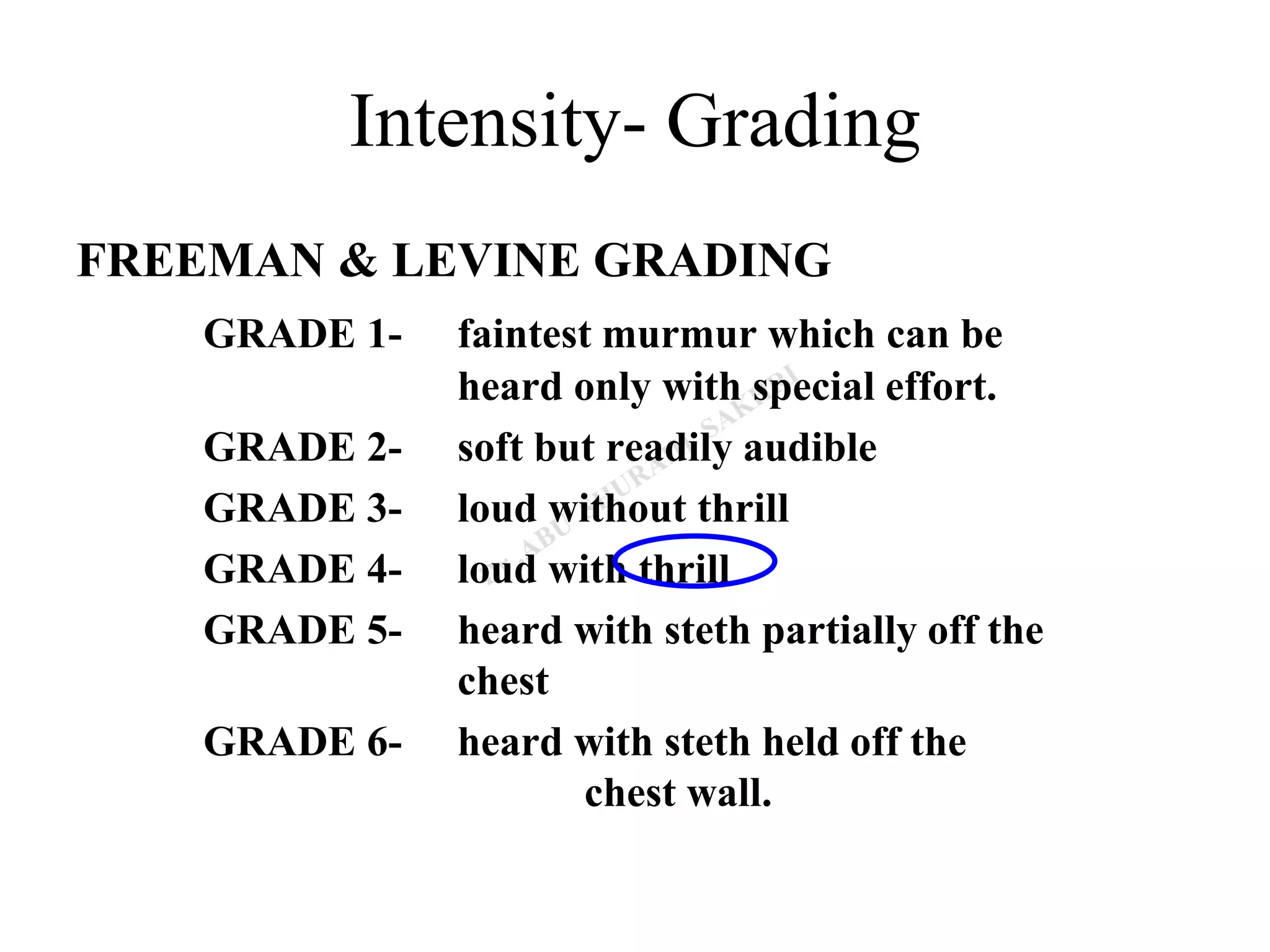
Intensity- Grading
FREEMAN & LEVINE GRADING
GRADE 1- faintest murmur which can be
heard only with special effort.
GRADE 2- soft but readily audible
GRADE 3- loud without thrill
GRADE 4- loud with thrill
GRADE 5- heard with steth partially off the
chest
GRADE 6- heard with steth held off the
chest wall.
Quality & Pitch
• Depends on two factors
1. Pressure difference or gradient- Gr pitch
2. Amount of Flow- Flow pitch
PITCH Hz Flow Pr Gr QUALIT
Y
E.g.:
LOW 25-125 rumbling MDM-
MS
MEDIUM 125-
300
harsh AS
HIGH >300 blowing MR,AR
Conduction of murmur
Site to which conducted aids in diagnosis
• MS localized to apex
• MR conducted to axilla and back; LLSB in MVP-MR
• AS conducted to Carotids
Classification & types of
murmurs
Classification & types of murmurs
early systolic
mid systolic
• Systolic murmur late systolic
pan/holo systolic
early diastolic
• Diastolic murmur mid diastolic
pre systolic
• Continuous murmur
Systolic Murmurs
Midsystolic murmur
• Most common murmur heard in everyday practice.
• Starts at an interval after S1 and ends before S2.
• It could be PATHOLOGICAL
INNOCENT/PHYSIOLOGICAL
• 5 settings
1. Ventricular outflow obstruction
2. Dilation of aorta and pulmonary trunk
3. Accelerated systolic flow into aorta or pulmonary trunk
4. Innocent midsystolic murmur( including those due to
morphological changes of valve with no obstruction)
5. Some forms of MR
Ventricular outflow obstruction
Phasic flow across left and
right outflow tract
• Isovolumic contraction (b)
• Maximal ejection (c)
• Start of relaxation and reduced
ejection (d)
• Isovolumic relaxation (e)
• LV filling, rapid phase (f)
• Slow LV filling (diastasis) (g)
• Atrial systole or booster (a)
AS
• IVC S1 ventricular pressure
increases opening of Aorta and
pulmonary valve ejection
commences and murmur begins
• Ejection increases murmur
becomes crescendo
• Ejection declines murmur in
decrescendo
• Murmur ends before
ventricular pressure drops
below aortic pressure at which
aortic valve and pulmonary
valve closes generating a2 and
p2
AS
• Harsh, crescendo-decrescendo
MSM
• Early sys peak short duration vs.
Late systolic peak long duration
• Always Symmetrical [vs. PS]
• ES absent in calcific valves, sub
and supra valvular AS
• Length and loudness do not
necessarily corresponds to
severity but length more
suggestive of severity than other
murmurs
S4
Reverse
splitting S2
AS
• Gallaverdin phenomenon/
hourglass phenomenon
Lower n (aortic) vs. Higher n
(mitral) periodic vibrations of stiffened
non calcific aortic valve
• Differentiating from MR
MR AS [ Gallaverdin]
Apical mid sys/ Holosystolic Apical mid sys
A2 buried in late sys
vibrations
Clear S2 heard
P/PVC unchanged P/PVC mur =
End of Long cycles in AF
unchanged
End of Long cycles
in AF =
AS
Postextrasystolic enhancement results from the variable interaction of three
factors:
1) Increase in the contractile state (inotropism) of the ventricular muscle
which is more evident if there is hypertrophy and/or depressed
ventricular function.
2) The pause provides longer filling time for the ventricle, which is more
consequential in hypertrophic ventricles (e.g., aortic stenosis) than in
ventricular volume overload states (e.g., mitral regurgitation).
3) Lastly, there is more time for arterial runoff, and in the case of aortic
regurgitation, more backflow into the ventricle. This effect lowers the
arterial diastolic pressure and the impedance to forward flow
(afterload) in the beat following the pause.
AS
Valvular AS Supra
valvular
Sub valvular
BP difference nil RUL > LUL Nil
Thrill Max 2 RICS;
Supra sternal &
carotids
Max Right
carotid
Mid LSB
Ejection
sound
Present Absent Absent
Murmur
Maximum
2 RICS 1 RICS Mid LSB
Assoc AR +/- rare +/-
HOCM
• Dynamic LVOT obstruction
• Factors increasing gradient
– LV Contractility
• Exercise
• Cathecolamines
• Digitalis
– Ventricular Volume
• Valsalva
• Standing
• Nitroglycerine/ Amyl nitrate
• Tachycardia
– Aortic impedance and pressure
• Sustained Handgrip
• Passive Leg Raise
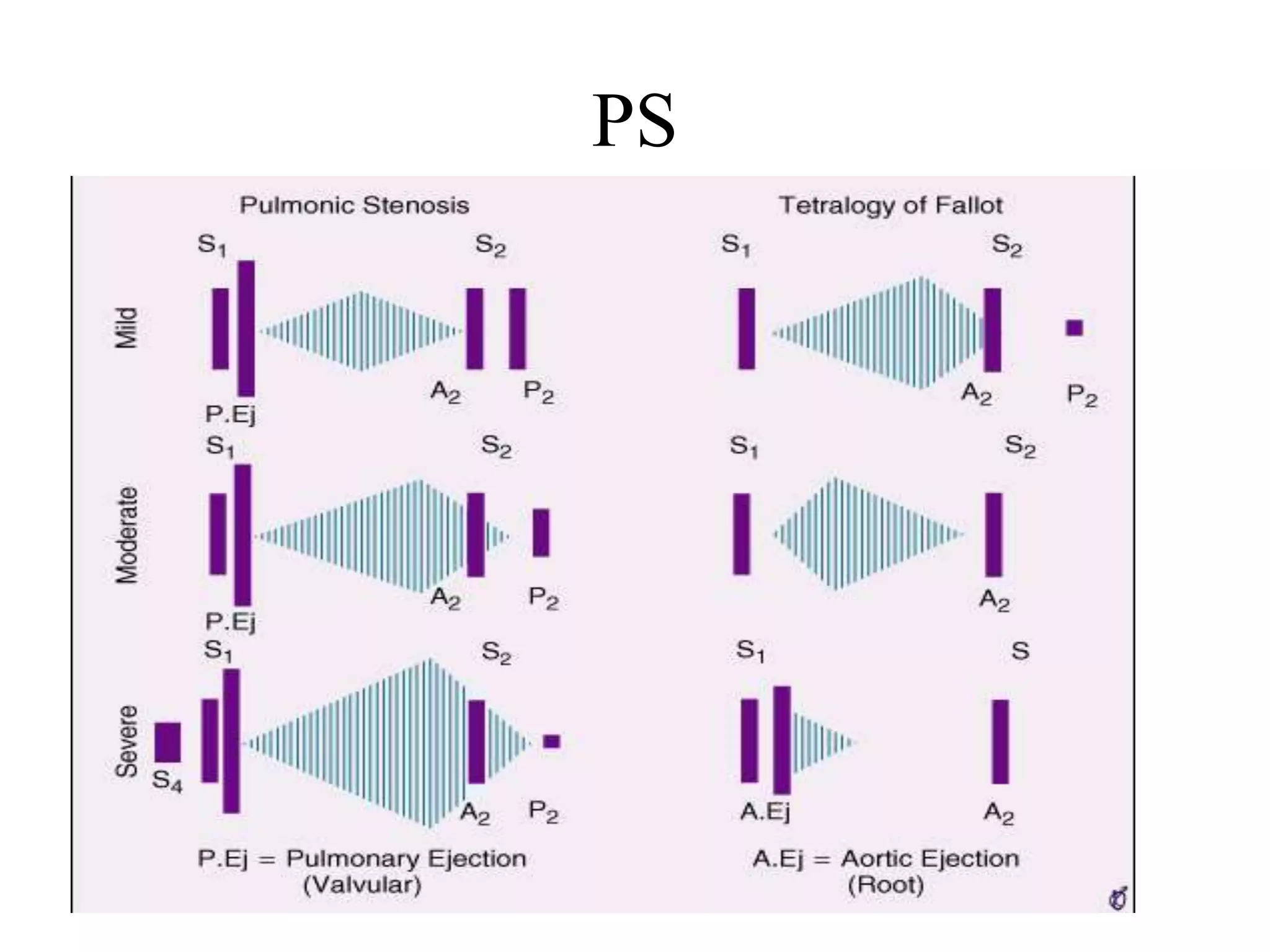
PS
• Murmur brought on by a phasic
ejection click; radiates up &
left
• As severity increases length
increases and P2 becomes soft
(abruptness of closure reduced),
S2 split widens, S4
• Loses symmetry becomes kite
shaped
• May engulf A2 and P2 may be
inaudible; may be confused with
VSD
PS
Other causes of MSM
Dilation of Aorta & Pulmonary trunk
• Short soft midsystolic murmur
• Left sided murmurs in marfan’s syndrome, syphilis
• Right sided murmurs in idiopathic dilation of pulmonary
artery, pulmonary hypertension
MSM of Hyperdynamic circulation
• Normal aorta or pulmonary trunk but increased flow
• Anaemia, pregnancy, fever, thyrotoxicosis
Other causes of MSM
OS-ASD
• Rapid flow across pulmonary valve to dilated pulmonary
trunk
Pure AR
• Due to Accelerated LV ejection
Physiological causes
Innocent systolic murmur
• Still’s murmur
• Pulmonary mid systolic murmur
• Peripheral pulmonary systolic murmur
• Supraclavicular or brachiocephalic systolic murmur
• Aortic sclerosis
• Systolic mammary soufflé
Physiological murmurs
Still’s murmur
• Short buzzing murmur
‘twanging of a rubber band’
• Pure medium frequency by
periodic vibrations of pulmonic
leaflets at their attachment
Physiological murmurs
Pulmonary mid systolic murmur &
Peripheral pulmonary systolic
murmur
• Angulation and disparity
between pulmonary trunk and
its branches turbulent flow
• Normally disappears with
maturity of pulmonary bed
Physiological murmurs
Supraclavicular or brachiocephalic
systolic murmur
• Aortic origins of major normal
brachiocephalic arteries
• Crescendo-decrescendo, abrupt
onset, short, sometimes
radiating below clavicle
• vs. supra valvular AS – these
murmur are softer below
clavicle and decreases with
shoulder abduction
Physiological murmurs
Mammary Soufflé
• Late Pregnancy or puerperium
• Sometimes continuous louder in
systole, distinct gap from S1 [
time for ejected blood to reach
mammary arteries]
• 2 or 3 RICS/ LICS
• Light Pressure augments
murmur becomes continuous;
firm Pr abolishes murmur
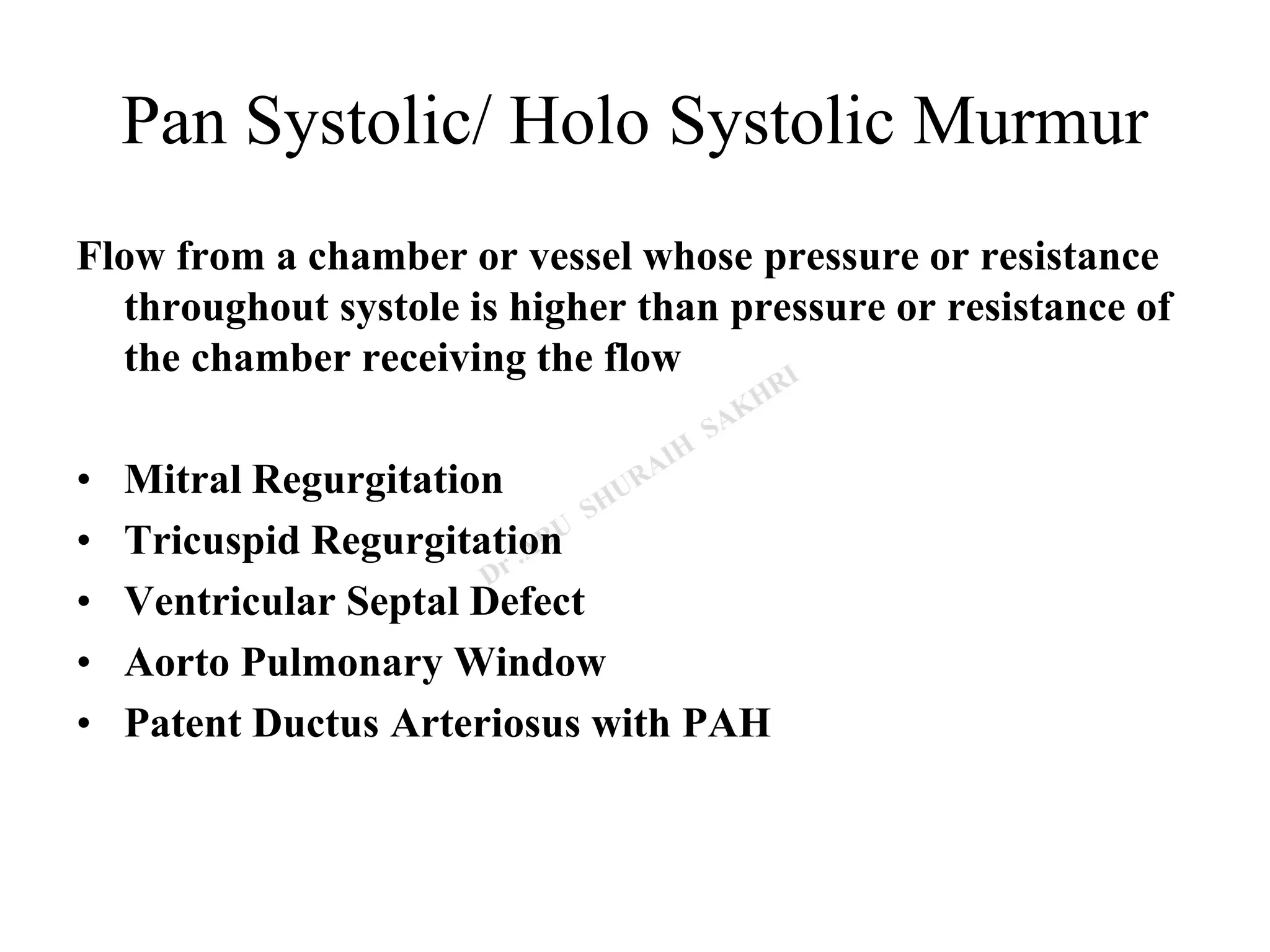
Pan Systolic/ Holo Systolic Murmur
Flow from a chamber or vessel whose pressure or resistance
throughout systole is higher than pressure or resistance of
the chamber receiving the flow
• Mitral Regurgitation
• Tricuspid Regurgitation
• Ventricular Septal Defect
• Aorto Pulmonary Window
• Patent Ductus Arteriosus with PAH
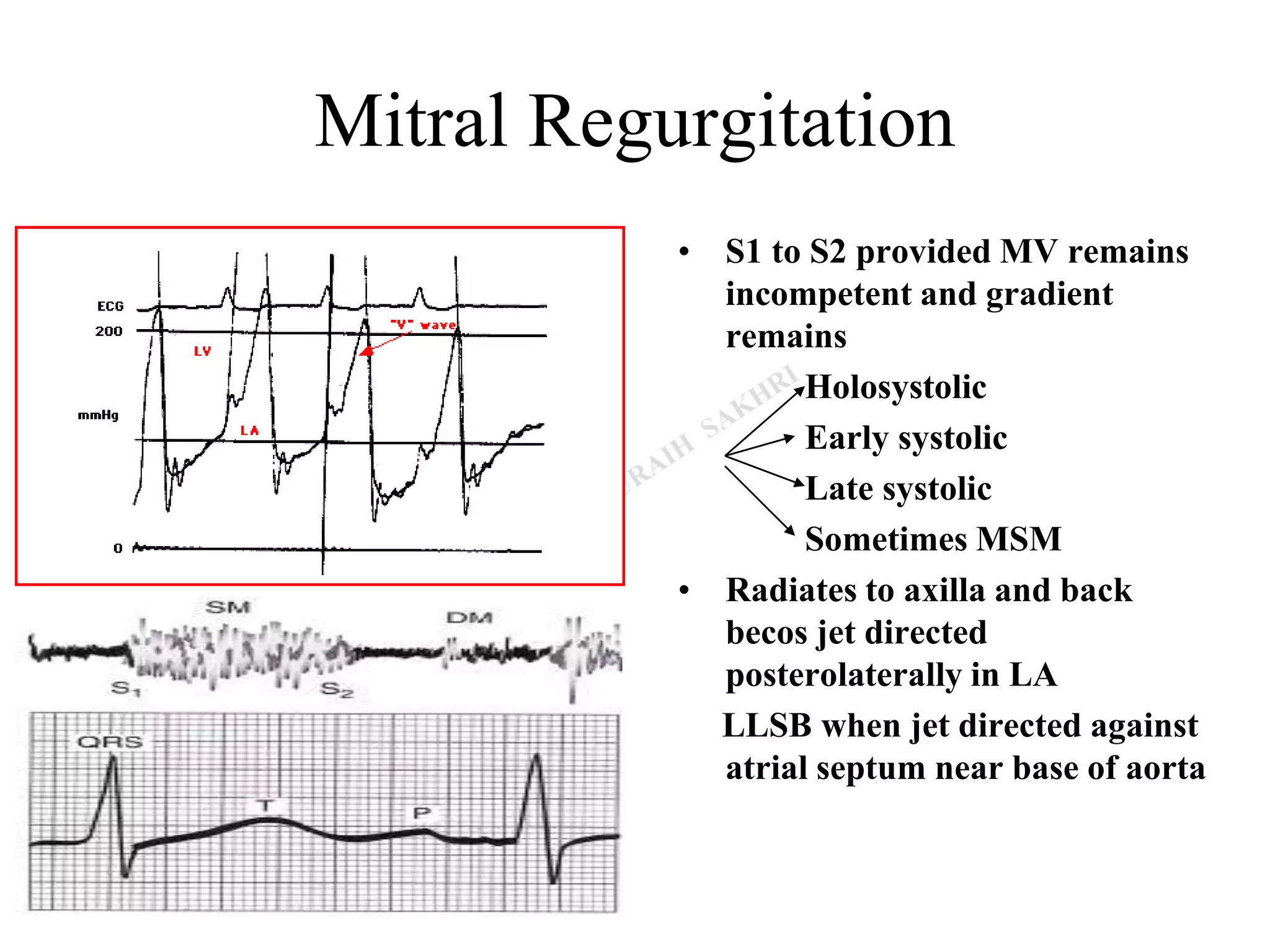
Mitral Regurgitation
• S1 to S2 provided MV remains
incompetent and gradient
remains
Holosystolic
Early systolic
Late systolic
Sometimes MSM
• Radiates to axilla and back
becos jet directed
posterolaterally in LA
LLSB when jet directed against
atrial septum near base of aorta
Tricuspid Regurgitation
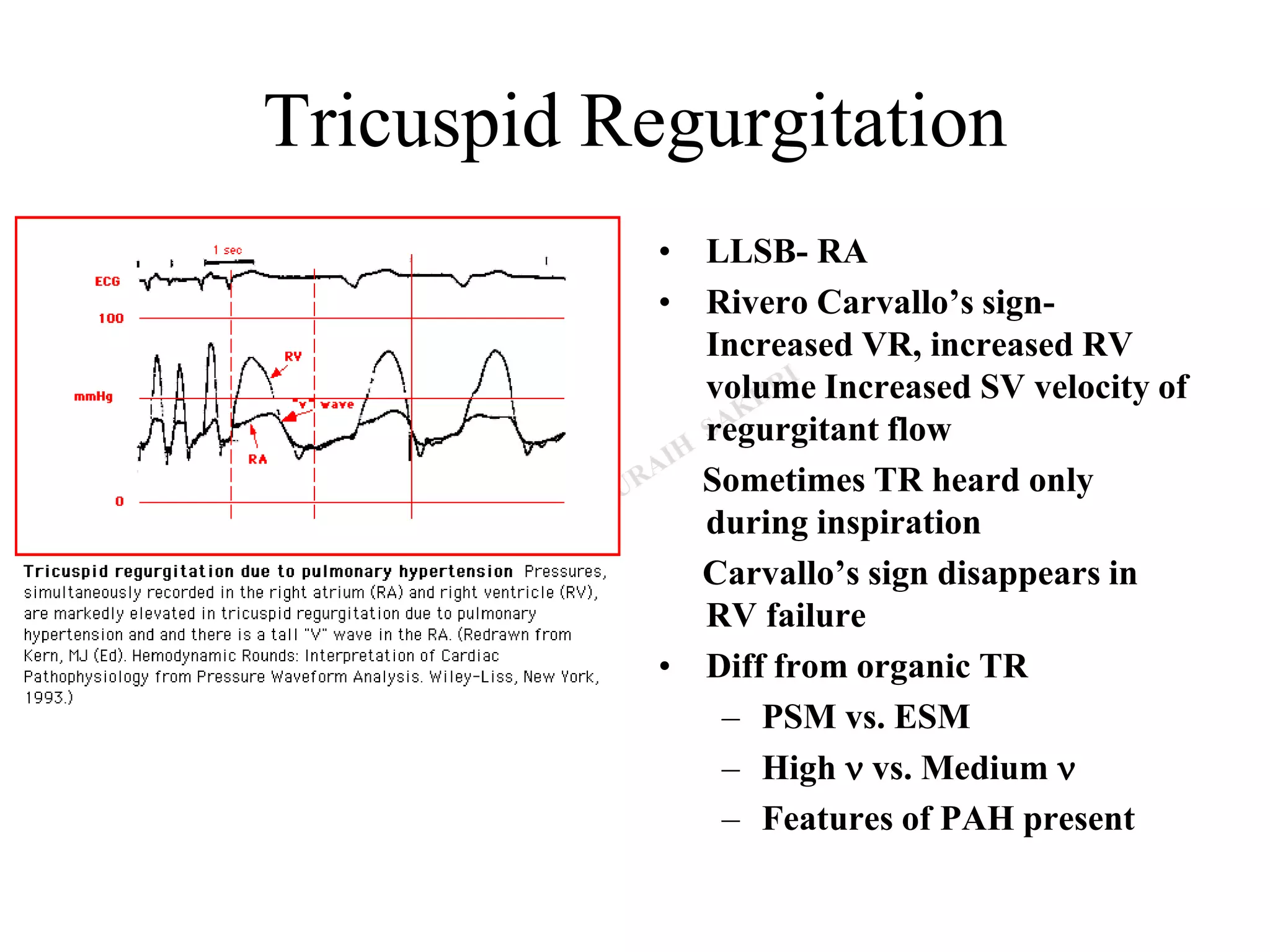
• LLSB- RA
• Rivero Carvallo’s sign-
Increased VR, increased RV
volume Increased SV velocity of
regurgitant flow
Sometimes TR heard only
during inspiration
Carvallo’s sign disappears in
RV failure
• Diff from organic TR
– PSM vs. ESM
– High n vs. Medium n
– Features of PAH present
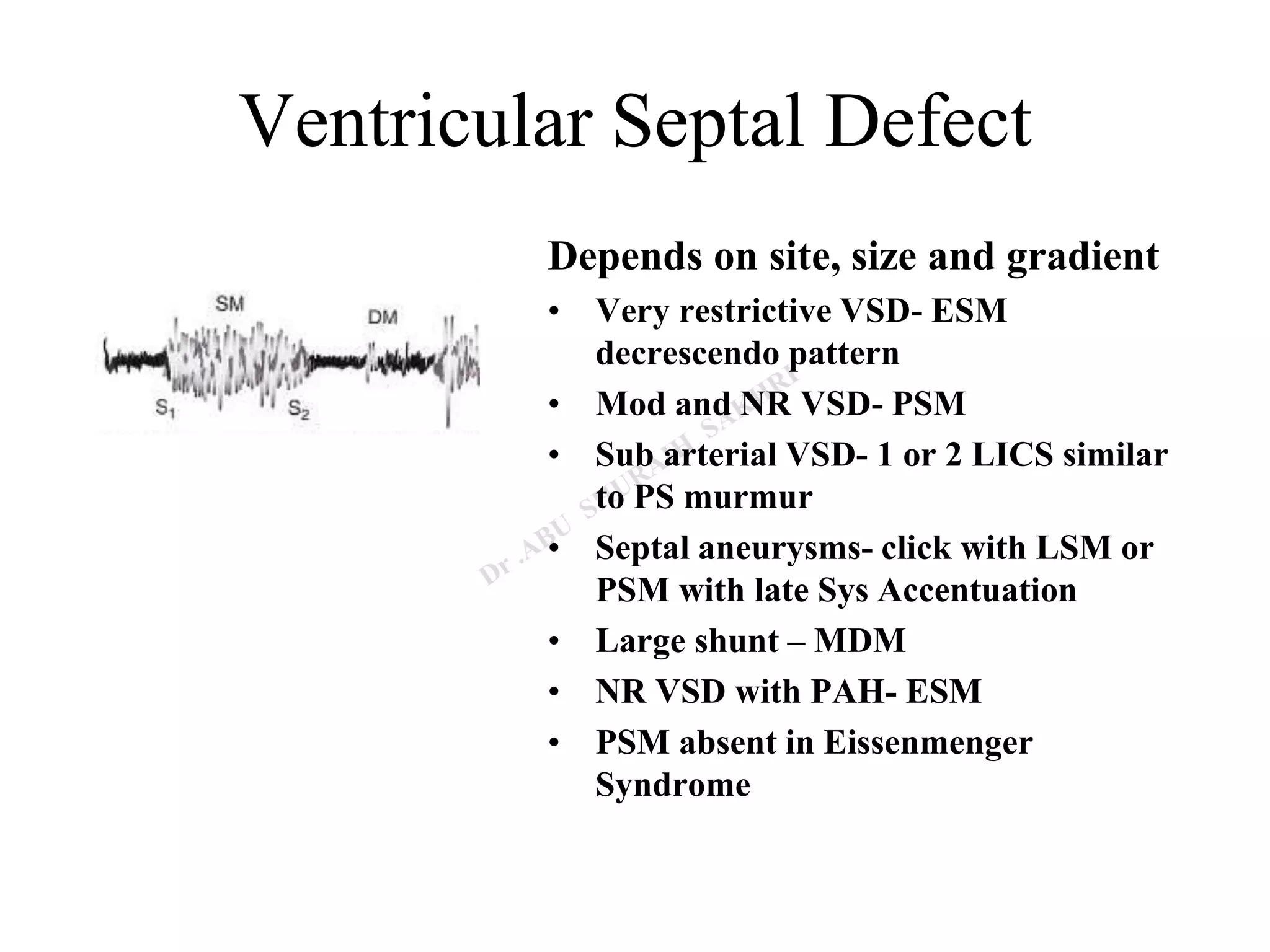
Ventricular Septal Defect
Depends on site, size and gradient
• Very restrictive VSD- ESM
decrescendo pattern
• Mod and NR VSD- PSM
• Sub arterial VSD- 1 or 2 LICS similar
to PS murmur
• Septal aneurysms- click with LSM or
PSM with late Sys Accentuation
• Large shunt – MDM
• NR VSD with PAH- ESM
• PSM absent in Eissenmenger
Syndrome
Other PSM
• Aorto Pulmonary Window with PAH
– Otherwise continuous murmur
– Diastolic component reduced with increasing PAH
• PDA with PAH
– Similar mechanism
ESM
Acute Mitral Regurgitation
• Decrescendo murmur
• Non distensible LA , large v
wave approaching LV pressure
in late systole
• Maximum flow early systole
and minimum to nil flow in late
systole
Other ESM
• Normal pressure TR, Organic TR
Tall RA v waves reach the level of normal RV pressure in late systole,
so lower rate of regurgitant flow
Moderate to low frequency as compared to high frequency in high
pressure TR
• VSD with PVR or small muscular VSD
-Equalization of pressures in cases of PAH
-Small VSD closes in late systole
LSM
MVP
• Leaflets remains competent during early
ventricular contraction but overshoot in
late systole [critical V. dimensions]
• One or more mid systolic clicks precede
murmur [sudden deceleration of the
column of blood against the prolapsed
leaflet or scallops]
• Longer and softer
– Prompt standing after squatting
– Valsalva II
• Short & louder
– squatting
– Sustained hand grip
– Amyl nitrate
Other LSM- papillary muscle dysfunction
Post Pap Muscle . Late systolic cresendo to S2
Barlow’s syndrome refers to the
spectrum of symptoms caused by MVP
[click or murmur alone to palpitations,
chest pain, or syncope]
Diastolic Murmurs
Early diastolic murmur
• AR murmur
-Soft high frequency early diastolic
murmur with pt sitting & leaning
forward in full held expiration
-3 LICS [ 2 & 3 RICS in root dil]
-musical quality in eversion
-Austin Flint murmur
-Cole- Cecil murmur- AR murmur
in left axilla due to higher position of
apex
AR
• Difference between acute and
chronic AR
• Austin Flint Murmur to be
discussed
A/C AR C/C AR
Short mur. -
early
equalization of
diastolic
pressures
Long mur.
Medium n –
velocity less
rapid and
pressure
gradient lower
High n
Associated S4
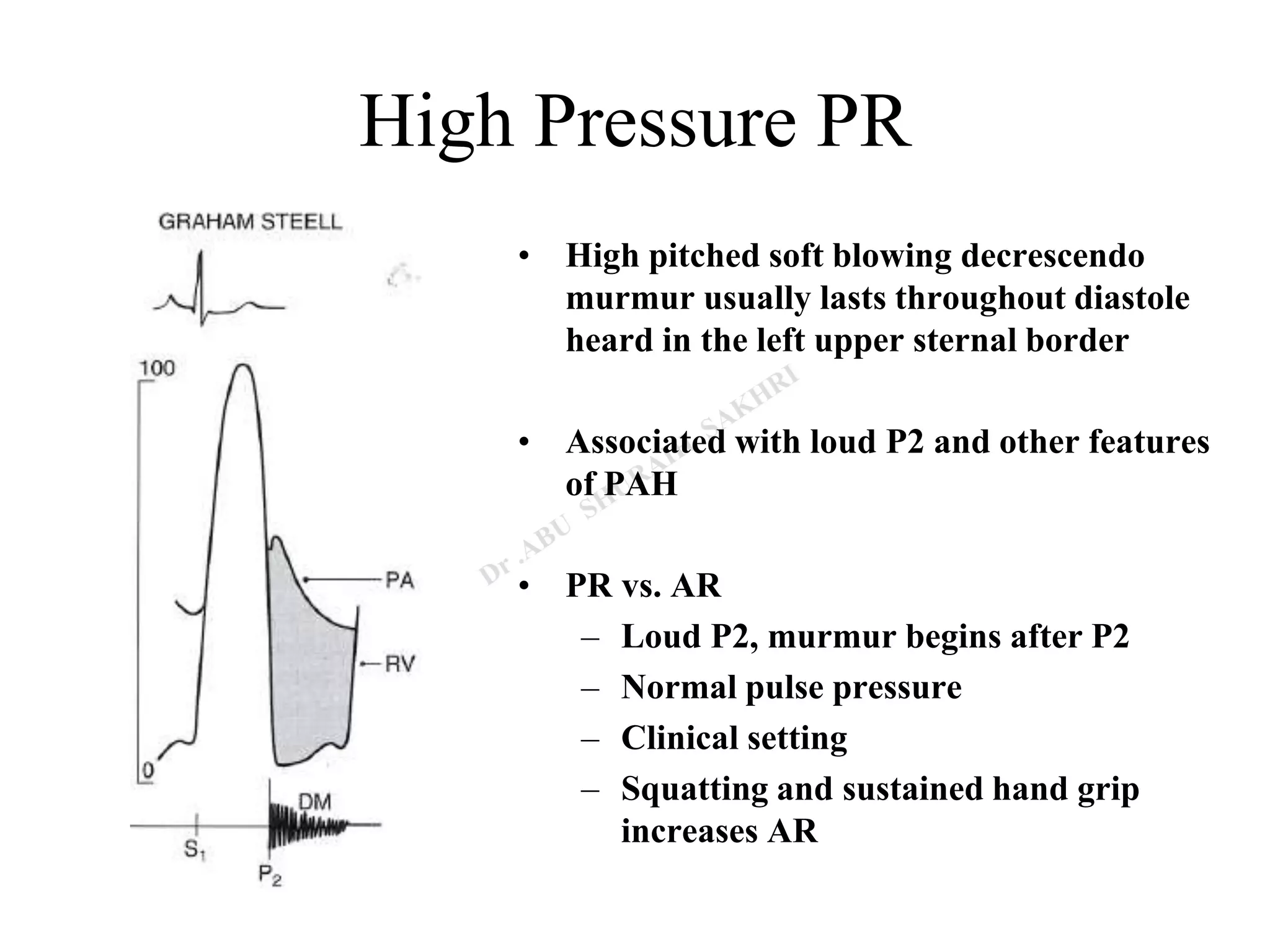
High Pressure PR
• High pitched soft blowing decrescendo
murmur usually lasts throughout diastole
heard in the left upper sternal border
• Associated with loud P2 and other features
of PAH
• PR vs. AR
– Loud P2, murmur begins after P2
– Normal pulse pressure
– Clinical setting
– Squatting and sustained hand grip
increases AR
High Pressure vs. Normal Pressure
High Pressure
Normal
pressure
Decrescendo Crescendo
decrescendo
High frequency Medium to low
pitched
Onset immediately
with p2
Delayed in onset
Usu extends
throughout
diastole
Short duration
Features of PAH
present
Usually absent
Mid Diastolic Murmur
-Begin At Clear Interval After S2
I Rapid Filling Phase
Av valve obstruction Stenotic AV valves, tumors
Functional obstruction
Abnormal patterns of AV flow increased flow volume
increased flow velocity
II Incompetent Pulmonary Valve [PR with normal PA
Pressure]
III Atherosclerotic extramural coronary arteries
Mid Diastolic Murmur
RV
- TS
LV
- MS
- Austin Flint murmur
- Carey-Comb's
OTHERS
-Atrial Myxoma
- TR
- ASD
- VSD
- PDA
- MR
MS
• Low n rough rumbling [sound
of distant thunder] MDM
• Localized to apex, better heard
in left lateral position with bell
• Length a severity
• Long murmurs up to S1 even in
long cycles of AF- severe MS
• Late diastolic or Pre systolic
accentuation usually seen in
pliable valves and in NSR [
sometimes in AF]
TS
• Similar to MS
• Murmur usually seen associated with AF
• Diff. from MS
– Increases during inspiration [Augmentation of RV volume, RV
Diastolic Pr., Flow rate and gradient across valve]
– LLSB
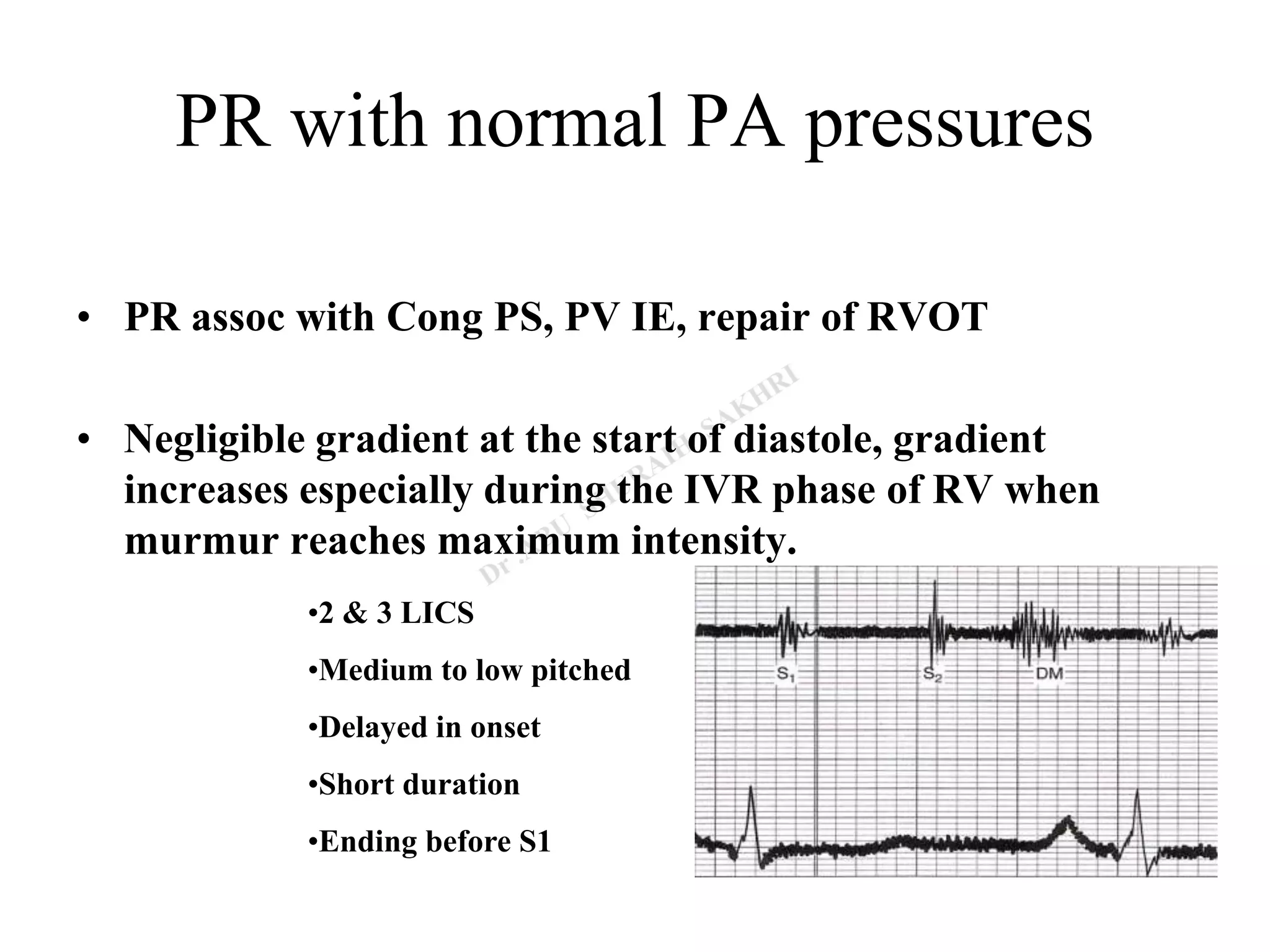
PR with normal PA pressures
• PR assoc with Cong PS, PV IE, repair of RVOT
• Negligible gradient at the start of diastole, gradient
increases especially during the IVR phase of RV when
murmur reaches maximum intensity.
•2 & 3 LICS
•Medium to low pitched
•Delayed in onset
•Short duration
•Ending before S1
Austin Flint Murmur
• Severe AR regurgitant jet directed toward the AML
prevent the latter from opening well during diastole
generating turbulent flow
• Low n MDM or late diastolic, best heard at the apex.
• To differentiate from MS
– No OS
– Amyl nitrate inhalation AR, Austin flint murmur
Other Mid Diastolic Murmur
• Carey Coomb’s murmurs
– Acute rheumatic fever, mitral valve structures acutely inflamed with some
thickening and edema turbulence of flow during the rapid filling phase.
+ moderate MR [increased mitral inflow in diastole]
– Low pitched short MDM.
– good evidence of active carditis
Flow Murmurs
• Increased AV flow
• TR, ASD, MR, VSD, PDA, hyperdynamic circulation
• To differentiate from MS & TS
– Short MDM
– Medium Pitch- increased flow
– Preceded by S3
– Absence of Opening Snap
– Thrill less common
Late Diastolic/ Pre-systolic Murmurs
MS
• Higher frequency than MDM
• Sometimes only PSA heard- mild MS
• Generally absent in calcified valves and most of AF [ may
be present during short cycle lengths in AF]
• Cause-
– Increased flow during atrial contraction in late systole
– Increased dp/dt of LV contraction increases turbulence
[ esp. in AF short cycles]
Other diastolic murmurs
• Cabot– Locke Murmur- [Diastolic Flow murmur]
– The Cabot–Locke murmur is a diastolic murmur that sounds similar to
aortic insufficiency but does not have a decrescendo; it is heard best at the
left sternal border. [High flow thru coronary vessels, LMCA, LAD]
– The murmur resolves with treatment of anaemia.
• Dock’s murmur
– diastolic crescendo-decrescendo, with late accentuation, [consistent with
blood flow through the coronary] in a sharply localized area, 4 cm left of
the sternum in the 3LICS, detectable only when the patient was sitting
upright.
– Due to stenosis of LAD
Other diastolic murmurs
• Key–Hodgkin murmur
– EDM of AR; it has a raspy quality, [sound of a saw cutting through wood].
Hodgkin correlated the murmur with retroversion of the aortic valve
leaflets in syphilitic disease.
• Rytand’s murmur in complete heart block
– MDM or Late diastolic murmur
– Atrial contraction coincides with the phase of rapid diastolic filling
increased flow short MDM [intermittent].
– Another theory- Delayed V. contraction following A. contraction may lead
to diastolic MR & TR, because AV valve closure does not occur [unless V.
systole supervenes]. When higher V than A pressure during atrial
relaxation, an incompletely closed AV valve may lead to a reverse gradient
with a considerable regurgitation volume.
Continuous murmur
Continuous murmur
• Begin in systolic and continues without interruption
through the timing of S2 into all or part of diastole
• Flow from zone of higher resistance into lower resistance
without phasic interruption b/w systole & diastole
1. Connection b/w high pressure chamber/vessel & low
pressure chamber/vessel
2. Disturbance in flow patterns in arteries
3. Disturbances in flow patterns in veins
Connection b/w high pressure
chamber/vessel & low pressure
chamber/vessel
1. From the aorta
a. Persistent ductus arteriosus
b. Aorto-pulmonary window
c. RSOV
2. From the coronary artery:
1. Coronary arteriovenous fistulae draining into RA, RV, PA
2. ALCAPA
3. Other arteriovenous communications
1. Broncho-pulmonary collaterals
2. Chest wall arteries–pulmonary vessels
3. Peripheral A-V Fistula
4. Others
1. Lutembacher syndrome with restricted ASD
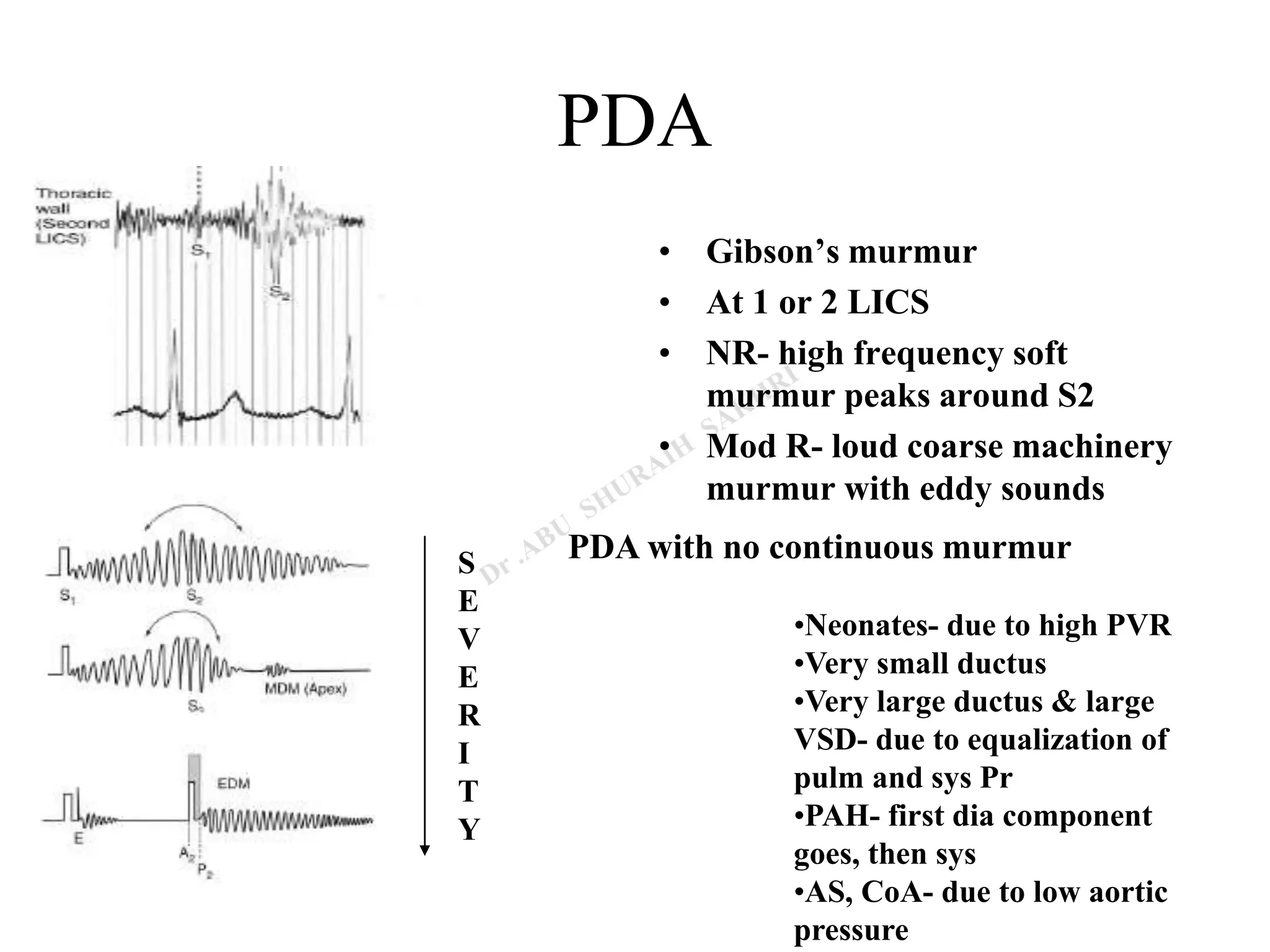
PDA
• Gibson’s murmur
• At 1 or 2 LICS
• NR- high frequency soft
murmur peaks around S2
• Mod R- loud coarse machinery
murmur with eddy sounds
S
E
V
E
R
I
T
Y
PDA with no continuous murmur
•Neonates- due to high PVR
•Very small ductus
•Very large ductus & large
VSD- due to equalization of
pulm and sys Pr
•PAH- first dia component
goes, then sys
•AS, CoA- due to low aortic
pressure
Continuous murmurs
• APW
– 2 or 3 LICS
– Usually associated with early devp of eissenmenger
• RSOV
– No peaking at S2 seen [peaks in sys or dia.]
– To RA- RLSB
RV- LLSB
RVOT- 3 LICS
• Lutembacher syndrome with restricted ASD
– LLSB [body of RA]
Continuous murmurs
• C-AVF
– RA- RLSB or RUSB
– CS- back b/w spine & Lt scapula
– RV inflow- LLSB
– RVOT- Upper to Mid LSB [beat to beat change in murmur may be
present, RV systolic compression, valsalva softens murmur]
– PA- ULSB [no eddy sounds]
• ALCAPA
– Murmur louder in diastole [LV contr. I/C flow]
– Do not peak at S2
– Usu LUSB or RUSB
-LA- ULSB rad to Lt ant ax line
- Lt SVC- upper to mid LSB
Disturbance in flow patterns in arteries
• AV Fistula
– Murmur heard in the venous side
• Due to rapid blood flow-
– cervical venous hum, mammary soufflé, hyperthyroidism, hemangioma,
hyperemia of neoplasm (HCC, RCC, Paget’s disease)
• Stenosed arteries with inadequate distal collaterals
– aortic arch vessel occlusions, atherosclerotic carotids, coarctation of aorta,
main pulmonary artery stenosis and periph pulmonary artery stenosis
Disturbances in flow patterns in veins
Venous hum
• Healthy children, young healthy
adults, pregnancy
• Sitting, Bell, medial aspect of Rt
SCl fossa, with face pulled
leftwards & upwards
disappears when returned to
normal position
• Louder in diastole, +/- high
pitched whine
• Radiation to infra clavicular
areas confuse with other mur.
Check by obliteration
Dynamic Auscultation
It refers to the technique of altering circulatory dynamics by
a variety of physiological and pharmacological maneuvers
and determining the effects of these maneuvers on heart
sounds and murmurs .
Intervention
• Position
• Physical maneuvers
• Pharmacological
Position
A. Lt Lateral Decubitus
LV impulse [apical sounds, murmurs better heard]
Act of turning increases HR[ MDM & PSA of MS ],
induces PVC [AS murmur vs. MR murmur (n/c)]
B. Sitting leaning forward full held expiration
AR & PR EDM
C. Sitting with legs dangling
Further reduces venous return
If S2 fails to fuse on sitting
D. Elbow Knee Position
Pericardial friction rub
Position
E. Standing to squatting and vice versa
– Standing[ venous return, BP ]; [opp. in squatting]
1. All murmurs [except HOCM , MVP earlier]
• HOCM [ LV contractility, after load, preload]
• MVP [ preload, afterload ]
2. A2- P2 , A2-OS , A2-S3 (n/c)
F. Hyperextension of shoulders
supraclavicular Systolic murmurs
G. Stretching of Neck
Venous hum
H. Passive elevation of both legs
Transiently increases venous return, increase S3
Physical Maneuvers
Inspiration
• Right sided events become more
prominent
• S2 split appreciable
• RVs3 RVs4 prominent
• Tricuspid sys & dia Mur
increased
• Pulm ejection sound reduced
Expiration
• Left sided events become more
prominent
• Diff AR & PR
• Pericardial friction rub
[exhalation & supine]
• Innocent pulm mid sys murmur
becomes more prominent becos
of reduced AP diameter
Inspiration followed by forced exhalation against a closed
glottis for 10 to 20 seconds
Physician has to keep flat of the hand on the abdomen to
provide the patient a force to breathe against
Not attempted in patients with IHD
Normal response has four phases
Valsalva Maneuver
Valsalva Maneuver
•initial pulm VR = SV
• I/T Pr directly
transmitted to aorta.
I/T Pr = VR = BP
sympathetic tone HR
Sudden I/T Pr = BP
sudden return of peripherally pooled blood
to the vaso-constricted arterial
system (20 to the increased sympathetic tone)
Phase II – Decrease in systemic venous return , systolic
pressure and pulse pressure
• S3 & S4 attenuated
• A2-P2 interval narrows
• All murmurs except MVP / HOCM decrease
Phase III- increased Left murmurs & Phase IV- increased
Right murmurs
Valsalva Maneuver
Valsalva Maneuver
I/T Pr = VR = BP
sympathetic tone HR
sudden return of peripherally pooled blood
to the vaso-constricted arterial
system (20 to the increased sympathetic tone)
PHASE II
PHASE IV
MAXIMAL SYMPATHETIC
ACTIVATION
FLAT PART OF
STARLING’S CURVE
HEART
FAILURE
ASD
MS
Isometric Exercise
Calibrated Handgrip device or a handball.
Better to carryout bilaterally, sustained for 20-30 secs
Not to be done in arrhythmia / Ischemia
Transient but significant increase in SVR, BP, HR , CO , LV filling
pressure , Heart size
1. LVS3 & LVS4 increases
2. Systolic Murmur of AS reduced – reduced gradient across aortic
valve
3. AR , MR , VSD – increased
4. MDM of MS – increased
5. Syst Murmur of HOCM reduced
6. MVP murmur + click delayed
• Few minutes of brisk walking sufficient
• Must be auscultated quickly before effect wears off
– Increases Ms murmur in low output states
– Wide Split of S2 in RVF further widens after exercise
Isotonic Exercise
Thank you

HEART MURMURS

  • 1.
  • 2.
    Definition of murmur •“Relatively prolonged series of audible vibrations” • Characterized by the timing in cardiac cycle, intensity (loudness), frequency (pitch), quality, configuration, duration and direction of radiation.
  • 3.
    How is amurmur produced and heard?
  • 4.
    How is amurmur produced? Sound is produced by vibration Turbulence generated in the blood column vibrations set up in the vessel wall & cardiac structures murmurs
  • 5.
    How is amurmur produced? L = linear dimension (internal diameter In pipes) V = mean fluid velocity Q = volumetric flow rate A = pipe cross-sectional area m = dynamic viscosity of the fluid n = kinematic viscosity [m/ r] r = density of the fluid Q = V1*A1= V2*A2 Q = P/R [Re >4000 turbulent flow] Re => Turbulence => murmur
  • 6.
    Auscultation of murmur Otherfactors affecting auscultation of murmur • Distance from chest wall, position of patient • Underlying soft tissue, lung, fluid • Quality of apparatus
  • 7.
    Auscultation of murmur Upper3rd L St-C Jn 4th L cos. cart. in L St. border 4th RICS
  • 8.
    How to describea murmur?
  • 9.
    Description of aMurmur • Position in the cardiac cycle • Site of murmur [max. intensity] • Intensity • Quality & Pitch • Conduction • Dynamic changes
  • 10.
    Position in thecardiac cycle early systolic mid systolic • Systolic murmur late systolic pan/holo systolic early diastolic • Diastolic murmur mid diastolic pre systolic • Continuous murmur
  • 11.
    Site of murmur SystolicDiastolic Continuous Apex MR MS, Flow mur. LLSB TR, VSD TS, Flow mur. RSOV to RV, RLSB- RSOV to RA, Cor AVF ULSB PS PR, AR PDA- 1 & 2 LICS, APW- 3 LICS URSB AS Others
  • 12.
    Intensity- Grading FREEMAN &LEVINE GRADING GRADE 1- faintest murmur which can be heard only with special effort. GRADE 2- soft but readily audible GRADE 3- loud without thrill GRADE 4- loud with thrill GRADE 5- heard with steth partially off the chest GRADE 6- heard with steth held off the chest wall.
  • 13.
    Quality & Pitch •Depends on two factors 1. Pressure difference or gradient- Gr pitch 2. Amount of Flow- Flow pitch PITCH Hz Flow Pr Gr QUALIT Y E.g.: LOW 25-125 rumbling MDM- MS MEDIUM 125- 300 harsh AS HIGH >300 blowing MR,AR
  • 14.
    Conduction of murmur Siteto which conducted aids in diagnosis • MS localized to apex • MR conducted to axilla and back; LLSB in MVP-MR • AS conducted to Carotids
  • 15.
  • 16.
    Classification & typesof murmurs early systolic mid systolic • Systolic murmur late systolic pan/holo systolic early diastolic • Diastolic murmur mid diastolic pre systolic • Continuous murmur
  • 17.
  • 19.
    Midsystolic murmur • Mostcommon murmur heard in everyday practice. • Starts at an interval after S1 and ends before S2. • It could be PATHOLOGICAL INNOCENT/PHYSIOLOGICAL • 5 settings 1. Ventricular outflow obstruction 2. Dilation of aorta and pulmonary trunk 3. Accelerated systolic flow into aorta or pulmonary trunk 4. Innocent midsystolic murmur( including those due to morphological changes of valve with no obstruction) 5. Some forms of MR
  • 20.
    Ventricular outflow obstruction Phasicflow across left and right outflow tract • Isovolumic contraction (b) • Maximal ejection (c) • Start of relaxation and reduced ejection (d) • Isovolumic relaxation (e) • LV filling, rapid phase (f) • Slow LV filling (diastasis) (g) • Atrial systole or booster (a)
  • 21.
    AS • IVC S1ventricular pressure increases opening of Aorta and pulmonary valve ejection commences and murmur begins • Ejection increases murmur becomes crescendo • Ejection declines murmur in decrescendo • Murmur ends before ventricular pressure drops below aortic pressure at which aortic valve and pulmonary valve closes generating a2 and p2
  • 22.
    AS • Harsh, crescendo-decrescendo MSM •Early sys peak short duration vs. Late systolic peak long duration • Always Symmetrical [vs. PS] • ES absent in calcific valves, sub and supra valvular AS • Length and loudness do not necessarily corresponds to severity but length more suggestive of severity than other murmurs S4 Reverse splitting S2
  • 23.
    AS • Gallaverdin phenomenon/ hourglassphenomenon Lower n (aortic) vs. Higher n (mitral) periodic vibrations of stiffened non calcific aortic valve • Differentiating from MR MR AS [ Gallaverdin] Apical mid sys/ Holosystolic Apical mid sys A2 buried in late sys vibrations Clear S2 heard P/PVC unchanged P/PVC mur = End of Long cycles in AF unchanged End of Long cycles in AF =
  • 24.
    AS Postextrasystolic enhancement resultsfrom the variable interaction of three factors: 1) Increase in the contractile state (inotropism) of the ventricular muscle which is more evident if there is hypertrophy and/or depressed ventricular function. 2) The pause provides longer filling time for the ventricle, which is more consequential in hypertrophic ventricles (e.g., aortic stenosis) than in ventricular volume overload states (e.g., mitral regurgitation). 3) Lastly, there is more time for arterial runoff, and in the case of aortic regurgitation, more backflow into the ventricle. This effect lowers the arterial diastolic pressure and the impedance to forward flow (afterload) in the beat following the pause.
  • 25.
    AS Valvular AS Supra valvular Subvalvular BP difference nil RUL > LUL Nil Thrill Max 2 RICS; Supra sternal & carotids Max Right carotid Mid LSB Ejection sound Present Absent Absent Murmur Maximum 2 RICS 1 RICS Mid LSB Assoc AR +/- rare +/-
  • 26.
    HOCM • Dynamic LVOTobstruction • Factors increasing gradient – LV Contractility • Exercise • Cathecolamines • Digitalis – Ventricular Volume • Valsalva • Standing • Nitroglycerine/ Amyl nitrate • Tachycardia – Aortic impedance and pressure • Sustained Handgrip • Passive Leg Raise
  • 27.
    PS • Murmur broughton by a phasic ejection click; radiates up & left • As severity increases length increases and P2 becomes soft (abruptness of closure reduced), S2 split widens, S4 • Loses symmetry becomes kite shaped • May engulf A2 and P2 may be inaudible; may be confused with VSD
  • 28.
  • 29.
    Other causes ofMSM Dilation of Aorta & Pulmonary trunk • Short soft midsystolic murmur • Left sided murmurs in marfan’s syndrome, syphilis • Right sided murmurs in idiopathic dilation of pulmonary artery, pulmonary hypertension MSM of Hyperdynamic circulation • Normal aorta or pulmonary trunk but increased flow • Anaemia, pregnancy, fever, thyrotoxicosis
  • 30.
    Other causes ofMSM OS-ASD • Rapid flow across pulmonary valve to dilated pulmonary trunk Pure AR • Due to Accelerated LV ejection
  • 31.
    Physiological causes Innocent systolicmurmur • Still’s murmur • Pulmonary mid systolic murmur • Peripheral pulmonary systolic murmur • Supraclavicular or brachiocephalic systolic murmur • Aortic sclerosis • Systolic mammary soufflé
  • 32.
    Physiological murmurs Still’s murmur •Short buzzing murmur ‘twanging of a rubber band’ • Pure medium frequency by periodic vibrations of pulmonic leaflets at their attachment
  • 33.
    Physiological murmurs Pulmonary midsystolic murmur & Peripheral pulmonary systolic murmur • Angulation and disparity between pulmonary trunk and its branches turbulent flow • Normally disappears with maturity of pulmonary bed
  • 34.
    Physiological murmurs Supraclavicular orbrachiocephalic systolic murmur • Aortic origins of major normal brachiocephalic arteries • Crescendo-decrescendo, abrupt onset, short, sometimes radiating below clavicle • vs. supra valvular AS – these murmur are softer below clavicle and decreases with shoulder abduction
  • 35.
    Physiological murmurs Mammary Soufflé •Late Pregnancy or puerperium • Sometimes continuous louder in systole, distinct gap from S1 [ time for ejected blood to reach mammary arteries] • 2 or 3 RICS/ LICS • Light Pressure augments murmur becomes continuous; firm Pr abolishes murmur
  • 36.
    Pan Systolic/ HoloSystolic Murmur Flow from a chamber or vessel whose pressure or resistance throughout systole is higher than pressure or resistance of the chamber receiving the flow • Mitral Regurgitation • Tricuspid Regurgitation • Ventricular Septal Defect • Aorto Pulmonary Window • Patent Ductus Arteriosus with PAH
  • 37.
    Mitral Regurgitation • S1to S2 provided MV remains incompetent and gradient remains Holosystolic Early systolic Late systolic Sometimes MSM • Radiates to axilla and back becos jet directed posterolaterally in LA LLSB when jet directed against atrial septum near base of aorta
  • 38.
    Tricuspid Regurgitation • LLSB-RA • Rivero Carvallo’s sign- Increased VR, increased RV volume Increased SV velocity of regurgitant flow Sometimes TR heard only during inspiration Carvallo’s sign disappears in RV failure • Diff from organic TR – PSM vs. ESM – High n vs. Medium n – Features of PAH present
  • 39.
    Ventricular Septal Defect Dependson site, size and gradient • Very restrictive VSD- ESM decrescendo pattern • Mod and NR VSD- PSM • Sub arterial VSD- 1 or 2 LICS similar to PS murmur • Septal aneurysms- click with LSM or PSM with late Sys Accentuation • Large shunt – MDM • NR VSD with PAH- ESM • PSM absent in Eissenmenger Syndrome
  • 40.
    Other PSM • AortoPulmonary Window with PAH – Otherwise continuous murmur – Diastolic component reduced with increasing PAH • PDA with PAH – Similar mechanism
  • 41.
    ESM Acute Mitral Regurgitation •Decrescendo murmur • Non distensible LA , large v wave approaching LV pressure in late systole • Maximum flow early systole and minimum to nil flow in late systole
  • 42.
    Other ESM • Normalpressure TR, Organic TR Tall RA v waves reach the level of normal RV pressure in late systole, so lower rate of regurgitant flow Moderate to low frequency as compared to high frequency in high pressure TR • VSD with PVR or small muscular VSD -Equalization of pressures in cases of PAH -Small VSD closes in late systole
  • 43.
    LSM MVP • Leaflets remainscompetent during early ventricular contraction but overshoot in late systole [critical V. dimensions] • One or more mid systolic clicks precede murmur [sudden deceleration of the column of blood against the prolapsed leaflet or scallops] • Longer and softer – Prompt standing after squatting – Valsalva II • Short & louder – squatting – Sustained hand grip – Amyl nitrate Other LSM- papillary muscle dysfunction Post Pap Muscle . Late systolic cresendo to S2 Barlow’s syndrome refers to the spectrum of symptoms caused by MVP [click or murmur alone to palpitations, chest pain, or syncope]
  • 44.
  • 46.
    Early diastolic murmur •AR murmur -Soft high frequency early diastolic murmur with pt sitting & leaning forward in full held expiration -3 LICS [ 2 & 3 RICS in root dil] -musical quality in eversion -Austin Flint murmur -Cole- Cecil murmur- AR murmur in left axilla due to higher position of apex
  • 47.
    AR • Difference betweenacute and chronic AR • Austin Flint Murmur to be discussed A/C AR C/C AR Short mur. - early equalization of diastolic pressures Long mur. Medium n – velocity less rapid and pressure gradient lower High n Associated S4
  • 48.
    High Pressure PR •High pitched soft blowing decrescendo murmur usually lasts throughout diastole heard in the left upper sternal border • Associated with loud P2 and other features of PAH • PR vs. AR – Loud P2, murmur begins after P2 – Normal pulse pressure – Clinical setting – Squatting and sustained hand grip increases AR
  • 49.
    High Pressure vs.Normal Pressure High Pressure Normal pressure Decrescendo Crescendo decrescendo High frequency Medium to low pitched Onset immediately with p2 Delayed in onset Usu extends throughout diastole Short duration Features of PAH present Usually absent
  • 50.
    Mid Diastolic Murmur -BeginAt Clear Interval After S2 I Rapid Filling Phase Av valve obstruction Stenotic AV valves, tumors Functional obstruction Abnormal patterns of AV flow increased flow volume increased flow velocity II Incompetent Pulmonary Valve [PR with normal PA Pressure] III Atherosclerotic extramural coronary arteries
  • 51.
    Mid Diastolic Murmur RV -TS LV - MS - Austin Flint murmur - Carey-Comb's OTHERS -Atrial Myxoma - TR - ASD - VSD - PDA - MR
  • 52.
    MS • Low nrough rumbling [sound of distant thunder] MDM • Localized to apex, better heard in left lateral position with bell • Length a severity • Long murmurs up to S1 even in long cycles of AF- severe MS • Late diastolic or Pre systolic accentuation usually seen in pliable valves and in NSR [ sometimes in AF]
  • 53.
    TS • Similar toMS • Murmur usually seen associated with AF • Diff. from MS – Increases during inspiration [Augmentation of RV volume, RV Diastolic Pr., Flow rate and gradient across valve] – LLSB
  • 54.
    PR with normalPA pressures • PR assoc with Cong PS, PV IE, repair of RVOT • Negligible gradient at the start of diastole, gradient increases especially during the IVR phase of RV when murmur reaches maximum intensity. •2 & 3 LICS •Medium to low pitched •Delayed in onset •Short duration •Ending before S1
  • 55.
    Austin Flint Murmur •Severe AR regurgitant jet directed toward the AML prevent the latter from opening well during diastole generating turbulent flow • Low n MDM or late diastolic, best heard at the apex. • To differentiate from MS – No OS – Amyl nitrate inhalation AR, Austin flint murmur
  • 56.
    Other Mid DiastolicMurmur • Carey Coomb’s murmurs – Acute rheumatic fever, mitral valve structures acutely inflamed with some thickening and edema turbulence of flow during the rapid filling phase. + moderate MR [increased mitral inflow in diastole] – Low pitched short MDM. – good evidence of active carditis
  • 57.
    Flow Murmurs • IncreasedAV flow • TR, ASD, MR, VSD, PDA, hyperdynamic circulation • To differentiate from MS & TS – Short MDM – Medium Pitch- increased flow – Preceded by S3 – Absence of Opening Snap – Thrill less common
  • 58.
    Late Diastolic/ Pre-systolicMurmurs MS • Higher frequency than MDM • Sometimes only PSA heard- mild MS • Generally absent in calcified valves and most of AF [ may be present during short cycle lengths in AF] • Cause- – Increased flow during atrial contraction in late systole – Increased dp/dt of LV contraction increases turbulence [ esp. in AF short cycles]
  • 59.
    Other diastolic murmurs •Cabot– Locke Murmur- [Diastolic Flow murmur] – The Cabot–Locke murmur is a diastolic murmur that sounds similar to aortic insufficiency but does not have a decrescendo; it is heard best at the left sternal border. [High flow thru coronary vessels, LMCA, LAD] – The murmur resolves with treatment of anaemia. • Dock’s murmur – diastolic crescendo-decrescendo, with late accentuation, [consistent with blood flow through the coronary] in a sharply localized area, 4 cm left of the sternum in the 3LICS, detectable only when the patient was sitting upright. – Due to stenosis of LAD
  • 60.
    Other diastolic murmurs •Key–Hodgkin murmur – EDM of AR; it has a raspy quality, [sound of a saw cutting through wood]. Hodgkin correlated the murmur with retroversion of the aortic valve leaflets in syphilitic disease. • Rytand’s murmur in complete heart block – MDM or Late diastolic murmur – Atrial contraction coincides with the phase of rapid diastolic filling increased flow short MDM [intermittent]. – Another theory- Delayed V. contraction following A. contraction may lead to diastolic MR & TR, because AV valve closure does not occur [unless V. systole supervenes]. When higher V than A pressure during atrial relaxation, an incompletely closed AV valve may lead to a reverse gradient with a considerable regurgitation volume.
  • 61.
  • 62.
    Continuous murmur • Beginin systolic and continues without interruption through the timing of S2 into all or part of diastole • Flow from zone of higher resistance into lower resistance without phasic interruption b/w systole & diastole 1. Connection b/w high pressure chamber/vessel & low pressure chamber/vessel 2. Disturbance in flow patterns in arteries 3. Disturbances in flow patterns in veins
  • 63.
    Connection b/w highpressure chamber/vessel & low pressure chamber/vessel 1. From the aorta a. Persistent ductus arteriosus b. Aorto-pulmonary window c. RSOV 2. From the coronary artery: 1. Coronary arteriovenous fistulae draining into RA, RV, PA 2. ALCAPA 3. Other arteriovenous communications 1. Broncho-pulmonary collaterals 2. Chest wall arteries–pulmonary vessels 3. Peripheral A-V Fistula 4. Others 1. Lutembacher syndrome with restricted ASD
  • 64.
    PDA • Gibson’s murmur •At 1 or 2 LICS • NR- high frequency soft murmur peaks around S2 • Mod R- loud coarse machinery murmur with eddy sounds S E V E R I T Y PDA with no continuous murmur •Neonates- due to high PVR •Very small ductus •Very large ductus & large VSD- due to equalization of pulm and sys Pr •PAH- first dia component goes, then sys •AS, CoA- due to low aortic pressure
  • 65.
    Continuous murmurs • APW –2 or 3 LICS – Usually associated with early devp of eissenmenger • RSOV – No peaking at S2 seen [peaks in sys or dia.] – To RA- RLSB RV- LLSB RVOT- 3 LICS • Lutembacher syndrome with restricted ASD – LLSB [body of RA]
  • 66.
    Continuous murmurs • C-AVF –RA- RLSB or RUSB – CS- back b/w spine & Lt scapula – RV inflow- LLSB – RVOT- Upper to Mid LSB [beat to beat change in murmur may be present, RV systolic compression, valsalva softens murmur] – PA- ULSB [no eddy sounds] • ALCAPA – Murmur louder in diastole [LV contr. I/C flow] – Do not peak at S2 – Usu LUSB or RUSB -LA- ULSB rad to Lt ant ax line - Lt SVC- upper to mid LSB
  • 67.
    Disturbance in flowpatterns in arteries • AV Fistula – Murmur heard in the venous side • Due to rapid blood flow- – cervical venous hum, mammary soufflé, hyperthyroidism, hemangioma, hyperemia of neoplasm (HCC, RCC, Paget’s disease) • Stenosed arteries with inadequate distal collaterals – aortic arch vessel occlusions, atherosclerotic carotids, coarctation of aorta, main pulmonary artery stenosis and periph pulmonary artery stenosis
  • 68.
    Disturbances in flowpatterns in veins Venous hum • Healthy children, young healthy adults, pregnancy • Sitting, Bell, medial aspect of Rt SCl fossa, with face pulled leftwards & upwards disappears when returned to normal position • Louder in diastole, +/- high pitched whine • Radiation to infra clavicular areas confuse with other mur. Check by obliteration
  • 69.
  • 70.
    Dynamic Auscultation It refersto the technique of altering circulatory dynamics by a variety of physiological and pharmacological maneuvers and determining the effects of these maneuvers on heart sounds and murmurs .
  • 71.
    Intervention • Position • Physicalmaneuvers • Pharmacological
  • 72.
    Position A. Lt LateralDecubitus LV impulse [apical sounds, murmurs better heard] Act of turning increases HR[ MDM & PSA of MS ], induces PVC [AS murmur vs. MR murmur (n/c)] B. Sitting leaning forward full held expiration AR & PR EDM C. Sitting with legs dangling Further reduces venous return If S2 fails to fuse on sitting D. Elbow Knee Position Pericardial friction rub
  • 73.
    Position E. Standing tosquatting and vice versa – Standing[ venous return, BP ]; [opp. in squatting] 1. All murmurs [except HOCM , MVP earlier] • HOCM [ LV contractility, after load, preload] • MVP [ preload, afterload ] 2. A2- P2 , A2-OS , A2-S3 (n/c) F. Hyperextension of shoulders supraclavicular Systolic murmurs G. Stretching of Neck Venous hum H. Passive elevation of both legs Transiently increases venous return, increase S3
  • 74.
    Physical Maneuvers Inspiration • Rightsided events become more prominent • S2 split appreciable • RVs3 RVs4 prominent • Tricuspid sys & dia Mur increased • Pulm ejection sound reduced Expiration • Left sided events become more prominent • Diff AR & PR • Pericardial friction rub [exhalation & supine] • Innocent pulm mid sys murmur becomes more prominent becos of reduced AP diameter
  • 75.
    Inspiration followed byforced exhalation against a closed glottis for 10 to 20 seconds Physician has to keep flat of the hand on the abdomen to provide the patient a force to breathe against Not attempted in patients with IHD Normal response has four phases Valsalva Maneuver
  • 76.
    Valsalva Maneuver •initial pulmVR = SV • I/T Pr directly transmitted to aorta. I/T Pr = VR = BP sympathetic tone HR Sudden I/T Pr = BP sudden return of peripherally pooled blood to the vaso-constricted arterial system (20 to the increased sympathetic tone)
  • 77.
    Phase II –Decrease in systemic venous return , systolic pressure and pulse pressure • S3 & S4 attenuated • A2-P2 interval narrows • All murmurs except MVP / HOCM decrease Phase III- increased Left murmurs & Phase IV- increased Right murmurs Valsalva Maneuver
  • 78.
    Valsalva Maneuver I/T Pr= VR = BP sympathetic tone HR sudden return of peripherally pooled blood to the vaso-constricted arterial system (20 to the increased sympathetic tone) PHASE II PHASE IV MAXIMAL SYMPATHETIC ACTIVATION FLAT PART OF STARLING’S CURVE HEART FAILURE ASD MS
  • 79.
    Isometric Exercise Calibrated Handgripdevice or a handball. Better to carryout bilaterally, sustained for 20-30 secs Not to be done in arrhythmia / Ischemia Transient but significant increase in SVR, BP, HR , CO , LV filling pressure , Heart size 1. LVS3 & LVS4 increases 2. Systolic Murmur of AS reduced – reduced gradient across aortic valve 3. AR , MR , VSD – increased 4. MDM of MS – increased 5. Syst Murmur of HOCM reduced 6. MVP murmur + click delayed
  • 80.
    • Few minutesof brisk walking sufficient • Must be auscultated quickly before effect wears off – Increases Ms murmur in low output states – Wide Split of S2 in RVF further widens after exercise Isotonic Exercise
  • 81.