SYPHILIS
MUNIVENKATESH PARAMASIVAM
GROUP : 02
SYPHILIS
INTRODUCTION
• Caused by Treponema pallidum.
• Transmission: sexual; maternal-fetal, and
rarely by other means.
• Primary and secondary syphilis in the US
dropped by ~ 90 %t from 1990 to 2000, the
number of cases have gone up since then.
• A dramatic increase in cases in men from 2000
to 2002 reflected syphilis in MSM.
• Syphilis increases the risk of both transmitting
and getting infected with HIV.
• Do HIV testing in all patients with syphilis.
STAGES OF SYPHILIS
1. Primary
2. Secondary
3. Latent
• Early latent
• Late latent
1. Late or tertiary
• May involve any organ, but main parts are:
– Neurosyphilis
– Cardiovascular syphilis
– Late benign (gumma)
PRIMARY SYPHILIS
(The Chancre)
 Incubation period 9-90 days, usually ~21 days.
 Develops at site of contact/inoculation.
 Classically: single, painless, clean-based, indurated ulcer, with
firm, raised borders. Atypical presentations may occur.
 Mostly anogenital, but may occur at any site (tongue,
pharynx, lips, fingers, nipples, etc...)
 Non-tender regional adenopathy
 Very infectious.
 May be darkfield positive but serologically negative.
 Untreated, heals in several weeks, leaving a faint scar.
Chancre
Oral chancres in primary syphilis
SECONDARY SYPHILIS
• Seen 6 wks to 6 mos after primary chancre
• Usually diffuse non-pruritic, indurated rash, including palms &
soles.
• May also cause:
– Fever, malaise, headache, sore throat, myalgia,
arthralgia, generalized lymphadenopathy
– Hepatitis (10%)
– Renal: an immune complex type of nephropathy
with transient nephrotic syndrome
– Iritis or an anterior uveitis
– Bone: periostitis
– CSF pleocytosis in 10 - 30% (but, symptomatic
meningitis is seen in <1%)
SECONDARY SYPHILIS
(Cont.)
 The skin rash:
Diffuse,
often with a superficial scale (papulosquamous).
May leave residual pigmentation or depigmentation.
 Condylomata Lata:
Formed by coalescence of large, pale, flat-topped papules.
Occur in warm, moist areas such as the perineum.
Highly infectious.
 Mucosal lesions:
~ 30% of secondary syphilis patients develop mucous patch (slightly
raised, oval area covered by a grayish white membrane, with a pink
base that does not bleed).
Highly infectious
Condylomata lata
LATENT SYPHILIS
Positive syphilis serology without clinical signs of
syphilis (& has normal CSF).
– It begins with the end of secondary syphilis and
may last for a lifetime.
– Pt may or may not have a h/o primary or
secondary syphilis.
– Diseases known to cause occasional false-positive
nontreponemal test reactions for syphilis, such as
systemic lupus erythematosus (SLE), and
congenital syphilis must be excluded before the
diagnosis of latent syphilis can be made.
• Is divided into early and late latency.
LATENT SYPHILIS (cont.)
1. Early latent:
 The first year after the resolution of primary or
secondary lesions, or
 A reactive serologic test for syphilis in an
asymptomatic individual who has had a negative
serologic test within the preceding year.
 Infectious.
1. Late latent:
 Usually not infectious, except for the pregnant
woman, who may transmit infection to her fetus.
LATE SYPHILIS
‘Tertiary Syphilis’
• Is the destructive stage of the disease.
• Lesions develop in skin, bone, & visceral organs (any organ).
• The main types are:
– Late benign (gummatous)
– Cardiovascular &
– Neurosyphilis
• Can be crippling and life threatening
• Blindness, deafness, deformity, lack of coordination, paralysis, dementia
may occur
• It is usually very slowly progressive, barring certain neurologic syndromes
which may develop suddenly due to endarteritis and thrombosis in the CNS
• Late syphilis is noninfectious.
LATE BENIGN SYPHILIS
(THE GUMMA)
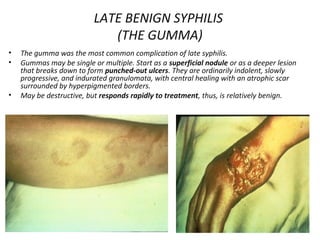
• The gumma was the most common complication of late syphilis.
• Gummas may be single or multiple. Start as a superficial nodule or as a deeper lesion
that breaks down to form punched-out ulcers. They are ordinarily indolent, slowly
progressive, and indurated granulomata, with central healing with an atrophic scar
surrounded by hyperpigmented borders.
• May be destructive, but responds rapidly to treatment, thus, is relatively benign.
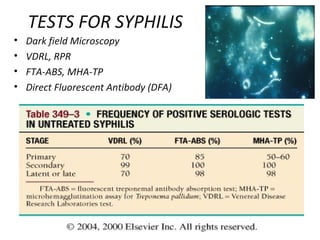
TESTS FOR SYPHILIS
• Dark field Microscopy
• VDRL, RPR
• FTA-ABS, MHA-TP
• Direct Fluorescent Antibody (DFA)
Primary, Secondary, Early Latent
Syphilis
Recommended regimen
-Benzathine Penicillin G, 2.4 million units IM
Penicillin Allergy*
-Doxycycline 100 mg twice daily x 14 days
or
-Ceftriaxone 1 gm IM/IV daily x 8-10 days (limited studies)
or
-Azithromycin 2 gm single oral dose (preliminary data)
*
Congenital Syphilis
 Congenital syphilis is transmitted in utero after the first 16 weeks of
pregnancy, therefore it is usually not a cause of abortion during the first
trimester.
 The infected child born later in a family usually has less severe syphilis.
 Again, it has been divided according to the arbitrary dividing line of two
years into early and late types.
 Early Congenital
 The features are similar to secondary syphilis. Usually it occurs 2-8 weeks
after birth, presenting with failure to thrive, muco-cutaneous lesions
(condylomata lata), generalized lymphadenopathy, nasal snuffles and
skin rash.
 Late Congenital
 The onset usually occurs at or near puberty. Well-known stigmata include
nerve deafness, interstitial keratitis, Hutchison's teeth (Hutchison's triad),
rhagades around mouth, clutton's joint, osteitis & chondritis (saddle nose,
frontal bossing, sabre tibia) and perforated palate.
CONGENITAL SYPHILIS
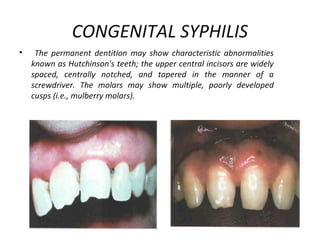
• The permanent dentition may show characteristic abnormalities
known as Hutchinson's teeth; the upper central incisors are widely
spaced, centrally notched, and tapered in the manner of a
screwdriver. The molars may show multiple, poorly developed
cusps (i.e., mulberry molars).
Congenital Syphilis
Proven/highly probable disease
Aqueous crystalline penicillin G 100,000
-150,000 units/kg/day, administered as
50,000 units/kg/dose IV q 12 hours during the
first 7 days and thereafter q 8 hours for 10
days
or
Procaine penicillin G 50,000 units/kg/dose IM in
a single daily dose for 10 days

Syphilis

  • 1.
  • 2.
    SYPHILIS INTRODUCTION • Caused byTreponema pallidum. • Transmission: sexual; maternal-fetal, and rarely by other means. • Primary and secondary syphilis in the US dropped by ~ 90 %t from 1990 to 2000, the number of cases have gone up since then. • A dramatic increase in cases in men from 2000 to 2002 reflected syphilis in MSM. • Syphilis increases the risk of both transmitting and getting infected with HIV. • Do HIV testing in all patients with syphilis.
  • 3.
    STAGES OF SYPHILIS 1.Primary 2. Secondary 3. Latent • Early latent • Late latent 1. Late or tertiary • May involve any organ, but main parts are: – Neurosyphilis – Cardiovascular syphilis – Late benign (gumma)
  • 4.
    PRIMARY SYPHILIS (The Chancre) Incubation period 9-90 days, usually ~21 days.  Develops at site of contact/inoculation.  Classically: single, painless, clean-based, indurated ulcer, with firm, raised borders. Atypical presentations may occur.  Mostly anogenital, but may occur at any site (tongue, pharynx, lips, fingers, nipples, etc...)  Non-tender regional adenopathy  Very infectious.  May be darkfield positive but serologically negative.  Untreated, heals in several weeks, leaving a faint scar.
  • 5.
  • 6.
    Oral chancres inprimary syphilis
  • 7.
    SECONDARY SYPHILIS • Seen6 wks to 6 mos after primary chancre • Usually diffuse non-pruritic, indurated rash, including palms & soles. • May also cause: – Fever, malaise, headache, sore throat, myalgia, arthralgia, generalized lymphadenopathy – Hepatitis (10%) – Renal: an immune complex type of nephropathy with transient nephrotic syndrome – Iritis or an anterior uveitis – Bone: periostitis – CSF pleocytosis in 10 - 30% (but, symptomatic meningitis is seen in <1%)
  • 8.
    SECONDARY SYPHILIS (Cont.)  Theskin rash: Diffuse, often with a superficial scale (papulosquamous). May leave residual pigmentation or depigmentation.  Condylomata Lata: Formed by coalescence of large, pale, flat-topped papules. Occur in warm, moist areas such as the perineum. Highly infectious.  Mucosal lesions: ~ 30% of secondary syphilis patients develop mucous patch (slightly raised, oval area covered by a grayish white membrane, with a pink base that does not bleed). Highly infectious
  • 10.
  • 11.
    LATENT SYPHILIS Positive syphilisserology without clinical signs of syphilis (& has normal CSF). – It begins with the end of secondary syphilis and may last for a lifetime. – Pt may or may not have a h/o primary or secondary syphilis. – Diseases known to cause occasional false-positive nontreponemal test reactions for syphilis, such as systemic lupus erythematosus (SLE), and congenital syphilis must be excluded before the diagnosis of latent syphilis can be made. • Is divided into early and late latency.
  • 12.
    LATENT SYPHILIS (cont.) 1.Early latent:  The first year after the resolution of primary or secondary lesions, or  A reactive serologic test for syphilis in an asymptomatic individual who has had a negative serologic test within the preceding year.  Infectious. 1. Late latent:  Usually not infectious, except for the pregnant woman, who may transmit infection to her fetus.
  • 13.
    LATE SYPHILIS ‘Tertiary Syphilis’ •Is the destructive stage of the disease. • Lesions develop in skin, bone, & visceral organs (any organ). • The main types are: – Late benign (gummatous) – Cardiovascular & – Neurosyphilis • Can be crippling and life threatening • Blindness, deafness, deformity, lack of coordination, paralysis, dementia may occur • It is usually very slowly progressive, barring certain neurologic syndromes which may develop suddenly due to endarteritis and thrombosis in the CNS • Late syphilis is noninfectious.
  • 14.
    LATE BENIGN SYPHILIS (THEGUMMA) • The gumma was the most common complication of late syphilis. • Gummas may be single or multiple. Start as a superficial nodule or as a deeper lesion that breaks down to form punched-out ulcers. They are ordinarily indolent, slowly progressive, and indurated granulomata, with central healing with an atrophic scar surrounded by hyperpigmented borders. • May be destructive, but responds rapidly to treatment, thus, is relatively benign.
  • 15.
    TESTS FOR SYPHILIS •Dark field Microscopy • VDRL, RPR • FTA-ABS, MHA-TP • Direct Fluorescent Antibody (DFA)
  • 16.
    Primary, Secondary, EarlyLatent Syphilis Recommended regimen -Benzathine Penicillin G, 2.4 million units IM Penicillin Allergy* -Doxycycline 100 mg twice daily x 14 days or -Ceftriaxone 1 gm IM/IV daily x 8-10 days (limited studies) or -Azithromycin 2 gm single oral dose (preliminary data) *
  • 17.
    Congenital Syphilis  Congenitalsyphilis is transmitted in utero after the first 16 weeks of pregnancy, therefore it is usually not a cause of abortion during the first trimester.  The infected child born later in a family usually has less severe syphilis.  Again, it has been divided according to the arbitrary dividing line of two years into early and late types.  Early Congenital  The features are similar to secondary syphilis. Usually it occurs 2-8 weeks after birth, presenting with failure to thrive, muco-cutaneous lesions (condylomata lata), generalized lymphadenopathy, nasal snuffles and skin rash.  Late Congenital  The onset usually occurs at or near puberty. Well-known stigmata include nerve deafness, interstitial keratitis, Hutchison's teeth (Hutchison's triad), rhagades around mouth, clutton's joint, osteitis & chondritis (saddle nose, frontal bossing, sabre tibia) and perforated palate.
  • 18.
    CONGENITAL SYPHILIS • Thepermanent dentition may show characteristic abnormalities known as Hutchinson's teeth; the upper central incisors are widely spaced, centrally notched, and tapered in the manner of a screwdriver. The molars may show multiple, poorly developed cusps (i.e., mulberry molars).
  • 19.
    Congenital Syphilis Proven/highly probabledisease Aqueous crystalline penicillin G 100,000 -150,000 units/kg/day, administered as 50,000 units/kg/dose IV q 12 hours during the first 7 days and thereafter q 8 hours for 10 days or Procaine penicillin G 50,000 units/kg/dose IM in a single daily dose for 10 days