SYPHILIS
INTRODUCTION
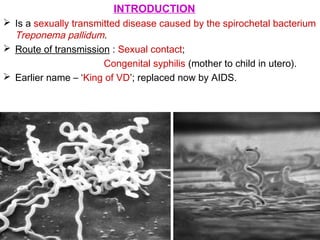
 Is a sexually transmitted disease caused by the spirochetal bacterium
Treponema pallidum.
 Route of transmission : Sexual contact;
Congenital syphilis (mother to child in utero).
 Earlier name – ‘King of VD’; replaced now by AIDS.
SYPHILIS INFECTION
 4 stages
1] Primary syphilis
 via direct sexual contact (exposure to the infectious lesions of a person
with syphilis).
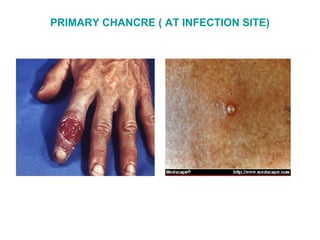
 Primary chancre of syphilis is seen at the site of infection 10-90 days
post-initial exposure (average 21 days)
 Chancre:
 1° skin lesion at site of contact (usually genitalia, but can be anywhere on
the body).
 firm, painless skin ulceration localized at the point of initial exposure to the
spirochete (often on penis / vagina / rectum).
 Multiple lesions (rarely); typically only one lesion is seen.
 Persists for 4 - 6 weeks, then heals; local lymph node swelling can
occur.
 Asymptomatic during initial incubation period (many patients do not seek
medical care immediately).
 Cannot be contracted through toilet seats, daily activities, hot tubs, or
sharing eating utensils or clothing
PRIMARY CHANCRE ( AT INFECTION SITE)
2] Secondary syphilis
 Approximately 1-6 months post-primary infection (commonly 6 - 8
weeks).
 Many different manifestations.
 Patient is most contagious in this stage.
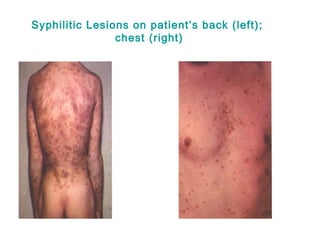
 Symmetrical reddish-pink non-itchy rash on trunk and extremities.
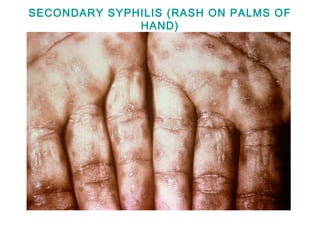
 Rash – usually on palms of the hands and the soles of the feet.
 Moist areas of body - the rash becomes flat, broad, whitish lesions
known as ‘Condylomata lata’.
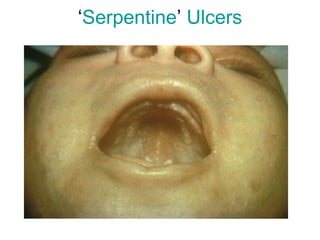
 ‘Serpentine Ulcers’ – in mouth.
 Mucous patches on the genitals or in the mouth.
 Genital warts, ulcers and chancres.
 All of these lesions are infectious and contain active treponema
organisms.
 Fever, sore throat, malaise, wt. loss, headache, meningismus.
 Enlarged lymph nodes
 Rare manifestations :
• acute meningitis, hepatitis, renal disease, hypertrophic gastritis, patchy
proctitis, ulcerative colitis, rectosigmoid mass, arthritis, periostitis, optic
neuritis, intersitial keratitis, iritis, and uveitis.
Syphilitic Lesions on patient’s back (left);
chest (right)
SECONDARY SYPHILIS (RASH ON PALMS OF
HAND)
‘Serpentine’ Ulcers
3] Latent syphilis
 Defined as having ‘serologic proof of infection without signs or
symptoms of disease.’
 Can be either early or late.
 Early latent syphilis: having syphilis for two years or less from the
time of initial infection without signs or symptoms of disease.
 Late latent syphilis: infection for more than two years but without
clinical evidence of disease.
 Distinction is important for both therapy and risk for transmission.
* Early latent syphilis : single I.M. injection of long-acting penicillin;
* Late latent syphilis : three injections each week.
 50% of latent syphilis cases progress into late stage syphilis;
25% stay in the latent stage, and rest 25% make a full recovery.
4] Tertiary syphilis
 Occurs 1-10 years after initial infection, (can take up
to 50 years also).
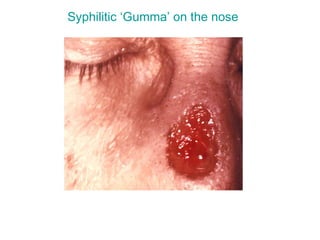
 ‘Gummas’ or granulomas…
 soft, tumor-like balls of inflammation;
 are chronic; immune system is unable to completely clear
the organism.
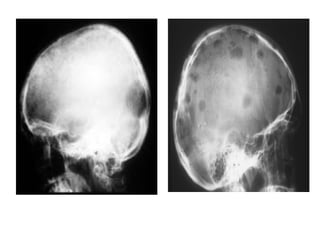
 appear almost anywhere in the body (including the
skeleton).
 Gummas: indicate chronic inflammatory state in body;
mass-effects upon the local anatomy.
Tertiary Syphilis (contd’.)
 Diverse Neurological complications at this stage.
 Neuropathic joint disease - joint surfaces
degenerate due to loss of sensation and fine position
sense (proprioception).
 Severe manifestations - Neurosyphilis and CV
syphilis.
 ‘Generalized paresis of the insane’ - changes in
personality and emotions, hyperactive reflexes.
 Argyll-Robertson pupil (diagnostic sign in which the
small and irregular pupils constrict in response to
focusing the eyes, but not to light).
 ‘Tabes dorsalis’ (locomotor ataxia) - spinal cord
disorder, results in characteristic shuffling gait.
Tertiary Syphilis (contd.)
 CV complications :
• syphilitic aortitis, aortic aneurysm; aortic regurgitation;
• aneurysm of sinus of Valsalva.
• Infects the ascending aorta→ Dilation and aortic
regurgitation; (heard as a heart murmur).
• Insiduous course ( HF - presenting sign is observed after
years of disease).
• Coronary arteries - vessels narrowing.
• ‘de Musset's sign’ - Syphilitic aortitis causes bobbing of
the head (head nodding in time with the heart beat).
Syphilitic ‘Gumma’ on the nose
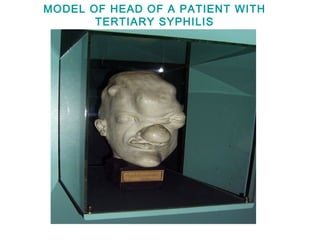
MODEL OF HEAD OF A PATIENT WITH
TERTIARY SYPHILIS
Neurosyphilis (contd.)
General Paresis / General Paresis of the Insane (GPI)
• Severe manifestation of neurosyphilis.
• Chronic dementia, ultimately results in death within 2-3 years.
• Patients - progressive personality changes, memory loss, poor
judgment. (Rarely - psychosis, depression or mania).
• Brain imaging usually shows atrophy.
EARLY DIAGNOSTIC TESTS
 Wasserman test (1906) – some false positive results, but
helped in preventing transmission to others.
 Hinton test (1930) – by William Augustus Hinton; fewer false
positive results
Both tests have been replaced by newer analytical tests.
DIAGNOSIS
 Fluid Microscopy
• from the 1° or 2° lesion using darkfield illumination;
• high accuracy.
 Rapid Plasma Reagin Test (RPR)
• Looks for non-specific Abs in patient’s blood (indicative of
syphilis);
• Does not look for Abs against the actual bacterium, but for Abs
against substances released by cells when damaged by T.
pallidum.
• Visualize the ‘Flocculation reactions’.
• Effective screening test only; ‘False Positives’ (sometimes).
 Venereal Disease Research Laboratory tests (VDRL test)
• Developed in 1946 by Harris, Rosenberg and Reidel.
• Non-treponemal serological screening for syphilis;
• To assess response to therapy; detects CNS involvement;
Used as a diagnostic aid (congenital syphilis).
• Detects ‘Anti-cardiolipin Abs’
• False positives: hepatitis, drugs, pregnancy, RA,
rheumatic fever, lupus and leprosy.
Cardiolipin
• is an important component of the inner mitochondrial membranes; (IgG, IgM or IgA).
• is seen in many diseases like syphilis, malaria, TB etc.
VDRL test (contd).
 Fluorescent Treponemal Ab - Absorption test (FTA-ABS)
• More specific; uses Treponemal species- specific Abs.
• Disadvantage – once a patient is positive, the test always shows
positive (even when patient has recovered); can’t establish
therapy efficacy.
 Treponema Pallidum Haemagglutination test (TPHA)
• Classic, indirect hemagglutination test.
• For the detection of Abs against Treponema pallidum.
• RBCs are sensitized with T. pallidum antigens → RBCs aggregate
together to form distinctive patterns on the surface of a microplate
wells.
• False Positives are common (due to Abs directed against other
non-pathogenic or non target treponemas, such as T. pallidum
subsp endemicum, T. pallidum subsp. pertenue, and T. carateum).
Dx tests (contd.)
 ELISA test
 Sexual history of patient
 CSF analysis (Leucocytsis in Neurosyphilis)
PREVENTION
 Abstinence; protective devices.
 T. pallidum readily crosses intact mucosa and cut skin,
including areas not covered by a condom.
 Individuals sexually exposed to a person with primary,
secondary, or early latent syphilis within 90 days preceding the
diagnosis should be assumed to be infected and treated for
syphilis, even if they are currently seronegative.
 Long-term sex partners of patients with late syphilis should be
evaluated clinically and serologically and treated appropriately.
 All patients with syphilis should be tested for HIV.
 Patient education is important.
TREATMENT
1] Penicillin G
• First choice of treatment.
• For Early syphilis – one dose is sufficient.
• For Latent Syphilis – weekly dose for 3 weeks.
• Parenteral penicillin G can be used during pregnancy.
2] Oral Tetracycline and Doxycycline
• For penicillin-sensitive patients.
3] Ceftriaxone, Azithromycin
 Neurosyphilis
• NO oral antibiotics
• Penicillin G i.v. Q4H continuously for 10 – 14 days.
• Procaine penicillin + Probenecid – if I.V. administration isn’t
possible.
• Procaine injections are very painful;
• Benzathine penicillin G - 3 weekly doses after completing 14-
day course of aq.crystalline / aq.procaine penicillin G.
• Ceftriaxone I.M. daily for 14 days
THE END

Syphilis in a nutshell

  • 1.
  • 2.
    INTRODUCTION  Is asexually transmitted disease caused by the spirochetal bacterium Treponema pallidum.  Route of transmission : Sexual contact; Congenital syphilis (mother to child in utero).  Earlier name – ‘King of VD’; replaced now by AIDS.
  • 3.
    SYPHILIS INFECTION  4stages 1] Primary syphilis  via direct sexual contact (exposure to the infectious lesions of a person with syphilis).  Primary chancre of syphilis is seen at the site of infection 10-90 days post-initial exposure (average 21 days)  Chancre:  1° skin lesion at site of contact (usually genitalia, but can be anywhere on the body).  firm, painless skin ulceration localized at the point of initial exposure to the spirochete (often on penis / vagina / rectum).  Multiple lesions (rarely); typically only one lesion is seen.  Persists for 4 - 6 weeks, then heals; local lymph node swelling can occur.  Asymptomatic during initial incubation period (many patients do not seek medical care immediately).  Cannot be contracted through toilet seats, daily activities, hot tubs, or sharing eating utensils or clothing
  • 4.
    PRIMARY CHANCRE (AT INFECTION SITE)
  • 5.
    2] Secondary syphilis Approximately 1-6 months post-primary infection (commonly 6 - 8 weeks).  Many different manifestations.  Patient is most contagious in this stage.  Symmetrical reddish-pink non-itchy rash on trunk and extremities.  Rash – usually on palms of the hands and the soles of the feet.  Moist areas of body - the rash becomes flat, broad, whitish lesions known as ‘Condylomata lata’.  ‘Serpentine Ulcers’ – in mouth.  Mucous patches on the genitals or in the mouth.  Genital warts, ulcers and chancres.  All of these lesions are infectious and contain active treponema organisms.  Fever, sore throat, malaise, wt. loss, headache, meningismus.  Enlarged lymph nodes  Rare manifestations : • acute meningitis, hepatitis, renal disease, hypertrophic gastritis, patchy proctitis, ulcerative colitis, rectosigmoid mass, arthritis, periostitis, optic neuritis, intersitial keratitis, iritis, and uveitis.
  • 6.
    Syphilitic Lesions onpatient’s back (left); chest (right)
  • 7.
    SECONDARY SYPHILIS (RASHON PALMS OF HAND)
  • 8.
  • 9.
    3] Latent syphilis Defined as having ‘serologic proof of infection without signs or symptoms of disease.’  Can be either early or late.  Early latent syphilis: having syphilis for two years or less from the time of initial infection without signs or symptoms of disease.  Late latent syphilis: infection for more than two years but without clinical evidence of disease.  Distinction is important for both therapy and risk for transmission. * Early latent syphilis : single I.M. injection of long-acting penicillin; * Late latent syphilis : three injections each week.  50% of latent syphilis cases progress into late stage syphilis; 25% stay in the latent stage, and rest 25% make a full recovery.
  • 10.
    4] Tertiary syphilis Occurs 1-10 years after initial infection, (can take up to 50 years also).  ‘Gummas’ or granulomas…  soft, tumor-like balls of inflammation;  are chronic; immune system is unable to completely clear the organism.  appear almost anywhere in the body (including the skeleton).  Gummas: indicate chronic inflammatory state in body; mass-effects upon the local anatomy.
  • 11.
    Tertiary Syphilis (contd’.) Diverse Neurological complications at this stage.  Neuropathic joint disease - joint surfaces degenerate due to loss of sensation and fine position sense (proprioception).  Severe manifestations - Neurosyphilis and CV syphilis.  ‘Generalized paresis of the insane’ - changes in personality and emotions, hyperactive reflexes.  Argyll-Robertson pupil (diagnostic sign in which the small and irregular pupils constrict in response to focusing the eyes, but not to light).  ‘Tabes dorsalis’ (locomotor ataxia) - spinal cord disorder, results in characteristic shuffling gait.
  • 12.
    Tertiary Syphilis (contd.) CV complications : • syphilitic aortitis, aortic aneurysm; aortic regurgitation; • aneurysm of sinus of Valsalva. • Infects the ascending aorta→ Dilation and aortic regurgitation; (heard as a heart murmur). • Insiduous course ( HF - presenting sign is observed after years of disease). • Coronary arteries - vessels narrowing. • ‘de Musset's sign’ - Syphilitic aortitis causes bobbing of the head (head nodding in time with the heart beat).
  • 13.
  • 14.
    MODEL OF HEADOF A PATIENT WITH TERTIARY SYPHILIS
  • 16.
    Neurosyphilis (contd.) General Paresis/ General Paresis of the Insane (GPI) • Severe manifestation of neurosyphilis. • Chronic dementia, ultimately results in death within 2-3 years. • Patients - progressive personality changes, memory loss, poor judgment. (Rarely - psychosis, depression or mania). • Brain imaging usually shows atrophy.
  • 17.
    EARLY DIAGNOSTIC TESTS Wasserman test (1906) – some false positive results, but helped in preventing transmission to others.  Hinton test (1930) – by William Augustus Hinton; fewer false positive results Both tests have been replaced by newer analytical tests.
  • 18.
    DIAGNOSIS  Fluid Microscopy •from the 1° or 2° lesion using darkfield illumination; • high accuracy.  Rapid Plasma Reagin Test (RPR) • Looks for non-specific Abs in patient’s blood (indicative of syphilis); • Does not look for Abs against the actual bacterium, but for Abs against substances released by cells when damaged by T. pallidum. • Visualize the ‘Flocculation reactions’. • Effective screening test only; ‘False Positives’ (sometimes).
  • 19.
     Venereal DiseaseResearch Laboratory tests (VDRL test) • Developed in 1946 by Harris, Rosenberg and Reidel. • Non-treponemal serological screening for syphilis; • To assess response to therapy; detects CNS involvement; Used as a diagnostic aid (congenital syphilis). • Detects ‘Anti-cardiolipin Abs’ • False positives: hepatitis, drugs, pregnancy, RA, rheumatic fever, lupus and leprosy. Cardiolipin • is an important component of the inner mitochondrial membranes; (IgG, IgM or IgA). • is seen in many diseases like syphilis, malaria, TB etc.
  • 20.
    VDRL test (contd). Fluorescent Treponemal Ab - Absorption test (FTA-ABS) • More specific; uses Treponemal species- specific Abs. • Disadvantage – once a patient is positive, the test always shows positive (even when patient has recovered); can’t establish therapy efficacy.  Treponema Pallidum Haemagglutination test (TPHA) • Classic, indirect hemagglutination test. • For the detection of Abs against Treponema pallidum. • RBCs are sensitized with T. pallidum antigens → RBCs aggregate together to form distinctive patterns on the surface of a microplate wells. • False Positives are common (due to Abs directed against other non-pathogenic or non target treponemas, such as T. pallidum subsp endemicum, T. pallidum subsp. pertenue, and T. carateum).
  • 21.
    Dx tests (contd.) ELISA test  Sexual history of patient  CSF analysis (Leucocytsis in Neurosyphilis)
  • 22.
    PREVENTION  Abstinence; protectivedevices.  T. pallidum readily crosses intact mucosa and cut skin, including areas not covered by a condom.  Individuals sexually exposed to a person with primary, secondary, or early latent syphilis within 90 days preceding the diagnosis should be assumed to be infected and treated for syphilis, even if they are currently seronegative.  Long-term sex partners of patients with late syphilis should be evaluated clinically and serologically and treated appropriately.  All patients with syphilis should be tested for HIV.  Patient education is important.
  • 23.
    TREATMENT 1] Penicillin G •First choice of treatment. • For Early syphilis – one dose is sufficient. • For Latent Syphilis – weekly dose for 3 weeks. • Parenteral penicillin G can be used during pregnancy. 2] Oral Tetracycline and Doxycycline • For penicillin-sensitive patients. 3] Ceftriaxone, Azithromycin
  • 24.
     Neurosyphilis • NOoral antibiotics • Penicillin G i.v. Q4H continuously for 10 – 14 days. • Procaine penicillin + Probenecid – if I.V. administration isn’t possible. • Procaine injections are very painful; • Benzathine penicillin G - 3 weekly doses after completing 14- day course of aq.crystalline / aq.procaine penicillin G. • Ceftriaxone I.M. daily for 14 days
  • 25.