SYPHILIS
CONTENT:
Definition
 Epidemiology
 Etiology/Causative organism
 Immunology
 Mode of transmission
 Stages of acquired syphilis
 Clinical presentation
 Diagnosis
 Treatment
DEFINITION:
Syphilis is a venereal (sexually-transmitted) disease caused by spirochetes, Treponema pallidum.
EPIDEMIOLOGY:
Although syphilis was the fifth most frequently reported communicable disease in the United States in
2001, the incidence of this disease has declined by almost 80% since 1990.
In addition to being highly contagious, syphilis is of major concern because, if left untreated, it can
progress to a chronic systemic disease that can be fatal or seriously disabling.
ETIOLOGY/CAUSATIVE ORGANISM:
Treponema pallidum is a coiled spiral filament, 10µm long that moves actively in fresh preparations.
The organism cannot be stained by the usual methods and can be demonstrated in the exudates and
tissues by:
• Dark ground illumination (DGI) in fresh preparation;
• Fluorescent antibody technique; and
IMMUNOLOGY:
T. pallidum does not produce any endotoxin or exotoxin. The pathogenesis of the lesions appears to
be due to host immune response.
Treponemal infection is associated with two important antibodies which are immunoglobulins:
1. The Wassermann antibodies:
The Wassermann antibodies: Wassermann described a complement fixing against antigen of human
syphilitic tissue. The antigen is used in the standard test for syphilis (STS) as follows:
• Wassermann complement fixing test; and
• Venereal disease research laboratory (VDRL) test.
2. Treponemal antibodies:
Treponemal antibodies are produced which react with treponemal protein. The tests employed for
detecting these antibodies are:
• Reiter protein complement fixation (RPCF) test;
• Treponema pallidum immobilization (TPI) test;
• Fluorescent treponemal antibody (FTA) test; and
• Treponemal passive hemagglutination (TPHA) test.
MODE OF TRANSMISSION:
1. Sexual intercourse resulting in lesions on glans penis, vulva, vagina and cervix.
2. Intimate person to person contact, with lesions on lips, tongue or fingers.
3. Transfusion of infected blood.
4. Materno-foetal transmission in congenital syphilis if the mother is infected.
STAGES OF ACQUIRED SYPHILIS
Acquired syphilis is divided into three stages depending upon the period after which the lesions appear
and the type of lesions.
1. Primary syphilis:
 Typical lesion of primary syphilis is chancre which appears on genitals or extra-genital sites in 2-4
weeks after exposure to infection. Microscopic examination shows: ‘
Dense infiltrate of lymphocytes, plasma cells and a few macrophages.
Perivascular aggregation of mononuclear cells, particularly plasma cells (periarteritis and
endarteritis).
2. Secondary syphilis
Inadequately treated patients of primary syphilis develop mucocutaneous lesions and painless
lymphadenopathy in 2-3 months after the exposure.
Mucocutaneous lesions may be in the from of mucous patches on mouth, pharynx and vagina; and
generalized skin eruptions and condyloma Lata in congenital region.
3. Tertiary syphilis
After a latent period of appearance of secondary lesions and about 2-3 years following first
exposure, tertiary lesions of syphilis appear.
 Lesions of tertiary syphilis are much less infective than the other two stages of spirochetes,
can be demonstrated with great difficulty.
These lesions are of two main types:
a. Syphilitic gumma
It is a solitary, localized, rubbery lesion with central necrosis, seen in organs like liver, testis,
bone and brain.
In liver, the gumma is associated with scarring of hepatic parenchyma (hepar lobatum).
b. Diffused lesions of tertiary syphilis
The lesions appear following widespread dissemination of spirochetes in the body.
The diffuse lesions are predominantly seen in cardiovascular and nervous systems.
Cardiovascular syphilis mainly involves thoracic aorta.
Neurosyphilis may manifest as: meningovascular syphilis affecting chiefly the meninges;
tabes dorsalis affecting the spinal cord; and general paresis affecting the brain.
CONGENITAL SYPHILIS:
In pregnant women with syphilis, T. pallidum can cross the placenta at any time during
pregnancy.
The risk of fetal infection is greatest in pregnant women with primary and secondary syphilis
and declines in pregnant women with late disease.
Transmission of syphilis during pregnancy occurs primarily transplacentally and can result in
fetal death, prematurity, or congenital syphilis.
Symptoms can be seen during the first months of life (early congenital syphilis) or later in
childhood or adolescence (late congenital syphilis).
Manifestations of early congenital syphilis resemble those of secondary syphilis, whereas those
of late congenital syphilis correspond to the tertiary stage in adults.
CLINICAL PRESENTATION:
General:
Primary: Incubation period 10–90 days (mean 21 days).
Secondary: Develops 2–8 weeks after initial infection in untreated or inadequately treated
individuals.
Latent: Develops 4–10 weeks after secondary stage in untreated or inadequately treated
individuals.
Tertiary: Develops in approximately 30% of untreated or inadequately treated individuals 10–
30 years after initial infection
Site of Infection:
Primary: External genitalia, perianal region, mouth, and throat.
Secondary: Multisystem involvement secondary to hematogenous and lymphatic spread.
Latent: Potentially multisystem involvement (dormant).
Tertiary: CNS, heart, eyes, bones, and joints
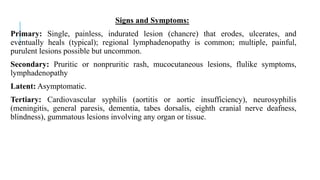
Signs and Symptoms:
Primary: Single, painless, indurated lesion (chancre) that erodes, ulcerates, and
eventually heals (typical); regional lymphadenopathy is common; multiple, painful,
purulent lesions possible but uncommon.
Secondary: Pruritic or nonpruritic rash, mucocutaneous lesions, flulike symptoms,
lymphadenopathy
Latent: Asymptomatic.
Tertiary: Cardiovascular syphilis (aortitis or aortic insufficiency), neurosyphilis
(meningitis, general paresis, dementia, tabes dorsalis, eighth cranial nerve deafness,
blindness), gummatous lesions involving any organ or tissue.
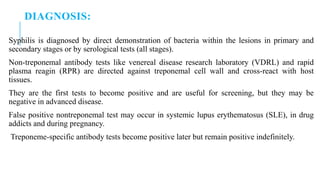
DIAGNOSIS:
Syphilis is diagnosed by direct demonstration of bacteria within the lesions in primary and
secondary stages or by serological tests (all stages).
Non-treponemal antibody tests like venereal disease research laboratory (VDRL) and rapid
plasma reagin (RPR) are directed against treponemal cell wall and cross-react with host
tissues.
They are the first tests to become positive and are useful for screening, but they may be
negative in advanced disease.
False positive nontreponemal test may occur in systemic lupus erythematosus (SLE), in drug
addicts and during pregnancy.
Treponeme-specific antibody tests become positive later but remain positive indefinitely.
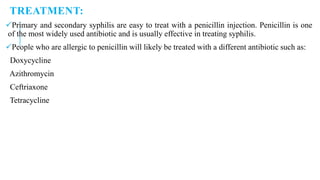
TREATMENT:
Primary and secondary syphilis are easy to treat with a penicillin injection. Penicillin is one
of the most widely used antibiotic and is usually effective in treating syphilis.
People who are allergic to penicillin will likely be treated with a different antibiotic such as:
Doxycycline
Azithromycin
Ceftriaxone
Tetracycline
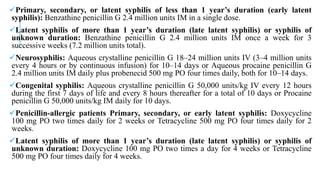
Primary, secondary, or latent syphilis of less than 1 year’s duration (early latent
syphilis): Benzathine penicillin G 2.4 million units IM in a single dose.
Latent syphilis of more than 1 year’s duration (late latent syphilis) or syphilis of
unknown duration: Benzathine penicillin G 2.4 million units IM once a week for 3
successive weeks (7.2 million units total).
Neurosyphilis: Aqueous crystalline penicillin G 18–24 million units IV (3–4 million units
every 4 hours or by continuous infusion) for 10–14 days or Aqueous procaine penicillin G
2.4 million units IM daily plus probenecid 500 mg PO four times daily, both for 10–14 days.
Congenital syphilis: Aqueous crystalline penicillin G 50,000 units/kg IV every 12 hours
during the first 7 days of life and every 8 hours thereafter for a total of 10 days or Procaine
penicillin G 50,000 units/kg IM daily for 10 days.
Penicillin-allergic patients Primary, secondary, or early latent syphilis: Doxycycline
100 mg PO two times daily for 2 weeks or Tetracycline 500 mg PO four times daily for 2
weeks.
Latent syphilis of more than 1 year’s duration (late latent syphilis) or syphilis of
unknown duration: Doxycycline 100 mg PO two times a day for 4 weeks or Tetracycline
500 mg PO four times daily for 4 weeks.
REFERENCE/BIBLIOGRAPHY:
1. Text book of pathology by Harsh Mohan.
2. Textbook of Pharmacotherapy: A Pathophysiologic approach by Joseph T. Dipiro.

syphillis.pptx

  • 1.
  • 2.
    CONTENT: Definition  Epidemiology  Etiology/Causativeorganism  Immunology  Mode of transmission  Stages of acquired syphilis  Clinical presentation  Diagnosis  Treatment
  • 3.
    DEFINITION: Syphilis is avenereal (sexually-transmitted) disease caused by spirochetes, Treponema pallidum. EPIDEMIOLOGY: Although syphilis was the fifth most frequently reported communicable disease in the United States in 2001, the incidence of this disease has declined by almost 80% since 1990. In addition to being highly contagious, syphilis is of major concern because, if left untreated, it can progress to a chronic systemic disease that can be fatal or seriously disabling. ETIOLOGY/CAUSATIVE ORGANISM: Treponema pallidum is a coiled spiral filament, 10µm long that moves actively in fresh preparations. The organism cannot be stained by the usual methods and can be demonstrated in the exudates and tissues by: • Dark ground illumination (DGI) in fresh preparation; • Fluorescent antibody technique; and
  • 4.
    IMMUNOLOGY: T. pallidum doesnot produce any endotoxin or exotoxin. The pathogenesis of the lesions appears to be due to host immune response. Treponemal infection is associated with two important antibodies which are immunoglobulins: 1. The Wassermann antibodies: The Wassermann antibodies: Wassermann described a complement fixing against antigen of human syphilitic tissue. The antigen is used in the standard test for syphilis (STS) as follows: • Wassermann complement fixing test; and • Venereal disease research laboratory (VDRL) test. 2. Treponemal antibodies: Treponemal antibodies are produced which react with treponemal protein. The tests employed for detecting these antibodies are: • Reiter protein complement fixation (RPCF) test; • Treponema pallidum immobilization (TPI) test; • Fluorescent treponemal antibody (FTA) test; and • Treponemal passive hemagglutination (TPHA) test.
  • 5.
    MODE OF TRANSMISSION: 1.Sexual intercourse resulting in lesions on glans penis, vulva, vagina and cervix. 2. Intimate person to person contact, with lesions on lips, tongue or fingers. 3. Transfusion of infected blood. 4. Materno-foetal transmission in congenital syphilis if the mother is infected.
  • 6.
    STAGES OF ACQUIREDSYPHILIS Acquired syphilis is divided into three stages depending upon the period after which the lesions appear and the type of lesions. 1. Primary syphilis:  Typical lesion of primary syphilis is chancre which appears on genitals or extra-genital sites in 2-4 weeks after exposure to infection. Microscopic examination shows: ‘ Dense infiltrate of lymphocytes, plasma cells and a few macrophages. Perivascular aggregation of mononuclear cells, particularly plasma cells (periarteritis and endarteritis). 2. Secondary syphilis Inadequately treated patients of primary syphilis develop mucocutaneous lesions and painless lymphadenopathy in 2-3 months after the exposure. Mucocutaneous lesions may be in the from of mucous patches on mouth, pharynx and vagina; and generalized skin eruptions and condyloma Lata in congenital region.
  • 7.
    3. Tertiary syphilis Aftera latent period of appearance of secondary lesions and about 2-3 years following first exposure, tertiary lesions of syphilis appear.  Lesions of tertiary syphilis are much less infective than the other two stages of spirochetes, can be demonstrated with great difficulty. These lesions are of two main types: a. Syphilitic gumma It is a solitary, localized, rubbery lesion with central necrosis, seen in organs like liver, testis, bone and brain. In liver, the gumma is associated with scarring of hepatic parenchyma (hepar lobatum). b. Diffused lesions of tertiary syphilis The lesions appear following widespread dissemination of spirochetes in the body. The diffuse lesions are predominantly seen in cardiovascular and nervous systems. Cardiovascular syphilis mainly involves thoracic aorta. Neurosyphilis may manifest as: meningovascular syphilis affecting chiefly the meninges; tabes dorsalis affecting the spinal cord; and general paresis affecting the brain.
  • 8.
    CONGENITAL SYPHILIS: In pregnantwomen with syphilis, T. pallidum can cross the placenta at any time during pregnancy. The risk of fetal infection is greatest in pregnant women with primary and secondary syphilis and declines in pregnant women with late disease. Transmission of syphilis during pregnancy occurs primarily transplacentally and can result in fetal death, prematurity, or congenital syphilis. Symptoms can be seen during the first months of life (early congenital syphilis) or later in childhood or adolescence (late congenital syphilis). Manifestations of early congenital syphilis resemble those of secondary syphilis, whereas those of late congenital syphilis correspond to the tertiary stage in adults.
  • 9.
    CLINICAL PRESENTATION: General: Primary: Incubationperiod 10–90 days (mean 21 days). Secondary: Develops 2–8 weeks after initial infection in untreated or inadequately treated individuals. Latent: Develops 4–10 weeks after secondary stage in untreated or inadequately treated individuals. Tertiary: Develops in approximately 30% of untreated or inadequately treated individuals 10– 30 years after initial infection Site of Infection: Primary: External genitalia, perianal region, mouth, and throat. Secondary: Multisystem involvement secondary to hematogenous and lymphatic spread. Latent: Potentially multisystem involvement (dormant). Tertiary: CNS, heart, eyes, bones, and joints
  • 10.
    Signs and Symptoms: Primary:Single, painless, indurated lesion (chancre) that erodes, ulcerates, and eventually heals (typical); regional lymphadenopathy is common; multiple, painful, purulent lesions possible but uncommon. Secondary: Pruritic or nonpruritic rash, mucocutaneous lesions, flulike symptoms, lymphadenopathy Latent: Asymptomatic. Tertiary: Cardiovascular syphilis (aortitis or aortic insufficiency), neurosyphilis (meningitis, general paresis, dementia, tabes dorsalis, eighth cranial nerve deafness, blindness), gummatous lesions involving any organ or tissue.
  • 11.
    DIAGNOSIS: Syphilis is diagnosedby direct demonstration of bacteria within the lesions in primary and secondary stages or by serological tests (all stages). Non-treponemal antibody tests like venereal disease research laboratory (VDRL) and rapid plasma reagin (RPR) are directed against treponemal cell wall and cross-react with host tissues. They are the first tests to become positive and are useful for screening, but they may be negative in advanced disease. False positive nontreponemal test may occur in systemic lupus erythematosus (SLE), in drug addicts and during pregnancy. Treponeme-specific antibody tests become positive later but remain positive indefinitely.
  • 12.
    TREATMENT: Primary and secondarysyphilis are easy to treat with a penicillin injection. Penicillin is one of the most widely used antibiotic and is usually effective in treating syphilis. People who are allergic to penicillin will likely be treated with a different antibiotic such as: Doxycycline Azithromycin Ceftriaxone Tetracycline
  • 13.
    Primary, secondary, orlatent syphilis of less than 1 year’s duration (early latent syphilis): Benzathine penicillin G 2.4 million units IM in a single dose. Latent syphilis of more than 1 year’s duration (late latent syphilis) or syphilis of unknown duration: Benzathine penicillin G 2.4 million units IM once a week for 3 successive weeks (7.2 million units total). Neurosyphilis: Aqueous crystalline penicillin G 18–24 million units IV (3–4 million units every 4 hours or by continuous infusion) for 10–14 days or Aqueous procaine penicillin G 2.4 million units IM daily plus probenecid 500 mg PO four times daily, both for 10–14 days. Congenital syphilis: Aqueous crystalline penicillin G 50,000 units/kg IV every 12 hours during the first 7 days of life and every 8 hours thereafter for a total of 10 days or Procaine penicillin G 50,000 units/kg IM daily for 10 days. Penicillin-allergic patients Primary, secondary, or early latent syphilis: Doxycycline 100 mg PO two times daily for 2 weeks or Tetracycline 500 mg PO four times daily for 2 weeks. Latent syphilis of more than 1 year’s duration (late latent syphilis) or syphilis of unknown duration: Doxycycline 100 mg PO two times a day for 4 weeks or Tetracycline 500 mg PO four times daily for 4 weeks.
  • 14.
    REFERENCE/BIBLIOGRAPHY: 1. Text bookof pathology by Harsh Mohan. 2. Textbook of Pharmacotherapy: A Pathophysiologic approach by Joseph T. Dipiro.