INFECTIOUS DISEASE OF
PATHOLOGY
(Bacterial Diseases)

Niesseria
Dr. Naila Awal
Classification
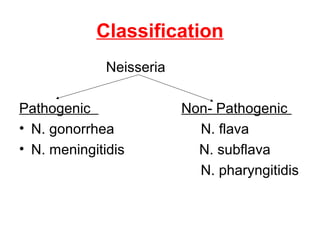
Neisseria
Pathogenic
• N. gonorrhea
• N. meningitidis

Non- Pathogenic
N. flava
N. subflava
N. pharyngitidis
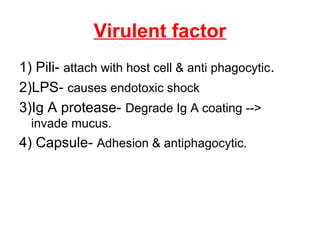
Virulent factor
1) Pili- attach with host cell & anti phagocytic.
2)LPS- causes endotoxic shock
3)Ig A protease- Degrade Ig A coating -->
invade mucus.

4) Capsule- Adhesion & antiphagocytic.
Pathogenesis of Neisseria
gonorrhoeae
•
•
•
•
•

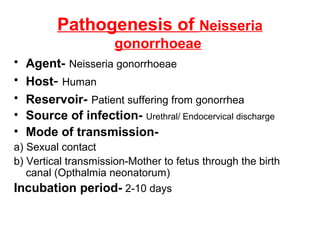
Agent- Neisseria gonorrhoeae
Host- Human
Reservoir- Patient suffering from gonorrhea
Source of infection- Urethral/ Endocervical discharge
Mode of transmission-

a) Sexual contact
b) Vertical transmission-Mother to fetus through the birth
canal (Opthalmia neonatorum)
Incubation period- 2-10 days
Primary infection begins at the columnar epithelium of
urethra & peri urethral gland. Also in endocervix, rectal
mucosa & conjunctiva.
After contact, bacteria attach to epithelial cell by pili
Then pass between the epithelial cell & goes to submucosa
& multiply
Immune response, manifested by inflammatory exudates
which is at 1st serous & later on purulent together with
infiltration of huge number of neutrophil & pus cell.
From primary site they spread upward to involve the other
sides of the body & causes lesion
Primary lesion
• Male- Acute anterior urethritis
Proctitis
Pharyngitis
• Female- Acute anterior urethritis
Endocervicitis
Note- They do not cause vaginitis, B/cA) vagina contain stratified squamous epithelium which prevents
attachment of N. gonorrhea.
B) Vaginal pH- acidic (Lactobacillus)

• Children- Vulvo vaginitis
• New born- Opthalmia neonatorum.
Secondary lesion
1)Via direct spreadMale

Prostatitis
Epididymitis

Female

Oophoritis
Salphingitis
Endometritis
Tubo- ovarian abscess
Bartholinitis
Pelvic peritonitis
2)Via lymphaticsCystitis
Pyelonephritis
Pyelitis

3) Via hematogenous route•
•
•
•

Ulcerative endocarditis
Septic arthritis
Tenosynovitis
Iritis
Pathogenesis of N meningitidis
• Mode of transmission- By airborne droplet
N meningitidis
Enter into nasopharynx & attach to epithelial cell of nasopharynx.
Invade mucous membrane
Colonize

Enters to the blood stream
CNS
Through pili, they attach to the meninges--> Meningitis
Complication
Male





Chronic prostatitis
Vesiculitis
Urethral stricture
Sterility –Due to fibrosis
caused by
bilateral epididymitis

Female
Sterility
Abortion-due to Endometritis
PID
Ectopic pregnancy( Due to
fibrosis of FT)
Lab diagnosis
SampleAcute infection• Male-Urethral discharge
• Female-Endocervical discharge

Chronic case• Male-Prostatic discharge by prostatic massage.
• Female-Endocervical discharge
Note- Not High vaginal swab b/c vaginal wall usualy not infected by
N. gonorrhoeae b/c it is lined by stratified squamous epithelium .
3) In case of proctitis- Rectal swab
4) In case of arthritis- Joint fluid
5) In case of opthalmia neonatorum –conjunctival
discharge.

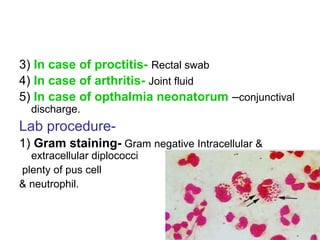
Lab procedure1) Gram staining- Gram negative Intracellular &
extracellular diplococci
plenty of pus cell
& neutrophil.
2)CultureNon- specificChocolate agar- Heat lysed sheep blood+ Agar

Specific culture mediaA) Modified New York City media (MNYCM)
Heat lysed sheep blood+ Agar+ Antibiotic (Lincomycin,
Colistin, Nystatin, Trimethoprim)

B) Thayer Martin Media (TMM)
Heat lysed sheep blood+ Agar+ Antibiotic (Vancomycin,
Colistin, Nystatin, Trimethoprim)
• NoteWhich 1 is better, MNYCM/TMM?
MNYCM b/c1) Contain Lincomycin
2)10% of Niesseria are sensitive to Vancomycin.
( Vancomycin kill Niesseria)
So we will miss 10% case if we use TMM.
But all gonococci are resistant to Lincomycin.
Incubate at 37C for 18-24 hrs in microaerophilic
environment by candle jar.
• Observation- 0.5-1 mm, circular, convex, graiysh white
translucent colony.
4) Gram staining- Gram negative diplococci
5) Biochemical test• Oxidase test- Positive test
• Rapid carbohydrate utilization test (RCUT)• N. Gonorrhoeae ferment glucose but not maltose.
• N. meningitidis ferment both.
6) Detection of Ag/Ab- Can be detected in serum but it is
useless as N. Gonorrhoeae undergoes rapid antigenic
mutation.
Pathology of gonorrhoea in
female genital tract
Acute Suppurative salphingitis- Tubal mucosa -->
congested
Infiltration of neutrophil, plasma cell & lymphocytes.

Salphingo-oophoritisTubal lumen is filled with exudates--> leak out of fimbriated
end--> Spill over to ovary.
Tubo-ovarian abscess- Collection of pus within tube &
ovary.
Pyosalphinx-Collection of pus within tube.
Chronic follicular salphingitis- The tubal epithelium is
denuded--> adhere to 1 another -->fuse to form gland
like space / pouch
Pathology of gonorrhea in
male genital tract
Extension of infection• Posterior urethra-->prostate-->Seminal vesicle->Epididymis
• Epididymis--> Frank abscess-->Extensive
destruction of the organ.
In neglected cases, the infection may spread to
testis & produce suppurative orchitis.
Neisseria

Neisseria

  • 1.
    INFECTIOUS DISEASE OF PATHOLOGY (BacterialDiseases) Niesseria Dr. Naila Awal
  • 2.
    Classification Neisseria Pathogenic • N. gonorrhea •N. meningitidis Non- Pathogenic N. flava N. subflava N. pharyngitidis
  • 3.
    Virulent factor 1) Pili-attach with host cell & anti phagocytic. 2)LPS- causes endotoxic shock 3)Ig A protease- Degrade Ig A coating --> invade mucus. 4) Capsule- Adhesion & antiphagocytic.
  • 4.
    Pathogenesis of Neisseria gonorrhoeae • • • • • Agent-Neisseria gonorrhoeae Host- Human Reservoir- Patient suffering from gonorrhea Source of infection- Urethral/ Endocervical discharge Mode of transmission- a) Sexual contact b) Vertical transmission-Mother to fetus through the birth canal (Opthalmia neonatorum) Incubation period- 2-10 days
  • 5.
    Primary infection beginsat the columnar epithelium of urethra & peri urethral gland. Also in endocervix, rectal mucosa & conjunctiva. After contact, bacteria attach to epithelial cell by pili Then pass between the epithelial cell & goes to submucosa & multiply Immune response, manifested by inflammatory exudates which is at 1st serous & later on purulent together with infiltration of huge number of neutrophil & pus cell. From primary site they spread upward to involve the other sides of the body & causes lesion
  • 6.
    Primary lesion • Male-Acute anterior urethritis Proctitis Pharyngitis • Female- Acute anterior urethritis Endocervicitis Note- They do not cause vaginitis, B/cA) vagina contain stratified squamous epithelium which prevents attachment of N. gonorrhea. B) Vaginal pH- acidic (Lactobacillus) • Children- Vulvo vaginitis • New born- Opthalmia neonatorum.
  • 7.
    Secondary lesion 1)Via directspreadMale Prostatitis Epididymitis Female Oophoritis Salphingitis Endometritis Tubo- ovarian abscess Bartholinitis Pelvic peritonitis
  • 8.
    2)Via lymphaticsCystitis Pyelonephritis Pyelitis 3) Viahematogenous route• • • • Ulcerative endocarditis Septic arthritis Tenosynovitis Iritis
  • 9.
    Pathogenesis of Nmeningitidis • Mode of transmission- By airborne droplet N meningitidis Enter into nasopharynx & attach to epithelial cell of nasopharynx. Invade mucous membrane Colonize Enters to the blood stream CNS Through pili, they attach to the meninges--> Meningitis
  • 10.
    Complication Male     Chronic prostatitis Vesiculitis Urethral stricture Sterility–Due to fibrosis caused by bilateral epididymitis Female Sterility Abortion-due to Endometritis PID Ectopic pregnancy( Due to fibrosis of FT)
  • 11.
    Lab diagnosis SampleAcute infection•Male-Urethral discharge • Female-Endocervical discharge Chronic case• Male-Prostatic discharge by prostatic massage. • Female-Endocervical discharge Note- Not High vaginal swab b/c vaginal wall usualy not infected by N. gonorrhoeae b/c it is lined by stratified squamous epithelium .
  • 12.
    3) In caseof proctitis- Rectal swab 4) In case of arthritis- Joint fluid 5) In case of opthalmia neonatorum –conjunctival discharge. Lab procedure1) Gram staining- Gram negative Intracellular & extracellular diplococci plenty of pus cell & neutrophil.
  • 13.
    2)CultureNon- specificChocolate agar-Heat lysed sheep blood+ Agar Specific culture mediaA) Modified New York City media (MNYCM) Heat lysed sheep blood+ Agar+ Antibiotic (Lincomycin, Colistin, Nystatin, Trimethoprim) B) Thayer Martin Media (TMM) Heat lysed sheep blood+ Agar+ Antibiotic (Vancomycin, Colistin, Nystatin, Trimethoprim)
  • 14.
    • NoteWhich 1is better, MNYCM/TMM? MNYCM b/c1) Contain Lincomycin 2)10% of Niesseria are sensitive to Vancomycin. ( Vancomycin kill Niesseria) So we will miss 10% case if we use TMM. But all gonococci are resistant to Lincomycin.
  • 15.
    Incubate at 37Cfor 18-24 hrs in microaerophilic environment by candle jar. • Observation- 0.5-1 mm, circular, convex, graiysh white translucent colony. 4) Gram staining- Gram negative diplococci 5) Biochemical test• Oxidase test- Positive test • Rapid carbohydrate utilization test (RCUT)• N. Gonorrhoeae ferment glucose but not maltose. • N. meningitidis ferment both. 6) Detection of Ag/Ab- Can be detected in serum but it is useless as N. Gonorrhoeae undergoes rapid antigenic mutation.
  • 16.
    Pathology of gonorrhoeain female genital tract Acute Suppurative salphingitis- Tubal mucosa --> congested Infiltration of neutrophil, plasma cell & lymphocytes. Salphingo-oophoritisTubal lumen is filled with exudates--> leak out of fimbriated end--> Spill over to ovary. Tubo-ovarian abscess- Collection of pus within tube & ovary. Pyosalphinx-Collection of pus within tube. Chronic follicular salphingitis- The tubal epithelium is denuded--> adhere to 1 another -->fuse to form gland like space / pouch
  • 17.
    Pathology of gonorrheain male genital tract Extension of infection• Posterior urethra-->prostate-->Seminal vesicle->Epididymis • Epididymis--> Frank abscess-->Extensive destruction of the organ. In neglected cases, the infection may spread to testis & produce suppurative orchitis.