

CLOSTRIDIUM TETANI
Dr. Rakesh Prasad Sah (Associate Professor,
Microbiology)
Clostridium tetani
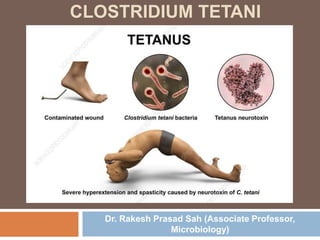
 Causative agent of Tetanus
 Tetanus: an acute ds  manifested by skeletal muscle spasm
and autonomic nervous system disturbance.
 Known since ancient time; isolated by Kitasato (1889).
 Widely distributed in soil and intestine of man and animals.
 Ubiquitous
Morphology
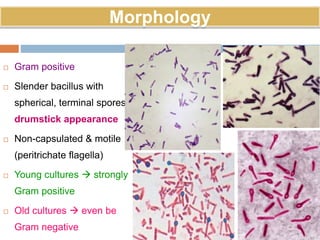
 Gram positive
 Slender bacillus with
spherical, terminal spores
drumstick appearance
 Non-capsulated & motile
(peritrichate flagella)
 Young cultures  strongly
Gram positive
 Old cultures  even be
Gram negative
Resistance
 Resistance of Cl. Tetani spores to heat vary in different strains.
 Most of the stains are killed by boiling for 10-15mins.
 Some resist boiling for 3 hrs.
 Autoclaving at 1210C for 20mins kills the spores of most strains.
 Spores are killed with Iodine (1% aqueous solution), H2O2 and
Glutaraldehyde(2%) within few hours.
 Spores may survive in soil for years.
Toxins
 Produces two distinct toxins
 Tetanolysin (haemolysin)
 Tetanospasmin (neurotoxin)
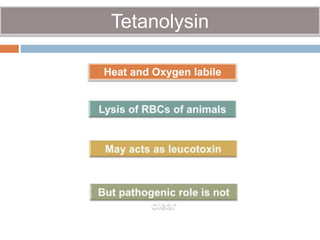
Tetanolysin
Heat and Oxygen labile
Tetanospasmin
 Proteinous in nature.
 Heat labile and oxygen stable.
 Powerful neurotoxin.
 Rapidly destroyed by proteolytic enzymes.
 Plasmid coded.
 Responsible for clinical manifestation of tetanus.
Tetanospasmin
 Lethal to mice and pigs in minute doses (0.0000001mg for
mouse).
 Good Ag and is specifically neutralized by the antitoxin.
 Is plasmid coded.
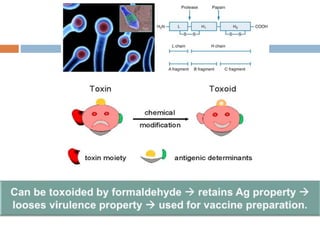
 Can be toxoided by formaldehyde  retains Ag property 
looses virulence property  used for vaccine preparation.
Mechanism of Action of Tetanus
Toxin
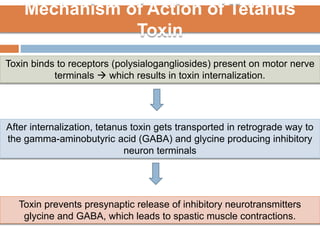
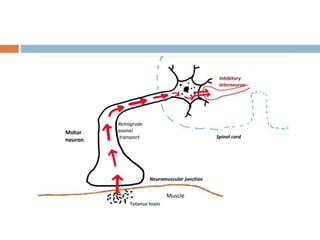
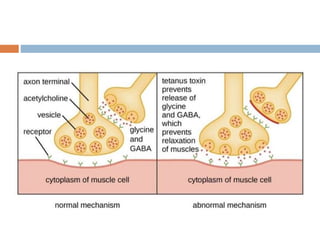
Toxin binds to receptors (polysialogangliosides) present on motor nerve
terminals  which results in toxin internalization.
After internalization, tetanus toxin gets transported in retrograde way to
the gamma-aminobutyric acid (GABA) and glycine producing inhibitory
neuron terminals
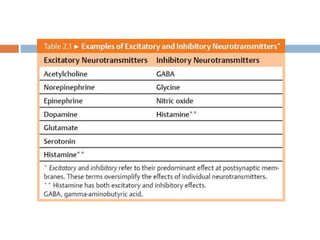
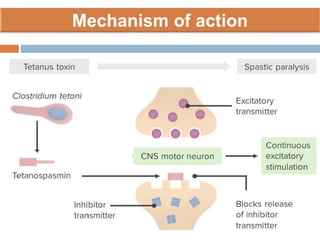
Toxin prevents presynaptic release of inhibitory neurotransmitters
glycine and GABA, which leads to spastic muscle contractions.
Pathogenesis
Mode of transmission
 Injury (superficial abrasions, punctured wounds, RTA)
 Surgery done without proper asepsis.
 Neonates: Following abortion/delivery, due to unhygenic
practices
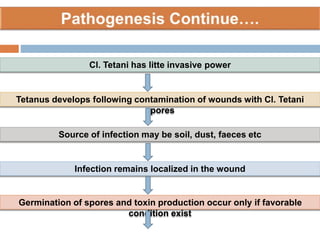
Cl. Tetani has litte invasive power
Tetanus develops following contamination of wounds with Cl. Tetani
spores
Source of infection may be soil, dust, faeces etc
Infection remains localized in the wound
Germination of spores and toxin production occur only if favorable
condition exist
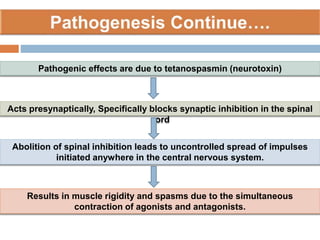
Pathogenic effects are due to tetanospasmin (neurotoxin)
Acts presynaptically, Specifically blocks synaptic inhibition in the spinal
cord
Abolition of spinal inhibition leads to uncontrolled spread of impulses
initiated anywhere in the central nervous system.
Results in muscle rigidity and spasms due to the simultaneous
contraction of agonists and antagonists.
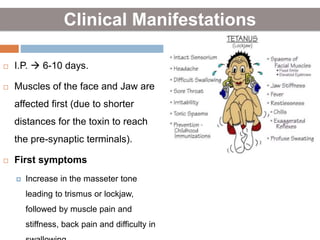
Clinical Manifestations
 I.P.  6-10 days.
 Muscles of the face and Jaw are
affected first (due to shorter
distances for the toxin to reach
the pre-synaptic terminals).
 First symptoms
 Increase in the masseter tone
leading to trismus or lockjaw,
followed by muscle pain and
stiffness, back pain and difficulty in
Clinical Manifestations
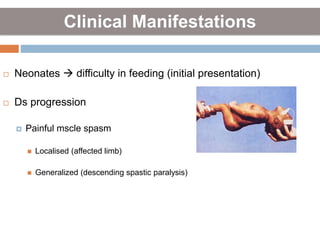
 Neonates  difficulty in feeding (initial presentation)
 Ds progression
 Painful mscle spasm
 Localised (affected limb)
 Generalized (descending spastic paralysis)
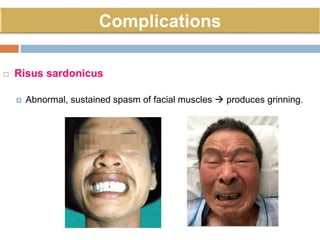
 Risus sardonicus
 Abnormal, sustained spasm of facial muscles  produces grinning.
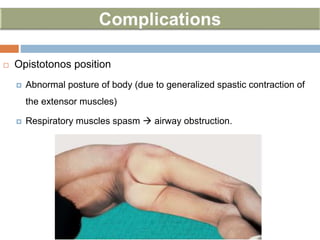
 Opistotonos position
 Abnormal posture of body (due to generalized spastic contraction of
the extensor muscles)
 Respiratory muscles spasm  airway obstruction.
 Autonomic disturbances (max 2nd week)
 Severe tetanus
 Low or high blood pressure
 Tachycardia
 Intestinal stasis
 Sweating
 Increased tracheal secretions
 Acute renal failure
Laboratory Diagnosis
 Specimen
 Wound swab
 Exudate or tissue from the wound.
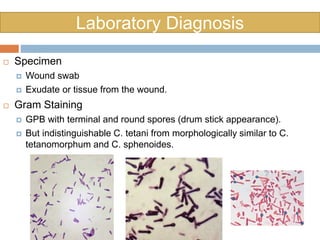
 Gram Staining
 GPB with terminal and round spores (drum stick appearance).
 But indistinguishable C. tetani from morphologically similar to C.
tetanomorphum and C. sphenoides.
Laboratory Diagnosis
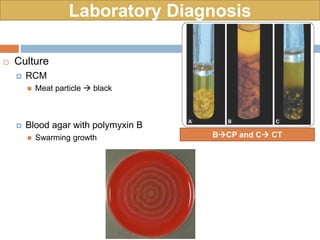
 Culture
 RCM
 Meat particle  black
 Blood agar with polymyxin B
 Swarming growth BCP and C CT
Prophylaxis
 Surgical
 Removal of foreign body, blood clots to prevent anaerobic condtions.
 Antibiotics
 Penicillin
 Erythromycin
 Immunisation
 Active immunisation
 Passive immunisation
 Combined prophylaxis
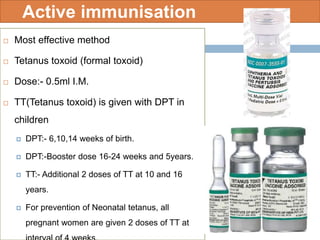
Active immunisation
 Most effective method
 Tetanus toxoid (formal toxoid)
 Dose:- 0.5ml I.M.
 TT(Tetanus toxoid) is given with DPT in
children
 DPT:- 6,10,14 weeks of birth.
 DPT:-Booster dose 16-24 weeks and 5years.
 TT:- Additional 2 doses of TT at 10 and 16
years.
 For prevention of Neonatal tetanus, all
pregnant women are given 2 doses of TT at
Passive Immunisation
 Antitetanus serum (ATS)  prepared by immunising horse with
toxoid for preventing tetanus.
 Human antitetanus immunoglobulins (HTIG).
Combined Prophylaxis
 In non-immune person
 Tetanus toxoid
 ATS or HTIG
Thank You...

Clostridium tetani.pptx

  • 1.
    CLOSTRIDIUM TETANI Dr. RakeshPrasad Sah (Associate Professor, Microbiology)
  • 2.
    Clostridium tetani  Causativeagent of Tetanus  Tetanus: an acute ds  manifested by skeletal muscle spasm and autonomic nervous system disturbance.  Known since ancient time; isolated by Kitasato (1889).  Widely distributed in soil and intestine of man and animals.  Ubiquitous
  • 3.
    Morphology  Gram positive Slender bacillus with spherical, terminal spores drumstick appearance  Non-capsulated & motile (peritrichate flagella)  Young cultures  strongly Gram positive  Old cultures  even be Gram negative
  • 4.
    Resistance  Resistance ofCl. Tetani spores to heat vary in different strains.  Most of the stains are killed by boiling for 10-15mins.  Some resist boiling for 3 hrs.  Autoclaving at 1210C for 20mins kills the spores of most strains.  Spores are killed with Iodine (1% aqueous solution), H2O2 and Glutaraldehyde(2%) within few hours.  Spores may survive in soil for years.
  • 5.
    Toxins  Produces twodistinct toxins  Tetanolysin (haemolysin)  Tetanospasmin (neurotoxin)
  • 6.
  • 7.
    Tetanospasmin  Proteinous innature.  Heat labile and oxygen stable.  Powerful neurotoxin.  Rapidly destroyed by proteolytic enzymes.  Plasmid coded.  Responsible for clinical manifestation of tetanus.
  • 8.
    Tetanospasmin  Lethal tomice and pigs in minute doses (0.0000001mg for mouse).  Good Ag and is specifically neutralized by the antitoxin.  Is plasmid coded.  Can be toxoided by formaldehyde  retains Ag property  looses virulence property  used for vaccine preparation.
  • 10.
    Mechanism of Actionof Tetanus Toxin Toxin binds to receptors (polysialogangliosides) present on motor nerve terminals  which results in toxin internalization. After internalization, tetanus toxin gets transported in retrograde way to the gamma-aminobutyric acid (GABA) and glycine producing inhibitory neuron terminals Toxin prevents presynaptic release of inhibitory neurotransmitters glycine and GABA, which leads to spastic muscle contractions.
  • 15.
    Pathogenesis Mode of transmission Injury (superficial abrasions, punctured wounds, RTA)  Surgery done without proper asepsis.  Neonates: Following abortion/delivery, due to unhygenic practices
  • 16.
    Cl. Tetani haslitte invasive power Tetanus develops following contamination of wounds with Cl. Tetani spores Source of infection may be soil, dust, faeces etc Infection remains localized in the wound Germination of spores and toxin production occur only if favorable condition exist
  • 17.
    Pathogenic effects aredue to tetanospasmin (neurotoxin) Acts presynaptically, Specifically blocks synaptic inhibition in the spinal cord Abolition of spinal inhibition leads to uncontrolled spread of impulses initiated anywhere in the central nervous system. Results in muscle rigidity and spasms due to the simultaneous contraction of agonists and antagonists.
  • 18.
    Clinical Manifestations  I.P. 6-10 days.  Muscles of the face and Jaw are affected first (due to shorter distances for the toxin to reach the pre-synaptic terminals).  First symptoms  Increase in the masseter tone leading to trismus or lockjaw, followed by muscle pain and stiffness, back pain and difficulty in
  • 19.
    Clinical Manifestations  Neonates difficulty in feeding (initial presentation)  Ds progression  Painful mscle spasm  Localised (affected limb)  Generalized (descending spastic paralysis)
  • 20.
     Risus sardonicus Abnormal, sustained spasm of facial muscles  produces grinning.
  • 21.
     Opistotonos position Abnormal posture of body (due to generalized spastic contraction of the extensor muscles)  Respiratory muscles spasm  airway obstruction.
  • 23.
     Autonomic disturbances(max 2nd week)  Severe tetanus  Low or high blood pressure  Tachycardia  Intestinal stasis  Sweating  Increased tracheal secretions  Acute renal failure
  • 24.
    Laboratory Diagnosis  Specimen Wound swab  Exudate or tissue from the wound.  Gram Staining  GPB with terminal and round spores (drum stick appearance).  But indistinguishable C. tetani from morphologically similar to C. tetanomorphum and C. sphenoides.
  • 25.
    Laboratory Diagnosis  Culture RCM  Meat particle  black  Blood agar with polymyxin B  Swarming growth BCP and C CT
  • 26.
    Prophylaxis  Surgical  Removalof foreign body, blood clots to prevent anaerobic condtions.  Antibiotics  Penicillin  Erythromycin  Immunisation  Active immunisation  Passive immunisation  Combined prophylaxis
  • 27.
    Active immunisation  Mosteffective method  Tetanus toxoid (formal toxoid)  Dose:- 0.5ml I.M.  TT(Tetanus toxoid) is given with DPT in children  DPT:- 6,10,14 weeks of birth.  DPT:-Booster dose 16-24 weeks and 5years.  TT:- Additional 2 doses of TT at 10 and 16 years.  For prevention of Neonatal tetanus, all pregnant women are given 2 doses of TT at
  • 28.
    Passive Immunisation  Antitetanusserum (ATS)  prepared by immunising horse with toxoid for preventing tetanus.  Human antitetanus immunoglobulins (HTIG).
  • 29.
    Combined Prophylaxis  Innon-immune person  Tetanus toxoid  ATS or HTIG
  • 30.