Electric Charge
and
Coulomb’s Law
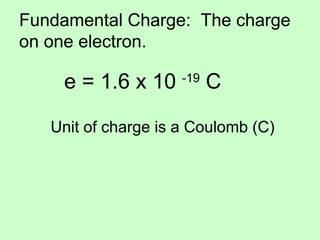
Fundamental Charge: The charge
on one electron.
e = 1.6 x 10 -19
C
Unit of charge is a Coulomb (C)
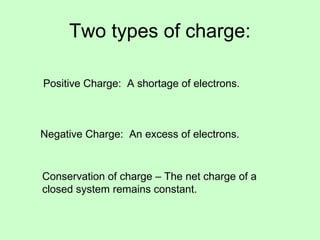
Two types of charge:
Positive Charge: A shortage of electrons.
Negative Charge: An excess of electrons.
Conservation of charge – The net charge of a
closed system remains constant.
+
n
+ +
+
+
+
n
n
n
n n
-
-
-
-
-
-
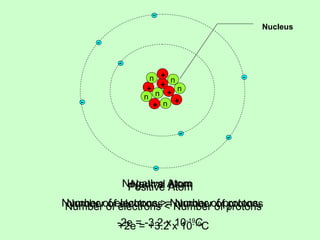
Neutral Atom
Number of electrons = Number of protons
Nucleus
Negative Atom
Number of electrons > Number of protons
-2e = -3.2 x 10⁻¹⁹
C
-
-
Positive Atom
Number of electrons < Number of protons
+2e = +3.2 x 10⁻¹⁹
C
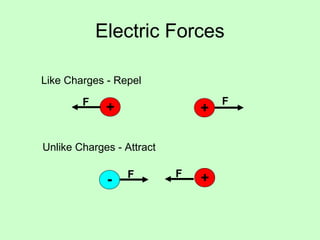
Electric Forces
Like Charges - Repel
Unlike Charges - Attract
- +F F
+ +
FF
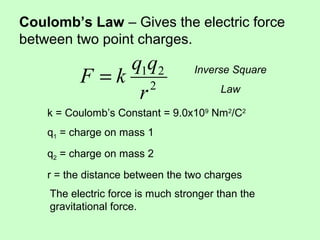
Coulomb’s Law – Gives the electric force
between two point charges.
2
21
r
qq
kF =
k = Coulomb’s Constant = 9.0x10⁹
Nm2
/C2
q1 = charge on mass 1
q2 = charge on mass 2
r = the distance between the two charges
The electric force is much stronger than the
gravitational force.
Inverse Square
Law
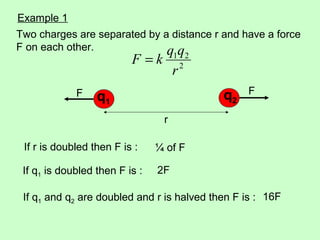
2
21
r
qq
kF =
If r is doubled then F is :
If q1 is doubled then F is :
If q1 and q2 are doubled and r is halved then F is :
¼ of F
2F
16F
Two charges are separated by a distance r and have a force
F on each other.
q1
q2
r
F F
Example 1
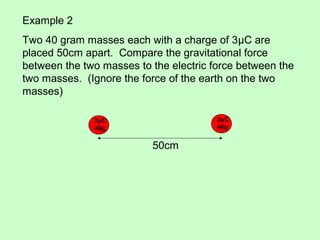
Example 2
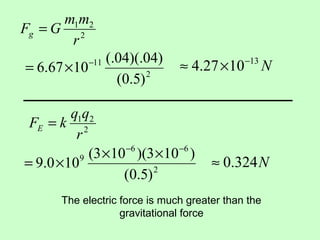
Two 40 gram masses each with a charge of 3μC are
placed 50cm apart. Compare the gravitational force
between the two masses to the electric force between the
two masses. (Ignore the force of the earth on the two
masses)
3μC
40g
50cm
3μC
40g
2
21
r
mm
GFg =
2
11
)5.0(
)04)(.04(.
1067.6 −
×= N13
1027.4 −
×≈
2
21
r
qq
kFE =
2
66
9
)5.0(
)103)(103(
100.9
−−
××
×= N324.0≈
The electric force is much greater than the
gravitational force
5μC
- 5μC
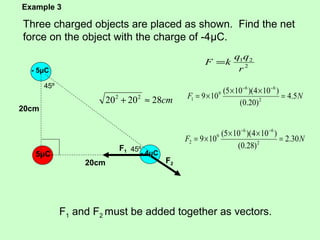
Three charged objects are placed as shown. Find the net
force on the object with the charge of -4μC.
- 4μC
F2
F1
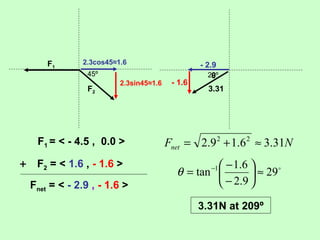
F1 and F2 must be added together as vectors.
20cm
20cm
cm282020 22
≈+
45º
45º
2
21
r
qq
kF =
NF 5.4
)20.0(
)104)(105(
109 2
66
9
1 =
××
×=
−−
NF 30.2
)28.0(
)104)(105(
109 2
66
9
2 =
××
×=
−−
Example 3
F1
F2
45º
2.3cos45≈1.6
2.3sin45≈1.6
F1 = < - 4.5 , 0.0 >
F2 = < 1.6 , - 1.6 >+
Fnet = < - 2.9 , - 1.6 >
NFnet 31.36.19.2 22
≈+=
- 2.9
- 1.6
3.31
θ

29
9.2
6.1
tan 1
≈





−
−
= −
θ
3.31N at 209º
29º
Example 4
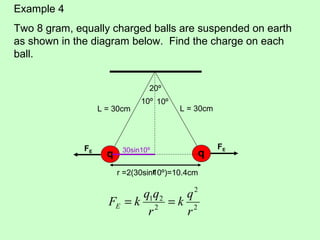
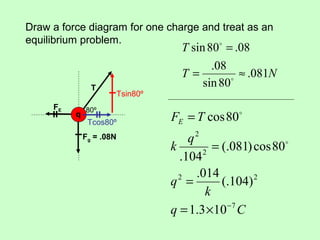
Two 8 gram, equally charged balls are suspended on earth
as shown in the diagram below. Find the charge on each
ball.
qq
20º
L = 30cmL = 30cm
FEFE
r =2(30sin10º)=10.4cm
2
2
2
21
r
q
k
r
qq
kFE ==
10º10º
30sin10º
r
Draw a force diagram for one charge and treat as an
equilibrium problem.
FE
Fg = .08N
T
q
Tsin80º
NT
T
081.
80sin
08.
08.80sin
≈=
=


Tcos80º
Cq
k
q
q
k
TFE
7
22
2
2
103.1
)104(.
014.
80cos)081(.
104.
80cos
−
×=
=
=
=

80º

Coulombs law

  • 1.
  • 2.
    Fundamental Charge: Thecharge on one electron. e = 1.6 x 10 -19 C Unit of charge is a Coulomb (C)
  • 3.
    Two types ofcharge: Positive Charge: A shortage of electrons. Negative Charge: An excess of electrons. Conservation of charge – The net charge of a closed system remains constant.
  • 4.
    + n + + + + + n n n n n - - - - - - NeutralAtom Number of electrons = Number of protons Nucleus Negative Atom Number of electrons > Number of protons -2e = -3.2 x 10⁻¹⁹ C - - Positive Atom Number of electrons < Number of protons +2e = +3.2 x 10⁻¹⁹ C
  • 5.
    Electric Forces Like Charges- Repel Unlike Charges - Attract - +F F + + FF
  • 6.
    Coulomb’s Law –Gives the electric force between two point charges. 2 21 r qq kF = k = Coulomb’s Constant = 9.0x10⁹ Nm2 /C2 q1 = charge on mass 1 q2 = charge on mass 2 r = the distance between the two charges The electric force is much stronger than the gravitational force. Inverse Square Law
  • 7.
    2 21 r qq kF = If ris doubled then F is : If q1 is doubled then F is : If q1 and q2 are doubled and r is halved then F is : ¼ of F 2F 16F Two charges are separated by a distance r and have a force F on each other. q1 q2 r F F Example 1
  • 8.
    Example 2 Two 40gram masses each with a charge of 3μC are placed 50cm apart. Compare the gravitational force between the two masses to the electric force between the two masses. (Ignore the force of the earth on the two masses) 3μC 40g 50cm 3μC 40g
  • 9.
    2 21 r mm GFg = 2 11 )5.0( )04)(.04(. 1067.6 − ×=N13 1027.4 − ×≈ 2 21 r qq kFE = 2 66 9 )5.0( )103)(103( 100.9 −− ×× ×= N324.0≈ The electric force is much greater than the gravitational force
  • 10.
    5μC - 5μC Three chargedobjects are placed as shown. Find the net force on the object with the charge of -4μC. - 4μC F2 F1 F1 and F2 must be added together as vectors. 20cm 20cm cm282020 22 ≈+ 45º 45º 2 21 r qq kF = NF 5.4 )20.0( )104)(105( 109 2 66 9 1 = ×× ×= −− NF 30.2 )28.0( )104)(105( 109 2 66 9 2 = ×× ×= −− Example 3
  • 11.
    F1 F2 45º 2.3cos45≈1.6 2.3sin45≈1.6 F1 = <- 4.5 , 0.0 > F2 = < 1.6 , - 1.6 >+ Fnet = < - 2.9 , - 1.6 > NFnet 31.36.19.2 22 ≈+= - 2.9 - 1.6 3.31 θ  29 9.2 6.1 tan 1 ≈      − − = − θ 3.31N at 209º 29º
  • 12.
    Example 4 Two 8gram, equally charged balls are suspended on earth as shown in the diagram below. Find the charge on each ball. qq 20º L = 30cmL = 30cm FEFE r =2(30sin10º)=10.4cm 2 2 2 21 r q k r qq kFE == 10º10º 30sin10º r
  • 13.
    Draw a forcediagram for one charge and treat as an equilibrium problem. FE Fg = .08N T q Tsin80º NT T 081. 80sin 08. 08.80sin ≈= =   Tcos80º Cq k q q k TFE 7 22 2 2 103.1 )104(. 014. 80cos)081(. 104. 80cos − ×= = = =  80º