BASICS OF ELECTRICAL AND
ELECTRONICS ENGINEERING
ASSIGNMENT PRESENTATION
COUNTERS – DIGITAL ELECTRONICS
Content
• INTRODUCTION
• BENEFITS OF COUNTERS
• TYPES OF COUNTERS
• ASYNCHRONOUS COUNTERS
• BINARY RIPPLE COUNTER
Introduction
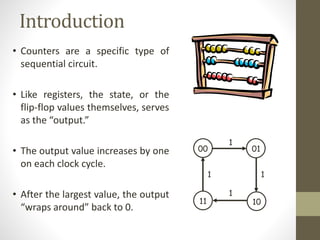
• Counters are a specific type of
sequential circuit.
• Like registers, the state, or the
flip-flop values themselves, serves
as the “output.”
• The output value increases by one
on each clock cycle.
• After the largest value, the output
“wraps around” back to 0.
00 01
1011
1
11
1
Benefits of counters
• Counters can act as simple clocks to keep track of “time.”
• You may need to record how many times something has
happened.
• How many bits have been sent or received?
• How many steps have been performed in some computation?
• All processors contain a program counter, or PC.
• The PC increments once on each clock cycle, and the next
program instruction is then executed.
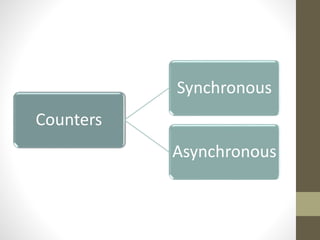
Counters
Synchronous
Asynchronous
Asynchronous Counters
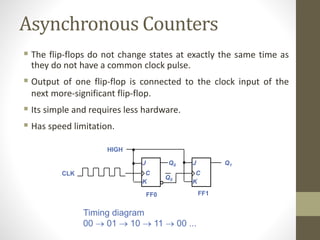
 The flip-flops do not change states at exactly the same time as
they do not have a common clock pulse.
 Output of one flip-flop is connected to the clock input of the
next more-significant flip-flop.
 Its simple and requires less hardware.
 Has speed limitation.
K
J
K
J
HIGH
Q0 Q1
Q0
FF1FF0
CLK CC
Timing diagram
00  01  10  11  00 ...
Binary ripple counter
• The counter is called ripple counter because the output of one
flip-flop feed to the clock input of another
• The flip flops respond to negative going clock edge.
• Each flip flop divides the incoming clock pulse frequency by a
factor of 2.
•
• Cumulative delay is a drawback.
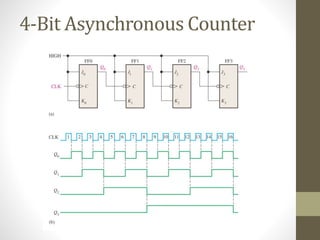
4-Bit Asynchronous Counter
Synchronous Counter
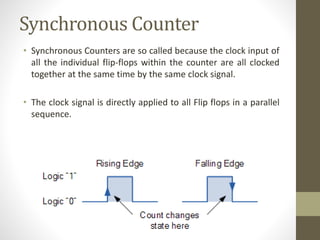
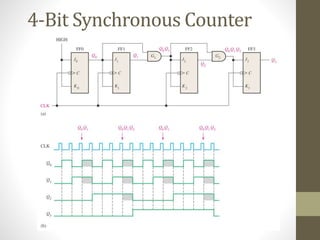
• Synchronous Counters are so called because the clock input of
all the individual flip-flops within the counter are all clocked
together at the same time by the same clock signal.
• The clock signal is directly applied to all Flip flops in a parallel
sequence.
4-Bit Synchronous Counter
Thank you all !!!

Digital Electronics - Counters

  • 1.
    BASICS OF ELECTRICALAND ELECTRONICS ENGINEERING ASSIGNMENT PRESENTATION COUNTERS – DIGITAL ELECTRONICS
  • 2.
    Content • INTRODUCTION • BENEFITSOF COUNTERS • TYPES OF COUNTERS • ASYNCHRONOUS COUNTERS • BINARY RIPPLE COUNTER
  • 3.
    Introduction • Counters area specific type of sequential circuit. • Like registers, the state, or the flip-flop values themselves, serves as the “output.” • The output value increases by one on each clock cycle. • After the largest value, the output “wraps around” back to 0. 00 01 1011 1 11 1
  • 4.
    Benefits of counters •Counters can act as simple clocks to keep track of “time.” • You may need to record how many times something has happened. • How many bits have been sent or received? • How many steps have been performed in some computation? • All processors contain a program counter, or PC. • The PC increments once on each clock cycle, and the next program instruction is then executed.
  • 5.
  • 6.
    Asynchronous Counters  Theflip-flops do not change states at exactly the same time as they do not have a common clock pulse.  Output of one flip-flop is connected to the clock input of the next more-significant flip-flop.  Its simple and requires less hardware.  Has speed limitation. K J K J HIGH Q0 Q1 Q0 FF1FF0 CLK CC Timing diagram 00  01  10  11  00 ...
  • 7.
    Binary ripple counter •The counter is called ripple counter because the output of one flip-flop feed to the clock input of another • The flip flops respond to negative going clock edge. • Each flip flop divides the incoming clock pulse frequency by a factor of 2. • • Cumulative delay is a drawback.
  • 8.
  • 9.
    Synchronous Counter • SynchronousCounters are so called because the clock input of all the individual flip-flops within the counter are all clocked together at the same time by the same clock signal. • The clock signal is directly applied to all Flip flops in a parallel sequence.
  • 10.
  • 11.