
Prof. Neha Sharma
Asst. Prof.(EC Department)
In the coding, when numbers, letters or words
are represented by a specific group of
symbols, it is said that the number, letter or
word is being encoded. The group of symbols
is called as a code. The digital data is
represented, stored and transmitted as group
of binary bits. This group is also called as
binary code
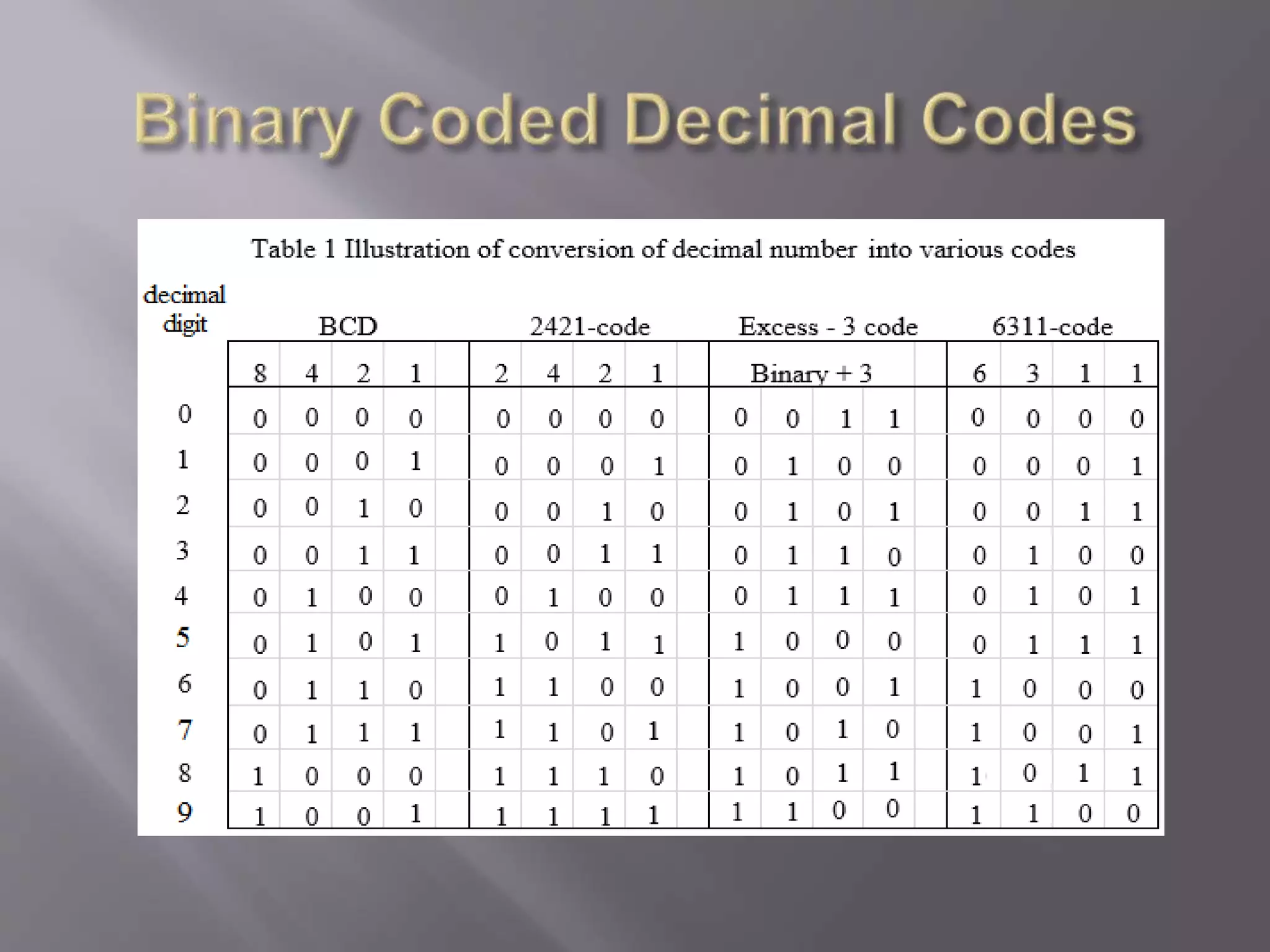
Weighted binary codes are those binary codes
which obey the positional weight principle.
Each position of the number represents a
specific weight. Several systems of the codes
are used to express the decimal digits 0
through 9. In these codes each decimal digit is
represented by a group of four bits.
In this type of binary codes, the positional
weights are not assigned. The examples of non-
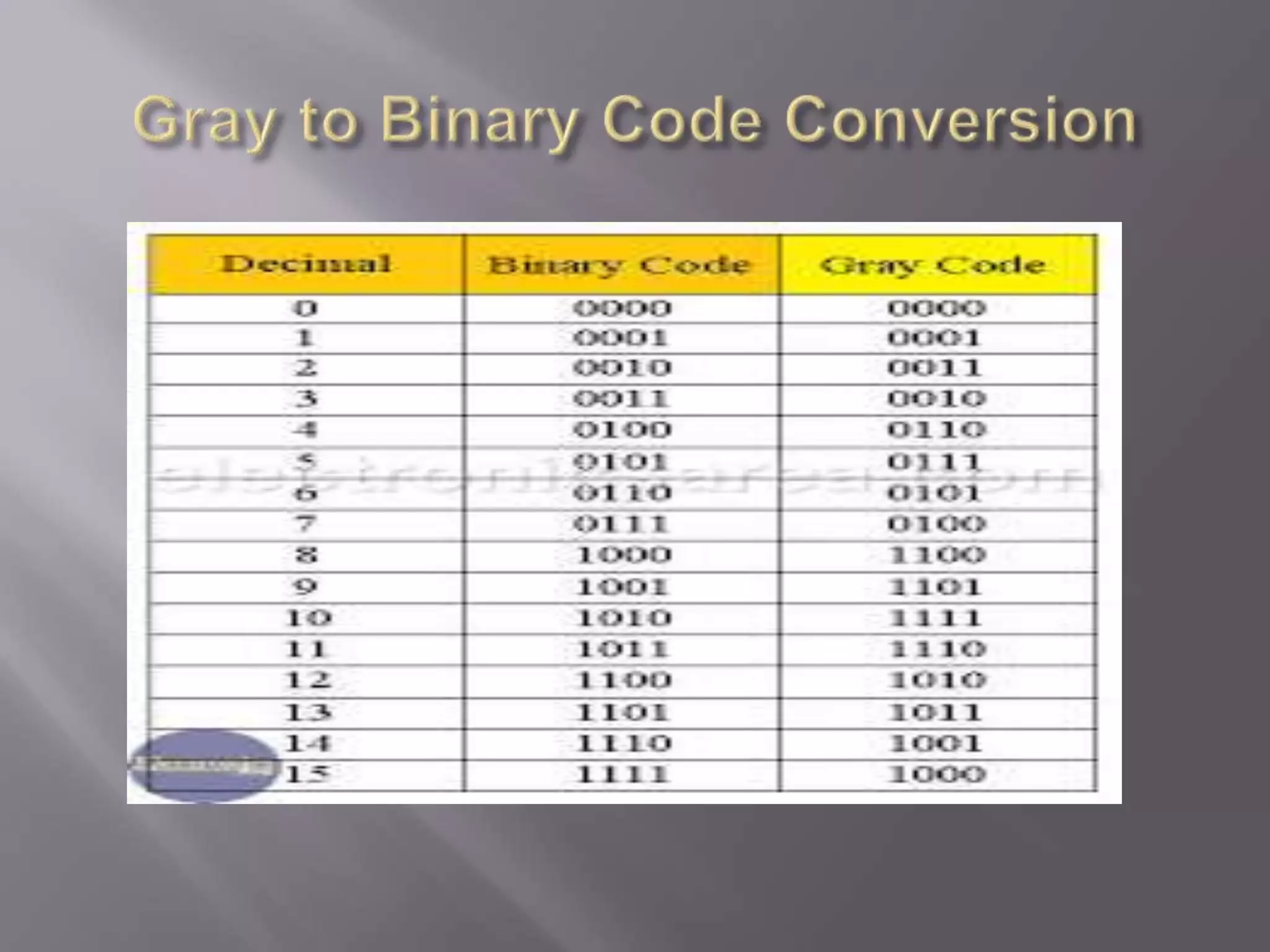
weighted codes are Excess-3 code and Gray
code.
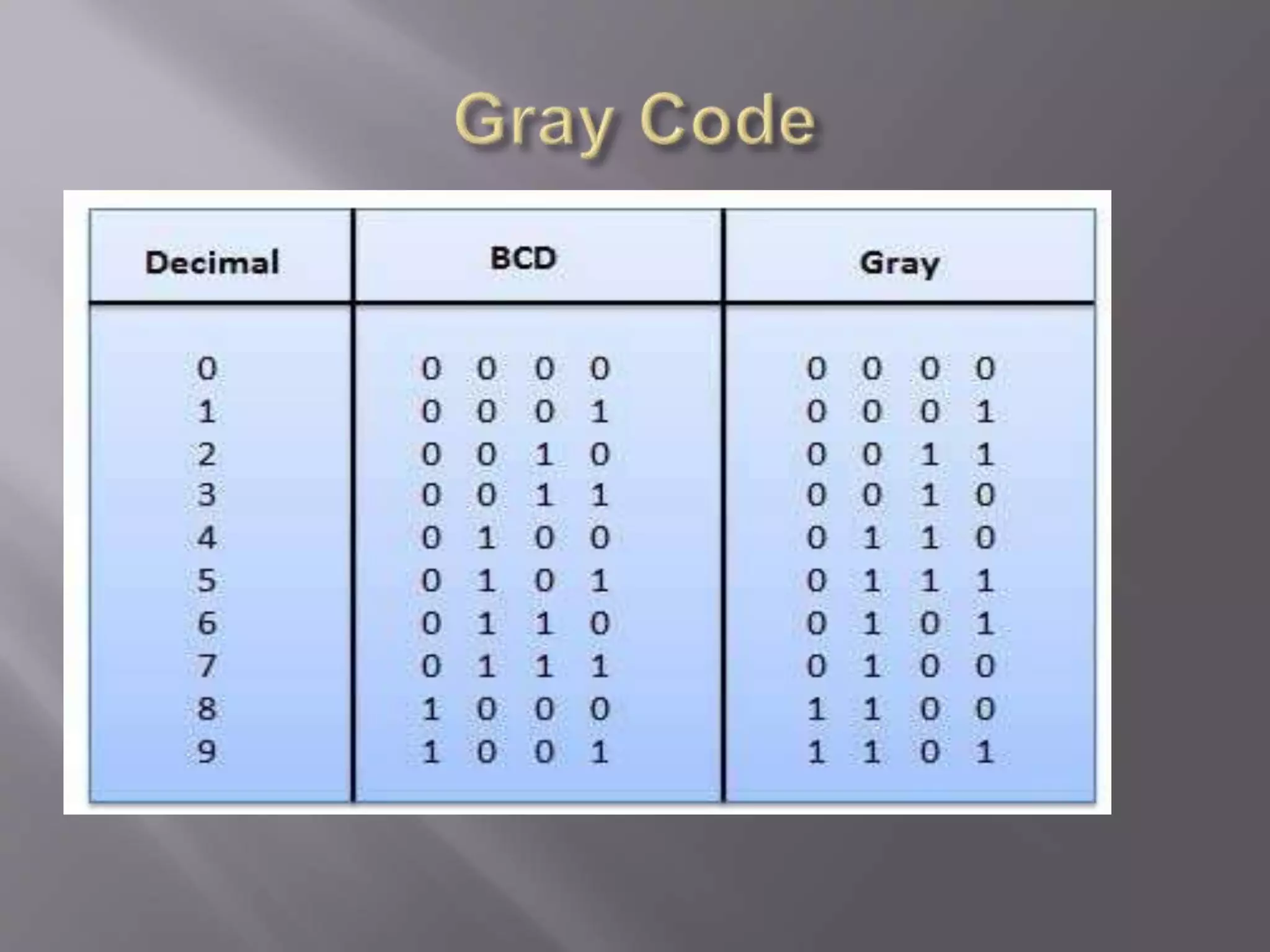
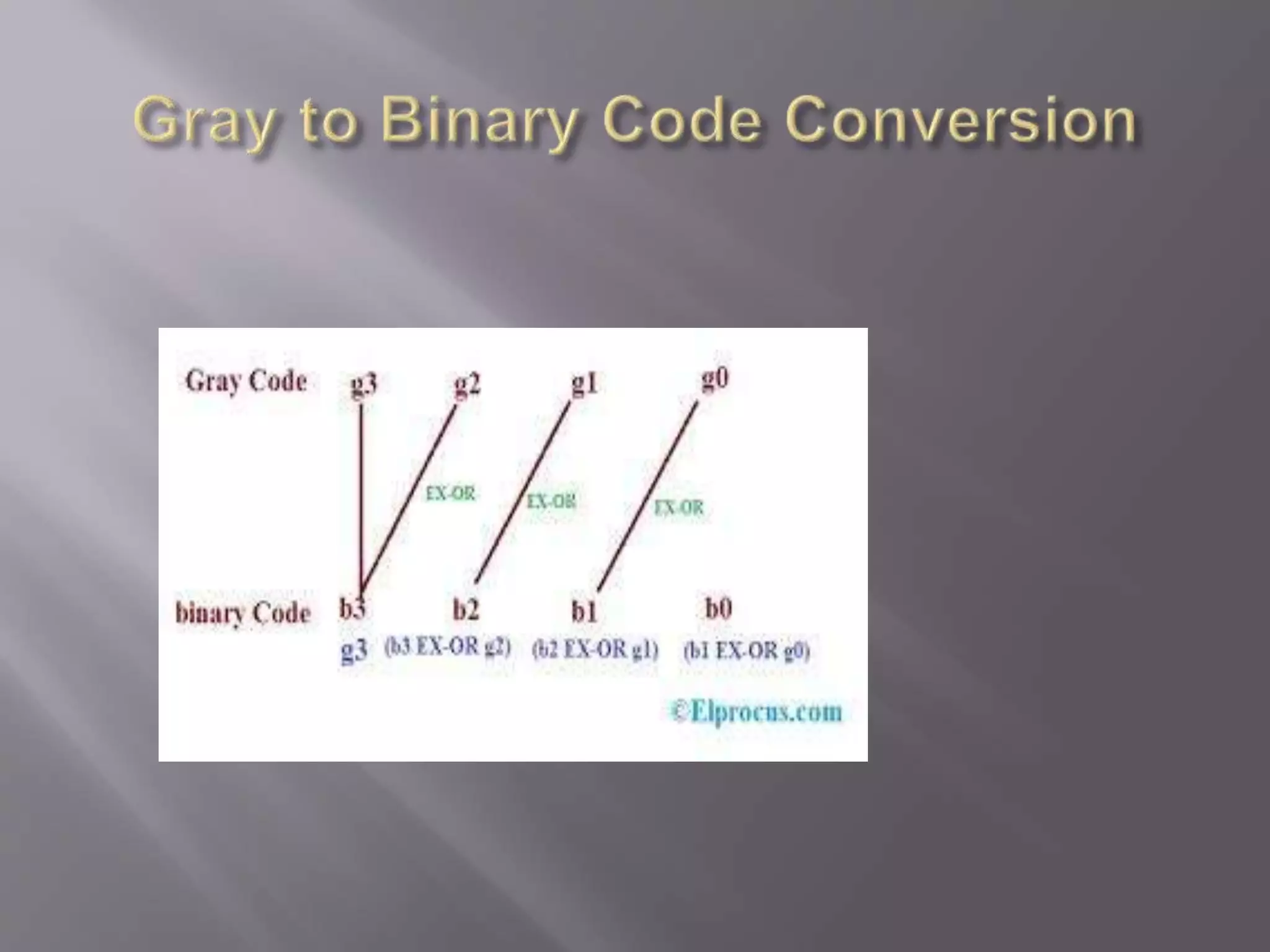
 When you count up or down in binary, the
number of bit that change with each digit
change varies.
 From 0 to 1 just have a single but
 From 1 to 2 have 2 bits, a 1 to 0 transition and a 0
to 1 transition
 From 7 to 8 have 3 bits changing back to 0 and 1
bit changing to a 1
 For some applications multiple bit changes
cause significant problems.
 Application of Gray code
 Gray code is popularly used in the shaft
position encoders.
 A shaft position encoder produces a code word
which represents the angular position of the
shaft.
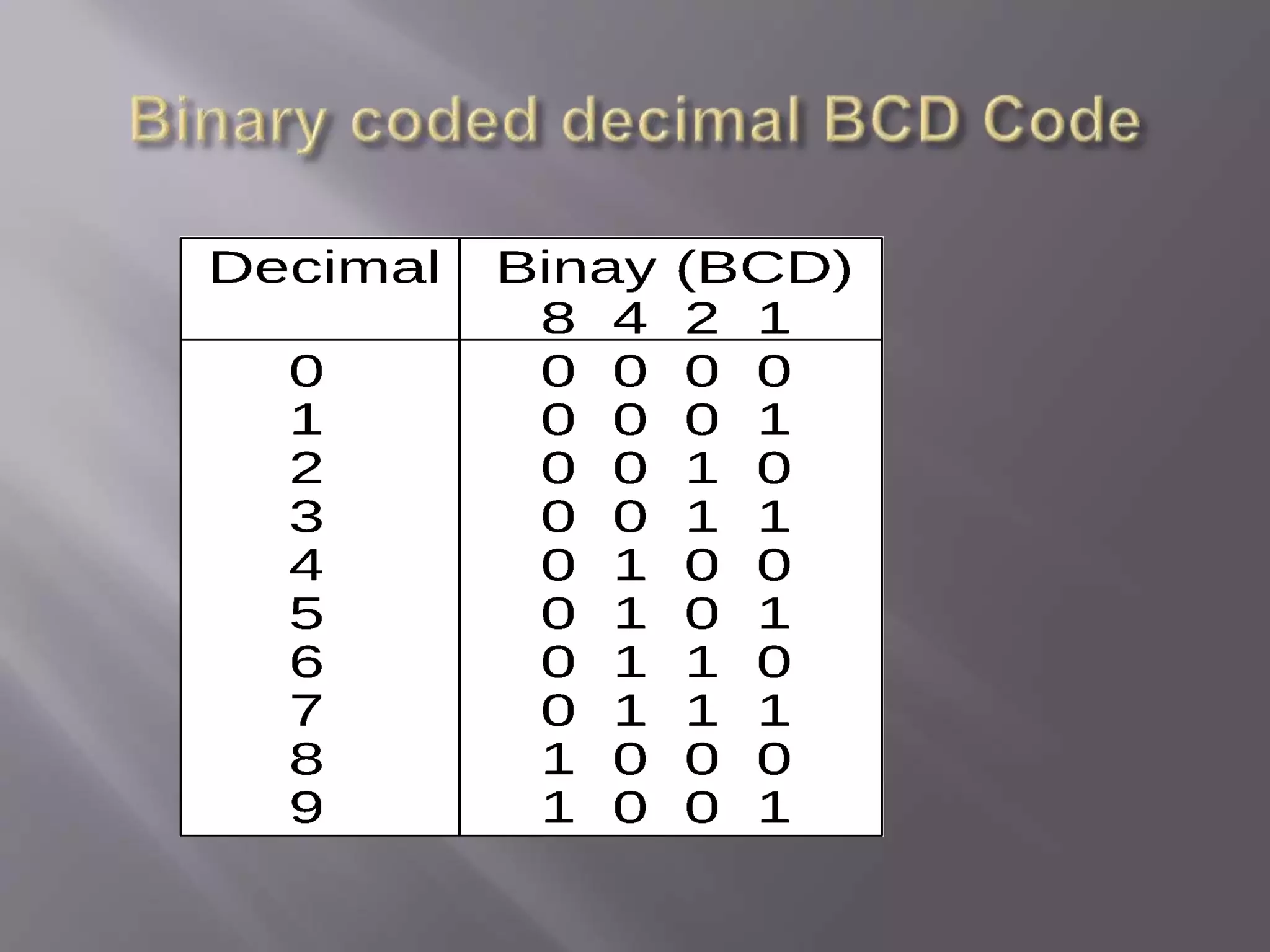
 In this code each decimal digit is represented
by a 4-bit binary number. BCD is a way to
express each of the decimal digits with a binary
code. In the BCD, with four bits we can
represent sixteen numbers 0000to1111. But in
BCD code only first ten of these are used
0000to1001. The remaining six code
combinations i.e. 1010 to 1111 are invalid in
BCD.
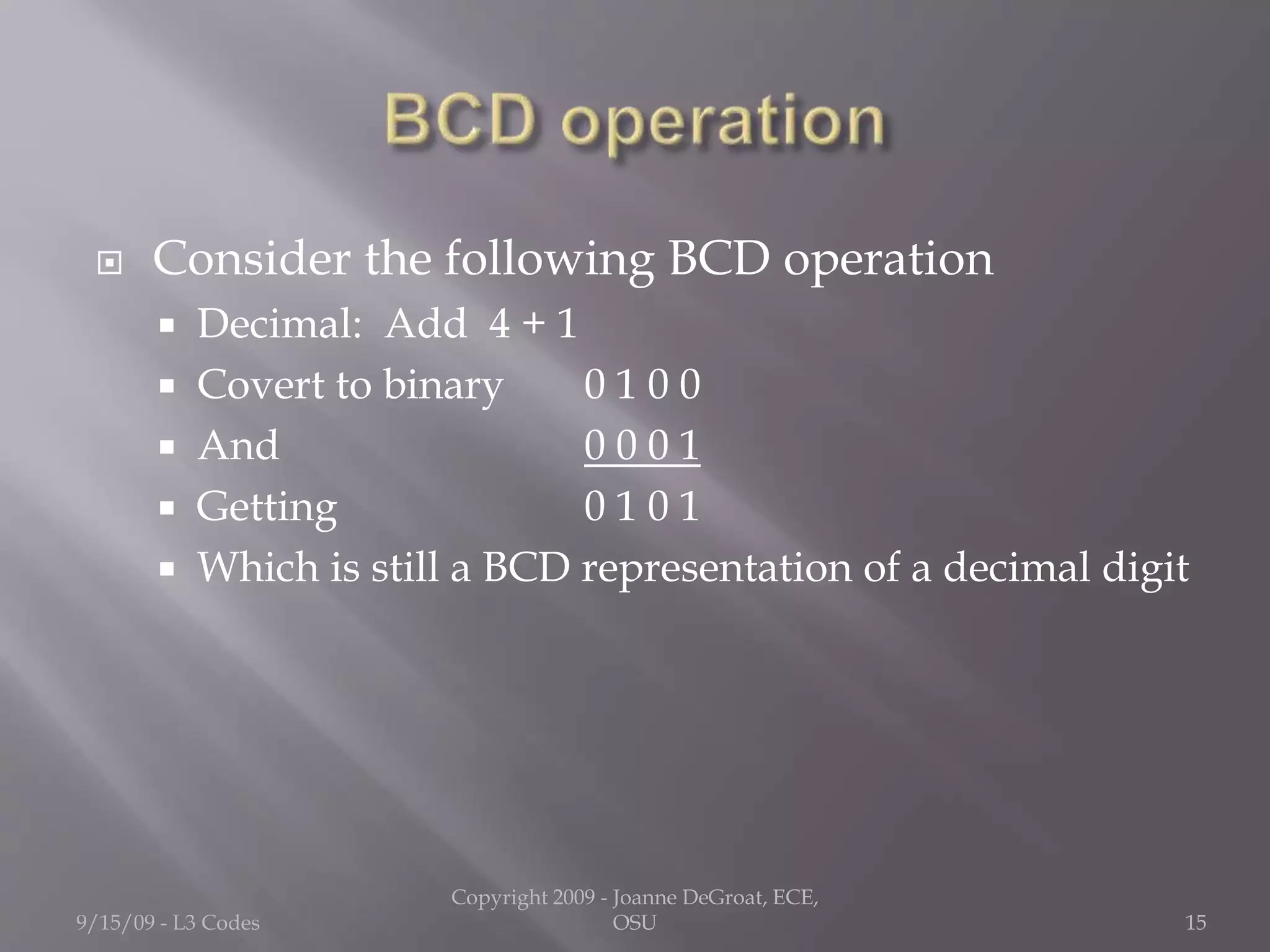
 Consider the following BCD operation
 Decimal: Add 4 + 1
 Covert to binary 0 1 0 0
 And 0 0 0 1
 Getting 0 1 0 1
 Which is still a BCD representation of a decimal digit
9/15/09 - L3 Codes
Copyright 2009 - Joanne DeGroat, ECE,
OSU 15
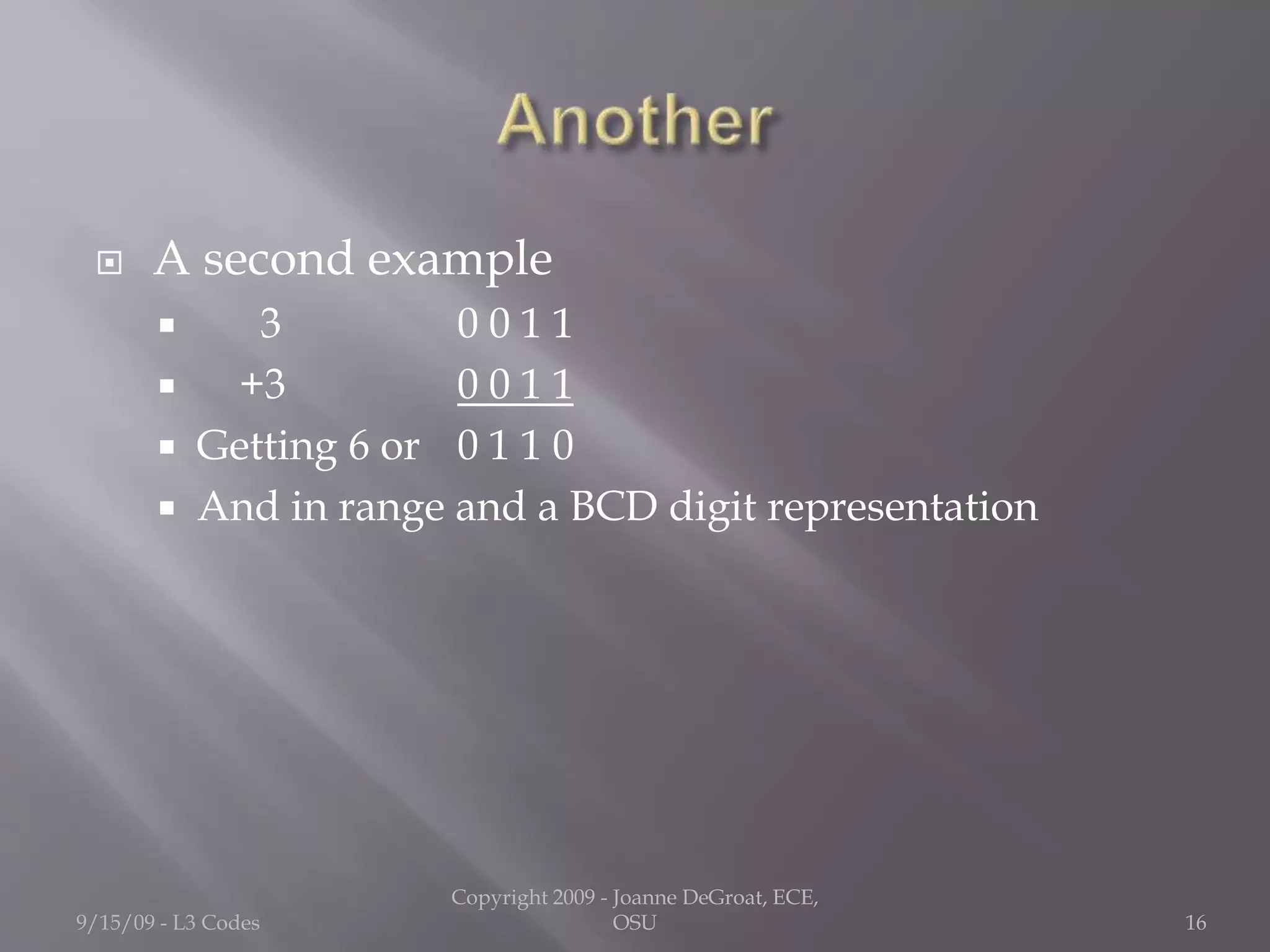
 A second example
 3 0 0 1 1
 +3 0 0 1 1
 Getting 6 or 0 1 1 0
 And in range and a BCD digit representation
9/15/09 - L3 Codes
Copyright 2009 - Joanne DeGroat, ECE,
OSU 16
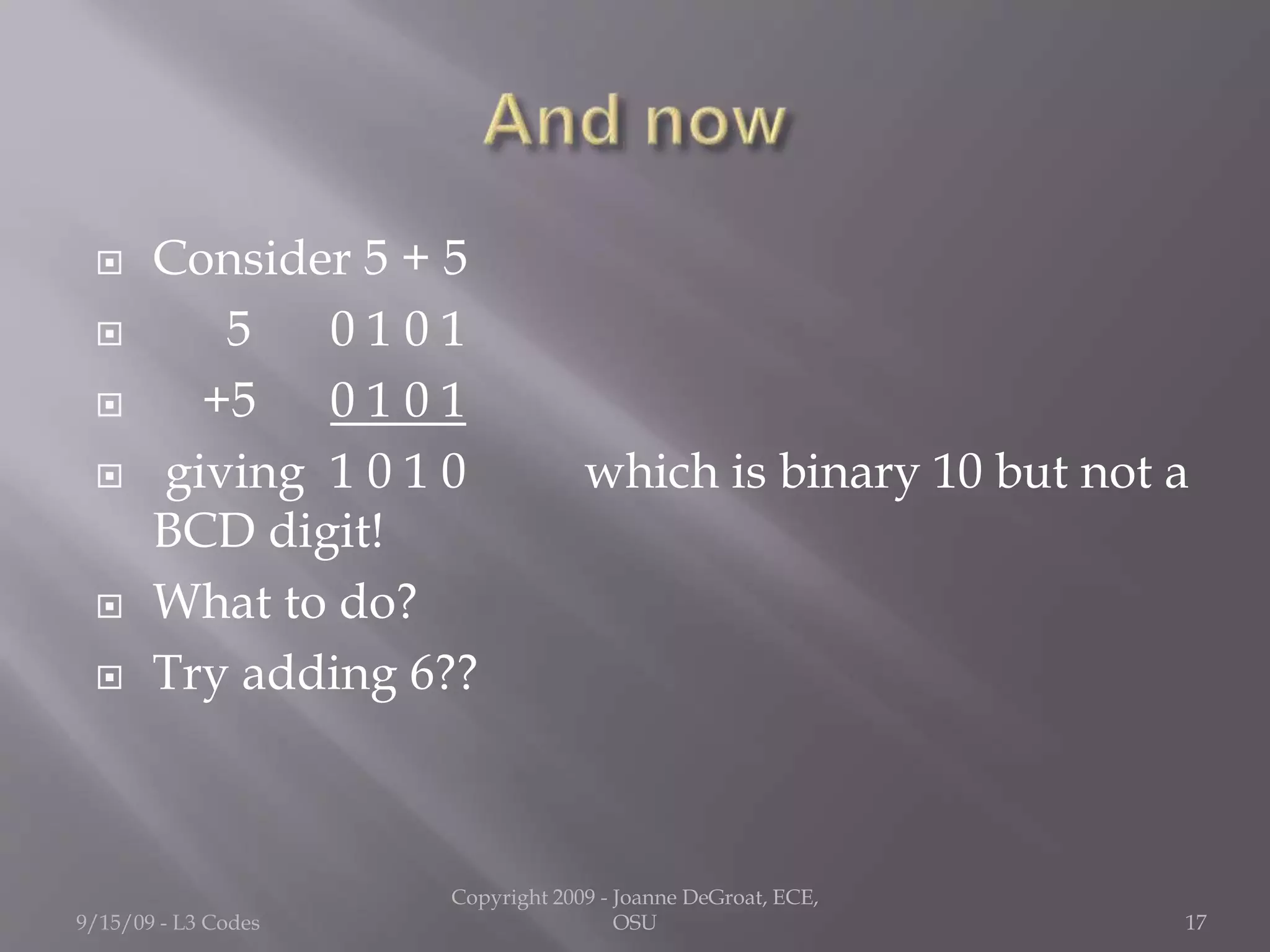
 Consider 5 + 5
 5 0 1 0 1
 +5 0 1 0 1
 giving 1 0 1 0 which is binary 10 but not a
BCD digit!
 What to do?
 Try adding 6??
9/15/09 - L3 Codes
Copyright 2009 - Joanne DeGroat, ECE,
OSU 17
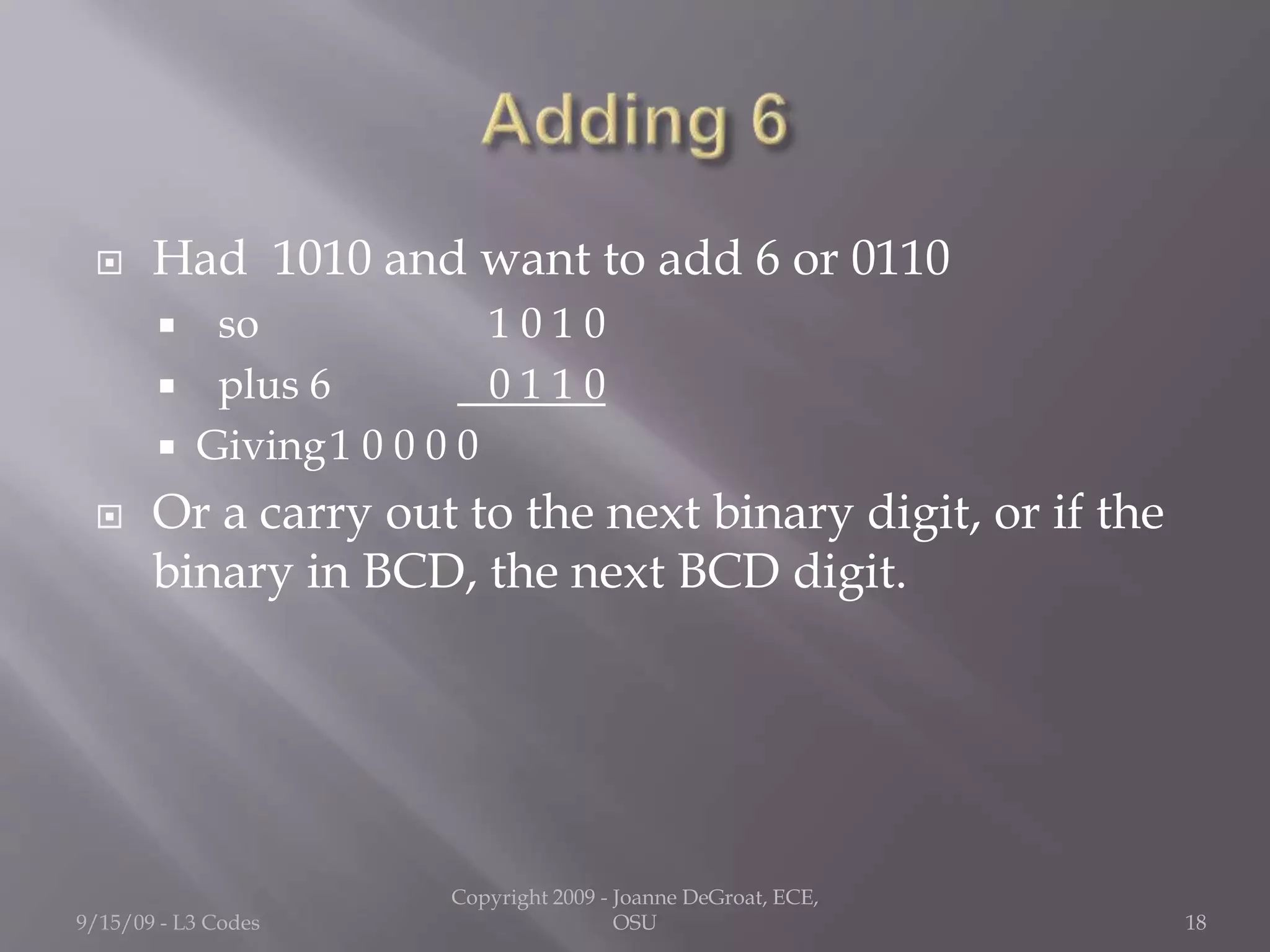
 Had 1010 and want to add 6 or 0110
 so 1 0 1 0
 plus 6 0 1 1 0
 Giving1 0 0 0 0
 Or a carry out to the next binary digit, or if the
binary in BCD, the next BCD digit.
9/15/09 - L3 Codes
Copyright 2009 - Joanne DeGroat, ECE,
OSU 18
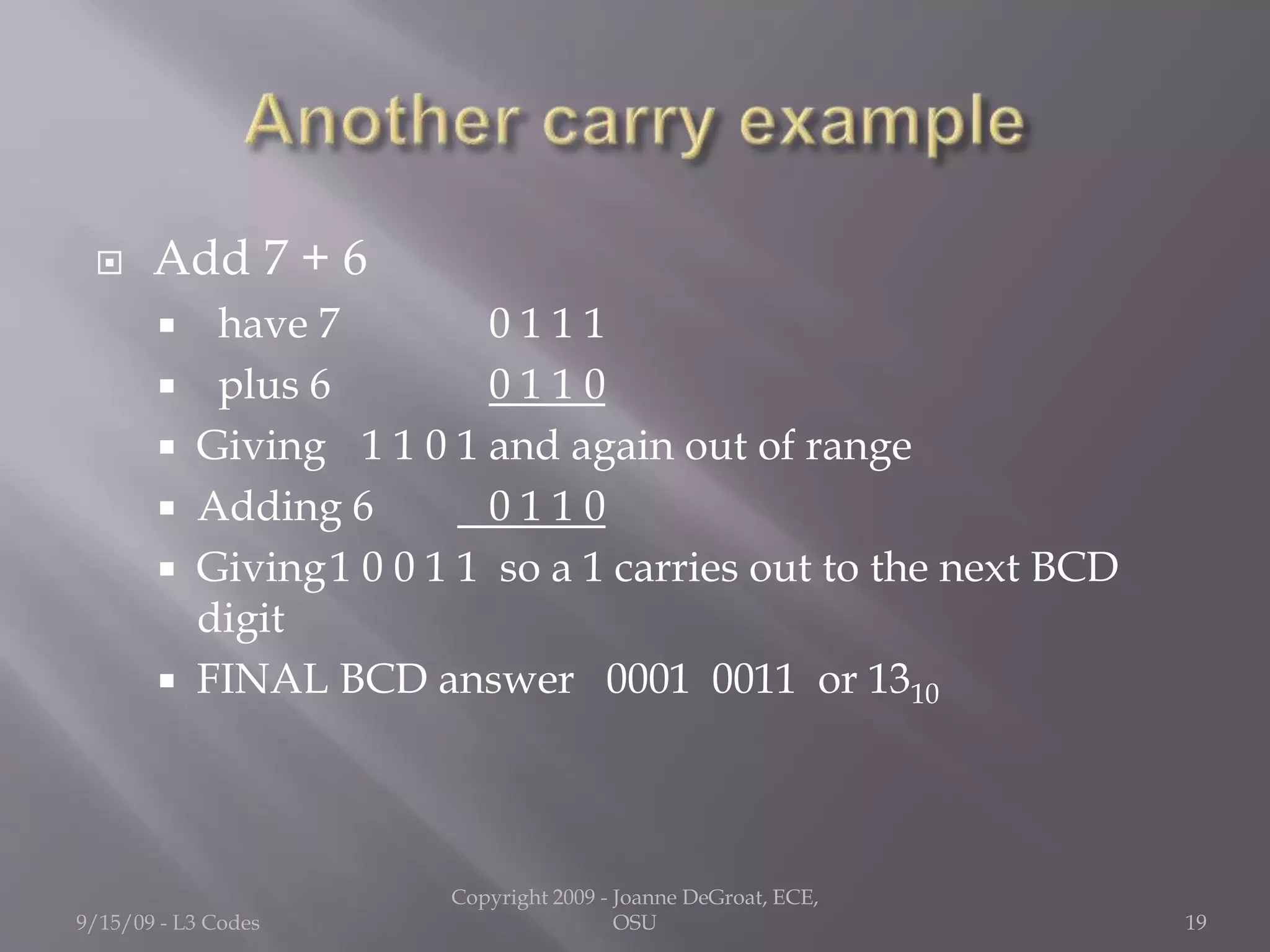
 Add 7 + 6
 have 7 0 1 1 1
 plus 6 0 1 1 0
 Giving 1 1 0 1 and again out of range
 Adding 6 0 1 1 0
 Giving1 0 0 1 1 so a 1 carries out to the next BCD
digit
 FINAL BCD answer 0001 0011 or 1310
9/15/09 - L3 Codes
Copyright 2009 - Joanne DeGroat, ECE,
OSU 19
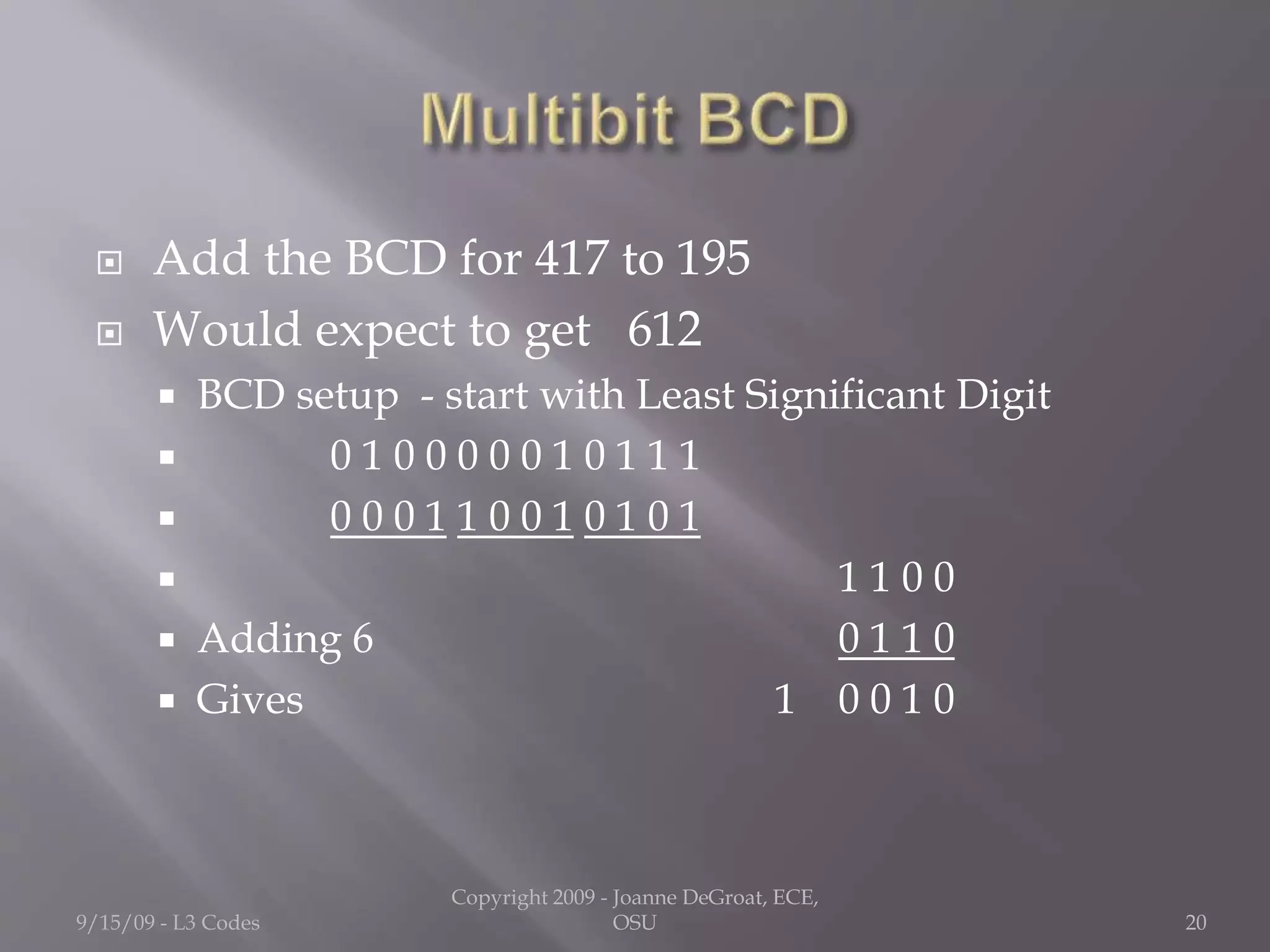
 Add the BCD for 417 to 195
 Would expect to get 612
 BCD setup - start with Least Significant Digit
 0 1 0 0 0 0 0 1 0 1 1 1
 0 0 0 1 1 0 0 1 0 1 0 1
 1 1 0 0
 Adding 6 0 1 1 0
 Gives 1 0 0 1 0
9/15/09 - L3 Codes
Copyright 2009 - Joanne DeGroat, ECE,
OSU 20
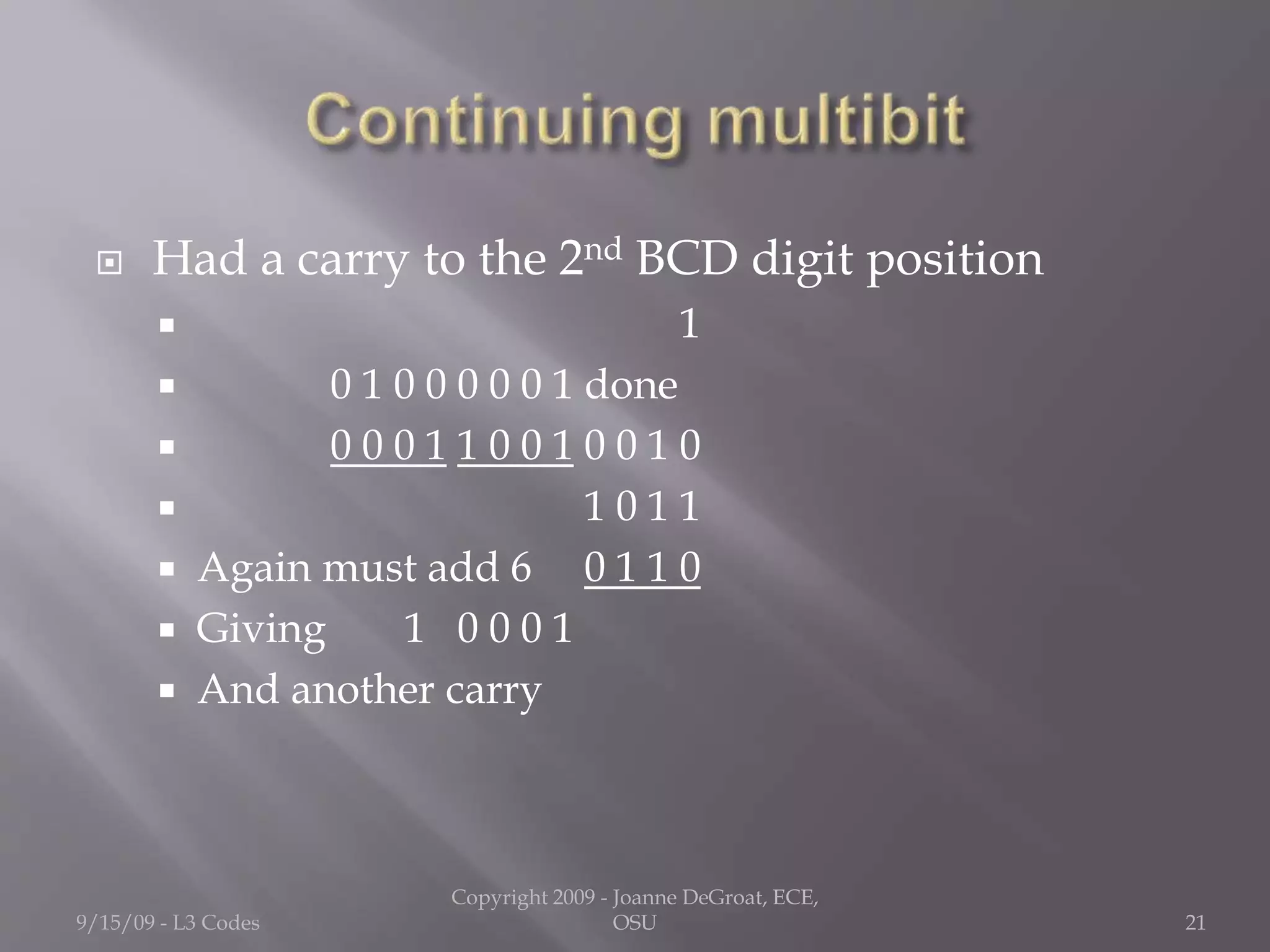
 Had a carry to the 2nd BCD digit position
 1
 0 1 0 0 0 0 0 1 done
 0 0 0 1 1 0 0 1 0 0 1 0
 1 0 1 1
 Again must add 6 0 1 1 0
 Giving 1 0 0 0 1
 And another carry
9/15/09 - L3 Codes
Copyright 2009 - Joanne DeGroat, ECE,
OSU 21
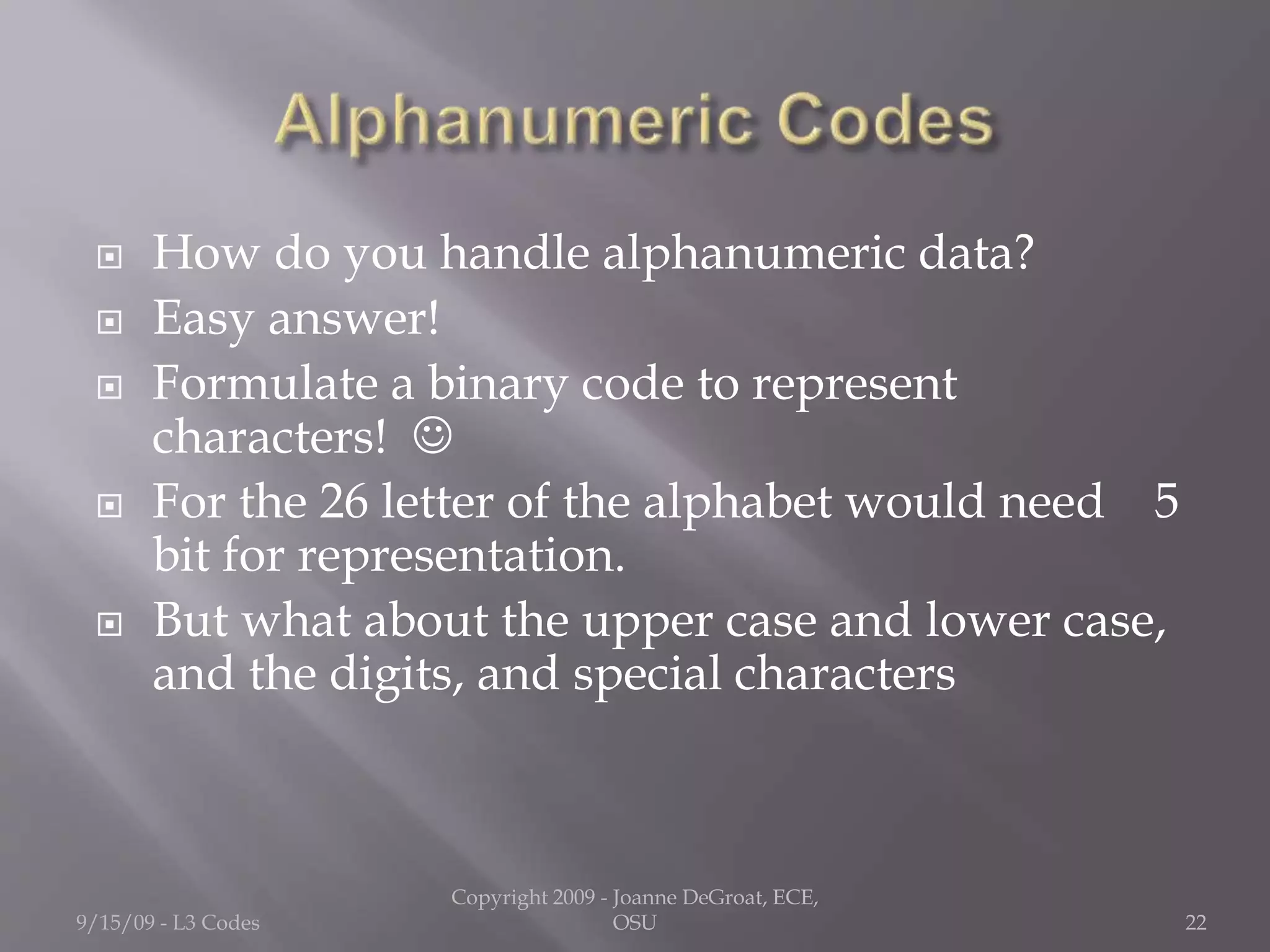
 How do you handle alphanumeric data?
 Easy answer!
 Formulate a binary code to represent
characters! 
 For the 26 letter of the alphabet would need 5
bit for representation.
 But what about the upper case and lower case,
and the digits, and special characters
9/15/09 - L3 Codes
Copyright 2009 - Joanne DeGroat, ECE,
OSU 22
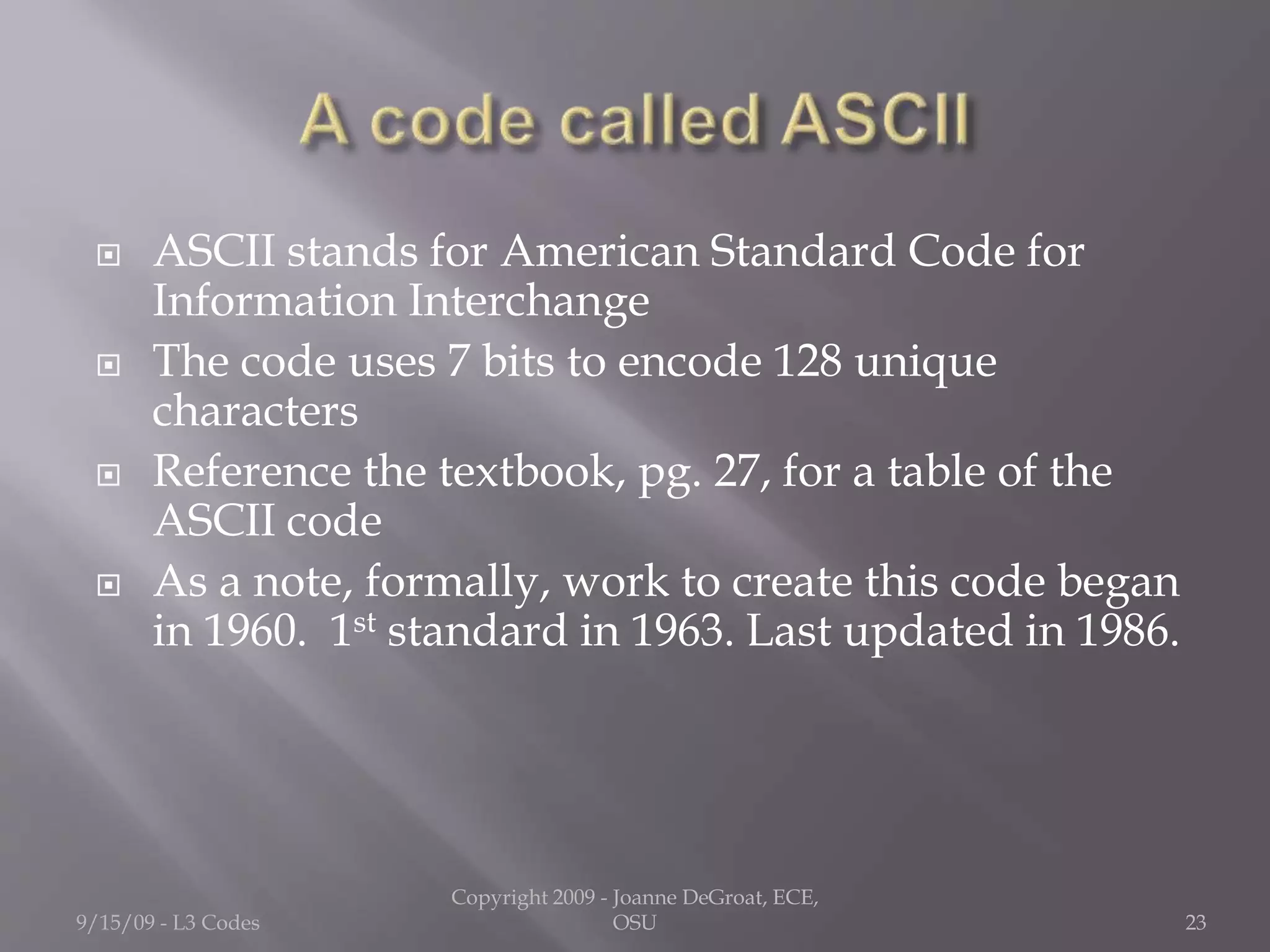
 ASCII stands for American Standard Code for
Information Interchange
 The code uses 7 bits to encode 128 unique
characters
 Reference the textbook, pg. 27, for a table of the
ASCII code
 As a note, formally, work to create this code began
in 1960. 1st standard in 1963. Last updated in 1986.
9/15/09 - L3 Codes
Copyright 2009 - Joanne DeGroat, ECE,
OSU 23
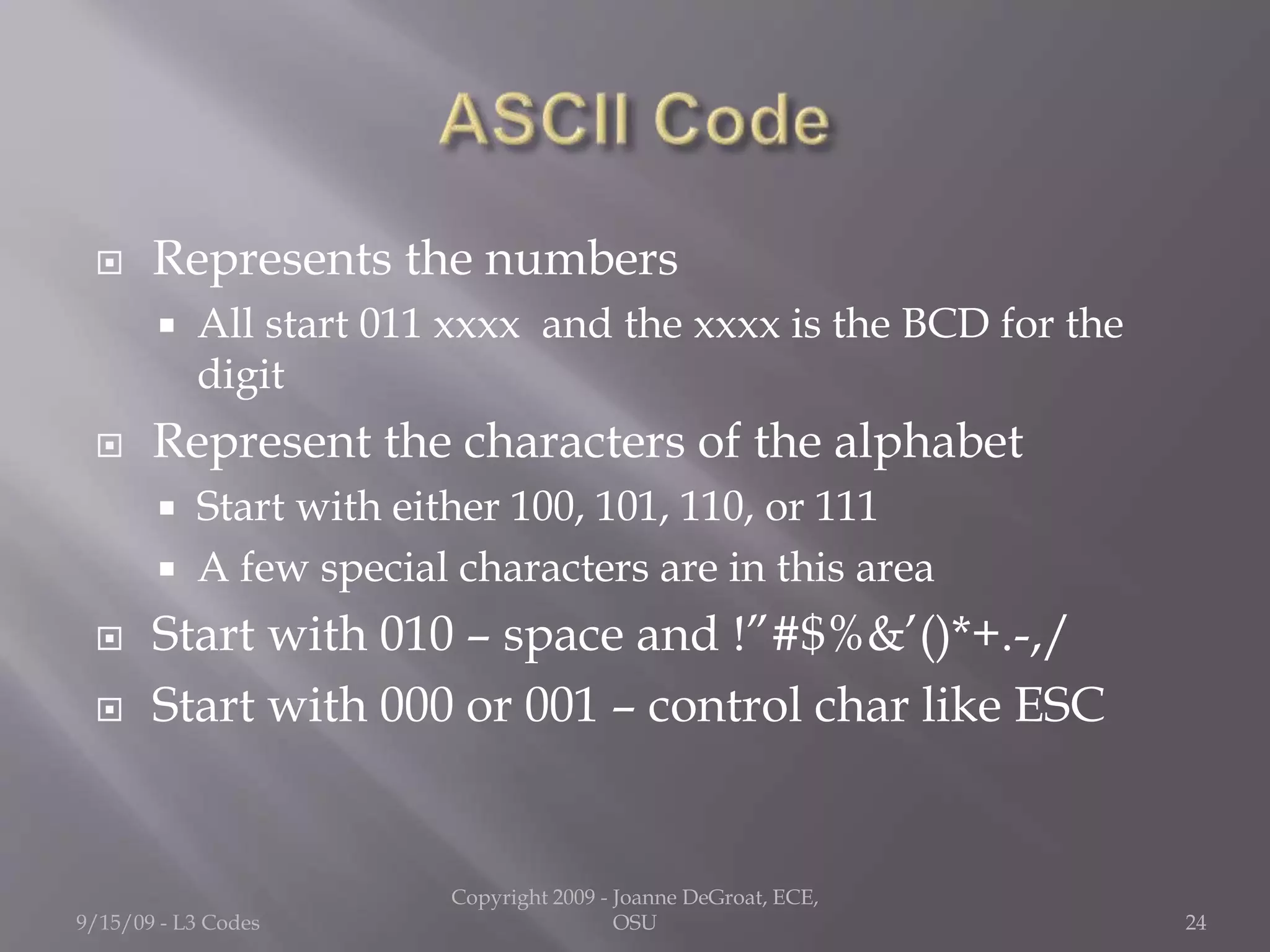
 Represents the numbers
 All start 011 xxxx and the xxxx is the BCD for the
digit
 Represent the characters of the alphabet
 Start with either 100, 101, 110, or 111
 A few special characters are in this area
 Start with 010 – space and !”#$%&’()*+.-,/
 Start with 000 or 001 – control char like ESC
9/15/09 - L3 Codes
Copyright 2009 - Joanne DeGroat, ECE,
OSU 24
 Encoding of 123
 011 0001 011 0010 011 0011
 Encoding of Joanne
 100 1010 110 1111 110 0001
 110 1110 110 1110 110 0101
 Note that these are 7 bit codes
9/15/09 - L3 Codes
Copyright 2009 - Joanne DeGroat, ECE,
OSU 25
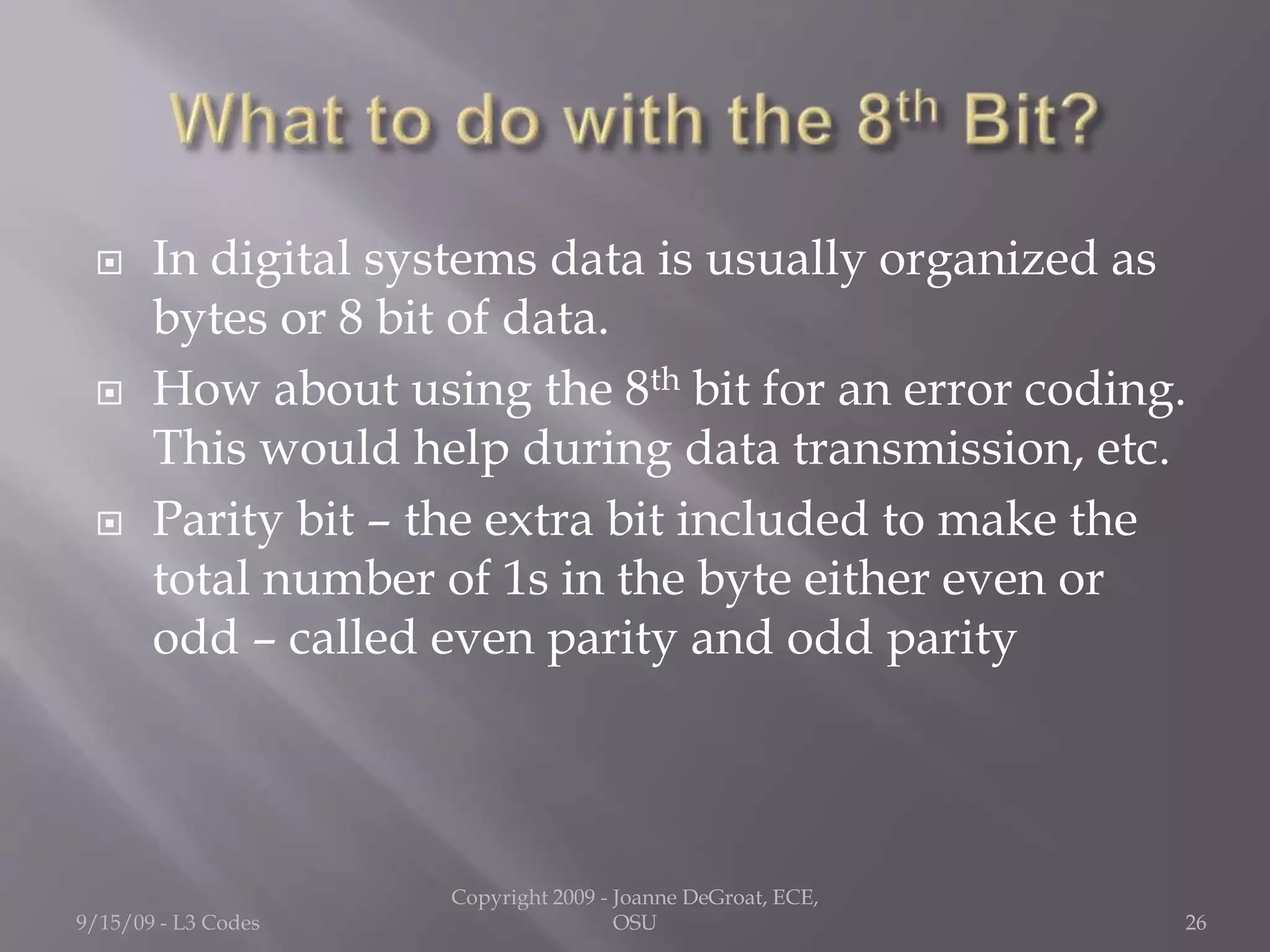
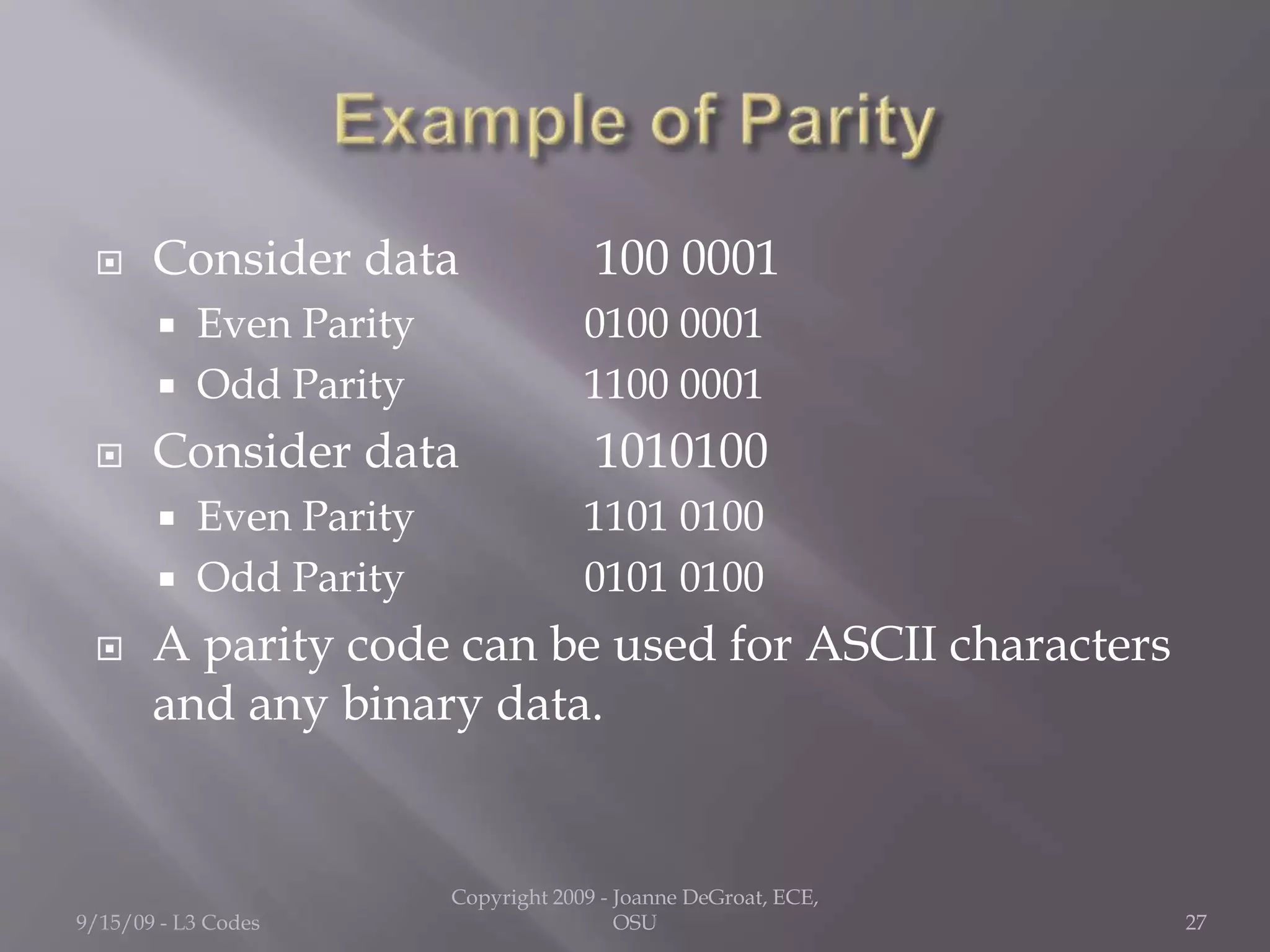
 In digital systems data is usually organized as
bytes or 8 bit of data.
 How about using the 8th bit for an error coding.
This would help during data transmission, etc.
 Parity bit – the extra bit included to make the
total number of 1s in the byte either even or
odd – called even parity and odd parity
9/15/09 - L3 Codes
Copyright 2009 - Joanne DeGroat, ECE,
OSU 26
 Consider data 100 0001
 Even Parity 0100 0001
 Odd Parity 1100 0001
 Consider data 1010100
 Even Parity 1101 0100
 Odd Parity 0101 0100
 A parity code can be used for ASCII characters
and any binary data.
9/15/09 - L3 Codes
Copyright 2009 - Joanne DeGroat, ECE,
OSU 27
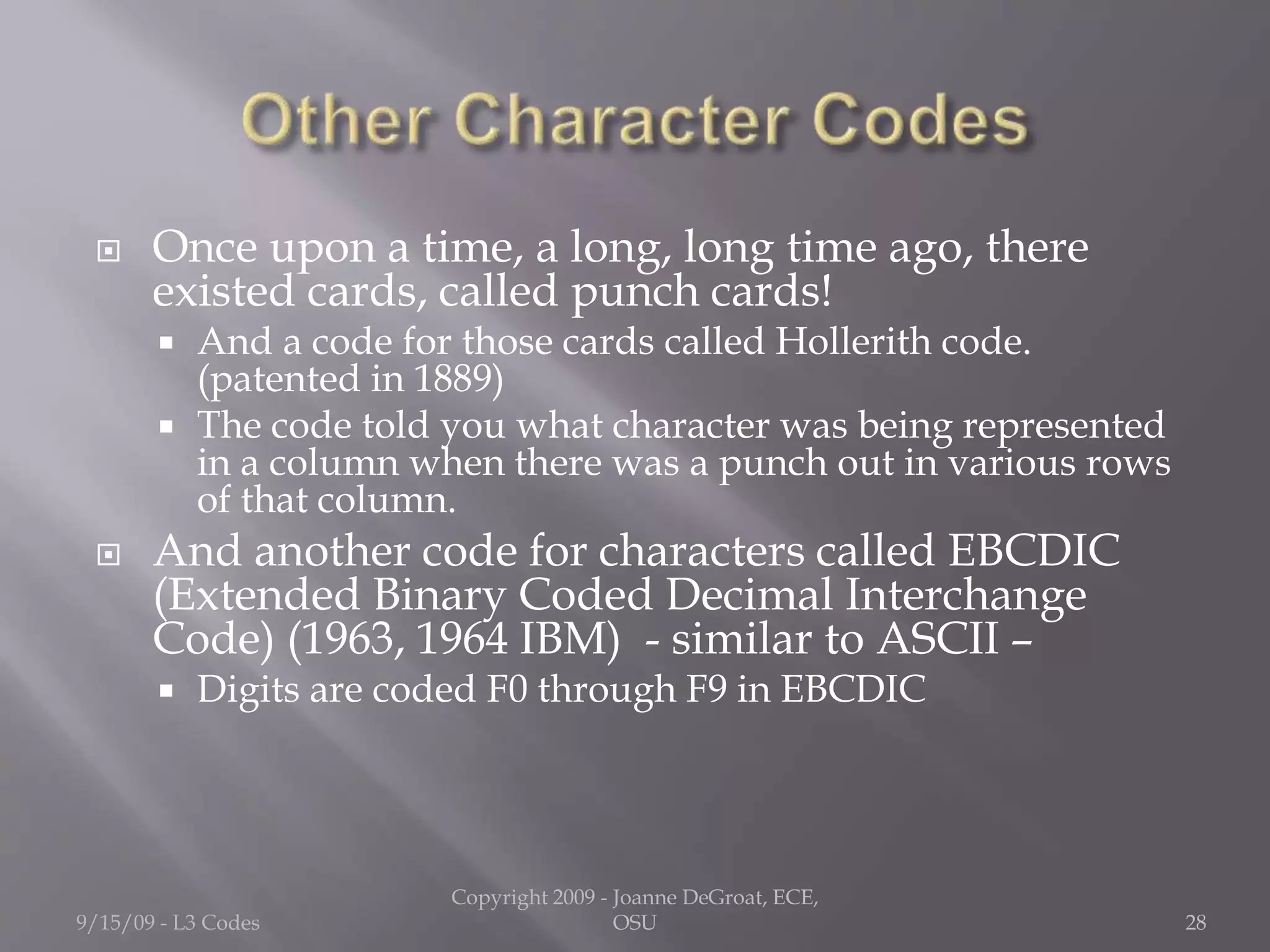
 Once upon a time, a long, long time ago, there
existed cards, called punch cards!
 And a code for those cards called Hollerith code.
(patented in 1889)
 The code told you what character was being represented
in a column when there was a punch out in various rows
of that column.
 And another code for characters called EBCDIC
(Extended Binary Coded Decimal Interchange
Code) (1963, 1964 IBM) - similar to ASCII –
 Digits are coded F0 through F9 in EBCDIC
9/15/09 - L3 Codes
Copyright 2009 - Joanne DeGroat, ECE,
OSU 28
Binary codes

Binary codes

  • 1.
    Prof. Neha Sharma Asst.Prof.(EC Department)
  • 2.
    In the coding,when numbers, letters or words are represented by a specific group of symbols, it is said that the number, letter or word is being encoded. The group of symbols is called as a code. The digital data is represented, stored and transmitted as group of binary bits. This group is also called as binary code
  • 4.
    Weighted binary codesare those binary codes which obey the positional weight principle. Each position of the number represents a specific weight. Several systems of the codes are used to express the decimal digits 0 through 9. In these codes each decimal digit is represented by a group of four bits.
  • 5.
    In this typeof binary codes, the positional weights are not assigned. The examples of non- weighted codes are Excess-3 code and Gray code.
  • 7.
     When youcount up or down in binary, the number of bit that change with each digit change varies.  From 0 to 1 just have a single but  From 1 to 2 have 2 bits, a 1 to 0 transition and a 0 to 1 transition  From 7 to 8 have 3 bits changing back to 0 and 1 bit changing to a 1  For some applications multiple bit changes cause significant problems.
  • 9.
  • 10.
     Gray codeis popularly used in the shaft position encoders.  A shaft position encoder produces a code word which represents the angular position of the shaft.
  • 13.
     In thiscode each decimal digit is represented by a 4-bit binary number. BCD is a way to express each of the decimal digits with a binary code. In the BCD, with four bits we can represent sixteen numbers 0000to1111. But in BCD code only first ten of these are used 0000to1001. The remaining six code combinations i.e. 1010 to 1111 are invalid in BCD.
  • 15.
     Consider thefollowing BCD operation  Decimal: Add 4 + 1  Covert to binary 0 1 0 0  And 0 0 0 1  Getting 0 1 0 1  Which is still a BCD representation of a decimal digit 9/15/09 - L3 Codes Copyright 2009 - Joanne DeGroat, ECE, OSU 15
  • 16.
     A secondexample  3 0 0 1 1  +3 0 0 1 1  Getting 6 or 0 1 1 0  And in range and a BCD digit representation 9/15/09 - L3 Codes Copyright 2009 - Joanne DeGroat, ECE, OSU 16
  • 17.
     Consider 5+ 5  5 0 1 0 1  +5 0 1 0 1  giving 1 0 1 0 which is binary 10 but not a BCD digit!  What to do?  Try adding 6?? 9/15/09 - L3 Codes Copyright 2009 - Joanne DeGroat, ECE, OSU 17
  • 18.
     Had 1010and want to add 6 or 0110  so 1 0 1 0  plus 6 0 1 1 0  Giving1 0 0 0 0  Or a carry out to the next binary digit, or if the binary in BCD, the next BCD digit. 9/15/09 - L3 Codes Copyright 2009 - Joanne DeGroat, ECE, OSU 18
  • 19.
     Add 7+ 6  have 7 0 1 1 1  plus 6 0 1 1 0  Giving 1 1 0 1 and again out of range  Adding 6 0 1 1 0  Giving1 0 0 1 1 so a 1 carries out to the next BCD digit  FINAL BCD answer 0001 0011 or 1310 9/15/09 - L3 Codes Copyright 2009 - Joanne DeGroat, ECE, OSU 19
  • 20.
     Add theBCD for 417 to 195  Would expect to get 612  BCD setup - start with Least Significant Digit  0 1 0 0 0 0 0 1 0 1 1 1  0 0 0 1 1 0 0 1 0 1 0 1  1 1 0 0  Adding 6 0 1 1 0  Gives 1 0 0 1 0 9/15/09 - L3 Codes Copyright 2009 - Joanne DeGroat, ECE, OSU 20
  • 21.
     Had acarry to the 2nd BCD digit position  1  0 1 0 0 0 0 0 1 done  0 0 0 1 1 0 0 1 0 0 1 0  1 0 1 1  Again must add 6 0 1 1 0  Giving 1 0 0 0 1  And another carry 9/15/09 - L3 Codes Copyright 2009 - Joanne DeGroat, ECE, OSU 21
  • 22.
     How doyou handle alphanumeric data?  Easy answer!  Formulate a binary code to represent characters!   For the 26 letter of the alphabet would need 5 bit for representation.  But what about the upper case and lower case, and the digits, and special characters 9/15/09 - L3 Codes Copyright 2009 - Joanne DeGroat, ECE, OSU 22
  • 23.
     ASCII standsfor American Standard Code for Information Interchange  The code uses 7 bits to encode 128 unique characters  Reference the textbook, pg. 27, for a table of the ASCII code  As a note, formally, work to create this code began in 1960. 1st standard in 1963. Last updated in 1986. 9/15/09 - L3 Codes Copyright 2009 - Joanne DeGroat, ECE, OSU 23
  • 24.
     Represents thenumbers  All start 011 xxxx and the xxxx is the BCD for the digit  Represent the characters of the alphabet  Start with either 100, 101, 110, or 111  A few special characters are in this area  Start with 010 – space and !”#$%&’()*+.-,/  Start with 000 or 001 – control char like ESC 9/15/09 - L3 Codes Copyright 2009 - Joanne DeGroat, ECE, OSU 24
  • 25.
     Encoding of123  011 0001 011 0010 011 0011  Encoding of Joanne  100 1010 110 1111 110 0001  110 1110 110 1110 110 0101  Note that these are 7 bit codes 9/15/09 - L3 Codes Copyright 2009 - Joanne DeGroat, ECE, OSU 25
  • 26.
     In digitalsystems data is usually organized as bytes or 8 bit of data.  How about using the 8th bit for an error coding. This would help during data transmission, etc.  Parity bit – the extra bit included to make the total number of 1s in the byte either even or odd – called even parity and odd parity 9/15/09 - L3 Codes Copyright 2009 - Joanne DeGroat, ECE, OSU 26
  • 27.
     Consider data100 0001  Even Parity 0100 0001  Odd Parity 1100 0001  Consider data 1010100  Even Parity 1101 0100  Odd Parity 0101 0100  A parity code can be used for ASCII characters and any binary data. 9/15/09 - L3 Codes Copyright 2009 - Joanne DeGroat, ECE, OSU 27
  • 28.
     Once upona time, a long, long time ago, there existed cards, called punch cards!  And a code for those cards called Hollerith code. (patented in 1889)  The code told you what character was being represented in a column when there was a punch out in various rows of that column.  And another code for characters called EBCDIC (Extended Binary Coded Decimal Interchange Code) (1963, 1964 IBM) - similar to ASCII –  Digits are coded F0 through F9 in EBCDIC 9/15/09 - L3 Codes Copyright 2009 - Joanne DeGroat, ECE, OSU 28