Download as PDF, PPTX
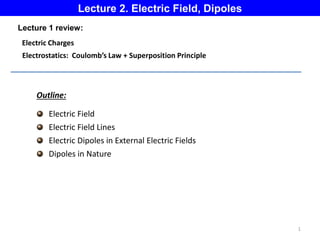


The document discusses electric fields and electric dipoles. It defines the electric field as a vector field generated by electric charges that acts upon other charges. Electric field lines are introduced to visualize electric fields, with higher density of lines indicating stronger fields. Dipoles, such as water molecules, have a built-in electric polarity due to unequal charge distribution. When placed in an external electric field, dipoles experience a torque attempting to align them with the field but do not experience a net force. Microwave ovens work by using an oscillating electric field to cause the rotation of polar water molecules in food, generating heat through molecular collisions.


