Poynting vector:Poynting vector:
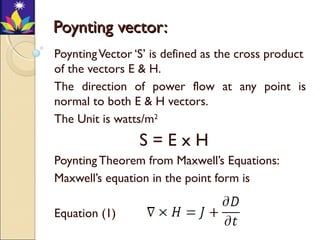
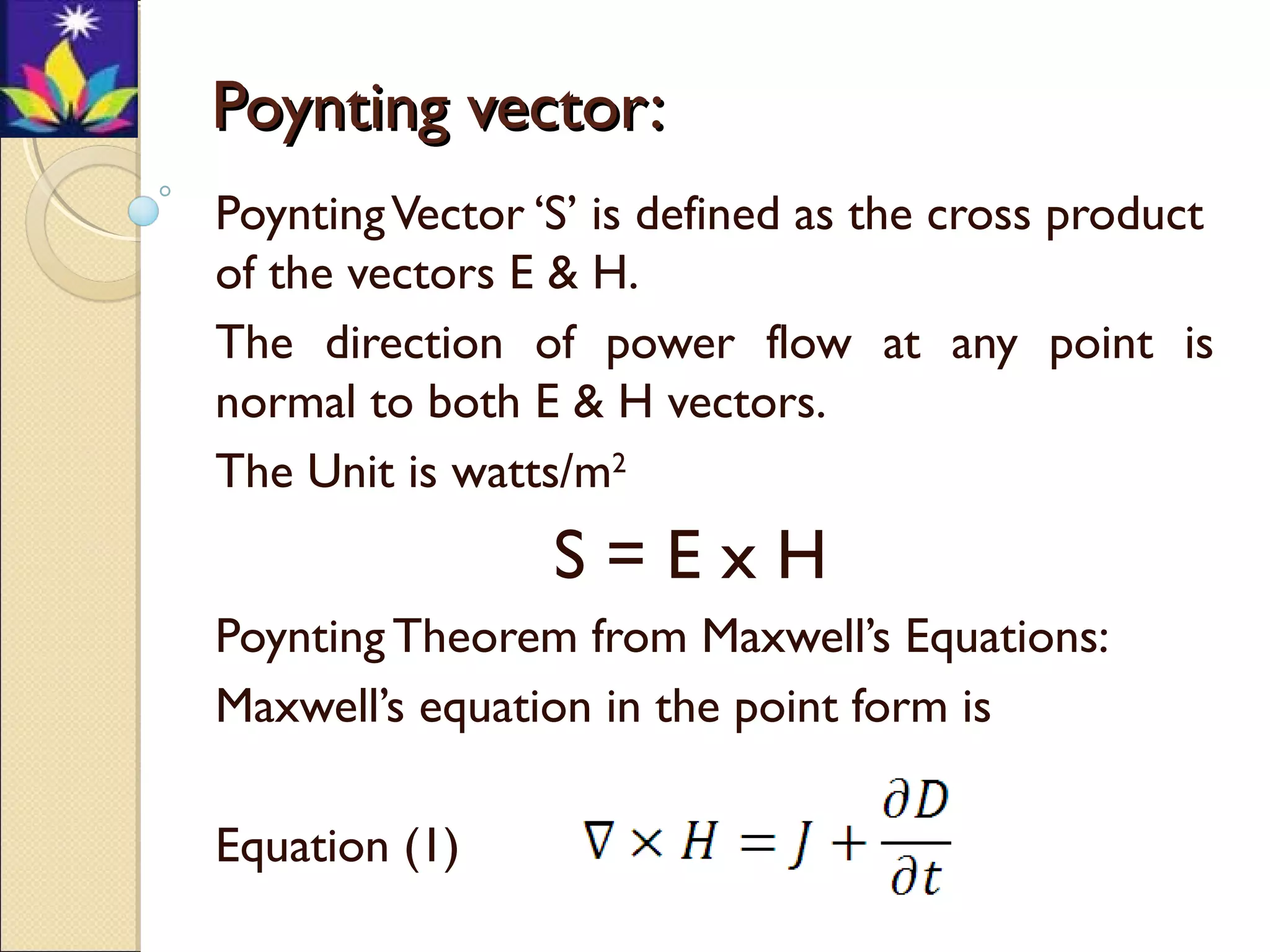
PoyntingVector ‘S’ is defined as the cross product
of the vectors E & H.
The direction of power flow at any point is
normal to both E & H vectors.
The Unit is watts/m2
S = E x H
Poynting Theorem from Maxwell’s Equations:
Maxwell’s equation in the point form is
Equation (1)
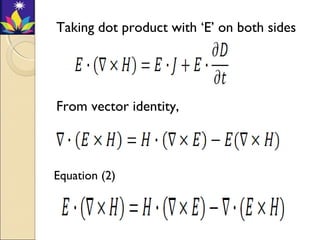
Taking dot product with ‘E’ on both sides
From vector identity,
Equation (2)
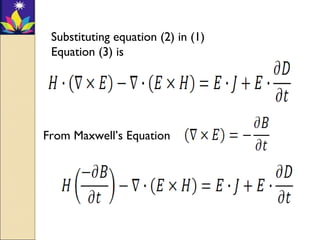
Substituting equation (2) in (1)
Equation (3) is
From Maxwell’s Equation
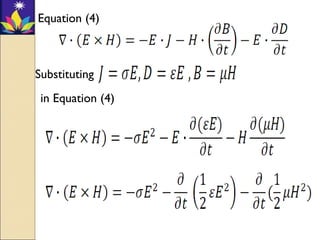
Equation (4)
Substituting
in Equation (4)
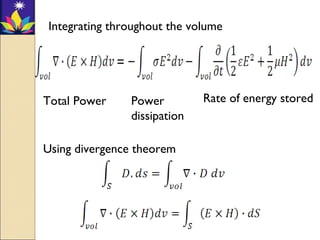
Integrating throughout the volume
Total Power Power
dissipation
Rate of energy stored
Using divergence theorem
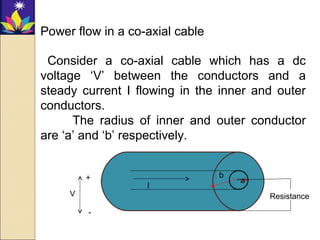
Power flow in a co-axial cable
Consider a co-axial cable which has a dc
voltage ‘V’ between the conductors and a
steady current I flowing in the inner and outer
conductors.
The radius of inner and outer conductor
are ‘a’ and ‘b’ respectively.
b
a
I
ResistanceV
+
-
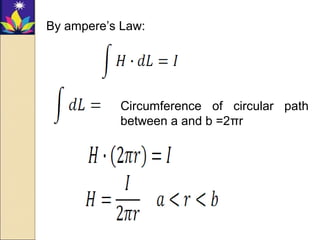
By ampere’s Law:
Circumference of circular path
between a and b =2πr
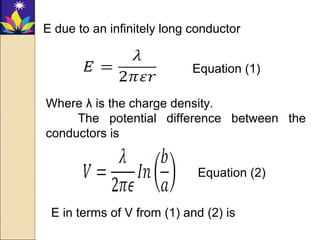
E due to an infinitely long conductor
Where λ is the charge density.
The potential difference between the
conductors is
E in terms of V from (1) and (2) is
Equation (1)
Equation (2)
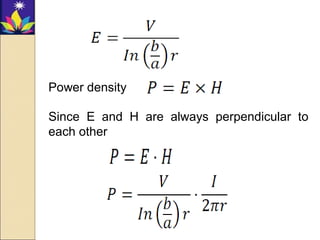
Power density
Since E and H are always perpendicular to
each other
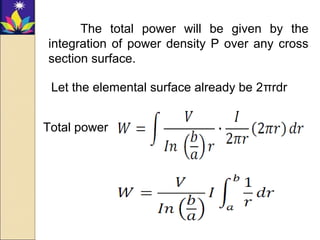
The total power will be given by the
integration of power density P over any cross
section surface.
Let the elemental surface already be 2πrdr
Total power
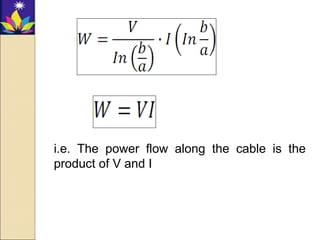
i.e. The power flow along the cable is the
product of V and I

Poynting vector

  • 1.
    Poynting vector:Poynting vector: PoyntingVector‘S’ is defined as the cross product of the vectors E & H. The direction of power flow at any point is normal to both E & H vectors. The Unit is watts/m2 S = E x H Poynting Theorem from Maxwell’s Equations: Maxwell’s equation in the point form is Equation (1)
  • 2.
    Taking dot productwith ‘E’ on both sides From vector identity, Equation (2)
  • 3.
    Substituting equation (2)in (1) Equation (3) is From Maxwell’s Equation
  • 4.
  • 5.
    Integrating throughout thevolume Total Power Power dissipation Rate of energy stored Using divergence theorem
  • 6.
    Power flow ina co-axial cable Consider a co-axial cable which has a dc voltage ‘V’ between the conductors and a steady current I flowing in the inner and outer conductors. The radius of inner and outer conductor are ‘a’ and ‘b’ respectively. b a I ResistanceV + -
  • 7.
    By ampere’s Law: Circumferenceof circular path between a and b =2πr
  • 8.
    E due toan infinitely long conductor Where λ is the charge density. The potential difference between the conductors is E in terms of V from (1) and (2) is Equation (1) Equation (2)
  • 9.
    Power density Since Eand H are always perpendicular to each other
  • 10.
    The total powerwill be given by the integration of power density P over any cross section surface. Let the elemental surface already be 2πrdr Total power
  • 11.
    i.e. The powerflow along the cable is the product of V and I