UNIT5UNIT5
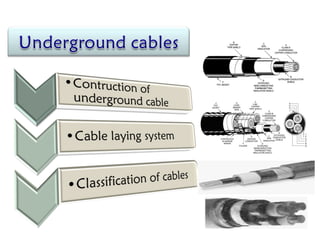
UndergroundUnderground
cablescables
IntroductionIntroduction
• Since the loads having the trends towards growing density. This requires the
better appearance, rugged construction, greater service reliability and
increased safety.
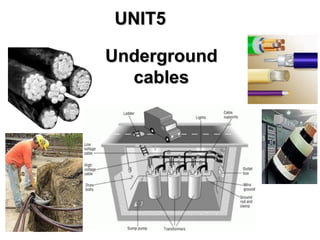
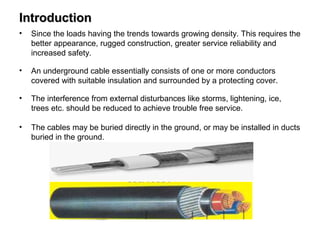
• An underground cable essentially consists of one or more conductors
covered with suitable insulation and surrounded by a protecting cover.
• The interference from external disturbances like storms, lightening, ice,
trees etc. should be reduced to achieve trouble free service.
• The cables may be buried directly in the ground, or may be installed in ducts
buried in the ground.
AdvantagesAdvantages
The underground cables have several advantages such as,
– Better general appearance
– Less liable to damage through storms or lighting
– Low maintenance cost
– Less chances of faults
– Small voltage drops
Dis-advantageDis-advantage
The major drawback is that they have greater installation cost and introduce
insulation problems at high voltages compared with equivalent overhead
system.
Construction of Cables
8Professional Associates Limited.
Construction of CablesConstruction of Cables
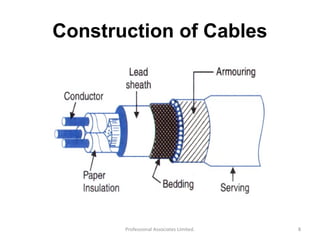
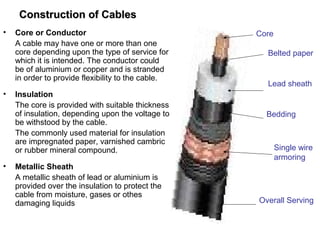
• Core or Conductor
A cable may have one or more than one
core depending upon the type of service for
which it is intended. The conductor could
be of aluminium or copper and is stranded
in order to provide flexibility to the cable.
• Insulation
The core is provided with suitable thickness
of insulation, depending upon the voltage to
be withstood by the cable.
The commonly used material for insulation
are impregnated paper, varnished cambric
or rubber mineral compound.
• Metallic Sheath
A metallic sheath of lead or aluminium is
provided over the insulation to protect the
cable from moisture, gases or othes
damaging liquids
Core
Belted paper
Lead sheath
Bedding
Single wire
armoring
Overall Serving
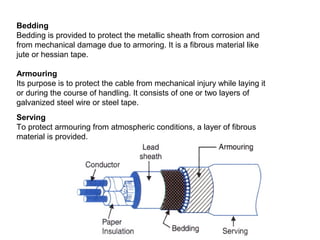
Bedding
Bedding is provided to protect the metallic sheath from corrosion and
from mechanical damage due to armoring. It is a fibrous material like
jute or hessian tape.
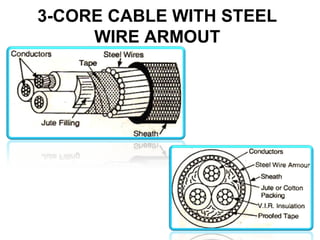
Armouring
Its purpose is to protect the cable from mechanical injury while laying it
or during the course of handling. It consists of one or two layers of
galvanized steel wire or steel tape.
Serving
To protect armouring from atmospheric conditions, a layer of fibrous
material is provided.
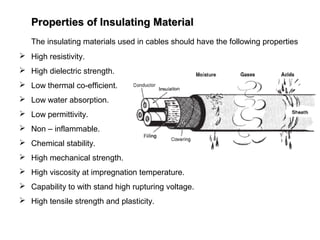
Properties of Insulating MaterialProperties of Insulating Material
The insulating materials used in cables should have the following properties
 High resistivity.
 High dielectric strength.
 Low thermal co-efficient.
 Low water absorption.
 Low permittivity.
 Non – inflammable.
 Chemical stability.
 High mechanical strength.
 High viscosity at impregnation temperature.
 Capability to with stand high rupturing voltage.
 High tensile strength and plasticity.
TYPES OF MATERIALS USED IN INSULATION.
Insulating Materials for Cables
• Rubber
It can be obtained from milky sap of tropical trees or from oil products.
It has the dielectric strength of 30 KV/mm.
Insulation resistivity of 10 exp 17 ohm.cm
Relative permittivity varying between 2 and 3.
They readily absorbs moisture, soft and liable to damage due to rough handling and ages
when exposed to light.
Maximum safe temperature is very low about 38 C
• Vulcanized India Rubber
It can be obtained from mixing pure rubber with mineral compounds i-e zinc oxide, red lead
and sulphur and heated upto 150 C.
It has greater mechanical strength, durability and wear resistant property.
The sulphur reacts quickly with copper so tinned copper conductors are used.
It is suitable for low and moderate voltage cables.
• Impregnated Paper
 This material has superseded the rubber, consists of chemically pulped paper
impregnated with napthenic and paraffinic materials.
 It has low cost, low capacitance, high dielectric strength and high insulation
resistance.
 The only disadvantage is the paper is hygroscopic, for this reason paper insulation is
always provided protective covering.
• Varnished Cambric
 This is simply the cotton cloth impregnated and coated with varnish.
 As the varnish cambric is also hygroscopic so need some protection.
 Its dielectric strength is about 4KV / mm and permittivity is 2.5 to 3.8.
• Polyvinyl chloride (PVC)
 This material has good dielectric strength, high insulation resistance and high
melting temperatures.
 These have not so good mechanical properties as those of rubber.
 It is inert to oxygen and almost inert to many alkalis and acids.
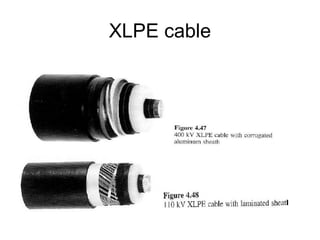
• XLPE Cables (Cross Linked Poly-ethene)
 This material has temperature range beyond 250 – 300 C
 This material gives good insulating properties
 It is light in weight, small overall dimensions, low dielectric constant and high
mechanical strength, low water absorption.
 These cables permit conductor temperature of 90 C and 250 C under normal and
short circuit conditions.
 These cables are suitable up to voltages of 33 KV.
CLSSIFICATION OF CABLESCLSSIFICATION OF CABLES
• Low tension (L.T) ----- up to 1000VLow tension (L.T) ----- up to 1000V
• High tension (H.T) ----- up to 11, 000VHigh tension (H.T) ----- up to 11, 000V
• Super tension (S.T) ---- from 22KV to 33KVSuper tension (S.T) ---- from 22KV to 33KV
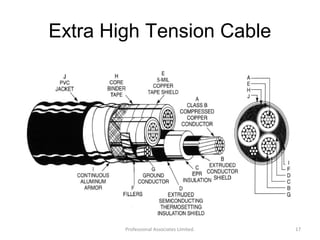
• Extra high tension (E.H.T) cables ------- from 33KV to 66KVExtra high tension (E.H.T) cables ------- from 33KV to 66KV
• Extra super voltage cables ------beyond 132KVExtra super voltage cables ------beyond 132KV
A cable may have one or more than one core depending upon the type of
service for application. It may be,
Single Core
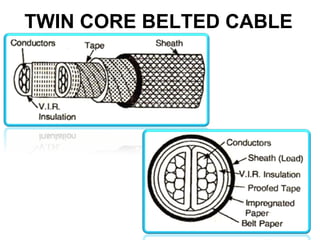
Two Core
Three Core
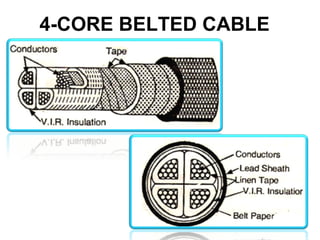
Four Core
Extra High Tension Cable
17Professional Associates Limited.
XLPE cable
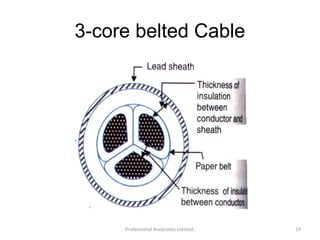
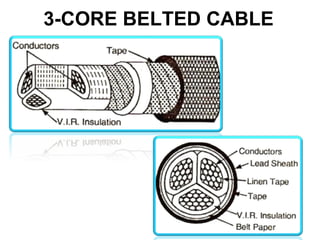
3-core belted Cable
19Professional Associates Limited.
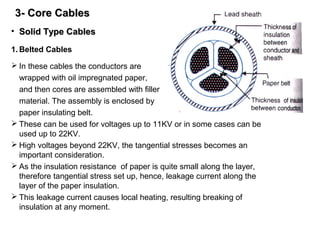
3- Core Cables3- Core Cables
• Solid Type CablesSolid Type Cables
1. Belted Cables
 In these cables the conductors are
wrapped with oil impregnated paper,
and then cores are assembled with filler
material. The assembly is enclosed by
paper insulating belt.
 These can be used for voltages up to 11KV or in some cases can be
used up to 22KV.
 High voltages beyond 22KV, the tangential stresses becomes an
important consideration.
 As the insulation resistance of paper is quite small along the layer,
therefore tangential stress set up, hence, leakage current along the
layer of the paper insulation.
 This leakage current causes local heating, resulting breaking of
insulation at any moment.
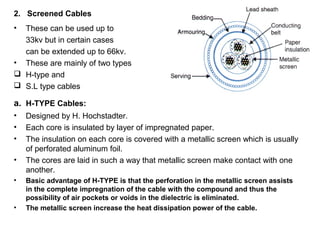
2. Screened Cables
• These can be used up to
33kv but in certain cases
can be extended up to 66kv.
• These are mainly of two types
 H-type and
 S.L type cables
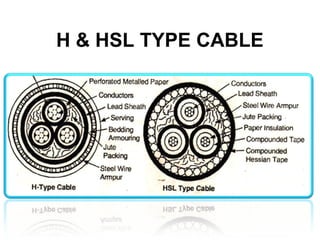
a. H-TYPE Cables:
• Designed by H. Hochstadter.
• Each core is insulated by layer of impregnated paper.
• The insulation on each core is covered with a metallic screen which is usually
of perforated aluminum foil.
• The cores are laid in such a way that metallic screen make contact with one
another.
• Basic advantage of H-TYPE is that the perforation in the metallic screen assists
in the complete impregnation of the cable with the compound and thus the
possibility of air pockets or voids in the dielectric is eliminated.
• The metallic screen increase the heat dissipation power of the cable.
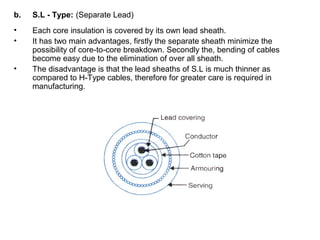
b. S.L - Type: (Separate Lead)
• Each core insulation is covered by its own lead sheath.
• It has two main advantages, firstly the separate sheath minimize the
possibility of core-to-core breakdown. Secondly the, bending of cables
become easy due to the elimination of over all sheath.
• The disadvantage is that the lead sheaths of S.L is much thinner as
compared to H-Type cables, therefore for greater care is required in
manufacturing.
• Pressurized Type CablesPressurized Type Cables
• In these cables pressure is maintained above atmosphere either by oil or by gas.
• Gas pressure cables are used up to 275KV.
• Oil filled cables are used up to 500KV.
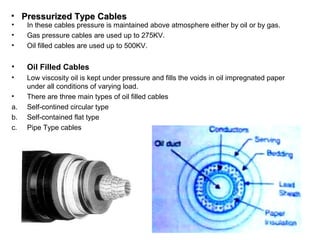
• Oil Filled Cables
• Low viscosity oil is kept under pressure and fills the voids in oil impregnated paper
under all conditions of varying load.
• There are three main types of oil filled cables
a. Self-contined circular type
b. Self-contained flat type
c. Pipe Type cables
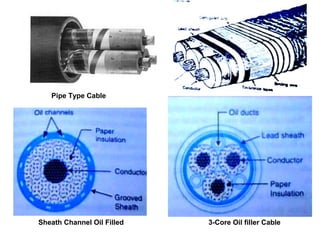
Pipe Type Cable
Sheath Channel Oil Filled 3-Core Oil filler Cable
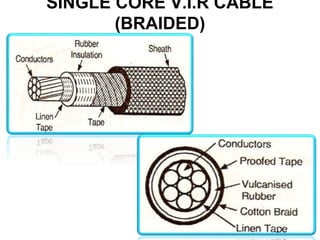
SINGLE CORE V.I.R CABLE
(BRAIDED)
TWIN CORE BELTED CABLE
3-CORE BELTED CABLE
4-CORE BELTED CABLE
3-CORE CABLE WITH STEEL
WIRE ARMOUT
H & HSL TYPE CABLE
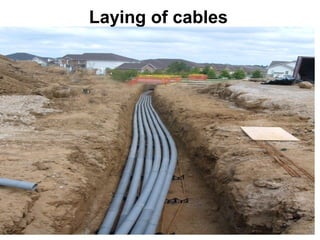
Laying of cables
31

Underground cables

  • 1.
  • 6.
    IntroductionIntroduction • Since theloads having the trends towards growing density. This requires the better appearance, rugged construction, greater service reliability and increased safety. • An underground cable essentially consists of one or more conductors covered with suitable insulation and surrounded by a protecting cover. • The interference from external disturbances like storms, lightening, ice, trees etc. should be reduced to achieve trouble free service. • The cables may be buried directly in the ground, or may be installed in ducts buried in the ground.
  • 7.
    AdvantagesAdvantages The underground cableshave several advantages such as, – Better general appearance – Less liable to damage through storms or lighting – Low maintenance cost – Less chances of faults – Small voltage drops Dis-advantageDis-advantage The major drawback is that they have greater installation cost and introduce insulation problems at high voltages compared with equivalent overhead system.
  • 8.
  • 9.
    Construction of CablesConstructionof Cables • Core or Conductor A cable may have one or more than one core depending upon the type of service for which it is intended. The conductor could be of aluminium or copper and is stranded in order to provide flexibility to the cable. • Insulation The core is provided with suitable thickness of insulation, depending upon the voltage to be withstood by the cable. The commonly used material for insulation are impregnated paper, varnished cambric or rubber mineral compound. • Metallic Sheath A metallic sheath of lead or aluminium is provided over the insulation to protect the cable from moisture, gases or othes damaging liquids Core Belted paper Lead sheath Bedding Single wire armoring Overall Serving
  • 10.
    Bedding Bedding is providedto protect the metallic sheath from corrosion and from mechanical damage due to armoring. It is a fibrous material like jute or hessian tape. Armouring Its purpose is to protect the cable from mechanical injury while laying it or during the course of handling. It consists of one or two layers of galvanized steel wire or steel tape. Serving To protect armouring from atmospheric conditions, a layer of fibrous material is provided.
  • 11.
    Properties of InsulatingMaterialProperties of Insulating Material The insulating materials used in cables should have the following properties  High resistivity.  High dielectric strength.  Low thermal co-efficient.  Low water absorption.  Low permittivity.  Non – inflammable.  Chemical stability.  High mechanical strength.  High viscosity at impregnation temperature.  Capability to with stand high rupturing voltage.  High tensile strength and plasticity.
  • 12.
    TYPES OF MATERIALSUSED IN INSULATION.
  • 13.
    Insulating Materials forCables • Rubber It can be obtained from milky sap of tropical trees or from oil products. It has the dielectric strength of 30 KV/mm. Insulation resistivity of 10 exp 17 ohm.cm Relative permittivity varying between 2 and 3. They readily absorbs moisture, soft and liable to damage due to rough handling and ages when exposed to light. Maximum safe temperature is very low about 38 C • Vulcanized India Rubber It can be obtained from mixing pure rubber with mineral compounds i-e zinc oxide, red lead and sulphur and heated upto 150 C. It has greater mechanical strength, durability and wear resistant property. The sulphur reacts quickly with copper so tinned copper conductors are used. It is suitable for low and moderate voltage cables.
  • 14.
    • Impregnated Paper This material has superseded the rubber, consists of chemically pulped paper impregnated with napthenic and paraffinic materials.  It has low cost, low capacitance, high dielectric strength and high insulation resistance.  The only disadvantage is the paper is hygroscopic, for this reason paper insulation is always provided protective covering. • Varnished Cambric  This is simply the cotton cloth impregnated and coated with varnish.  As the varnish cambric is also hygroscopic so need some protection.  Its dielectric strength is about 4KV / mm and permittivity is 2.5 to 3.8. • Polyvinyl chloride (PVC)  This material has good dielectric strength, high insulation resistance and high melting temperatures.  These have not so good mechanical properties as those of rubber.  It is inert to oxygen and almost inert to many alkalis and acids.
  • 15.
    • XLPE Cables(Cross Linked Poly-ethene)  This material has temperature range beyond 250 – 300 C  This material gives good insulating properties  It is light in weight, small overall dimensions, low dielectric constant and high mechanical strength, low water absorption.  These cables permit conductor temperature of 90 C and 250 C under normal and short circuit conditions.  These cables are suitable up to voltages of 33 KV.
  • 16.
    CLSSIFICATION OF CABLESCLSSIFICATIONOF CABLES • Low tension (L.T) ----- up to 1000VLow tension (L.T) ----- up to 1000V • High tension (H.T) ----- up to 11, 000VHigh tension (H.T) ----- up to 11, 000V • Super tension (S.T) ---- from 22KV to 33KVSuper tension (S.T) ---- from 22KV to 33KV • Extra high tension (E.H.T) cables ------- from 33KV to 66KVExtra high tension (E.H.T) cables ------- from 33KV to 66KV • Extra super voltage cables ------beyond 132KVExtra super voltage cables ------beyond 132KV A cable may have one or more than one core depending upon the type of service for application. It may be, Single Core Two Core Three Core Four Core
  • 17.
    Extra High TensionCable 17Professional Associates Limited.
  • 18.
  • 19.
  • 20.
    3- Core Cables3-Core Cables • Solid Type CablesSolid Type Cables 1. Belted Cables  In these cables the conductors are wrapped with oil impregnated paper, and then cores are assembled with filler material. The assembly is enclosed by paper insulating belt.  These can be used for voltages up to 11KV or in some cases can be used up to 22KV.  High voltages beyond 22KV, the tangential stresses becomes an important consideration.  As the insulation resistance of paper is quite small along the layer, therefore tangential stress set up, hence, leakage current along the layer of the paper insulation.  This leakage current causes local heating, resulting breaking of insulation at any moment.
  • 21.
    2. Screened Cables •These can be used up to 33kv but in certain cases can be extended up to 66kv. • These are mainly of two types  H-type and  S.L type cables a. H-TYPE Cables: • Designed by H. Hochstadter. • Each core is insulated by layer of impregnated paper. • The insulation on each core is covered with a metallic screen which is usually of perforated aluminum foil. • The cores are laid in such a way that metallic screen make contact with one another. • Basic advantage of H-TYPE is that the perforation in the metallic screen assists in the complete impregnation of the cable with the compound and thus the possibility of air pockets or voids in the dielectric is eliminated. • The metallic screen increase the heat dissipation power of the cable.
  • 22.
    b. S.L -Type: (Separate Lead) • Each core insulation is covered by its own lead sheath. • It has two main advantages, firstly the separate sheath minimize the possibility of core-to-core breakdown. Secondly the, bending of cables become easy due to the elimination of over all sheath. • The disadvantage is that the lead sheaths of S.L is much thinner as compared to H-Type cables, therefore for greater care is required in manufacturing.
  • 23.
    • Pressurized TypeCablesPressurized Type Cables • In these cables pressure is maintained above atmosphere either by oil or by gas. • Gas pressure cables are used up to 275KV. • Oil filled cables are used up to 500KV. • Oil Filled Cables • Low viscosity oil is kept under pressure and fills the voids in oil impregnated paper under all conditions of varying load. • There are three main types of oil filled cables a. Self-contined circular type b. Self-contained flat type c. Pipe Type cables
  • 24.
    Pipe Type Cable SheathChannel Oil Filled 3-Core Oil filler Cable
  • 25.
    SINGLE CORE V.I.RCABLE (BRAIDED)
  • 26.
  • 27.
  • 28.
  • 29.
    3-CORE CABLE WITHSTEEL WIRE ARMOUT
  • 30.
    H & HSLTYPE CABLE
  • 31.