Maxwell’s Equations
( )Gauss's law electric
0 Gauss's law in magnetism
Faraday's law
Ampere-Maxwell lawI
oS
S
B
E
o o o
q
d
ε
d
d
d
dt
d
dμ ε μ
dt
× =
× =
Φ
× = −
Φ
× = +
∫
∫
∫
∫
E A
B A
E s
B s
Ñ
Ñ
Ñ
Ñ
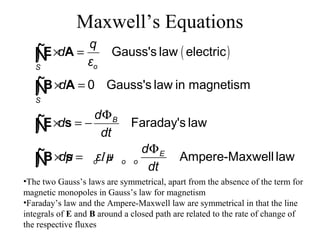
•The two Gauss’s laws are symmetrical, apart from the absence of the term for
magnetic monopoles in Gauss’s law for magnetism
•Faraday’s law and the Ampere-Maxwell law are symmetrical in that the line
integrals of E and B around a closed path are related to the rate of change of
the respective fluxes
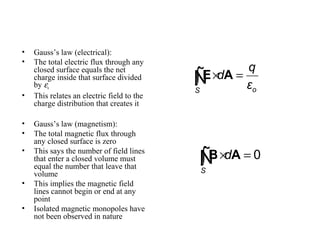
• Gauss’s law (electrical):
• The total electric flux through any
closed surface equals the net
charge inside that surface divided
by εo
• This relates an electric field to the
charge distribution that creates it
• Gauss’s law (magnetism):
• The total magnetic flux through
any closed surface is zero
• This says the number of field lines
that enter a closed volume must
equal the number that leave that
volume
• This implies the magnetic field
lines cannot begin or end at any
point
• Isolated magnetic monopoles have
not been observed in nature
oS
q
d
ε
× =∫E AÑ
0
S
d× =∫B AÑ
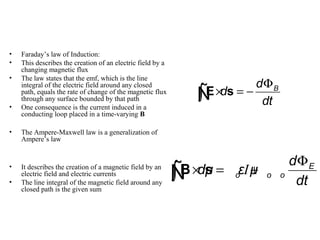
• Faraday’s law of Induction:
• This describes the creation of an electric field by a
changing magnetic flux
• The law states that the emf, which is the line
integral of the electric field around any closed
path, equals the rate of change of the magnetic flux
through any surface bounded by that path
• One consequence is the current induced in a
conducting loop placed in a time-varying B
• The Ampere-Maxwell law is a generalization of
Ampere’s law
• It describes the creation of a magnetic field by an
electric field and electric currents
• The line integral of the magnetic field around any
closed path is the given sum
Bd
d
dt
Φ
× = −∫E sÑ
I E
o o o
d
dμ ε μ
dt
Φ
× = +∫B sÑ
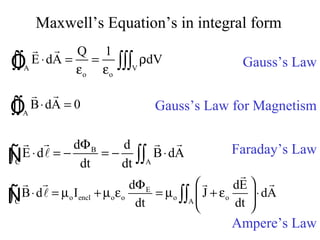
Maxwell’s Equation’s in integral form
A V
o o
Q 1
E dA dV⋅ = = ρ
ε ε∫∫ ∫∫∫
rr
Ò
A
B dA 0⋅ =∫∫
rr
Ò
Gauss’s Law
Gauss’s Law for Magnetism
B
C A
d d
E d B dA
dt dt
Φ
⋅ = − = − ⋅∫ ∫∫
r rr r
lÑ
E
o encl o o o o
C A
d dE
B d I J dA
dt dt
 Φ
⋅ = µ + µ ε = µ + ε ⋅ 
 
∫ ∫∫
r
r rr r
lÑ
Faraday’s Law
Ampere’s Law
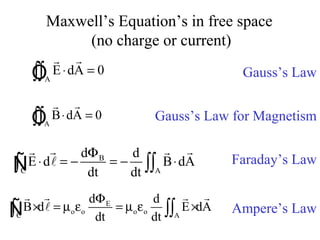
Maxwell’s Equation’s in free space
(no charge or current)
A
E dA 0⋅ =∫∫
rr
Ò
A
B dA 0⋅ =∫∫
rr
Ò
Gauss’s Law
Gauss’s Law for Magnetism
B
C A
d d
E d B dA
dt dt
Φ
⋅ = − = − ⋅∫ ∫∫
r rr r
lÑ
E
o o o oC A
d d
B d E dA
dt dt
Φ
× = µ ε = µ ε ×∫ ∫∫
r rr r
lÑ
Faraday’s Law
Ampere’s Law
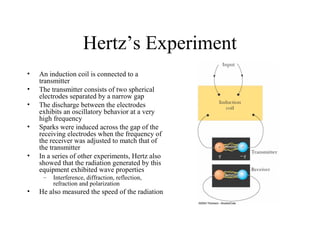
Hertz’s Experiment
• An induction coil is connected to a
transmitter
• The transmitter consists of two spherical
electrodes separated by a narrow gap
• The discharge between the electrodes
exhibits an oscillatory behavior at a very
high frequency
• Sparks were induced across the gap of the
receiving electrodes when the frequency of
the receiver was adjusted to match that of
the transmitter
• In a series of other experiments, Hertz also
showed that the radiation generated by this
equipment exhibited wave properties
– Interference, diffraction, reflection,
refraction and polarization
• He also measured the speed of the radiation
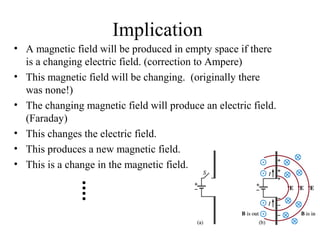
Implication
• A magnetic field will be produced in empty space if there
is a changing electric field. (correction to Ampere)
• This magnetic field will be changing. (originally there
was none!)
• The changing magnetic field will produce an electric field.
(Faraday)
• This changes the electric field.
• This produces a new magnetic field.
• This is a change in the magnetic field.
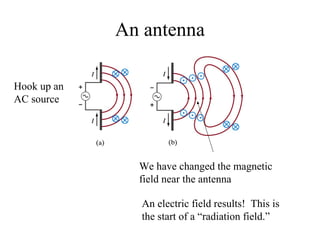
An antenna
We have changed the magnetic
field near the antenna
Hook up an
AC source
An electric field results! This is
the start of a “radiation field.”
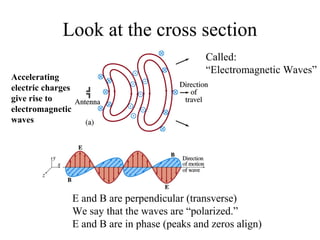
Look at the cross section
E and B are perpendicular (transverse)
We say that the waves are “polarized.”
E and B are in phase (peaks and zeros align)
Called:
“Electromagnetic Waves”
Accelerating
electric charges
give rise to
electromagnetic
waves
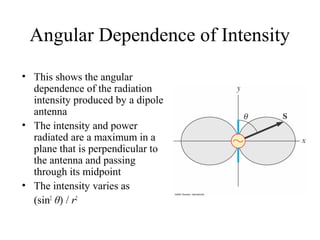
Angular Dependence of Intensity
• This shows the angular
dependence of the radiation
intensity produced by a dipole
antenna
• The intensity and power
radiated are a maximum in a
plane that is perpendicular to
the antenna and passing
through its midpoint
• The intensity varies as
(sin2
θ) / r2
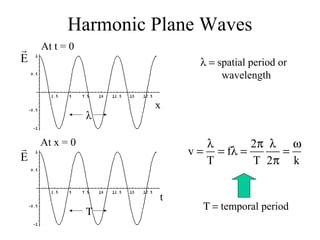
Harmonic Plane Waves
x
At t = 0
At x = 0
λ
λ = spatial period or
wavelength
Τ
Τ = temporal period
2
v f
T T 2 k
λ π λ ω
= = λ = =
π
t
E
r
E
r
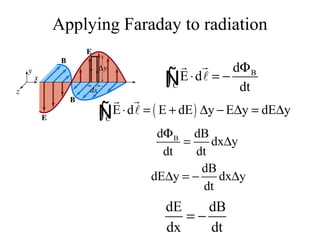
Applying Faraday to radiation
B
C
d
E d
dt
Φ
⋅ = −∫
rr
lÑ
( )C
E d E dE y E y dE y⋅ = + ∆ − ∆ = ∆∫
rr
lÑ
Bd dB
dx y
dt dt
Φ
= ∆
dB
dE y dx y
dt
∆ = − ∆
dE dB
dx dt
= −
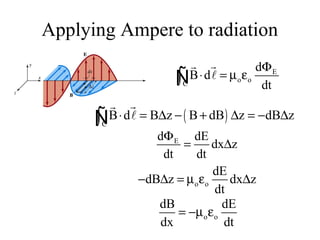
Applying Ampere to radiation
E
o o
C
d
B d
dt
Φ
⋅ = µ ε∫
rr
lÑ
( )C
B d B z B dB z dB z⋅ = ∆ − + ∆ = − ∆∫
rr
lÑ
Ed dE
dx z
dt dt
Φ
= ∆
o o
dE
dB z dx z
dt
− ∆ = µ ε ∆
o o
dB dE
dx dt
= −µ ε
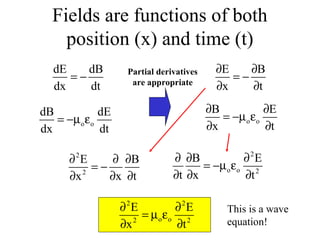
Fields are functions of both
position (x) and time (t)
o o
dB dE
dx dt
= −µ ε
dE dB
dx dt
= −
E B
x t
∂ ∂
= −
∂ ∂
o o
B E
x t
∂ ∂
= −µ ε
∂ ∂
2
2
E B
x x t
∂ ∂ ∂
= −
∂ ∂ ∂
2
o o 2
B E
t x t
∂ ∂ ∂
= −µ ε
∂ ∂ ∂
Partial derivatives
are appropriate
2 2
o o2 2
E E
x t
∂ ∂
= µ ε
∂ ∂
This is a wave
equation!
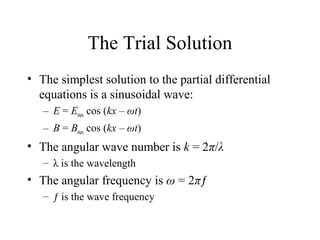
The Trial Solution
• The simplest solution to the partial differential
equations is a sinusoidal wave:
– E = Emax cos (kx – ωt)
– B = Bmax cos (kx – ωt)
• The angular wave number is k = 2π/λ
– λ is the wavelength
• The angular frequency is ω = 2πƒ
– ƒ is the wave frequency
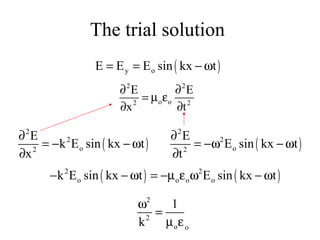
The trial solution
( )y oE E E sin kx t= = − ω
2 2
o o2 2
E E
x t
∂ ∂
= µ ε
∂ ∂
( )
2
2
o2
E
E sin kx t
t
∂
= −ω − ω
∂
( )
2
2
o2
E
k E sin kx t
x
∂
= − − ω
∂
( ) ( )2 2
o o o ok E sin kx t E sin kx t− −ω = −µ ε ω − ω
2
2
o o
1
k
ω
=
µ ε
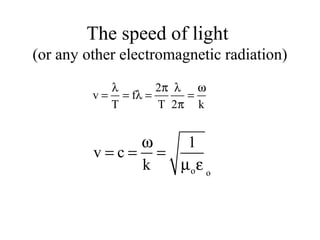
The speed of light
(or any other electromagnetic radiation)
o o
1
v c
k
ω
= = =
µ ε
2
v f
T T 2 k
λ π λ ω
= = λ = =
π
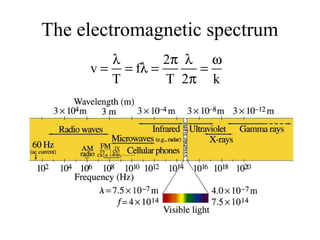
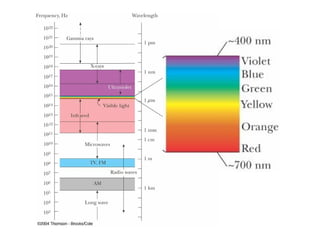
The electromagnetic spectrum
2
v f
T T 2 k
λ π λ ω
= = λ = =
π
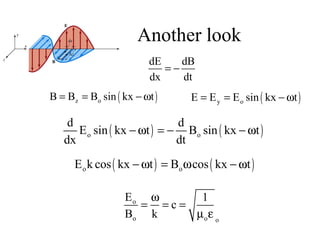
Another look
dE dB
dx dt
= −
( )y oE E E sin kx t= = − ω
( ) ( )o o
d d
E sin kx t B sin kx t
dx dt
− ω = − − ω
( ) ( )o oE k cos kx t B cos kx t−ω = ω −ω
o
o o o
E 1
c
B k
ω
= = =
µ ε
( )z oB B B sin kx t= = − ω
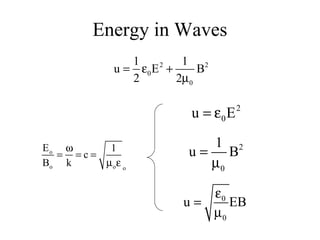
Energy in Waves
2 2
0
0
1 1
u E B
2 2
= ε +
µ
o
o o o
E 1
c
B k
ω
= = =
µ ε
2
0u E= ε
2
0
1
u B=
µ
0
0
u EB
ε
=
µ
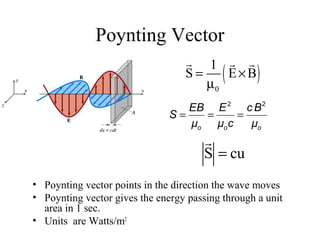
Poynting Vector
• Poynting vector points in the direction the wave moves
• Poynting vector gives the energy passing through a unit
area in 1 sec.
• Units are Watts/m2
( )
0
1
S E B= ×
µ
r r r
S cu=
r
= = =
2 2
o o o
E c BEB
S
μ μ c μ
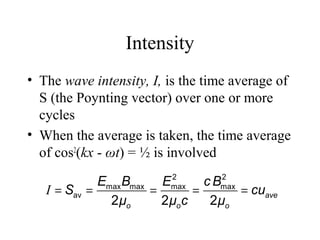
Intensity
• The wave intensity, I, is the time average of
S (the Poynting vector) over one or more
cycles
• When the average is taken, the time average
of cos2
(kx - ωt) = ½ is involved
= = = = =
2 2
max max max max
av
2 2 2
I ave
o o o
E B E c B
S cu
μ μ c μ
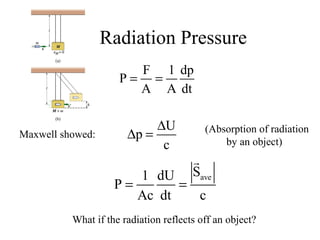
Radiation Pressure
U
p
c
∆
∆ =
F 1 dp
P
A A dt
= =
aveS1 dU
P
Ac dt c
= =
r
Maxwell showed:
(Absorption of radiation
by an object)
What if the radiation reflects off an object?
Pressure and Momentum
• For a perfectly reflecting surface,
p = 2U/c and P = 2S/c
• For a surface with a reflectivity somewhere
between a perfect reflector and a perfect absorber,
the momentum delivered to the surface will be
somewhere in between U/c and 2U/c
• For direct sunlight, the radiation pressure is about
5 x 10⁻⁶
N/m2

maxwells equation

  • 1.
    Maxwell’s Equations ( )Gauss'slaw electric 0 Gauss's law in magnetism Faraday's law Ampere-Maxwell lawI oS S B E o o o q d ε d d d dt d dμ ε μ dt × = × = Φ × = − Φ × = + ∫ ∫ ∫ ∫ E A B A E s B s Ñ Ñ Ñ Ñ •The two Gauss’s laws are symmetrical, apart from the absence of the term for magnetic monopoles in Gauss’s law for magnetism •Faraday’s law and the Ampere-Maxwell law are symmetrical in that the line integrals of E and B around a closed path are related to the rate of change of the respective fluxes
  • 2.
    • Gauss’s law(electrical): • The total electric flux through any closed surface equals the net charge inside that surface divided by εo • This relates an electric field to the charge distribution that creates it • Gauss’s law (magnetism): • The total magnetic flux through any closed surface is zero • This says the number of field lines that enter a closed volume must equal the number that leave that volume • This implies the magnetic field lines cannot begin or end at any point • Isolated magnetic monopoles have not been observed in nature oS q d ε × =∫E AÑ 0 S d× =∫B AÑ
  • 3.
    • Faraday’s lawof Induction: • This describes the creation of an electric field by a changing magnetic flux • The law states that the emf, which is the line integral of the electric field around any closed path, equals the rate of change of the magnetic flux through any surface bounded by that path • One consequence is the current induced in a conducting loop placed in a time-varying B • The Ampere-Maxwell law is a generalization of Ampere’s law • It describes the creation of a magnetic field by an electric field and electric currents • The line integral of the magnetic field around any closed path is the given sum Bd d dt Φ × = −∫E sÑ I E o o o d dμ ε μ dt Φ × = +∫B sÑ
  • 4.
    Maxwell’s Equation’s inintegral form A V o o Q 1 E dA dV⋅ = = ρ ε ε∫∫ ∫∫∫ rr Ò A B dA 0⋅ =∫∫ rr Ò Gauss’s Law Gauss’s Law for Magnetism B C A d d E d B dA dt dt Φ ⋅ = − = − ⋅∫ ∫∫ r rr r lÑ E o encl o o o o C A d dE B d I J dA dt dt  Φ ⋅ = µ + µ ε = µ + ε ⋅    ∫ ∫∫ r r rr r lÑ Faraday’s Law Ampere’s Law
  • 5.
    Maxwell’s Equation’s infree space (no charge or current) A E dA 0⋅ =∫∫ rr Ò A B dA 0⋅ =∫∫ rr Ò Gauss’s Law Gauss’s Law for Magnetism B C A d d E d B dA dt dt Φ ⋅ = − = − ⋅∫ ∫∫ r rr r lÑ E o o o oC A d d B d E dA dt dt Φ × = µ ε = µ ε ×∫ ∫∫ r rr r lÑ Faraday’s Law Ampere’s Law
  • 6.
    Hertz’s Experiment • Aninduction coil is connected to a transmitter • The transmitter consists of two spherical electrodes separated by a narrow gap • The discharge between the electrodes exhibits an oscillatory behavior at a very high frequency • Sparks were induced across the gap of the receiving electrodes when the frequency of the receiver was adjusted to match that of the transmitter • In a series of other experiments, Hertz also showed that the radiation generated by this equipment exhibited wave properties – Interference, diffraction, reflection, refraction and polarization • He also measured the speed of the radiation
  • 7.
    Implication • A magneticfield will be produced in empty space if there is a changing electric field. (correction to Ampere) • This magnetic field will be changing. (originally there was none!) • The changing magnetic field will produce an electric field. (Faraday) • This changes the electric field. • This produces a new magnetic field. • This is a change in the magnetic field.
  • 8.
    An antenna We havechanged the magnetic field near the antenna Hook up an AC source An electric field results! This is the start of a “radiation field.”
  • 9.
    Look at thecross section E and B are perpendicular (transverse) We say that the waves are “polarized.” E and B are in phase (peaks and zeros align) Called: “Electromagnetic Waves” Accelerating electric charges give rise to electromagnetic waves
  • 10.
    Angular Dependence ofIntensity • This shows the angular dependence of the radiation intensity produced by a dipole antenna • The intensity and power radiated are a maximum in a plane that is perpendicular to the antenna and passing through its midpoint • The intensity varies as (sin2 θ) / r2
  • 11.
    Harmonic Plane Waves x Att = 0 At x = 0 λ λ = spatial period or wavelength Τ Τ = temporal period 2 v f T T 2 k λ π λ ω = = λ = = π t E r E r
  • 12.
    Applying Faraday toradiation B C d E d dt Φ ⋅ = −∫ rr lÑ ( )C E d E dE y E y dE y⋅ = + ∆ − ∆ = ∆∫ rr lÑ Bd dB dx y dt dt Φ = ∆ dB dE y dx y dt ∆ = − ∆ dE dB dx dt = −
  • 13.
    Applying Ampere toradiation E o o C d B d dt Φ ⋅ = µ ε∫ rr lÑ ( )C B d B z B dB z dB z⋅ = ∆ − + ∆ = − ∆∫ rr lÑ Ed dE dx z dt dt Φ = ∆ o o dE dB z dx z dt − ∆ = µ ε ∆ o o dB dE dx dt = −µ ε
  • 14.
    Fields are functionsof both position (x) and time (t) o o dB dE dx dt = −µ ε dE dB dx dt = − E B x t ∂ ∂ = − ∂ ∂ o o B E x t ∂ ∂ = −µ ε ∂ ∂ 2 2 E B x x t ∂ ∂ ∂ = − ∂ ∂ ∂ 2 o o 2 B E t x t ∂ ∂ ∂ = −µ ε ∂ ∂ ∂ Partial derivatives are appropriate 2 2 o o2 2 E E x t ∂ ∂ = µ ε ∂ ∂ This is a wave equation!
  • 15.
    The Trial Solution •The simplest solution to the partial differential equations is a sinusoidal wave: – E = Emax cos (kx – ωt) – B = Bmax cos (kx – ωt) • The angular wave number is k = 2π/λ – λ is the wavelength • The angular frequency is ω = 2πƒ – ƒ is the wave frequency
  • 16.
    The trial solution ()y oE E E sin kx t= = − ω 2 2 o o2 2 E E x t ∂ ∂ = µ ε ∂ ∂ ( ) 2 2 o2 E E sin kx t t ∂ = −ω − ω ∂ ( ) 2 2 o2 E k E sin kx t x ∂ = − − ω ∂ ( ) ( )2 2 o o o ok E sin kx t E sin kx t− −ω = −µ ε ω − ω 2 2 o o 1 k ω = µ ε
  • 17.
    The speed oflight (or any other electromagnetic radiation) o o 1 v c k ω = = = µ ε 2 v f T T 2 k λ π λ ω = = λ = = π
  • 18.
    The electromagnetic spectrum 2 vf T T 2 k λ π λ ω = = λ = = π
  • 20.
    Another look dE dB dxdt = − ( )y oE E E sin kx t= = − ω ( ) ( )o o d d E sin kx t B sin kx t dx dt − ω = − − ω ( ) ( )o oE k cos kx t B cos kx t−ω = ω −ω o o o o E 1 c B k ω = = = µ ε ( )z oB B B sin kx t= = − ω
  • 21.
    Energy in Waves 22 0 0 1 1 u E B 2 2 = ε + µ o o o o E 1 c B k ω = = = µ ε 2 0u E= ε 2 0 1 u B= µ 0 0 u EB ε = µ
  • 22.
    Poynting Vector • Poyntingvector points in the direction the wave moves • Poynting vector gives the energy passing through a unit area in 1 sec. • Units are Watts/m2 ( ) 0 1 S E B= × µ r r r S cu= r = = = 2 2 o o o E c BEB S μ μ c μ
  • 23.
    Intensity • The waveintensity, I, is the time average of S (the Poynting vector) over one or more cycles • When the average is taken, the time average of cos2 (kx - ωt) = ½ is involved = = = = = 2 2 max max max max av 2 2 2 I ave o o o E B E c B S cu μ μ c μ
  • 24.
    Radiation Pressure U p c ∆ ∆ = F1 dp P A A dt = = aveS1 dU P Ac dt c = = r Maxwell showed: (Absorption of radiation by an object) What if the radiation reflects off an object?
  • 25.
    Pressure and Momentum •For a perfectly reflecting surface, p = 2U/c and P = 2S/c • For a surface with a reflectivity somewhere between a perfect reflector and a perfect absorber, the momentum delivered to the surface will be somewhere in between U/c and 2U/c • For direct sunlight, the radiation pressure is about 5 x 10⁻⁶ N/m2

Editor's Notes

  • #5 dS = n dA Flux = field integrated over a surface No magnetiic monopoles E .dl is an EMF (volts)
  • #6 dS = n dA Flux = field integrated over a surface No magnetiic monopoles E .dl is an EMF (volts)