Floating Point Arithmetic
Operations
Module 2
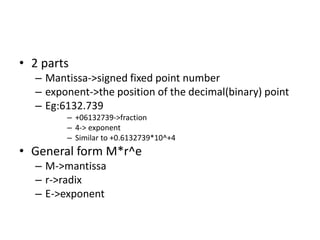
• 2 parts
– Mantissa->signed fixed point number
– exponent->the position of the decimal(binary) point
– Eg:6132.739
– +06132739->fraction
– 4-> exponent
– Similar to +0.6132739*10^+4
• General form M*r^e
– M->mantissa
– r->radix
– E->exponent
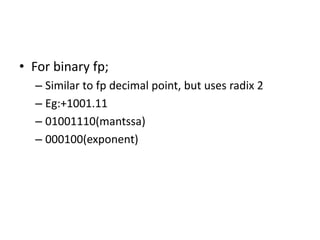
• For binary fp;
– Similar to fp decimal point, but uses radix 2
– Eg:+1001.11
– 01001110(mantssa)
– 000100(exponent)
Normalization
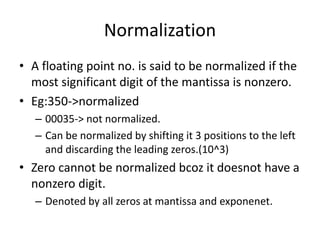
• A floating point no. is said to be normalized if the
most significant digit of the mantissa is nonzero.
• Eg:350->normalized
– 00035-> not normalized.
– Can be normalized by shifting it 3 positions to the left
and discarding the leading zeros.(10^3)
• Zero cannot be normalized bcoz it doesnot have a
nonzero digit.
– Denoted by all zeros at mantissa and exponenet.
• Operations on fp numbers requires complex
hardware and takes more time.
• Addition or subtraction requires:
– Alignment of radix point(exponents must be
equal).
– Done by shifting mantissa and adjust exponent
accordingly.
– Eg: 0.5372400*10^2+
0.1580000*10^-1
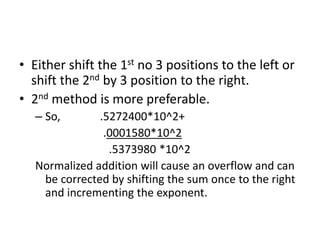
• Either shift the 1st no 3 positions to the left or
shift the 2nd by 3 position to the right.
• 2nd method is more preferable.
– So, .5272400*10^2+
.0001580*10^2
.5373980 *10^2
Normalized addition will cause an overflow and can
be corrected by shifting the sum once to the right
and incrementing the exponent.
• Underflow
– Floating point number has a 0 in the MSB of the
mantissa.
– Shift the mantissa to the left and decrement the
exponent(normalization)
• Multiplication and division doesnot require
alignment.
– Result(multiply mantissa and add the exponent for
multiplication)
– Divide the mantissa and subtract the exponent for
division
• The operation performed with exponent are:
– Compare &increment(align mantissa)
– Add &subtract(multiplication and division)
– Decrement(nomalization)
• Exponent representation
– Signed magnitude
– Signed 2’s complement
– Signed 1’s complement
– Biased exponent
• In biased exponent
– Sign bit is not taken as separate entity.
– Is a +ve number that is added to each exponent as
the floating point number is formed.
– Internally all exponents are +ve.
– the bias, is subtracted from the field to get the
true exponent value.
• Bias=(2k-1-1), where k is the number of bits in
the binary exponent.
• Advantages
– They contain only positive numbers(easy to
compare)
– The smallest possible biased exponent contains all
zeros
IEEE Standard for Binary Floating-
Point Representation
• IEEE 754 in 1985.
• developed to facilitate the portability of
• programs from one processor to another and
to encourage the development of
sophisticated, numerically oriented programs.
IEEE 754 Formats
Parameter List
Register Configuration
• The same registers & adders are in the case of
fixed point arithmetic are used for processing
mantissa.
• Differs the way in which exponents are
handled
• BR,AC,QR(divided into 2 parts).
• Mantissa is stored in B,A and Q registers
• Exponent in b,a,q registers.
– Mantissa in signed magnitude in A and sign in As
and MSB in A1.
– Biased exponent in a.
– A1->1 if the no. Has to be normalized
– Similarly for other registers
• 2Parallel adders
– 1 ,Adds two mantissas and sum stores in A,Carry
to E.
– 2nd adds the exponents(don’t have distinct sign
bit,but taken as +ve).
• Exponent overflow is neglected.
• Exponents are connected to comparator that
provides 3 binary outputs to indicate their
relative magnitude.
• The number in the mantissa is taken as a
fraction, so binary point resides to the left of
the magnitude part.
• Numbers are normalized both during initial
and after the operation.
A floating point operation may
produce:
Addition and Subtraction
• 1. Check for zeros.
• 2. Align the mantissas.
• 3. Add or subtract the mantissas.
• 4. Normalize the result.
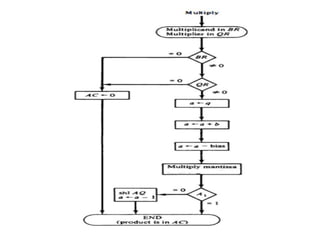
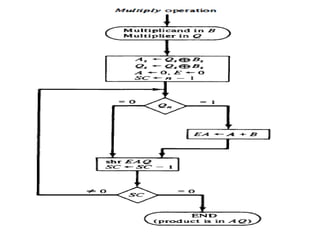
Multiplication
• multiply the mantissas and add the
exponents.
• No comparison of exponents or alignment of
mantissas is necessary.
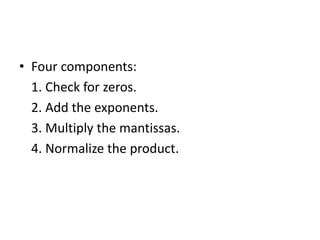
• Four components:
1. Check for zeros.
2. Add the exponents.
3. Multiply the mantissas.
4. Normalize the product.
Division
• Floating-point division requires that the
exponents be subtracted and the mantissas
divided.
• The mantissa division is done as in fixed-point
except that the dividend has a single-precision
mantissa that is placed in the AC.
• Check for zeros.
• Initialize registers and evaluate the sign
• Align the dividend(divide overflow check in
fixp).
• Subtract the exponents.
• Divide the mantissas.
Decimal Arithmetic Unit
• is a digital function that performs decimal
• microoperations.
• can add or subtract decimal numbers, usually
by forming the 9's or 10's complement of the
subtrahend.
• The unit accepts coded decimal numbers and
generates results in the same adopted binary
code.
• A single-stage decimal arithmetic unit consists
of:
– nine binary input variables
– five binary output variables
– ( since a minimum of four bits is required to
represent each coded decimal digit)
• Each stage must have four inputs for the
augend digit, four inputs for the addend digit,
and an input-carry.
• The outputs include four terminals for the
sum digit and one for the output-carry.
Once cell of Decimal additiom
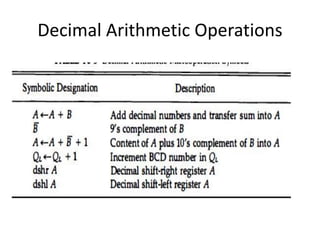
Decimal Arithmetic Operations
Addition and Subtraction
• Addition
– Parallel decimal adder
– Digit-serial. Bit-parallel decimal addition
– All serial decimal addition
Parallel Decimal Adder
624+829=1503
Digit-serial. Bit-parallel decimal
addition
All serial decimal addition
Multiplication
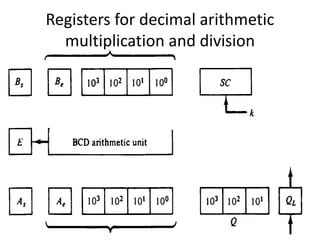
Registers for decimal arithmetic
multiplication and division
• Ae- to accommodate overflow(adding the
multiplicand to the partial product)
• Be-to form the 9’s complement of the divisor
when subtracted from the partial remainder.
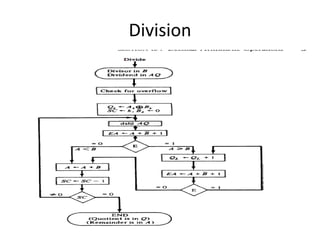
Division
Arithmetic and Logic Unit
• Is a multioperation, combinational logic digital
function.
• Perform
– a set of basic arithmetic operations
– Set of logical operations
• No. Of selection lines(to select a particular
operation).
• K selection variables->2k distinct operations.
4 bit ALU
• Design of ALU will be carried out in 3stages:
– Design of arithmetic section
– Design of logic section
– The arithmetic section will be modified so that it
can perform both arithmetic and logic operations.
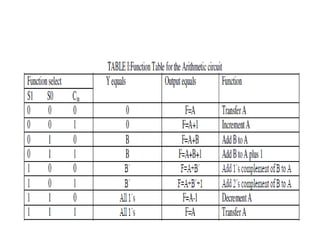
Design of Arithmetic unit
4bit adder/subtractor circuit
Design of LogiC Circuit
Combining Logic & Arithmetic Circuits
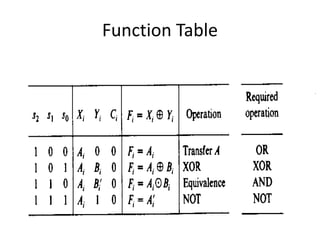
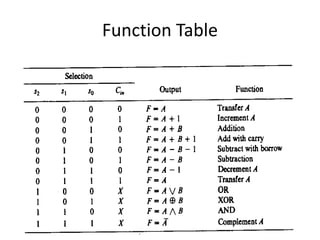
Function Table
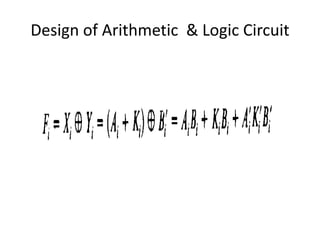
Design of Arithmetic & Logic Circuit
• When S2=0
• When s2=1
Function Table

Floating point arithmetic operations (1)

  • 1.
  • 2.
    • 2 parts –Mantissa->signed fixed point number – exponent->the position of the decimal(binary) point – Eg:6132.739 – +06132739->fraction – 4-> exponent – Similar to +0.6132739*10^+4 • General form M*r^e – M->mantissa – r->radix – E->exponent
  • 3.
    • For binaryfp; – Similar to fp decimal point, but uses radix 2 – Eg:+1001.11 – 01001110(mantssa) – 000100(exponent)
  • 4.
    Normalization • A floatingpoint no. is said to be normalized if the most significant digit of the mantissa is nonzero. • Eg:350->normalized – 00035-> not normalized. – Can be normalized by shifting it 3 positions to the left and discarding the leading zeros.(10^3) • Zero cannot be normalized bcoz it doesnot have a nonzero digit. – Denoted by all zeros at mantissa and exponenet.
  • 5.
    • Operations onfp numbers requires complex hardware and takes more time. • Addition or subtraction requires: – Alignment of radix point(exponents must be equal). – Done by shifting mantissa and adjust exponent accordingly. – Eg: 0.5372400*10^2+ 0.1580000*10^-1
  • 6.
    • Either shiftthe 1st no 3 positions to the left or shift the 2nd by 3 position to the right. • 2nd method is more preferable. – So, .5272400*10^2+ .0001580*10^2 .5373980 *10^2 Normalized addition will cause an overflow and can be corrected by shifting the sum once to the right and incrementing the exponent.
  • 7.
    • Underflow – Floatingpoint number has a 0 in the MSB of the mantissa. – Shift the mantissa to the left and decrement the exponent(normalization) • Multiplication and division doesnot require alignment. – Result(multiply mantissa and add the exponent for multiplication) – Divide the mantissa and subtract the exponent for division
  • 8.
    • The operationperformed with exponent are: – Compare &increment(align mantissa) – Add &subtract(multiplication and division) – Decrement(nomalization) • Exponent representation – Signed magnitude – Signed 2’s complement – Signed 1’s complement – Biased exponent
  • 9.
    • In biasedexponent – Sign bit is not taken as separate entity. – Is a +ve number that is added to each exponent as the floating point number is formed. – Internally all exponents are +ve. – the bias, is subtracted from the field to get the true exponent value. • Bias=(2k-1-1), where k is the number of bits in the binary exponent.
  • 10.
    • Advantages – Theycontain only positive numbers(easy to compare) – The smallest possible biased exponent contains all zeros
  • 13.
    IEEE Standard forBinary Floating- Point Representation • IEEE 754 in 1985. • developed to facilitate the portability of • programs from one processor to another and to encourage the development of sophisticated, numerically oriented programs.
  • 14.
  • 15.
  • 16.
    Register Configuration • Thesame registers & adders are in the case of fixed point arithmetic are used for processing mantissa. • Differs the way in which exponents are handled
  • 18.
    • BR,AC,QR(divided into2 parts). • Mantissa is stored in B,A and Q registers • Exponent in b,a,q registers. – Mantissa in signed magnitude in A and sign in As and MSB in A1. – Biased exponent in a. – A1->1 if the no. Has to be normalized – Similarly for other registers
  • 19.
    • 2Parallel adders –1 ,Adds two mantissas and sum stores in A,Carry to E. – 2nd adds the exponents(don’t have distinct sign bit,but taken as +ve). • Exponent overflow is neglected. • Exponents are connected to comparator that provides 3 binary outputs to indicate their relative magnitude.
  • 20.
    • The numberin the mantissa is taken as a fraction, so binary point resides to the left of the magnitude part. • Numbers are normalized both during initial and after the operation.
  • 21.
    A floating pointoperation may produce:
  • 22.
    Addition and Subtraction •1. Check for zeros. • 2. Align the mantissas. • 3. Add or subtract the mantissas. • 4. Normalize the result.
  • 24.
    Multiplication • multiply themantissas and add the exponents. • No comparison of exponents or alignment of mantissas is necessary.
  • 25.
    • Four components: 1.Check for zeros. 2. Add the exponents. 3. Multiply the mantissas. 4. Normalize the product.
  • 28.
    Division • Floating-point divisionrequires that the exponents be subtracted and the mantissas divided. • The mantissa division is done as in fixed-point except that the dividend has a single-precision mantissa that is placed in the AC.
  • 29.
    • Check forzeros. • Initialize registers and evaluate the sign • Align the dividend(divide overflow check in fixp). • Subtract the exponents. • Divide the mantissas.
  • 32.
    Decimal Arithmetic Unit •is a digital function that performs decimal • microoperations. • can add or subtract decimal numbers, usually by forming the 9's or 10's complement of the subtrahend. • The unit accepts coded decimal numbers and generates results in the same adopted binary code.
  • 33.
    • A single-stagedecimal arithmetic unit consists of: – nine binary input variables – five binary output variables – ( since a minimum of four bits is required to represent each coded decimal digit) • Each stage must have four inputs for the augend digit, four inputs for the addend digit, and an input-carry.
  • 34.
    • The outputsinclude four terminals for the sum digit and one for the output-carry.
  • 35.
    Once cell ofDecimal additiom
  • 36.
  • 37.
    Addition and Subtraction •Addition – Parallel decimal adder – Digit-serial. Bit-parallel decimal addition – All serial decimal addition
  • 38.
  • 39.
  • 40.
  • 41.
  • 42.
    Registers for decimalarithmetic multiplication and division
  • 43.
    • Ae- toaccommodate overflow(adding the multiplicand to the partial product) • Be-to form the 9’s complement of the divisor when subtracted from the partial remainder.
  • 45.
  • 46.
    Arithmetic and LogicUnit • Is a multioperation, combinational logic digital function. • Perform – a set of basic arithmetic operations – Set of logical operations • No. Of selection lines(to select a particular operation). • K selection variables->2k distinct operations.
  • 47.
  • 48.
    • Design ofALU will be carried out in 3stages: – Design of arithmetic section – Design of logic section – The arithmetic section will be modified so that it can perform both arithmetic and logic operations.
  • 49.
  • 52.
  • 53.
  • 54.
    Combining Logic &Arithmetic Circuits
  • 55.
  • 57.
    Design of Arithmetic& Logic Circuit
  • 58.
    Design of Arithmetic& Logic Circuit
  • 59.
  • 60.
  • 61.