x 
Chapter 7 _Sampling and Sampling Distributions 
Recall from before that the population is the set of all elements in a study while a sample 
is a subset of the population. 
We also talked about statistical inference, which is when we develop estimates of the 
population from sample data and infer what the population must look like. This is done 
b/c: 
-Population data is generally not something you can obtain 
-if the sampling is good it is much quicker and easier to get the estimate and it should be 
reliable 
A. Terms & Types of Simple Random Samples 
1. Parameter- the number and variable that describes the population. In general we 
assume this to be unknown, but in some instances it is known. 
2. Statistic – a value that is computed from the sample data. It comes exclusively from 
sample data and is not composed of any unknown parameters. 
3. Point Estimation – this is using the data from the sample to compute the value of a 
sample statistic. This is what serves as an estimate for the population parameter. 
a. point estimator – the estimate of the population parameter; an example is a point 
x 
_estimator for μ. 
b. point estimate – the actual value that is computed for the point estimator 
ex: = 4.7 
c. sampling error – the absolute value of the difference between the point estimate and the 
actual population statistic. 
Formula: | point estimate – population parameter | 
4. Simple Random Sample (Finite Population) – a SRS of size n from a finite 
population so size in is selected from all possible samples of size n. In this case each has 
an equally likely probability of being selected. 
-Two ways to do this: 
(a) Sampling with replacement – choose the sample and once a piece of data is chosen for 
your sample you take it out of the population 
(b) Sampling w/o replacement – in this instance after a piece of data is chosen for a 
sample, it is put back into the population and may be chosen again at random. 
5. Simple Random Sample (Infinite Population) – in this instance there are an infinite 
number of population data points. To be considered an infinite population SRS it must 
satisfy the following two conditions: 
1
(a) Each element must come from the population specified  no misidentification of 
population. 
(b) Each element is selected independently 
B. Introduction To Sampling Distributions 
-if you continue to take samples of data and compute every possible combination of 
samples (i.e. all permutations or combinations) of size n then the sample statistics/point 
estimators can have their own distribution. 
-so each sample statistic/point estimator will have its own distributions with its own 
mean, variance, and standard deviation. 
-we we know what type of distribution this is we can make probability statements from it 
and assess how close the point estimates are to the population parameters (i.e. how close 
_x 
x 
is to _μ) 
1. Sampling Distribution – the probability distribution of any particular sampling 
statistic. 
2. Law of Large Numbers – if we draw observations from a population with a finite 
mean μ at random, as we increase the number of observations we draw the value of the 
sample mean ( ) gets closer and closer to the population mean. 
x 
-note _that this makes sense b/c as you increase the size of your sample it gets closer to the 
size of the population. So it begins to look more and more like the population itself. For 
this reason the mean should approach the population mean. 
3. Sampling Distribution of - this is the probability distribution of all possible values 
of a sample mean given a certain size sample n. 
Ex: 
-Suppose we have a distribution as follows: 
If we want to create a sampling distribution we 
would take samples of size n, let’s say 15 
from the distribution to the right and from 
each sample obtain a mean, variance, 
and standard deviation. 
2 
x 
15 20 25 
Sample1- 
has own 
_x 
, s2, & 
s 
Sample 2- 
has own 
_x 
, s2, & 
s
…..continue with process for all possible samples of size 15. If we do this we can take 
the values from each sample and create its own distribution as shown below. 
Graphically: 
-notice now we have a distribution of sample means. 
This distribution is created from the means of each 
sample and it has its own variance and standard 
deviation. Note that they should be much 
smaller than the distribution sampled 
from since we created it from the sample 
means of the data. 
4. Characteristics of the Sampling Distribution of a. E ( ) = μ  so the mean of all values of x 
x 
__x 
_should be the population mean μ. This is 
x 
_called unbiasedness. Since the value of the sampling statistic converges to the population 
parameter. 
b. Standard Deviation of - called the standard error of the mean  it tells us how close 
our estimates of the mean are to the actual mean. 
i. finite population value – σ _x 
= (N -n) /(N -1) * (σ / n ) 
ii. infinite population - σ _x 
= σ / n 
x 
note: σ _= population variance, N = population size, n = sample size; must still use the 
infinite population estimate if n/N < 5% of the population size. 
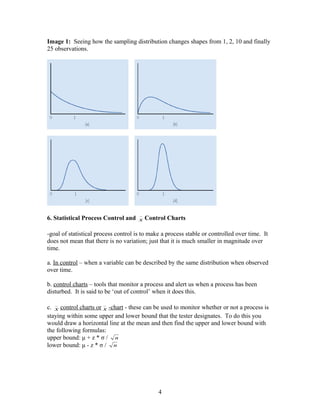
5. Central Limit Theorem – when choosing n and it is a SRS we can assume that the 
sampling distribution of ~N as N gets larger and larger. If it is greater than 30 we 
assume it is Normal. 
-if the population is normal, then the sampling distribution must be normal and this rule 
does not apply. This is for any size of sample. 
-as n increases the variance and standard deviation get tighter and there is a higher 
probability that the sample means is within a certain distance of the actual population 
mean. 
3 
_x 
20
Image 1: Seeing how the sampling distribution changes shapes from 1, 2, 10 and finally 
25 observations. 
6. Statistical Process Control and _x 
Control Charts 
-goal of statistical process control is to make a process stable or controlled over time. It 
does not mean that there is no variation; just that it is much smaller in magnitude over 
time. 
a. In control – when a variable can be described by the same distribution when observed 
over time. 
b. control charts – tools that monitor a process and alert us when a process has been 
disturbed. It is said to be ‘out of control’ when it does this. 
c. _x 
control charts or _x-chart - these can be used to monitor whether or not a process is 
staying within some upper and lower bound that the tester designates. To do this you 
would draw a horizontal line at the mean and then find the upper and lower bound with 
the following formulas: 
upper bound: μ + z * σ / n 
lower bound: μ - z * σ / n 
4
Note: that the tester determines how far away is acceptable in this process. It could be 3 
standard deviations (z’s) or it could be less. It depends on what is designated as a stable 
process over time. 
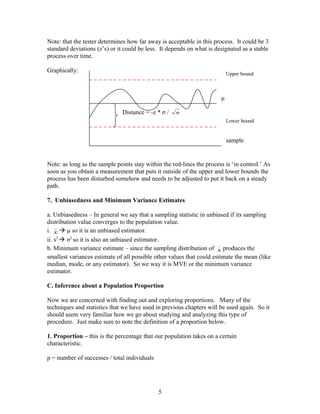
Graphically: 
Upper bound 
Lower bound 
x 
_Note: as long as the sample points stay within the red-lines the process is ‘in control.’ As 
soon as you obtain a measurement that puts it outside of the upper and lower bounds the 
process has been disturbed somehow and needs to be adjusted to put it back on a steady 
path. 
7. Unbiasedness and Minimum Variance Estimates 
a. Unbiasedness – In general we say that a sampling statistic in unbiased if its sampling 
distribution value converges to the population value. 
i.  μ so it is an unbiased estimator. 
ii. s2  σ2 so it is also an unbiased estimator. 
b. Minimum variance estimate – since the sampling distribution of _x 
produces the 
smallest variances estimate of all possible other values that could estimate the mean (like 
median, mode, or any estimator). So we way it is MVE or the minimum variance 
estimator. 
C. Inference about a Population Proportion 
Now we are concerned with finding out and exploring proportions. Many of the 
techniques and statistics that we have used in previous chapters will be used again. So it 
should seem very familiar how we go about studying and analyzing this type of 
procedure. Just make sure to note the definition of a proportion below. 
1. Proportion – this is the percentage that our population takes on a certain 
characteristic. 
p = number of successes / total individuals 
5 
μ 
sample 
Distance = -z * σ / n
= this is the sample proportion and is designated at p-hat. It is an actual calculated 
value. 
Example: Number of students who passed a class out of 20. If we let passing be greater 
than 70% and we find that 14 students had scores greater than 70% then our is: 
= 14 / 20 = 0.70 
2. Sampling Distribution of p: 
Just as with the mean we had a sampling distribution that had certain characteristics, we 
can also note that p also has the following characteristics. 
a. The expected value or mean of the sampling distribution is p (i.e. the population 
proportion) 
so E( ) = p 
b. The standard deviation of p or = 
c. graphically: We can use this just as before with our z. So if we assume that we have a 
normal distribution with a large enough sample size then our Z becomes: 
Z = ) / 
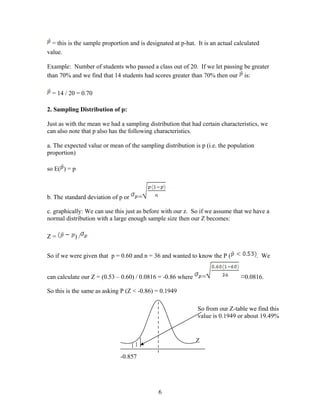
So if we were given that p = 0.60 and n = 36 and wanted to know the P ( . We 
can calculate our Z = (0.53 – 0.60) / 0.0816 = -0.86 where = ≈0.0816. 
So this is the same as asking P (Z < -0.86) = 0.1949 
6 
So from our Z-table we find this 
value is 0.1949 or about 19.49% 
Z 
-0.857 
Z
= this is the sample proportion and is designated at p-hat. It is an actual calculated 
value. 
Example: Number of students who passed a class out of 20. If we let passing be greater 
than 70% and we find that 14 students had scores greater than 70% then our is: 
= 14 / 20 = 0.70 
2. Sampling Distribution of p: 
Just as with the mean we had a sampling distribution that had certain characteristics, we 
can also note that p also has the following characteristics. 
a. The expected value or mean of the sampling distribution is p (i.e. the population 
proportion) 
so E( ) = p 
b. The standard deviation of p or = 
c. graphically: We can use this just as before with our z. So if we assume that we have a 
normal distribution with a large enough sample size then our Z becomes: 
Z = ) / 
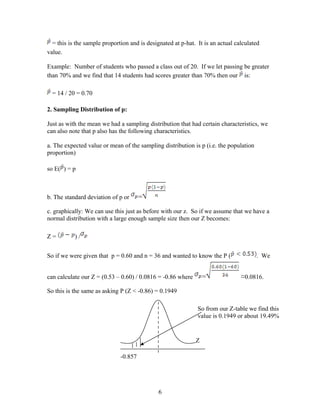
So if we were given that p = 0.60 and n = 36 and wanted to know the P ( . We 
can calculate our Z = (0.53 – 0.60) / 0.0816 = -0.86 where = ≈0.0816. 
So this is the same as asking P (Z < -0.86) = 0.1949 
6 
So from our Z-table we find this 
value is 0.1949 or about 19.49% 
Z 
-0.857 
Z

Chapter 7 sampling distributions

  • 1.
    x Chapter 7_Sampling and Sampling Distributions Recall from before that the population is the set of all elements in a study while a sample is a subset of the population. We also talked about statistical inference, which is when we develop estimates of the population from sample data and infer what the population must look like. This is done b/c: -Population data is generally not something you can obtain -if the sampling is good it is much quicker and easier to get the estimate and it should be reliable A. Terms & Types of Simple Random Samples 1. Parameter- the number and variable that describes the population. In general we assume this to be unknown, but in some instances it is known. 2. Statistic – a value that is computed from the sample data. It comes exclusively from sample data and is not composed of any unknown parameters. 3. Point Estimation – this is using the data from the sample to compute the value of a sample statistic. This is what serves as an estimate for the population parameter. a. point estimator – the estimate of the population parameter; an example is a point x _estimator for μ. b. point estimate – the actual value that is computed for the point estimator ex: = 4.7 c. sampling error – the absolute value of the difference between the point estimate and the actual population statistic. Formula: | point estimate – population parameter | 4. Simple Random Sample (Finite Population) – a SRS of size n from a finite population so size in is selected from all possible samples of size n. In this case each has an equally likely probability of being selected. -Two ways to do this: (a) Sampling with replacement – choose the sample and once a piece of data is chosen for your sample you take it out of the population (b) Sampling w/o replacement – in this instance after a piece of data is chosen for a sample, it is put back into the population and may be chosen again at random. 5. Simple Random Sample (Infinite Population) – in this instance there are an infinite number of population data points. To be considered an infinite population SRS it must satisfy the following two conditions: 1
  • 2.
    (a) Each elementmust come from the population specified  no misidentification of population. (b) Each element is selected independently B. Introduction To Sampling Distributions -if you continue to take samples of data and compute every possible combination of samples (i.e. all permutations or combinations) of size n then the sample statistics/point estimators can have their own distribution. -so each sample statistic/point estimator will have its own distributions with its own mean, variance, and standard deviation. -we we know what type of distribution this is we can make probability statements from it and assess how close the point estimates are to the population parameters (i.e. how close _x x is to _μ) 1. Sampling Distribution – the probability distribution of any particular sampling statistic. 2. Law of Large Numbers – if we draw observations from a population with a finite mean μ at random, as we increase the number of observations we draw the value of the sample mean ( ) gets closer and closer to the population mean. x -note _that this makes sense b/c as you increase the size of your sample it gets closer to the size of the population. So it begins to look more and more like the population itself. For this reason the mean should approach the population mean. 3. Sampling Distribution of - this is the probability distribution of all possible values of a sample mean given a certain size sample n. Ex: -Suppose we have a distribution as follows: If we want to create a sampling distribution we would take samples of size n, let’s say 15 from the distribution to the right and from each sample obtain a mean, variance, and standard deviation. 2 x 15 20 25 Sample1- has own _x , s2, & s Sample 2- has own _x , s2, & s
  • 3.
    …..continue with processfor all possible samples of size 15. If we do this we can take the values from each sample and create its own distribution as shown below. Graphically: -notice now we have a distribution of sample means. This distribution is created from the means of each sample and it has its own variance and standard deviation. Note that they should be much smaller than the distribution sampled from since we created it from the sample means of the data. 4. Characteristics of the Sampling Distribution of a. E ( ) = μ  so the mean of all values of x x __x _should be the population mean μ. This is x _called unbiasedness. Since the value of the sampling statistic converges to the population parameter. b. Standard Deviation of - called the standard error of the mean  it tells us how close our estimates of the mean are to the actual mean. i. finite population value – σ _x = (N -n) /(N -1) * (σ / n ) ii. infinite population - σ _x = σ / n x note: σ _= population variance, N = population size, n = sample size; must still use the infinite population estimate if n/N < 5% of the population size. 5. Central Limit Theorem – when choosing n and it is a SRS we can assume that the sampling distribution of ~N as N gets larger and larger. If it is greater than 30 we assume it is Normal. -if the population is normal, then the sampling distribution must be normal and this rule does not apply. This is for any size of sample. -as n increases the variance and standard deviation get tighter and there is a higher probability that the sample means is within a certain distance of the actual population mean. 3 _x 20
  • 4.
    Image 1: Seeinghow the sampling distribution changes shapes from 1, 2, 10 and finally 25 observations. 6. Statistical Process Control and _x Control Charts -goal of statistical process control is to make a process stable or controlled over time. It does not mean that there is no variation; just that it is much smaller in magnitude over time. a. In control – when a variable can be described by the same distribution when observed over time. b. control charts – tools that monitor a process and alert us when a process has been disturbed. It is said to be ‘out of control’ when it does this. c. _x control charts or _x-chart - these can be used to monitor whether or not a process is staying within some upper and lower bound that the tester designates. To do this you would draw a horizontal line at the mean and then find the upper and lower bound with the following formulas: upper bound: μ + z * σ / n lower bound: μ - z * σ / n 4
  • 5.
    Note: that thetester determines how far away is acceptable in this process. It could be 3 standard deviations (z’s) or it could be less. It depends on what is designated as a stable process over time. Graphically: Upper bound Lower bound x _Note: as long as the sample points stay within the red-lines the process is ‘in control.’ As soon as you obtain a measurement that puts it outside of the upper and lower bounds the process has been disturbed somehow and needs to be adjusted to put it back on a steady path. 7. Unbiasedness and Minimum Variance Estimates a. Unbiasedness – In general we say that a sampling statistic in unbiased if its sampling distribution value converges to the population value. i.  μ so it is an unbiased estimator. ii. s2  σ2 so it is also an unbiased estimator. b. Minimum variance estimate – since the sampling distribution of _x produces the smallest variances estimate of all possible other values that could estimate the mean (like median, mode, or any estimator). So we way it is MVE or the minimum variance estimator. C. Inference about a Population Proportion Now we are concerned with finding out and exploring proportions. Many of the techniques and statistics that we have used in previous chapters will be used again. So it should seem very familiar how we go about studying and analyzing this type of procedure. Just make sure to note the definition of a proportion below. 1. Proportion – this is the percentage that our population takes on a certain characteristic. p = number of successes / total individuals 5 μ sample Distance = -z * σ / n
  • 6.
    = this isthe sample proportion and is designated at p-hat. It is an actual calculated value. Example: Number of students who passed a class out of 20. If we let passing be greater than 70% and we find that 14 students had scores greater than 70% then our is: = 14 / 20 = 0.70 2. Sampling Distribution of p: Just as with the mean we had a sampling distribution that had certain characteristics, we can also note that p also has the following characteristics. a. The expected value or mean of the sampling distribution is p (i.e. the population proportion) so E( ) = p b. The standard deviation of p or = c. graphically: We can use this just as before with our z. So if we assume that we have a normal distribution with a large enough sample size then our Z becomes: Z = ) / So if we were given that p = 0.60 and n = 36 and wanted to know the P ( . We can calculate our Z = (0.53 – 0.60) / 0.0816 = -0.86 where = ≈0.0816. So this is the same as asking P (Z < -0.86) = 0.1949 6 So from our Z-table we find this value is 0.1949 or about 19.49% Z -0.857 Z
  • 7.
    = this isthe sample proportion and is designated at p-hat. It is an actual calculated value. Example: Number of students who passed a class out of 20. If we let passing be greater than 70% and we find that 14 students had scores greater than 70% then our is: = 14 / 20 = 0.70 2. Sampling Distribution of p: Just as with the mean we had a sampling distribution that had certain characteristics, we can also note that p also has the following characteristics. a. The expected value or mean of the sampling distribution is p (i.e. the population proportion) so E( ) = p b. The standard deviation of p or = c. graphically: We can use this just as before with our z. So if we assume that we have a normal distribution with a large enough sample size then our Z becomes: Z = ) / So if we were given that p = 0.60 and n = 36 and wanted to know the P ( . We can calculate our Z = (0.53 – 0.60) / 0.0816 = -0.86 where = ≈0.0816. So this is the same as asking P (Z < -0.86) = 0.1949 6 So from our Z-table we find this value is 0.1949 or about 19.49% Z -0.857 Z