Copyright © 2010 Pearson Education, Inc. Publishing as Prentice Hall
Statistics for
Business and Economics
7th Edition
Chapter 6
Sampling and
Sampling Distributions
Ch. 6-1
Chapter Goals
After completing this chapter, you should be able to:
 Describe a simple random sample and why sampling is
important
 Explain the difference between descriptive and
inferential statistics
 Define the concept of a sampling distribution
 Determine the mean and standard deviation for the
sampling distribution of the sample mean,
 Describe the Central Limit Theorem and its importance
 Determine the mean and standard deviation for the
sampling distribution of the sample proportion,
 Describe sampling distributions of sample variances
pˆ
X
Copyright © 2010 Pearson Education, Inc. Publishing as Prentice Hall Ch. 6-2
Tools of Business Statistics
 Descriptive statistics
 Collecting, presenting, and describing data
 Inferential statistics
 Drawing conclusions and/or making decisions
concerning a population based only on
sample data
Copyright © 2010 Pearson Education, Inc. Publishing as Prentice Hall Ch. 6-3
6.1
Populations and Samples
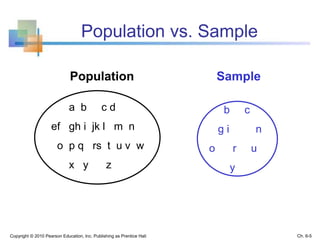
 A Population is the set of all items or individuals
of interest
 Examples: All likely voters in the next election
All parts produced today
All sales receipts for November
 A Sample is a subset of the population
 Examples: 1000 voters selected at random for interview
A few parts selected for destructive testing
Random receipts selected for audit
Copyright © 2010 Pearson Education, Inc. Publishing as Prentice Hall Ch. 6-4
Population vs. Sample
Copyright © 2010 Pearson Education, Inc. Publishing as Prentice Hall
a b c d
ef gh i jk l m n
o p q rs t u v w
x y z
Population Sample
b c
g i n
o r u
y
Ch. 6-5
Why Sample?
 Less time consuming than a census
 Less costly to administer than a census
 It is possible to obtain statistical results of a
sufficiently high precision based on samples.
Copyright © 2010 Pearson Education, Inc. Publishing as Prentice Hall Ch. 6-6
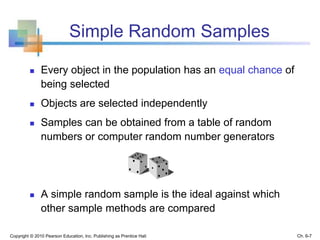
Simple Random Samples
 Every object in the population has an equal chance of
being selected
 Objects are selected independently
 Samples can be obtained from a table of random
numbers or computer random number generators
 A simple random sample is the ideal against which
other sample methods are compared
Copyright © 2010 Pearson Education, Inc. Publishing as Prentice Hall Ch. 6-7
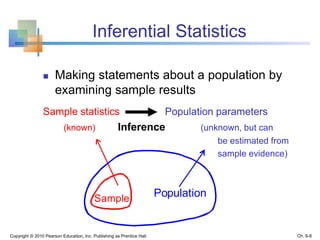
Inferential Statistics
 Making statements about a population by
examining sample results
Sample statistics Population parameters
(known) Inference (unknown, but can
be estimated from
sample evidence)
Copyright © 2010 Pearson Education, Inc. Publishing as Prentice Hall
Sample Population
Ch. 6-8
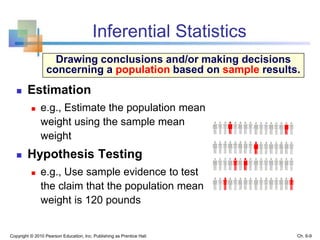
Inferential Statistics
 Estimation
 e.g., Estimate the population mean
weight using the sample mean
weight
 Hypothesis Testing
 e.g., Use sample evidence to test
the claim that the population mean
weight is 120 pounds
Copyright © 2010 Pearson Education, Inc. Publishing as Prentice Hall
Drawing conclusions and/or making decisions
concerning a population based on sample results.
Ch. 6-9
Sampling Distributions
 A sampling distribution is a distribution of
all of the possible values of a statistic for
a given size sample selected from a
population
Copyright © 2010 Pearson Education, Inc. Publishing as Prentice Hall Ch. 6-10
6.2
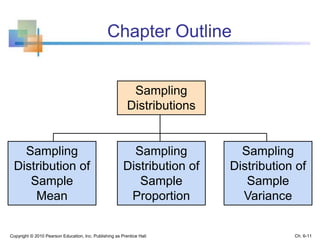
Chapter Outline
Copyright © 2010 Pearson Education, Inc. Publishing as Prentice Hall
Sampling
Distributions
Sampling
Distribution of
Sample
Mean
Sampling
Distribution of
Sample
Proportion
Sampling
Distribution of
Sample
Variance
Ch. 6-11
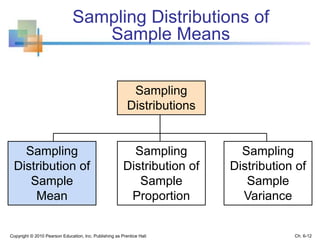
Sampling Distributions of
Sample Means
Copyright © 2010 Pearson Education, Inc. Publishing as Prentice Hall
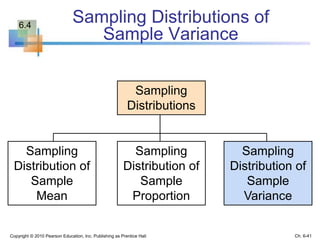
Sampling
Distributions
Sampling
Distribution of
Sample
Mean
Sampling
Distribution of
Sample
Proportion
Sampling
Distribution of
Sample
Variance
Ch. 6-12
Developing a
Sampling Distribution
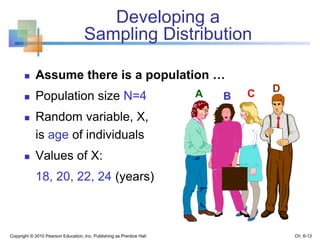
 Assume there is a population …
 Population size N=4
 Random variable, X,
is age of individuals
 Values of X:
18, 20, 22, 24 (years)
Copyright © 2010 Pearson Education, Inc. Publishing as Prentice Hall
A B C D
Ch. 6-13
Developing a
Sampling Distribution
Copyright © 2010 Pearson Education, Inc. Publishing as Prentice Hall
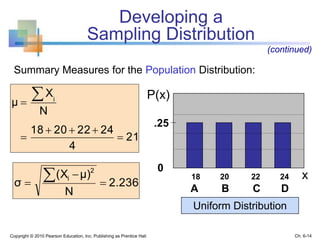
.25
0
18 20 22 24
A B C D
Uniform Distribution
P(x)
x
(continued)
Summary Measures for the Population Distribution:
21
4
24222018
N
X
μ i





2.236
N
μ)(X
σ
2
i




Ch. 6-14
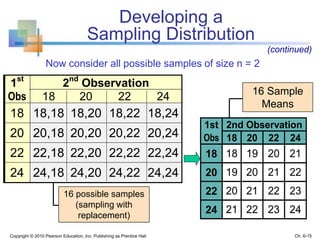
Now consider all possible samples of size n = 2
Copyright © 2010 Pearson Education, Inc. Publishing as Prentice Hall
1st
2nd
Observation
Obs 18 20 22 24
18 18,18 18,20 18,22 18,24
20 20,18 20,20 20,22 20,24
22 22,18 22,20 22,22 22,24
24 24,18 24,20 24,22 24,24
16 possible samples
(sampling with
replacement)
1st 2nd Observation
Obs 18 20 22 24
18 18 19 20 21
20 19 20 21 22
22 20 21 22 23
24 21 22 23 24
(continued)
Developing a
Sampling Distribution
16 Sample
Means
Ch. 6-15
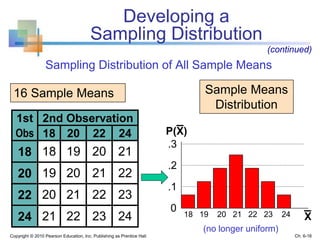
Sampling Distribution of All Sample Means
Copyright © 2010 Pearson Education, Inc. Publishing as Prentice Hall
1st 2nd Observation
Obs 18 20 22 24
18 18 19 20 21
20 19 20 21 22
22 20 21 22 23
24 21 22 23 24 18 19 20 21 22 23 24
0
.1
.2
.3
P(X)
X
Sample Means
Distribution
16 Sample Means
_
Developing a
Sampling Distribution
(continued)
(no longer uniform)
_
Ch. 6-16
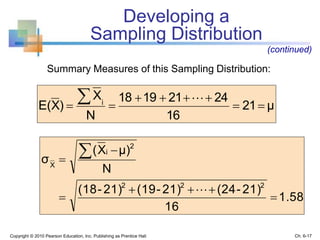
Summary Measures of this Sampling Distribution:
Copyright © 2010 Pearson Education, Inc. Publishing as Prentice Hall
Developing a
Sampling Distribution
(continued)
μ21
16
24211918
N
X
)XE( i



 
1.58
16
21)-(2421)-(1921)-(18
N
μ)X(
σ
222
2
i
X







Ch. 6-17
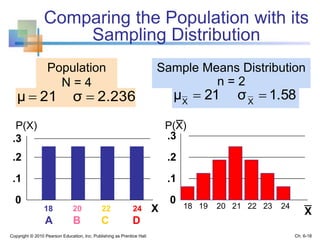
Comparing the Population with its
Sampling Distribution
Copyright © 2010 Pearson Education, Inc. Publishing as Prentice Hall
18 19 20 21 22 23 24
0
.1
.2
.3
P(X)
X18 20 22 24
A B C D
0
.1
.2
.3
Population
N = 4
P(X)
X
_
1.58σ21μ XX
2.236σ21μ 
Sample Means Distribution
n = 2
_
Ch. 6-18
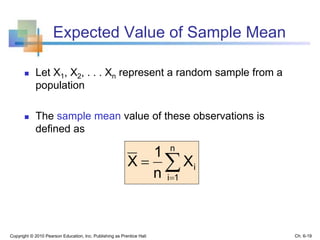
Expected Value of Sample Mean
 Let X1, X2, . . . Xn represent a random sample from a
population
 The sample mean value of these observations is
defined as
Copyright © 2010 Pearson Education, Inc. Publishing as Prentice Hall


n
1i
iX
n
1
X
Ch. 6-19
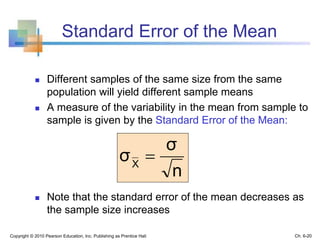
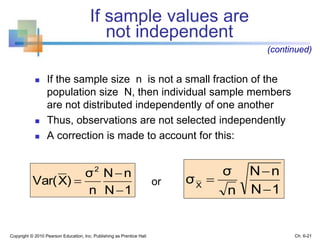
Standard Error of the Mean
 Different samples of the same size from the same
population will yield different sample means
 A measure of the variability in the mean from sample to
sample is given by the Standard Error of the Mean:
 Note that the standard error of the mean decreases as
the sample size increases
Copyright © 2010 Pearson Education, Inc. Publishing as Prentice Hall
n
σ
σX

Ch. 6-20
If sample values are
not independent
 If the sample size n is not a small fraction of the
population size N, then individual sample members
are not distributed independently of one another
 Thus, observations are not selected independently
 A correction is made to account for this:
or
Copyright © 2010 Pearson Education, Inc. Publishing as Prentice Hall Ch. 6-21
(continued)
1N
nN
n
σ
σX



1N
nN
n
σ
)XVar(
2



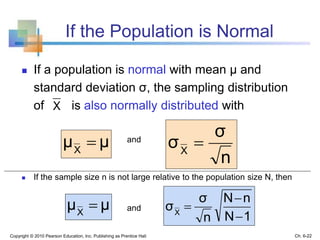
If the Population is Normal
 If a population is normal with mean μ and
standard deviation σ, the sampling distribution
of is also normally distributed with
and
 If the sample size n is not large relative to the population size N, then
and
Copyright © 2010 Pearson Education, Inc. Publishing as Prentice Hall
X
μμX

n
σ
σX

Ch. 6-22
1N
nN
n
σ
σX


μμX

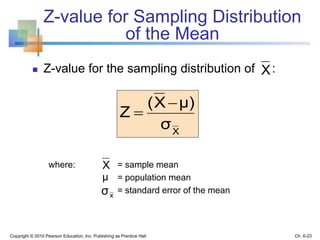
Z-value for Sampling Distribution
of the Mean
 Z-value for the sampling distribution of :
Copyright © 2010 Pearson Education, Inc. Publishing as Prentice Hall
where: = sample mean
= population mean
= standard error of the mean
X
μ
X
σ
μ)X(
Z


X
Ch. 6-23
xσ
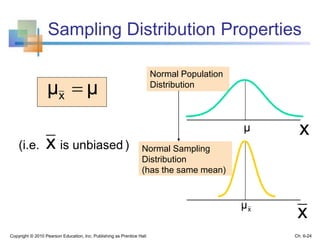
Sampling Distribution Properties
(i.e. is unbiased )
Copyright © 2010 Pearson Education, Inc. Publishing as Prentice Hall
Normal Population
Distribution
Normal Sampling
Distribution
(has the same mean)
x
x
x
μμx 
μ
xμ
Ch. 6-24
Sampling Distribution Properties
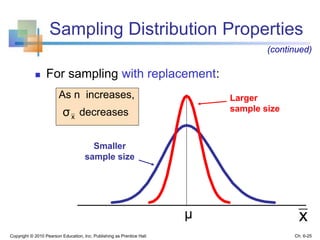
 For sampling with replacement:
As n increases,
decreases
Copyright © 2010 Pearson Education, Inc. Publishing as Prentice Hall
Larger
sample size
Smaller
sample size
x
(continued)
xσ
μ
Ch. 6-25
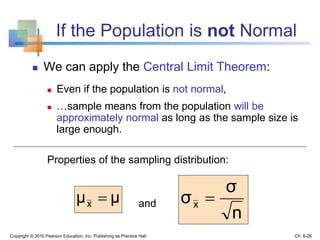
If the Population is not Normal
 We can apply the Central Limit Theorem:
 Even if the population is not normal,
 …sample means from the population will be
approximately normal as long as the sample size is
large enough.
Properties of the sampling distribution:
and
Copyright © 2010 Pearson Education, Inc. Publishing as Prentice Hall
μμx 
n
σ
σx 
Ch. 6-26
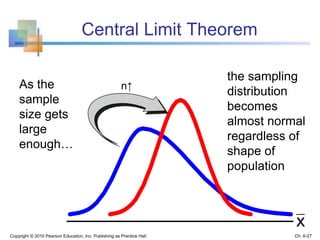
Central Limit Theorem
Copyright © 2010 Pearson Education, Inc. Publishing as Prentice Hall
n↑As the
sample
size gets
large
enough…
the sampling
distribution
becomes
almost normal
regardless of
shape of
population
x
Ch. 6-27
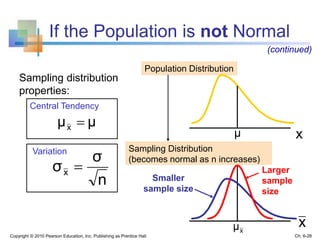
If the Population is not Normal
Copyright © 2010 Pearson Education, Inc. Publishing as Prentice Hall
Population Distribution
Sampling Distribution
(becomes normal as n increases)
Central Tendency
Variation
x
x
Larger
sample
size
Smaller
sample size
(continued)
Sampling distribution
properties:
μμx 
n
σ
σx 
xμ
μ
Ch. 6-28
How Large is Large Enough?
 For most distributions, n > 25 will give a
sampling distribution that is nearly normal
 For normal population distributions, the
sampling distribution of the mean is always
normally distributed
Copyright © 2010 Pearson Education, Inc. Publishing as Prentice Hall Ch. 6-29
Example
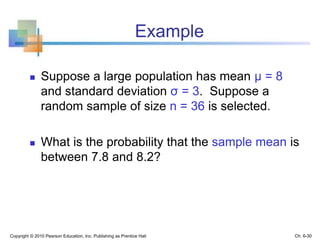
 Suppose a large population has mean μ = 8
and standard deviation σ = 3. Suppose a
random sample of size n = 36 is selected.
 What is the probability that the sample mean is
between 7.8 and 8.2?
Copyright © 2010 Pearson Education, Inc. Publishing as Prentice Hall Ch. 6-30
Example
Solution:
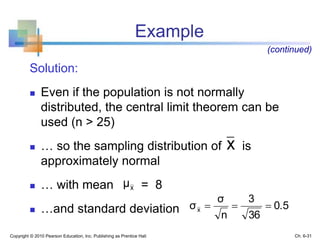
 Even if the population is not normally
distributed, the central limit theorem can be
used (n > 25)
 … so the sampling distribution of is
approximately normal
 … with mean = 8
 …and standard deviation
Copyright © 2010 Pearson Education, Inc. Publishing as Prentice Hall
(continued)
x
xμ
0.5
36
3
n
σ
σx 
Ch. 6-31
Example
Solution (continued):
Copyright © 2010 Pearson Education, Inc. Publishing as Prentice Hall
(continued)
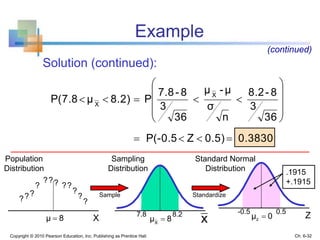
0.38300.5)ZP(-0.5
36
3
8-8.2
n
σ
μ-μ
36
3
8-7.8
P8.2)μP(7.8
X
X












Z7.8 8.2 -0.5 0.5
Sampling
Distribution
Standard Normal
Distribution .1915
+.1915
Population
Distribution
?
?
?
?
????
?
???
Sample Standardize
8μ  8μX
 0μz xX
Ch. 6-32
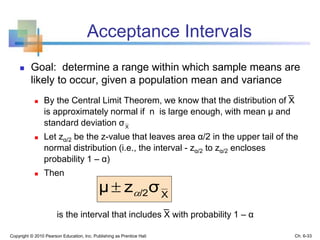
Acceptance Intervals
 Goal: determine a range within which sample means are
likely to occur, given a population mean and variance
 By the Central Limit Theorem, we know that the distribution of X
is approximately normal if n is large enough, with mean μ and
standard deviation
 Let zα/2 be the z-value that leaves area α/2 in the upper tail of the
normal distribution (i.e., the interval - zα/2 to zα/2 encloses
probability 1 – α)
 Then
is the interval that includes X with probability 1 – α
Copyright © 2010 Pearson Education, Inc. Publishing as Prentice Hall
X
σ
X/2σzμ 
Ch. 6-33
Copyright © 2010 Pearson Education, Inc. Publishing as Prentice Hall
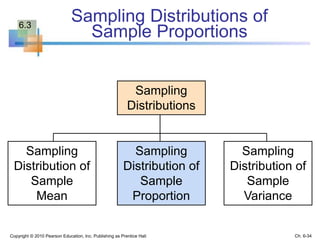
Sampling
Distributions
Sampling
Distribution of
Sample
Mean
Sampling
Distribution of
Sample
Proportion
Sampling
Distribution of
Sample
Variance
Ch. 6-34
Sampling Distributions of
Sample Proportions
6.3
Sampling Distributions of
Sample Proportions
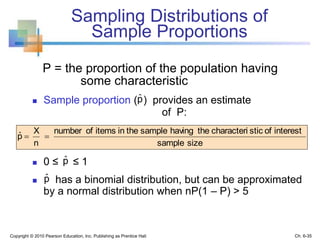
P = the proportion of the population having
some characteristic
 Sample proportion ( ) provides an estimate
of P:
 0 ≤ ≤ 1
 has a binomial distribution, but can be approximated
by a normal distribution when nP(1 – P) > 5
Copyright © 2010 Pearson Education, Inc. Publishing as Prentice Hall
sizesample
interestofsticcharacterithehavingsampletheinitemsofnumber
n
X
p ˆ
pˆ
pˆ
Ch. 6-35
pˆ
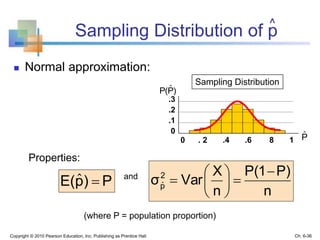
Sampling Distribution of p
 Normal approximation:
Properties:
and
Copyright © 2010 Pearson Education, Inc. Publishing as Prentice Hall
(where P = population proportion)
Sampling Distribution
.3
.2
.1
0
0 . 2 .4 .6 8 1
P)pE( ˆ
n
P)P(1
n
X
Varσ2
p







ˆ
^
)PP(ˆ
Pˆ
Ch. 6-36
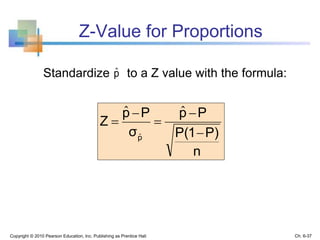
Z-Value for Proportions
Copyright © 2010 Pearson Education, Inc. Publishing as Prentice Hall
n
P)P(1
Pp
σ
Pp
Z
p 




ˆˆ
ˆ
Standardize to a Z value with the formula:
Ch. 6-37
pˆ
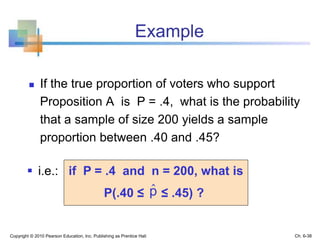
Example
 If the true proportion of voters who support
Proposition A is P = .4, what is the probability
that a sample of size 200 yields a sample
proportion between .40 and .45?
Copyright © 2010 Pearson Education, Inc. Publishing as Prentice Hall
 i.e.: if P = .4 and n = 200, what is
P(.40 ≤ ≤ .45) ?pˆ
Ch. 6-38
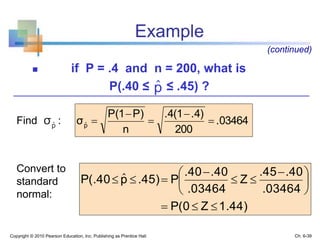
Example
 if P = .4 and n = 200, what is
P(.40 ≤ ≤ .45) ?
Copyright © 2010 Pearson Education, Inc. Publishing as Prentice Hall
(continued)
.03464
200
.4).4(1
n
P)P(1
σp




ˆ
1.44)ZP(0
.03464
.40.45
Z
.03464
.40.40
P.45)pP(.40






 


 ˆ
Find :
Convert to
standard
normal:
p
σˆ
Ch. 6-39
pˆ
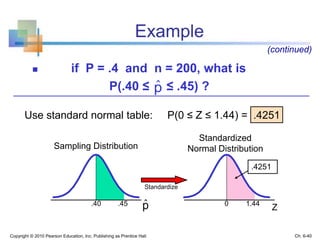
Example
 if P = .4 and n = 200, what is
P(.40 ≤ ≤ .45) ?
Copyright © 2010 Pearson Education, Inc. Publishing as Prentice Hall
Z.45 1.44
.4251
Standardize
Sampling Distribution
Standardized
Normal Distribution
(continued)
Use standard normal table: P(0 ≤ Z ≤ 1.44) = .4251
.40 0pˆ
Ch. 6-40
pˆ
Sampling Distributions of
Sample Variance
Copyright © 2010 Pearson Education, Inc. Publishing as Prentice Hall
Sampling
Distributions
Sampling
Distribution of
Sample
Mean
Sampling
Distribution of
Sample
Proportion
Sampling
Distribution of
Sample
Variance
Ch. 6-41
6.4
Sample Variance
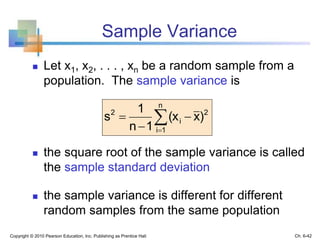
 Let x1, x2, . . . , xn be a random sample from a
population. The sample variance is
 the square root of the sample variance is called
the sample standard deviation
 the sample variance is different for different
random samples from the same population
Copyright © 2010 Pearson Education, Inc. Publishing as Prentice Hall




n
1i
2
i
2
)x(x
1n
1
s
Ch. 6-42
Sampling Distribution of
Sample Variances
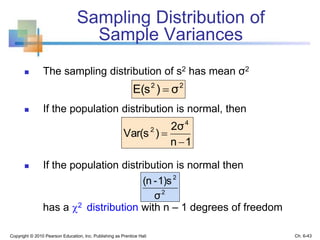
 The sampling distribution of s2 has mean σ2
 If the population distribution is normal, then
 If the population distribution is normal then
has a 2 distribution with n – 1 degrees of freedom
Copyright © 2010 Pearson Education, Inc. Publishing as Prentice Hall
22
σ)E(s 
1n
2σ
)Var(s
4
2


2
2
σ
1)s-(n
Ch. 6-43
The Chi-square Distribution
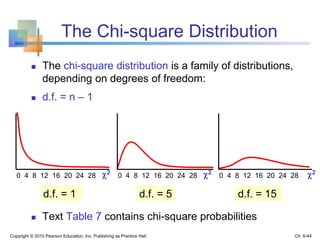
 The chi-square distribution is a family of distributions,
depending on degrees of freedom:
 d.f. = n – 1
 Text Table 7 contains chi-square probabilities
Copyright © 2010 Pearson Education, Inc. Publishing as Prentice Hall
0 4 8 12 16 20 24 28 0 4 8 12 16 20 24 28 0 4 8 12 16 20 24 28
d.f. = 1 d.f. = 5 d.f. = 15
2 22
Ch. 6-44
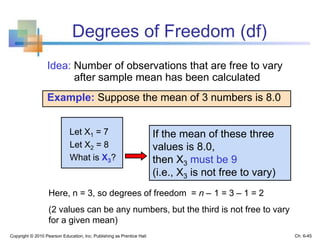
Degrees of Freedom (df)
Idea: Number of observations that are free to vary
after sample mean has been calculated
Example: Suppose the mean of 3 numbers is 8.0
Let X1 = 7
Let X2 = 8
What is X3?
Copyright © 2010 Pearson Education, Inc. Publishing as Prentice Hall
If the mean of these three
values is 8.0,
then X3 must be 9
(i.e., X3 is not free to vary)
Here, n = 3, so degrees of freedom = n – 1 = 3 – 1 = 2
(2 values can be any numbers, but the third is not free to vary
for a given mean)
Ch. 6-45
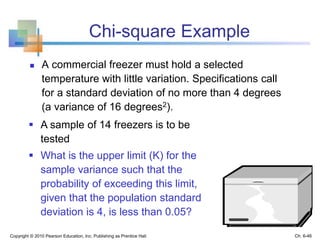
Chi-square Example
 A commercial freezer must hold a selected
temperature with little variation. Specifications call
for a standard deviation of no more than 4 degrees
(a variance of 16 degrees2).
Copyright © 2010 Pearson Education, Inc. Publishing as Prentice Hall
 A sample of 14 freezers is to be
tested
 What is the upper limit (K) for the
sample variance such that the
probability of exceeding this limit,
given that the population standard
deviation is 4, is less than 0.05?
Ch. 6-46
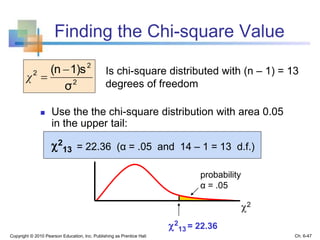
Finding the Chi-square Value
 Use the the chi-square distribution with area 0.05
in the upper tail:
Copyright © 2010 Pearson Education, Inc. Publishing as Prentice Hall
probability
α = .05
2
13
2
2
13
= 22.36
= 22.36 (α = .05 and 14 – 1 = 13 d.f.)
2
2
2
σ
1)s(n 
χ
Is chi-square distributed with (n – 1) = 13
degrees of freedom
Ch. 6-47
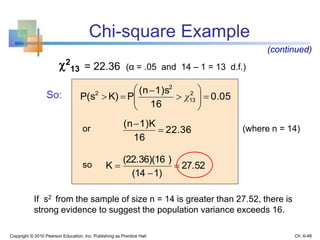
Chi-square Example
Copyright © 2010 Pearson Education, Inc. Publishing as Prentice Hall
0.05
16
1)s(n
PK)P(s 2
13
2
2








 χSo:
(continued)
2
13 = 22.36 (α = .05 and 14 – 1 = 13 d.f.)
22.36
16
1)K(n

 (where n = 14)
so 27.52
1)(14
)(22.36)(16
K 


If s2 from the sample of size n = 14 is greater than 27.52, there is
strong evidence to suggest the population variance exceeds 16.
or
Ch. 6-48
Chapter Summary
 Introduced sampling distributions
 Described the sampling distribution of sample means
 For normal populations
 Using the Central Limit Theorem
 Described the sampling distribution of sample
proportions
 Introduced the chi-square distribution
 Examined sampling distributions for sample variances
 Calculated probabilities using sampling distributions
Copyright © 2010 Pearson Education, Inc. Publishing as Prentice Hall Ch. 6-49

Chap06 sampling and sampling distributions

  • 1.
    Copyright © 2010Pearson Education, Inc. Publishing as Prentice Hall Statistics for Business and Economics 7th Edition Chapter 6 Sampling and Sampling Distributions Ch. 6-1
  • 2.
    Chapter Goals After completingthis chapter, you should be able to:  Describe a simple random sample and why sampling is important  Explain the difference between descriptive and inferential statistics  Define the concept of a sampling distribution  Determine the mean and standard deviation for the sampling distribution of the sample mean,  Describe the Central Limit Theorem and its importance  Determine the mean and standard deviation for the sampling distribution of the sample proportion,  Describe sampling distributions of sample variances pˆ X Copyright © 2010 Pearson Education, Inc. Publishing as Prentice Hall Ch. 6-2
  • 3.
    Tools of BusinessStatistics  Descriptive statistics  Collecting, presenting, and describing data  Inferential statistics  Drawing conclusions and/or making decisions concerning a population based only on sample data Copyright © 2010 Pearson Education, Inc. Publishing as Prentice Hall Ch. 6-3 6.1
  • 4.
    Populations and Samples A Population is the set of all items or individuals of interest  Examples: All likely voters in the next election All parts produced today All sales receipts for November  A Sample is a subset of the population  Examples: 1000 voters selected at random for interview A few parts selected for destructive testing Random receipts selected for audit Copyright © 2010 Pearson Education, Inc. Publishing as Prentice Hall Ch. 6-4
  • 5.
    Population vs. Sample Copyright© 2010 Pearson Education, Inc. Publishing as Prentice Hall a b c d ef gh i jk l m n o p q rs t u v w x y z Population Sample b c g i n o r u y Ch. 6-5
  • 6.
    Why Sample?  Lesstime consuming than a census  Less costly to administer than a census  It is possible to obtain statistical results of a sufficiently high precision based on samples. Copyright © 2010 Pearson Education, Inc. Publishing as Prentice Hall Ch. 6-6
  • 7.
    Simple Random Samples Every object in the population has an equal chance of being selected  Objects are selected independently  Samples can be obtained from a table of random numbers or computer random number generators  A simple random sample is the ideal against which other sample methods are compared Copyright © 2010 Pearson Education, Inc. Publishing as Prentice Hall Ch. 6-7
  • 8.
    Inferential Statistics  Makingstatements about a population by examining sample results Sample statistics Population parameters (known) Inference (unknown, but can be estimated from sample evidence) Copyright © 2010 Pearson Education, Inc. Publishing as Prentice Hall Sample Population Ch. 6-8
  • 9.
    Inferential Statistics  Estimation e.g., Estimate the population mean weight using the sample mean weight  Hypothesis Testing  e.g., Use sample evidence to test the claim that the population mean weight is 120 pounds Copyright © 2010 Pearson Education, Inc. Publishing as Prentice Hall Drawing conclusions and/or making decisions concerning a population based on sample results. Ch. 6-9
  • 10.
    Sampling Distributions  Asampling distribution is a distribution of all of the possible values of a statistic for a given size sample selected from a population Copyright © 2010 Pearson Education, Inc. Publishing as Prentice Hall Ch. 6-10 6.2
  • 11.
    Chapter Outline Copyright ©2010 Pearson Education, Inc. Publishing as Prentice Hall Sampling Distributions Sampling Distribution of Sample Mean Sampling Distribution of Sample Proportion Sampling Distribution of Sample Variance Ch. 6-11
  • 12.
    Sampling Distributions of SampleMeans Copyright © 2010 Pearson Education, Inc. Publishing as Prentice Hall Sampling Distributions Sampling Distribution of Sample Mean Sampling Distribution of Sample Proportion Sampling Distribution of Sample Variance Ch. 6-12
  • 13.
    Developing a Sampling Distribution Assume there is a population …  Population size N=4  Random variable, X, is age of individuals  Values of X: 18, 20, 22, 24 (years) Copyright © 2010 Pearson Education, Inc. Publishing as Prentice Hall A B C D Ch. 6-13
  • 14.
    Developing a Sampling Distribution Copyright© 2010 Pearson Education, Inc. Publishing as Prentice Hall .25 0 18 20 22 24 A B C D Uniform Distribution P(x) x (continued) Summary Measures for the Population Distribution: 21 4 24222018 N X μ i      2.236 N μ)(X σ 2 i     Ch. 6-14
  • 15.
    Now consider allpossible samples of size n = 2 Copyright © 2010 Pearson Education, Inc. Publishing as Prentice Hall 1st 2nd Observation Obs 18 20 22 24 18 18,18 18,20 18,22 18,24 20 20,18 20,20 20,22 20,24 22 22,18 22,20 22,22 22,24 24 24,18 24,20 24,22 24,24 16 possible samples (sampling with replacement) 1st 2nd Observation Obs 18 20 22 24 18 18 19 20 21 20 19 20 21 22 22 20 21 22 23 24 21 22 23 24 (continued) Developing a Sampling Distribution 16 Sample Means Ch. 6-15
  • 16.
    Sampling Distribution ofAll Sample Means Copyright © 2010 Pearson Education, Inc. Publishing as Prentice Hall 1st 2nd Observation Obs 18 20 22 24 18 18 19 20 21 20 19 20 21 22 22 20 21 22 23 24 21 22 23 24 18 19 20 21 22 23 24 0 .1 .2 .3 P(X) X Sample Means Distribution 16 Sample Means _ Developing a Sampling Distribution (continued) (no longer uniform) _ Ch. 6-16
  • 17.
    Summary Measures ofthis Sampling Distribution: Copyright © 2010 Pearson Education, Inc. Publishing as Prentice Hall Developing a Sampling Distribution (continued) μ21 16 24211918 N X )XE( i      1.58 16 21)-(2421)-(1921)-(18 N μ)X( σ 222 2 i X        Ch. 6-17
  • 18.
    Comparing the Populationwith its Sampling Distribution Copyright © 2010 Pearson Education, Inc. Publishing as Prentice Hall 18 19 20 21 22 23 24 0 .1 .2 .3 P(X) X18 20 22 24 A B C D 0 .1 .2 .3 Population N = 4 P(X) X _ 1.58σ21μ XX 2.236σ21μ  Sample Means Distribution n = 2 _ Ch. 6-18
  • 19.
    Expected Value ofSample Mean  Let X1, X2, . . . Xn represent a random sample from a population  The sample mean value of these observations is defined as Copyright © 2010 Pearson Education, Inc. Publishing as Prentice Hall   n 1i iX n 1 X Ch. 6-19
  • 20.
    Standard Error ofthe Mean  Different samples of the same size from the same population will yield different sample means  A measure of the variability in the mean from sample to sample is given by the Standard Error of the Mean:  Note that the standard error of the mean decreases as the sample size increases Copyright © 2010 Pearson Education, Inc. Publishing as Prentice Hall n σ σX  Ch. 6-20
  • 21.
    If sample valuesare not independent  If the sample size n is not a small fraction of the population size N, then individual sample members are not distributed independently of one another  Thus, observations are not selected independently  A correction is made to account for this: or Copyright © 2010 Pearson Education, Inc. Publishing as Prentice Hall Ch. 6-21 (continued) 1N nN n σ σX    1N nN n σ )XVar( 2   
  • 22.
    If the Populationis Normal  If a population is normal with mean μ and standard deviation σ, the sampling distribution of is also normally distributed with and  If the sample size n is not large relative to the population size N, then and Copyright © 2010 Pearson Education, Inc. Publishing as Prentice Hall X μμX  n σ σX  Ch. 6-22 1N nN n σ σX   μμX 
  • 23.
    Z-value for SamplingDistribution of the Mean  Z-value for the sampling distribution of : Copyright © 2010 Pearson Education, Inc. Publishing as Prentice Hall where: = sample mean = population mean = standard error of the mean X μ X σ μ)X( Z   X Ch. 6-23 xσ
  • 24.
    Sampling Distribution Properties (i.e.is unbiased ) Copyright © 2010 Pearson Education, Inc. Publishing as Prentice Hall Normal Population Distribution Normal Sampling Distribution (has the same mean) x x x μμx  μ xμ Ch. 6-24
  • 25.
    Sampling Distribution Properties For sampling with replacement: As n increases, decreases Copyright © 2010 Pearson Education, Inc. Publishing as Prentice Hall Larger sample size Smaller sample size x (continued) xσ μ Ch. 6-25
  • 26.
    If the Populationis not Normal  We can apply the Central Limit Theorem:  Even if the population is not normal,  …sample means from the population will be approximately normal as long as the sample size is large enough. Properties of the sampling distribution: and Copyright © 2010 Pearson Education, Inc. Publishing as Prentice Hall μμx  n σ σx  Ch. 6-26
  • 27.
    Central Limit Theorem Copyright© 2010 Pearson Education, Inc. Publishing as Prentice Hall n↑As the sample size gets large enough… the sampling distribution becomes almost normal regardless of shape of population x Ch. 6-27
  • 28.
    If the Populationis not Normal Copyright © 2010 Pearson Education, Inc. Publishing as Prentice Hall Population Distribution Sampling Distribution (becomes normal as n increases) Central Tendency Variation x x Larger sample size Smaller sample size (continued) Sampling distribution properties: μμx  n σ σx  xμ μ Ch. 6-28
  • 29.
    How Large isLarge Enough?  For most distributions, n > 25 will give a sampling distribution that is nearly normal  For normal population distributions, the sampling distribution of the mean is always normally distributed Copyright © 2010 Pearson Education, Inc. Publishing as Prentice Hall Ch. 6-29
  • 30.
    Example  Suppose alarge population has mean μ = 8 and standard deviation σ = 3. Suppose a random sample of size n = 36 is selected.  What is the probability that the sample mean is between 7.8 and 8.2? Copyright © 2010 Pearson Education, Inc. Publishing as Prentice Hall Ch. 6-30
  • 31.
    Example Solution:  Even ifthe population is not normally distributed, the central limit theorem can be used (n > 25)  … so the sampling distribution of is approximately normal  … with mean = 8  …and standard deviation Copyright © 2010 Pearson Education, Inc. Publishing as Prentice Hall (continued) x xμ 0.5 36 3 n σ σx  Ch. 6-31
  • 32.
    Example Solution (continued): Copyright ©2010 Pearson Education, Inc. Publishing as Prentice Hall (continued) 0.38300.5)ZP(-0.5 36 3 8-8.2 n σ μ-μ 36 3 8-7.8 P8.2)μP(7.8 X X             Z7.8 8.2 -0.5 0.5 Sampling Distribution Standard Normal Distribution .1915 +.1915 Population Distribution ? ? ? ? ???? ? ??? Sample Standardize 8μ  8μX  0μz xX Ch. 6-32
  • 33.
    Acceptance Intervals  Goal:determine a range within which sample means are likely to occur, given a population mean and variance  By the Central Limit Theorem, we know that the distribution of X is approximately normal if n is large enough, with mean μ and standard deviation  Let zα/2 be the z-value that leaves area α/2 in the upper tail of the normal distribution (i.e., the interval - zα/2 to zα/2 encloses probability 1 – α)  Then is the interval that includes X with probability 1 – α Copyright © 2010 Pearson Education, Inc. Publishing as Prentice Hall X σ X/2σzμ  Ch. 6-33
  • 34.
    Copyright © 2010Pearson Education, Inc. Publishing as Prentice Hall Sampling Distributions Sampling Distribution of Sample Mean Sampling Distribution of Sample Proportion Sampling Distribution of Sample Variance Ch. 6-34 Sampling Distributions of Sample Proportions 6.3
  • 35.
    Sampling Distributions of SampleProportions P = the proportion of the population having some characteristic  Sample proportion ( ) provides an estimate of P:  0 ≤ ≤ 1  has a binomial distribution, but can be approximated by a normal distribution when nP(1 – P) > 5 Copyright © 2010 Pearson Education, Inc. Publishing as Prentice Hall sizesample interestofsticcharacterithehavingsampletheinitemsofnumber n X p ˆ pˆ pˆ Ch. 6-35 pˆ
  • 36.
    Sampling Distribution ofp  Normal approximation: Properties: and Copyright © 2010 Pearson Education, Inc. Publishing as Prentice Hall (where P = population proportion) Sampling Distribution .3 .2 .1 0 0 . 2 .4 .6 8 1 P)pE( ˆ n P)P(1 n X Varσ2 p        ˆ ^ )PP(ˆ Pˆ Ch. 6-36
  • 37.
    Z-Value for Proportions Copyright© 2010 Pearson Education, Inc. Publishing as Prentice Hall n P)P(1 Pp σ Pp Z p      ˆˆ ˆ Standardize to a Z value with the formula: Ch. 6-37 pˆ
  • 38.
    Example  If thetrue proportion of voters who support Proposition A is P = .4, what is the probability that a sample of size 200 yields a sample proportion between .40 and .45? Copyright © 2010 Pearson Education, Inc. Publishing as Prentice Hall  i.e.: if P = .4 and n = 200, what is P(.40 ≤ ≤ .45) ?pˆ Ch. 6-38
  • 39.
    Example  if P= .4 and n = 200, what is P(.40 ≤ ≤ .45) ? Copyright © 2010 Pearson Education, Inc. Publishing as Prentice Hall (continued) .03464 200 .4).4(1 n P)P(1 σp     ˆ 1.44)ZP(0 .03464 .40.45 Z .03464 .40.40 P.45)pP(.40            ˆ Find : Convert to standard normal: p σˆ Ch. 6-39 pˆ
  • 40.
    Example  if P= .4 and n = 200, what is P(.40 ≤ ≤ .45) ? Copyright © 2010 Pearson Education, Inc. Publishing as Prentice Hall Z.45 1.44 .4251 Standardize Sampling Distribution Standardized Normal Distribution (continued) Use standard normal table: P(0 ≤ Z ≤ 1.44) = .4251 .40 0pˆ Ch. 6-40 pˆ
  • 41.
    Sampling Distributions of SampleVariance Copyright © 2010 Pearson Education, Inc. Publishing as Prentice Hall Sampling Distributions Sampling Distribution of Sample Mean Sampling Distribution of Sample Proportion Sampling Distribution of Sample Variance Ch. 6-41 6.4
  • 42.
    Sample Variance  Letx1, x2, . . . , xn be a random sample from a population. The sample variance is  the square root of the sample variance is called the sample standard deviation  the sample variance is different for different random samples from the same population Copyright © 2010 Pearson Education, Inc. Publishing as Prentice Hall     n 1i 2 i 2 )x(x 1n 1 s Ch. 6-42
  • 43.
    Sampling Distribution of SampleVariances  The sampling distribution of s2 has mean σ2  If the population distribution is normal, then  If the population distribution is normal then has a 2 distribution with n – 1 degrees of freedom Copyright © 2010 Pearson Education, Inc. Publishing as Prentice Hall 22 σ)E(s  1n 2σ )Var(s 4 2   2 2 σ 1)s-(n Ch. 6-43
  • 44.
    The Chi-square Distribution The chi-square distribution is a family of distributions, depending on degrees of freedom:  d.f. = n – 1  Text Table 7 contains chi-square probabilities Copyright © 2010 Pearson Education, Inc. Publishing as Prentice Hall 0 4 8 12 16 20 24 28 0 4 8 12 16 20 24 28 0 4 8 12 16 20 24 28 d.f. = 1 d.f. = 5 d.f. = 15 2 22 Ch. 6-44
  • 45.
    Degrees of Freedom(df) Idea: Number of observations that are free to vary after sample mean has been calculated Example: Suppose the mean of 3 numbers is 8.0 Let X1 = 7 Let X2 = 8 What is X3? Copyright © 2010 Pearson Education, Inc. Publishing as Prentice Hall If the mean of these three values is 8.0, then X3 must be 9 (i.e., X3 is not free to vary) Here, n = 3, so degrees of freedom = n – 1 = 3 – 1 = 2 (2 values can be any numbers, but the third is not free to vary for a given mean) Ch. 6-45
  • 46.
    Chi-square Example  Acommercial freezer must hold a selected temperature with little variation. Specifications call for a standard deviation of no more than 4 degrees (a variance of 16 degrees2). Copyright © 2010 Pearson Education, Inc. Publishing as Prentice Hall  A sample of 14 freezers is to be tested  What is the upper limit (K) for the sample variance such that the probability of exceeding this limit, given that the population standard deviation is 4, is less than 0.05? Ch. 6-46
  • 47.
    Finding the Chi-squareValue  Use the the chi-square distribution with area 0.05 in the upper tail: Copyright © 2010 Pearson Education, Inc. Publishing as Prentice Hall probability α = .05 2 13 2 2 13 = 22.36 = 22.36 (α = .05 and 14 – 1 = 13 d.f.) 2 2 2 σ 1)s(n  χ Is chi-square distributed with (n – 1) = 13 degrees of freedom Ch. 6-47
  • 48.
    Chi-square Example Copyright ©2010 Pearson Education, Inc. Publishing as Prentice Hall 0.05 16 1)s(n PK)P(s 2 13 2 2          χSo: (continued) 2 13 = 22.36 (α = .05 and 14 – 1 = 13 d.f.) 22.36 16 1)K(n   (where n = 14) so 27.52 1)(14 )(22.36)(16 K    If s2 from the sample of size n = 14 is greater than 27.52, there is strong evidence to suggest the population variance exceeds 16. or Ch. 6-48
  • 49.
    Chapter Summary  Introducedsampling distributions  Described the sampling distribution of sample means  For normal populations  Using the Central Limit Theorem  Described the sampling distribution of sample proportions  Introduced the chi-square distribution  Examined sampling distributions for sample variances  Calculated probabilities using sampling distributions Copyright © 2010 Pearson Education, Inc. Publishing as Prentice Hall Ch. 6-49