QuantInsti
11 January 2014
Basic Statistics
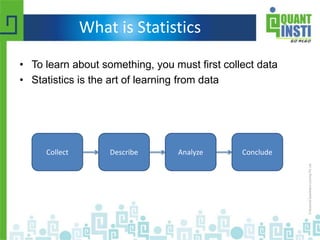
What is Statistics
• To learn about something, you must first collect data
• Statistics is the art of learning from data
Collect Describe ConcludeAnalyze
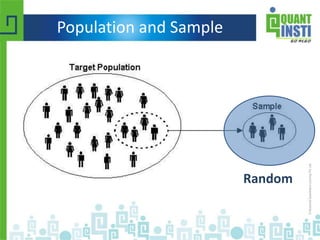
Population and Sample
Random
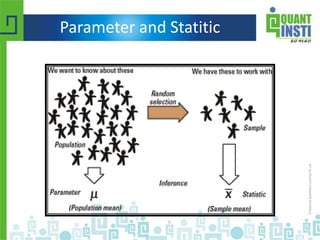
Parameter and Statitic
Branches of Statistics
• Descriptive statistics:
– Organization, summarization, and display of data.
• Inferential statistics:
– Draw conclusions about a population
– Probability is a basic tool
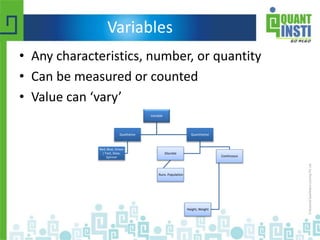
Variables
• Any characteristics, number, or quantity
• Can be measured or counted
• Value can ‘vary’
Variable
Qualitative
Red, Blue, Green
/ Fast, Slow,
Spinner
Quantitative
Continuous
Height, Weight
Discrete
Runs. Population
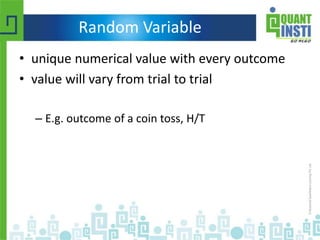
Random Variable
• unique numerical value with every outcome
• value will vary from trial to trial
– E.g. outcome of a coin toss, H/T
Classification of Data
According to number of variables
• Univariate
– only one variable, e.g. average weight
• Bivariate
– two variables, e.g. relationship between the height
and weight
Central Tendency
• Mean
– Sum of observations / number of observations
• Median
– Middle value of observations
• Mode
– Most frequently occurring value
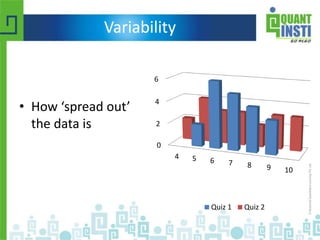
Variability
• How ‘spread out’
the data is
0
2
4
6
4 5 6 7 8 9 10
Quiz 1 Quiz 2
Range and Quartile
• Range
– Difference between largest and smallest value
• Quartile
– Divide a rank-ordered data into four equal parts
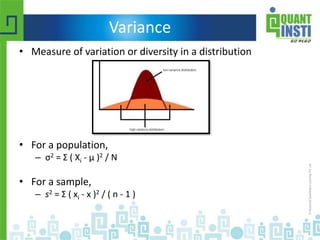
Variance
• Measure of variation or diversity in a distribution
• For a population,
– σ2 = Σ ( Xi - μ )2 / N
• For a sample,
– s2 = Σ ( xi - x )2 / ( n - 1 )
Standard Deviation
• For a population
– σ = sqrt[ σ2 ] = sqrt [ Σ ( Xi - μ )2 / N ]
• For a sample
– s = sqrt[ s2 ] = sqrt [ Σ ( xi - x )2 / ( n - 1 ) ]
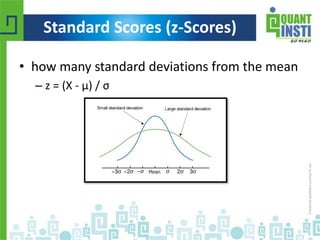
Standard Scores (z-Scores)
• how many standard deviations from the mean
– z = (X - μ) / σ
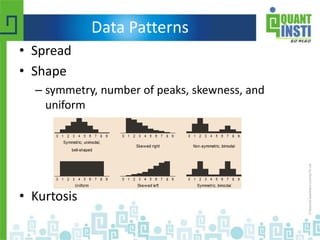
Data Patterns
• Spread
• Shape
– symmetry, number of peaks, skewness, and
uniform
• Kurtosis
Basics of Set Theory - I
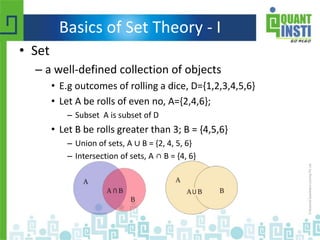
• Set
– a well-defined collection of objects
• E.g outcomes of rolling a dice, D={1,2,3,4,5,6}
• Let A be rolls of even no, A={2,4,6};
– Subset A is subset of D
• Let B be rolls greater than 3; B = {4,5,6}
– Union of sets, A ∪ B = {2, 4, 5, 6}
– Intersection of sets, A ∩ B = {4, 6}
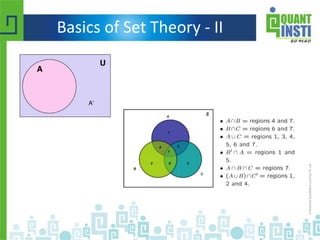
Basics of Set Theory - II
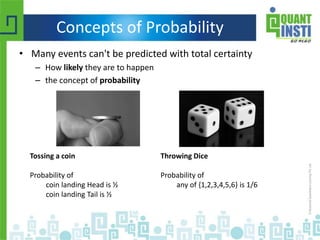
Concepts of Probability
• Many events can't be predicted with total certainty
– How likely they are to happen
– the concept of probability
Tossing a coin
Probability of
coin landing Head is ½
coin landing Tail is ½
Throwing Dice
Probability of
any of {1,2,3,4,5,6} is 1/6
Some Definitions
• Sample Space (S)
– all possible outcomes of a statistical experiment
– e.g. {H,T}, {1,2,3,4,5,6}
• Events (E)
– sets, or collections, of outcomes
– e.g. roll and even number {2,4,6}
– Mutually exclusive or not
• Sample Point
– One possible outcome
Probability Model
• Probability function P
– Assigns a number to each outcome
– Cannot be negative, i.e. P≥0
– Sum of all probabilities in sample space = 1, i.e. ∑P
=1
– For event A,
• P(A) =
Number of outcomes favourable to A
Total number of outcomes for the experiment
– E.g. A coin is tossed twice. What is the probability
that at least on head occurs?
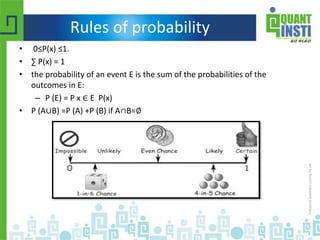
Rules of probability
• 0≤P(x) ≤1.
• ∑ P(x) = 1
• the probability of an event E is the sum of the probabilities of the
outcomes in E:
– P (E) = P x ∈ E P(x)
• P (A∪B) =P (A) +P (B) if A∩B=∅
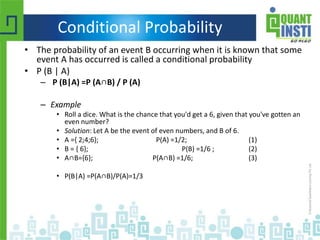
Conditional Probability
• The probability of an event B occurring when it is known that some
event A has occurred is called a conditional probability
• P (B | A)
– P (B|A) =P (A∩B) / P (A)
– Example
• Roll a dice. What is the chance that you'd get a 6, given that you've gotten an
even number?
• Solution: Let A be the event of even numbers, and B of 6.
• A ={ 2;4;6}; P(A) =1/2; (1)
• B = { 6}; P(B) =1/6 ; (2)
• A∩B={6}; P(A∩B) =1/6; (3)
• P(B|A) =P(A∩B)/P(A)=1/3
Rules of Probability
• Addition
– Event A or Event B occurs
• P (A ∪ B) = P (A) + P (B) - P (A ∩ B))
– Mutually exclusive
• Subtraction
– Event A will not occur
• P (A) = 1 - P (A')
• Multiplication
– Event A and Event B
• P (A ∩ B) = P (A) * P (B|A)
– Independent events
Venn Diagrams
Bayes’ Theorem
• P(A 𝑘|B) =
P(Ak∩B)
P(A1∩B) + P(A2∩B) + ... + P(An∩B)
– Useful for calculating conditional probabilities
• A1, A2, ... , Anmutually exclusive, form S
• B is even from sample space, P(B)>0
– Also written as
• P(Ak|B) =
P(Ak)P(B|Ak)
P(A1)P(B|A1)+P(A2)P(B|A2)+...+P(An)P(B|An)
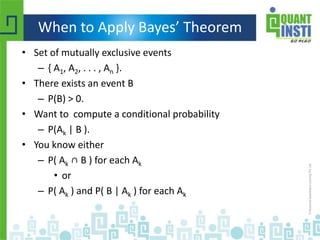
When to Apply Bayes’ Theorem
• Set of mutually exclusive events
– { A1, A2, . . . , An }.
• There exists an event B
– P(B) > 0.
• Want to compute a conditional probability
– P(Ak | B ).
• You know either
– P( Ak ∩ B ) for each Ak
• or
– P( Ak ) and P( B | Ak ) for each Ak
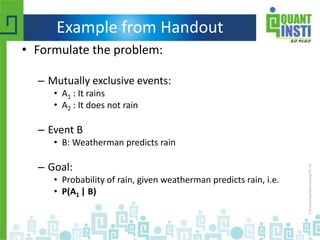
Example from Handout
• Formulate the problem:
– Mutually exclusive events:
• A1 : It rains
• A2 : It does not rain
– Event B
• B: Weatherman predicts rain
– Goal:
• Probability of rain, given weatherman predicts rain, i.e.
• P(A1 | B)
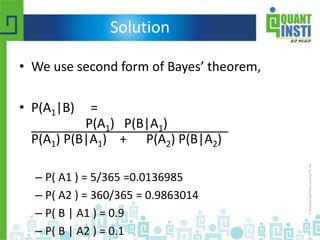
Solution
• We use second form of Bayes’ theorem,
• P(A1|B) =
P(A1) P(B|A1)
P(A1) P(B|A1) + P(A2) P(B|A2)
– P( A1 ) = 5/365 =0.0136985
– P( A2 ) = 360/365 = 0.9863014
– P( B | A1 ) = 0.9
– P( B | A2 ) = 0.1
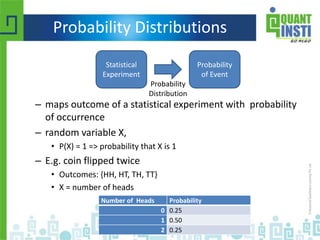
Probability Distributions
– maps outcome of a statistical experiment with probability
of occurrence
– random variable X,
• P(X) = 1 => probability that X is 1
– E.g. coin flipped twice
• Outcomes: {HH, HT, TH, TT}
• X = number of heads
Statistical
Experiment
Probability
of Event
Probability
Distribution
Number of Heads Probability
0 0.25
1 0.50
2 0.25
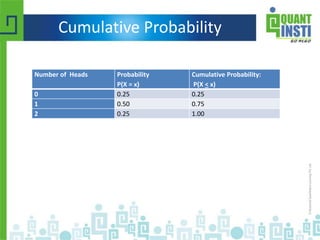
Cumulative Probability
Number of Heads Probability
P(X = x)
Cumulative Probability:
P(X < x)
0 0.25 0.25
1 0.50 0.75
2 0.25 1.00
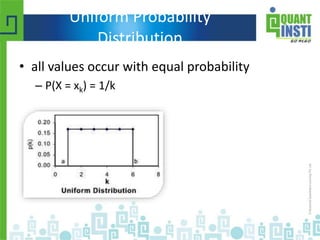
Uniform Probability
Distribution
• all values occur with equal probability
– P(X = xk) = 1/k
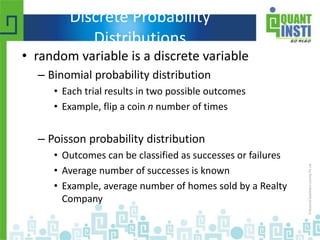
Discrete Probability
Distributions
• random variable is a discrete variable
– Binomial probability distribution
• Each trial results in two possible outcomes
• Example, flip a coin n number of times
– Poisson probability distribution
• Outcomes can be classified as successes or failures
• Average number of successes is known
• Example, average number of homes sold by a Realty
Company
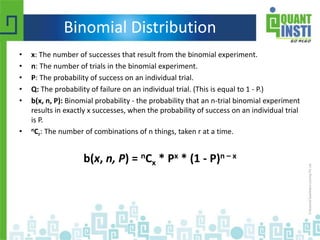
Binomial Distribution
• x: The number of successes that result from the binomial experiment.
• n: The number of trials in the binomial experiment.
• P: The probability of success on an individual trial.
• Q: The probability of failure on an individual trial. (This is equal to 1 - P.)
• b(x, n, P): Binomial probability - the probability that an n-trial binomial experiment
results in exactly x successes, when the probability of success on an individual trial
is P.
• nCr: The number of combinations of n things, taken r at a time.
b(x, n, P) = nCx * Px * (1 - P)n – x
Binomial Distribution
Number of heads Probability
0 0.25
1 0.50
2 0.25
The mean of the distribution (μx) is equal to n * P .
The variance (σ2
x) is n * P * ( 1 - P )
The standard deviation (σx) is sqrt[ n * P * ( 1 - P ) ].
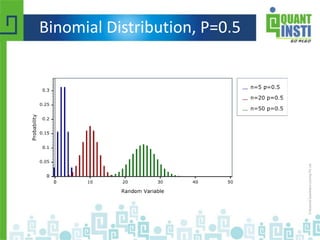
Binomial Distribution, P=0.5
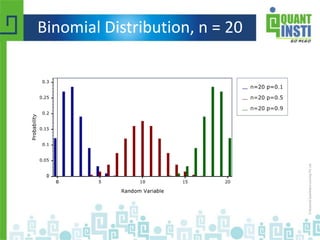
Binomial Distribution, n = 20
Cumulative Binomial Probability
• probability that the binomial random variable
falls within a specified range
• example, the cumulative binomial probability
of obtaining 45 or fewer heads in 100 tosses
of a coin
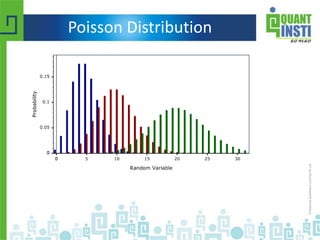
Poisson Distribution
• Outcomes that can be classified as successes or failures.
• Average number of successes in a specified region is known.
• The probability that a success will occur is proportional to the size of the
region.
• The probability that a success will occur in an extremely small region is
virtually zero
• e: A constant equal to approximately 2.71828.
• λ or μ: The mean number of successes that occur in a specified region.
• x: The actual number of successes that occur in a specified region.
• P(x; λ or μ): The Poisson probability that exactly x successes occur in a Poisson
experiment, when the mean number of successes is μ.
P(x; λ) = (e-λ) λx) / x!
Poisson Distribution
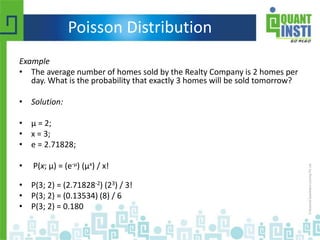
Example
• The average number of homes sold by the Realty Company is 2 homes per
day. What is the probability that exactly 3 homes will be sold tomorrow?
• Solution:
• μ = 2;
• x = 3;
• e = 2.71828;
• P(x; μ) = (e-μ) (μx) / x!
• P(3; 2) = (2.71828-2) (23) / 3!
• P(3; 2) = (0.13534) (8) / 6
• P(3; 2) = 0.180
Normal Distribution
X = { 1/[ σ * sqrt(2π) ] } * e^(-(x-μ)^2 /2 /σ^2 )
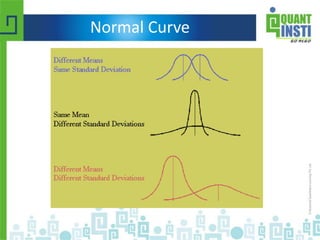
Normal Curve
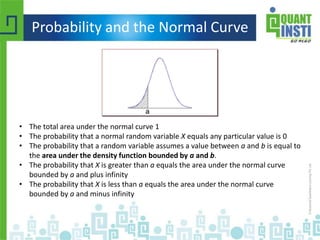
Probability and the Normal Curve
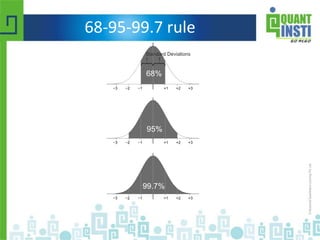
• The total area under the normal curve 1
• The probability that a normal random variable X equals any particular value is 0
• The probability that a random variable assumes a value between a and b is equal to
the area under the density function bounded by a and b.
• The probability that X is greater than a equals the area under the normal curve
bounded by a and plus infinity
• The probability that X is less than a equals the area under the normal curve
bounded by a and minus infinity
68-95-99.7 rule
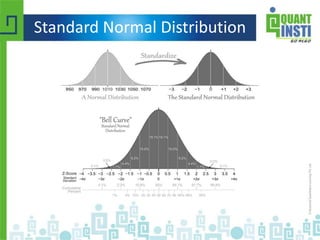
Standard Normal Distribution
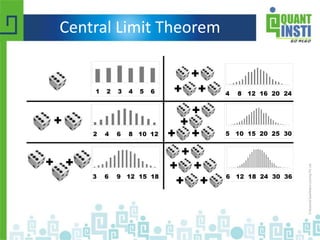
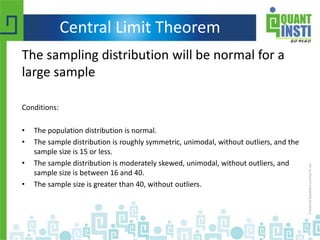
Central Limit Theorem
The sampling distribution will be normal for a
large sample
Conditions:
• The population distribution is normal.
• The sample distribution is roughly symmetric, unimodal, without outliers, and the
sample size is 15 or less.
• The sample distribution is moderately skewed, unimodal, without outliers, and
sample size is between 16 and 40.
• The sample size is greater than 40, without outliers.
Student's t Distribution
• t = [x - μ] / [s / sqrt( n ) ]
• Small sample sizes
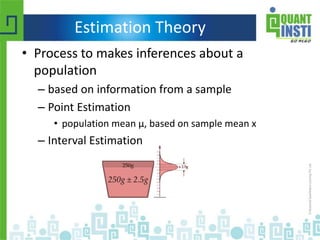
Estimation Theory
• Process to makes inferences about a
population
– based on information from a sample
– Point Estimation
• population mean μ, based on sample mean x
– Interval Estimation
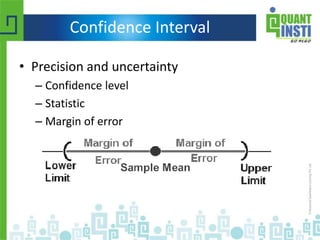
Confidence Interval
• Precision and uncertainty
– Confidence level
– Statistic
– Margin of error
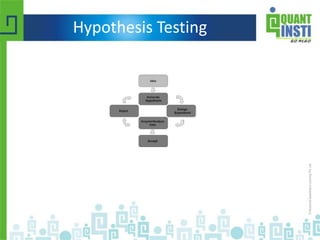
Hypothesis Testing
Statistical Hypotheses
• Examine random sample from a population
• Null hypothesis
– H0
– observations result purely from chance.
• Alternative hypothesis
– Ha
– observations are influenced by some non-random
cause.
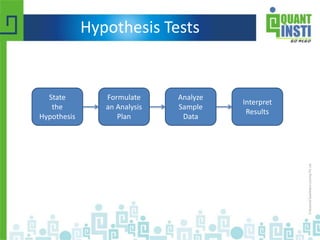
Hypothesis Tests
State
the
Hypothesis
Formulate
an Analysis
Plan
Interpret
Results
Analyze
Sample
Data
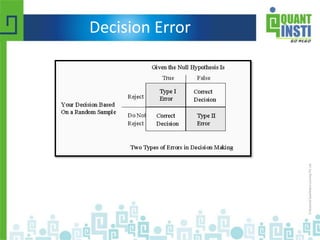
Decision Error
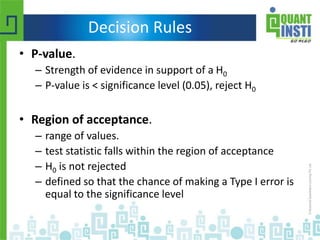
Decision Rules
• P-value.
– Strength of evidence in support of a H0
– P-value is < significance level (0.05), reject H0
• Region of acceptance.
– range of values.
– test statistic falls within the region of acceptance
– H0 is not rejected
– defined so that the chance of making a Type I error is
equal to the significance level
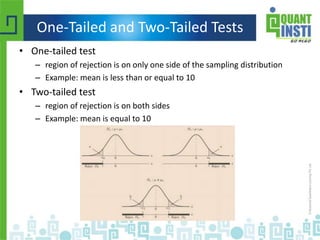
One-Tailed and Two-Tailed Tests
• One-tailed test
– region of rejection is on only one side of the sampling distribution
– Example: mean is less than or equal to 10
• Two-tailed test
– region of rejection is on both sides
– Example: mean is equal to 10
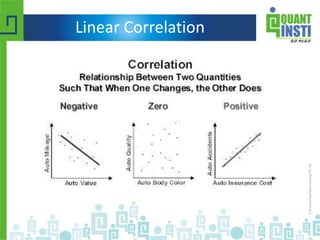
Linear Correlation
Correlation Coefficients
• Measure the strength of association between two
variables
• Pearson product-moment correlation coefficient
r = Σ (xy) / sqrt[ ( Σ x2 ) * ( Σ y2 ) ]
– x = xi - x,
– xi is the x value for observation i
– x is the mean x value,
– y = yi – y
– yi is the y value for observation I
– y is the mean y value.
Correlation Coefficients
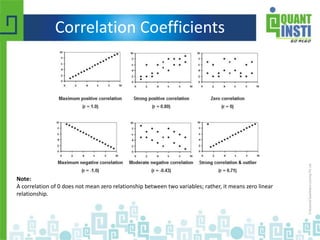
Note:
A correlation of 0 does not mean zero relationship between two variables; rather, it means zero linear
relationship.
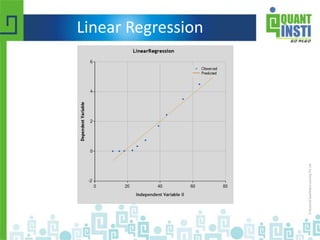
Linear Regression
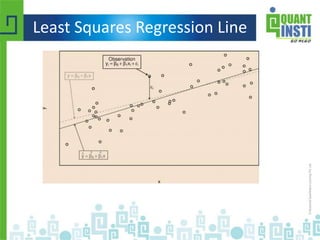
Least Squares Regression Line
Regression line
• ŷ = b0 + b1x
– b1 = Σ [ (xi - x)(yi - y) ] / Σ [ (xi - x)2]
– b1 = r * (sy / sx)
– b0 = y - b1 * x
• b0 is the constant in the regression equation
• b1 is the regression coefficient
• r is the correlation between x and y
• xi is the X value of observation I
• yi is the Y value of observation I
• x is the mean of X
• y is the mean of Y
• sx is the standard deviation of X
• sy is the standard deviation of Y
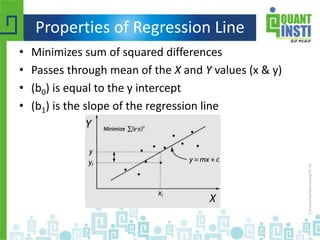
Properties of Regression Line
• Minimizes sum of squared differences
• Passes through mean of the X and Y values (x & y)
• (b0) is equal to the y intercept
• (b1) is the slope of the regression line
Coefficient of Determination
• R2
– Between 0 and 1
– R2 = 0, dependent variable cannot be predicted
– R2 = 1, dependent variable can be predicted without error
– An R2 between 0 and 1 indicates the extent to which the
dependent variable is predictable.
• R2 = 0.10 means that 10% of the variance in Y is predictable from X
• R2 = 0.20 means that 20% is predictable
R2 = { ( 1 / N ) * Σ [ (xi - x) * (yi - y) ] / (σx * σy ) }2
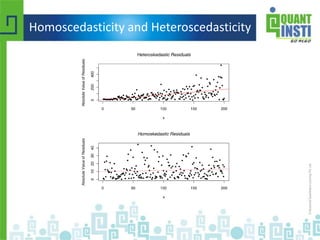
Homoscedasticity and Heteroscedasticity
Thank You!
To Learn Automated Trading
Email: contact@quantinsti.com
Connect With Us:
SINGAPORE
11 Collyer Quay,
#10-10, The Arcade,
Singapore - 049317
Phone: +65-6221-3654
INDIA
A-309, Boomerang,
Chandivali Farm Road, Powai,
Mumbai - 400 072
Phone: +91-022-61691400

Basic statistics for algorithmic trading

  • 1.
  • 2.
    What is Statistics •To learn about something, you must first collect data • Statistics is the art of learning from data Collect Describe ConcludeAnalyze
  • 3.
  • 4.
  • 5.
    Branches of Statistics •Descriptive statistics: – Organization, summarization, and display of data. • Inferential statistics: – Draw conclusions about a population – Probability is a basic tool
  • 6.
    Variables • Any characteristics,number, or quantity • Can be measured or counted • Value can ‘vary’ Variable Qualitative Red, Blue, Green / Fast, Slow, Spinner Quantitative Continuous Height, Weight Discrete Runs. Population
  • 7.
    Random Variable • uniquenumerical value with every outcome • value will vary from trial to trial – E.g. outcome of a coin toss, H/T
  • 8.
    Classification of Data Accordingto number of variables • Univariate – only one variable, e.g. average weight • Bivariate – two variables, e.g. relationship between the height and weight
  • 9.
    Central Tendency • Mean –Sum of observations / number of observations • Median – Middle value of observations • Mode – Most frequently occurring value
  • 10.
    Variability • How ‘spreadout’ the data is 0 2 4 6 4 5 6 7 8 9 10 Quiz 1 Quiz 2
  • 11.
    Range and Quartile •Range – Difference between largest and smallest value • Quartile – Divide a rank-ordered data into four equal parts
  • 12.
    Variance • Measure ofvariation or diversity in a distribution • For a population, – σ2 = Σ ( Xi - μ )2 / N • For a sample, – s2 = Σ ( xi - x )2 / ( n - 1 )
  • 13.
    Standard Deviation • Fora population – σ = sqrt[ σ2 ] = sqrt [ Σ ( Xi - μ )2 / N ] • For a sample – s = sqrt[ s2 ] = sqrt [ Σ ( xi - x )2 / ( n - 1 ) ]
  • 14.
    Standard Scores (z-Scores) •how many standard deviations from the mean – z = (X - μ) / σ
  • 15.
    Data Patterns • Spread •Shape – symmetry, number of peaks, skewness, and uniform • Kurtosis
  • 16.
    Basics of SetTheory - I • Set – a well-defined collection of objects • E.g outcomes of rolling a dice, D={1,2,3,4,5,6} • Let A be rolls of even no, A={2,4,6}; – Subset A is subset of D • Let B be rolls greater than 3; B = {4,5,6} – Union of sets, A ∪ B = {2, 4, 5, 6} – Intersection of sets, A ∩ B = {4, 6}
  • 17.
    Basics of SetTheory - II
  • 18.
    Concepts of Probability •Many events can't be predicted with total certainty – How likely they are to happen – the concept of probability Tossing a coin Probability of coin landing Head is ½ coin landing Tail is ½ Throwing Dice Probability of any of {1,2,3,4,5,6} is 1/6
  • 19.
    Some Definitions • SampleSpace (S) – all possible outcomes of a statistical experiment – e.g. {H,T}, {1,2,3,4,5,6} • Events (E) – sets, or collections, of outcomes – e.g. roll and even number {2,4,6} – Mutually exclusive or not • Sample Point – One possible outcome
  • 20.
    Probability Model • Probabilityfunction P – Assigns a number to each outcome – Cannot be negative, i.e. P≥0 – Sum of all probabilities in sample space = 1, i.e. ∑P =1 – For event A, • P(A) = Number of outcomes favourable to A Total number of outcomes for the experiment – E.g. A coin is tossed twice. What is the probability that at least on head occurs?
  • 21.
    Rules of probability •0≤P(x) ≤1. • ∑ P(x) = 1 • the probability of an event E is the sum of the probabilities of the outcomes in E: – P (E) = P x ∈ E P(x) • P (A∪B) =P (A) +P (B) if A∩B=∅
  • 22.
    Conditional Probability • Theprobability of an event B occurring when it is known that some event A has occurred is called a conditional probability • P (B | A) – P (B|A) =P (A∩B) / P (A) – Example • Roll a dice. What is the chance that you'd get a 6, given that you've gotten an even number? • Solution: Let A be the event of even numbers, and B of 6. • A ={ 2;4;6}; P(A) =1/2; (1) • B = { 6}; P(B) =1/6 ; (2) • A∩B={6}; P(A∩B) =1/6; (3) • P(B|A) =P(A∩B)/P(A)=1/3
  • 23.
    Rules of Probability •Addition – Event A or Event B occurs • P (A ∪ B) = P (A) + P (B) - P (A ∩ B)) – Mutually exclusive • Subtraction – Event A will not occur • P (A) = 1 - P (A') • Multiplication – Event A and Event B • P (A ∩ B) = P (A) * P (B|A) – Independent events
  • 24.
  • 25.
    Bayes’ Theorem • P(A𝑘|B) = P(Ak∩B) P(A1∩B) + P(A2∩B) + ... + P(An∩B) – Useful for calculating conditional probabilities • A1, A2, ... , Anmutually exclusive, form S • B is even from sample space, P(B)>0 – Also written as • P(Ak|B) = P(Ak)P(B|Ak) P(A1)P(B|A1)+P(A2)P(B|A2)+...+P(An)P(B|An)
  • 26.
    When to ApplyBayes’ Theorem • Set of mutually exclusive events – { A1, A2, . . . , An }. • There exists an event B – P(B) > 0. • Want to compute a conditional probability – P(Ak | B ). • You know either – P( Ak ∩ B ) for each Ak • or – P( Ak ) and P( B | Ak ) for each Ak
  • 27.
    Example from Handout •Formulate the problem: – Mutually exclusive events: • A1 : It rains • A2 : It does not rain – Event B • B: Weatherman predicts rain – Goal: • Probability of rain, given weatherman predicts rain, i.e. • P(A1 | B)
  • 28.
    Solution • We usesecond form of Bayes’ theorem, • P(A1|B) = P(A1) P(B|A1) P(A1) P(B|A1) + P(A2) P(B|A2) – P( A1 ) = 5/365 =0.0136985 – P( A2 ) = 360/365 = 0.9863014 – P( B | A1 ) = 0.9 – P( B | A2 ) = 0.1
  • 29.
    Probability Distributions – mapsoutcome of a statistical experiment with probability of occurrence – random variable X, • P(X) = 1 => probability that X is 1 – E.g. coin flipped twice • Outcomes: {HH, HT, TH, TT} • X = number of heads Statistical Experiment Probability of Event Probability Distribution Number of Heads Probability 0 0.25 1 0.50 2 0.25
  • 30.
    Cumulative Probability Number ofHeads Probability P(X = x) Cumulative Probability: P(X < x) 0 0.25 0.25 1 0.50 0.75 2 0.25 1.00
  • 31.
    Uniform Probability Distribution • allvalues occur with equal probability – P(X = xk) = 1/k
  • 32.
    Discrete Probability Distributions • randomvariable is a discrete variable – Binomial probability distribution • Each trial results in two possible outcomes • Example, flip a coin n number of times – Poisson probability distribution • Outcomes can be classified as successes or failures • Average number of successes is known • Example, average number of homes sold by a Realty Company
  • 33.
    Binomial Distribution • x:The number of successes that result from the binomial experiment. • n: The number of trials in the binomial experiment. • P: The probability of success on an individual trial. • Q: The probability of failure on an individual trial. (This is equal to 1 - P.) • b(x, n, P): Binomial probability - the probability that an n-trial binomial experiment results in exactly x successes, when the probability of success on an individual trial is P. • nCr: The number of combinations of n things, taken r at a time. b(x, n, P) = nCx * Px * (1 - P)n – x
  • 34.
    Binomial Distribution Number ofheads Probability 0 0.25 1 0.50 2 0.25 The mean of the distribution (μx) is equal to n * P . The variance (σ2 x) is n * P * ( 1 - P ) The standard deviation (σx) is sqrt[ n * P * ( 1 - P ) ].
  • 35.
  • 36.
  • 37.
    Cumulative Binomial Probability •probability that the binomial random variable falls within a specified range • example, the cumulative binomial probability of obtaining 45 or fewer heads in 100 tosses of a coin
  • 38.
    Poisson Distribution • Outcomesthat can be classified as successes or failures. • Average number of successes in a specified region is known. • The probability that a success will occur is proportional to the size of the region. • The probability that a success will occur in an extremely small region is virtually zero • e: A constant equal to approximately 2.71828. • λ or μ: The mean number of successes that occur in a specified region. • x: The actual number of successes that occur in a specified region. • P(x; λ or μ): The Poisson probability that exactly x successes occur in a Poisson experiment, when the mean number of successes is μ. P(x; λ) = (e-λ) λx) / x!
  • 39.
  • 40.
    Poisson Distribution Example • Theaverage number of homes sold by the Realty Company is 2 homes per day. What is the probability that exactly 3 homes will be sold tomorrow? • Solution: • μ = 2; • x = 3; • e = 2.71828; • P(x; μ) = (e-μ) (μx) / x! • P(3; 2) = (2.71828-2) (23) / 3! • P(3; 2) = (0.13534) (8) / 6 • P(3; 2) = 0.180
  • 41.
    Normal Distribution X ={ 1/[ σ * sqrt(2π) ] } * e^(-(x-μ)^2 /2 /σ^2 )
  • 42.
  • 43.
    Probability and theNormal Curve • The total area under the normal curve 1 • The probability that a normal random variable X equals any particular value is 0 • The probability that a random variable assumes a value between a and b is equal to the area under the density function bounded by a and b. • The probability that X is greater than a equals the area under the normal curve bounded by a and plus infinity • The probability that X is less than a equals the area under the normal curve bounded by a and minus infinity
  • 44.
  • 45.
  • 46.
  • 47.
    Central Limit Theorem Thesampling distribution will be normal for a large sample Conditions: • The population distribution is normal. • The sample distribution is roughly symmetric, unimodal, without outliers, and the sample size is 15 or less. • The sample distribution is moderately skewed, unimodal, without outliers, and sample size is between 16 and 40. • The sample size is greater than 40, without outliers.
  • 48.
    Student's t Distribution •t = [x - μ] / [s / sqrt( n ) ] • Small sample sizes
  • 49.
    Estimation Theory • Processto makes inferences about a population – based on information from a sample – Point Estimation • population mean μ, based on sample mean x – Interval Estimation
  • 50.
    Confidence Interval • Precisionand uncertainty – Confidence level – Statistic – Margin of error
  • 51.
  • 52.
    Statistical Hypotheses • Examinerandom sample from a population • Null hypothesis – H0 – observations result purely from chance. • Alternative hypothesis – Ha – observations are influenced by some non-random cause.
  • 53.
  • 54.
  • 55.
    Decision Rules • P-value. –Strength of evidence in support of a H0 – P-value is < significance level (0.05), reject H0 • Region of acceptance. – range of values. – test statistic falls within the region of acceptance – H0 is not rejected – defined so that the chance of making a Type I error is equal to the significance level
  • 56.
    One-Tailed and Two-TailedTests • One-tailed test – region of rejection is on only one side of the sampling distribution – Example: mean is less than or equal to 10 • Two-tailed test – region of rejection is on both sides – Example: mean is equal to 10
  • 57.
  • 58.
    Correlation Coefficients • Measurethe strength of association between two variables • Pearson product-moment correlation coefficient r = Σ (xy) / sqrt[ ( Σ x2 ) * ( Σ y2 ) ] – x = xi - x, – xi is the x value for observation i – x is the mean x value, – y = yi – y – yi is the y value for observation I – y is the mean y value.
  • 59.
    Correlation Coefficients Note: A correlationof 0 does not mean zero relationship between two variables; rather, it means zero linear relationship.
  • 60.
  • 61.
  • 62.
    Regression line • ŷ= b0 + b1x – b1 = Σ [ (xi - x)(yi - y) ] / Σ [ (xi - x)2] – b1 = r * (sy / sx) – b0 = y - b1 * x • b0 is the constant in the regression equation • b1 is the regression coefficient • r is the correlation between x and y • xi is the X value of observation I • yi is the Y value of observation I • x is the mean of X • y is the mean of Y • sx is the standard deviation of X • sy is the standard deviation of Y
  • 63.
    Properties of RegressionLine • Minimizes sum of squared differences • Passes through mean of the X and Y values (x & y) • (b0) is equal to the y intercept • (b1) is the slope of the regression line
  • 64.
    Coefficient of Determination •R2 – Between 0 and 1 – R2 = 0, dependent variable cannot be predicted – R2 = 1, dependent variable can be predicted without error – An R2 between 0 and 1 indicates the extent to which the dependent variable is predictable. • R2 = 0.10 means that 10% of the variance in Y is predictable from X • R2 = 0.20 means that 20% is predictable R2 = { ( 1 / N ) * Σ [ (xi - x) * (yi - y) ] / (σx * σy ) }2
  • 65.
  • 66.
    Thank You! To LearnAutomated Trading Email: contact@quantinsti.com Connect With Us: SINGAPORE 11 Collyer Quay, #10-10, The Arcade, Singapore - 049317 Phone: +65-6221-3654 INDIA A-309, Boomerang, Chandivali Farm Road, Powai, Mumbai - 400 072 Phone: +91-022-61691400