Random Variables
          VOCABULARY
       RANDOM VARIABLE
  PROBABILITY DISTRIBUTION
        EXPECTED VALUE
    LAW OF LARGE NUMBERS
    BINOMIAL DISTRIBUTION
 BINOMIAL RANDOM VARIABLE
     BINOMIAL COEFFICIENT
GEOMETRIC RANDOM VARIABLE
   GEOMETRIC DISTRIBUTION
          SIMULATION
Key Points


 A random variable is a numerical measure(face up number of a
  die) of the outcomes of a random phenomenon(rolling a die)
 If X is a random variable and a and b are fixed numbers, then
  μₐ₊ᵦₓ= a+βµₓ and Ợ²ₐ₊ᵦₓ=b²Ợ²x
 If X and Y are random variables, then μₓ₊ᵧ= μₓ + μᵧ
 If X and Y are independent random variables, then Ợ² ₓ₊ᵧ=
  Ợ²ₓ + Ợ²ᵧ and Ợ² ₓ₋ᵧ= Ợ²ₓ + Ợ²ᵧ
 As the number of trials in a binomial distribution gets
  larger, the binomial distribution gets closer to a normal
  distribution
Random Phenomenom


  Picking a student at random
Random Phenomenom


Clicking a Facebook profile at random
Random Variable

 A ______ ______ is a numerical measure of the
  outcomes of a random phenomenon
 The driving force behind many decisions in
  science, business, and every day life is the
  question, “What are the chances?”
 Picking a student at random is a random
  phenomenon.
 The students grades, height, etc are random
  variables that describe properties of the student.
Random Variable


The random variables can be: goals inside, goals outside, goals with
                         right foot, etc..
Random Variable


The random variables can be: # of friends, # of miles ran, # of books
                        recently read, etc
Random Variable


The random variables can be categorical as well( top album, movies
                 watched, favorite artists, etc)
Random Variable- Probability distribution

 A _______ ________ is a listing or graphing of
 the probabilities associated with a random variable
Random Variable- Probability(or population)
              distribution


   The probability distribution can be used to answer
   questions about the variable x( which in this case is the
   number of tails obtained when a fair coin is tossed three
   times)

   Example: What is probability that there is at least one tails
   in three tosses of the coin? This question is written as
   P(X≥1)

   P(X≥1)= P(X=1) + P(X=2)+ P(X=3)= 1/8 +3/8+3/8= 7/8
Random variable- discrete and continuous


 _______ random variables takes a countable
 number of values(# of votes a certain candidate
 receives)

 _______ random variables can take all the possible
 values in a given range(the weight of animals in a
 certain regions)
Discrete Probability Distribution


Probabilities of certain number of surf boards being sold

Doesn’t make sense for someone to purchase 1.3 surfboards
Continuous Probability Distribution


Infinite values of x are represented with a Continuous Probability
                            Distribution
Random variable- expected value

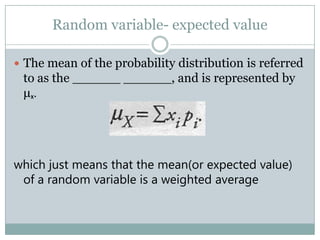
 The mean of the probability distribution is referred
 to as the ______ ______, and is represented by
 μₓ.


which just means that the mean(or expected value)
 of a random variable is a weighted average
Random Variable- Expected Value


For this probability distribution, the
expected value is

= 0(1/8) + 1(3/8) + 2(3/8) + 3(1/8)= 12/8=
1.5
Law of Large Numbers

 The _______ of _______ _______states that the
 actual mean of many trials approaches the true mean
 of the distribution as the number of trials increases
Rules for Means and Variances of Random
                Variables
Binomial Distribution

 ________ ________ models situations with the
 following conditions:

1. Each observation falls into one of just two categories(
   success or failure)
2. The number of observations is the fixed number n
3. The n observations are all independent
4. The probability of success, p, is the same for each
   observation
Binomial Distribution

 For data produced with the binomial model, the
  binomial random variable is the number of
  successes, X.
 The probability distribution of X is a binomial
  distribution
 When finding binomial probabilities, remember that
  you are finding the probability of obtaining k successes
  in n trials
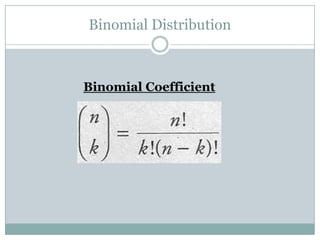
Binomial Distribution


Binomial Coefficient
Binomial Distribution


Binomial Coefficient
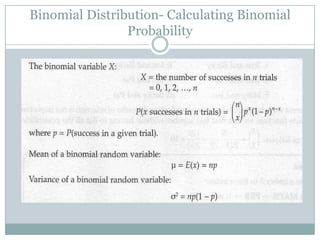
Binomial Distribution- Calculating Binomial
                Probability
Binomial Distribution- Calculating binomial
                probability
Mean and Standard deviation of Binomial
             Distribution
Geometric Distribution

 Each observation falls into one of two categories,
  success or failure
 The variable of interest (usually X) is the number of
  trials required to obtain the first success
 The n observations are all independent
 The probability of success, p, is the same for each
  observation
Geometric Distribution


Example: If one planned to roll a die until they got a 5, the random
variable X= the number of trials until the first 5 occurs.

Find the probability that it would take 8 rolls given that all the
conditions of the geometric model are met
Geometric Distribution

 Expected Value of Geometric Distributions

If X is a geometric random variable with probability of success P
on each trial, then the mean or _______ _______ of the
random variable is   μ= 1/p.

Random variables

  • 1.
    Random Variables VOCABULARY RANDOM VARIABLE PROBABILITY DISTRIBUTION EXPECTED VALUE LAW OF LARGE NUMBERS BINOMIAL DISTRIBUTION BINOMIAL RANDOM VARIABLE BINOMIAL COEFFICIENT GEOMETRIC RANDOM VARIABLE GEOMETRIC DISTRIBUTION SIMULATION
  • 2.
    Key Points  Arandom variable is a numerical measure(face up number of a die) of the outcomes of a random phenomenon(rolling a die)  If X is a random variable and a and b are fixed numbers, then μₐ₊ᵦₓ= a+βµₓ and Ợ²ₐ₊ᵦₓ=b²Ợ²x  If X and Y are random variables, then μₓ₊ᵧ= μₓ + μᵧ  If X and Y are independent random variables, then Ợ² ₓ₊ᵧ= Ợ²ₓ + Ợ²ᵧ and Ợ² ₓ₋ᵧ= Ợ²ₓ + Ợ²ᵧ  As the number of trials in a binomial distribution gets larger, the binomial distribution gets closer to a normal distribution
  • 3.
    Random Phenomenom Picking a student at random
  • 4.
    Random Phenomenom Clicking aFacebook profile at random
  • 5.
    Random Variable  A______ ______ is a numerical measure of the outcomes of a random phenomenon  The driving force behind many decisions in science, business, and every day life is the question, “What are the chances?”  Picking a student at random is a random phenomenon.  The students grades, height, etc are random variables that describe properties of the student.
  • 6.
    Random Variable The randomvariables can be: goals inside, goals outside, goals with right foot, etc..
  • 7.
    Random Variable The randomvariables can be: # of friends, # of miles ran, # of books recently read, etc
  • 8.
    Random Variable The randomvariables can be categorical as well( top album, movies watched, favorite artists, etc)
  • 9.
    Random Variable- Probabilitydistribution  A _______ ________ is a listing or graphing of the probabilities associated with a random variable
  • 10.
    Random Variable- Probability(orpopulation) distribution The probability distribution can be used to answer questions about the variable x( which in this case is the number of tails obtained when a fair coin is tossed three times) Example: What is probability that there is at least one tails in three tosses of the coin? This question is written as P(X≥1) P(X≥1)= P(X=1) + P(X=2)+ P(X=3)= 1/8 +3/8+3/8= 7/8
  • 11.
    Random variable- discreteand continuous  _______ random variables takes a countable number of values(# of votes a certain candidate receives)  _______ random variables can take all the possible values in a given range(the weight of animals in a certain regions)
  • 12.
    Discrete Probability Distribution Probabilitiesof certain number of surf boards being sold Doesn’t make sense for someone to purchase 1.3 surfboards
  • 13.
    Continuous Probability Distribution Infinitevalues of x are represented with a Continuous Probability Distribution
  • 14.
    Random variable- expectedvalue  The mean of the probability distribution is referred to as the ______ ______, and is represented by μₓ. which just means that the mean(or expected value) of a random variable is a weighted average
  • 15.
    Random Variable- ExpectedValue For this probability distribution, the expected value is = 0(1/8) + 1(3/8) + 2(3/8) + 3(1/8)= 12/8= 1.5
  • 16.
    Law of LargeNumbers  The _______ of _______ _______states that the actual mean of many trials approaches the true mean of the distribution as the number of trials increases
  • 17.
    Rules for Meansand Variances of Random Variables
  • 18.
    Binomial Distribution  ________________ models situations with the following conditions: 1. Each observation falls into one of just two categories( success or failure) 2. The number of observations is the fixed number n 3. The n observations are all independent 4. The probability of success, p, is the same for each observation
  • 19.
    Binomial Distribution  Fordata produced with the binomial model, the binomial random variable is the number of successes, X.  The probability distribution of X is a binomial distribution  When finding binomial probabilities, remember that you are finding the probability of obtaining k successes in n trials
  • 20.
  • 21.
  • 22.
  • 23.
  • 24.
    Mean and Standarddeviation of Binomial Distribution
  • 25.
    Geometric Distribution  Eachobservation falls into one of two categories, success or failure  The variable of interest (usually X) is the number of trials required to obtain the first success  The n observations are all independent  The probability of success, p, is the same for each observation
  • 26.
    Geometric Distribution Example: Ifone planned to roll a die until they got a 5, the random variable X= the number of trials until the first 5 occurs. Find the probability that it would take 8 rolls given that all the conditions of the geometric model are met
  • 27.
    Geometric Distribution ExpectedValue of Geometric Distributions If X is a geometric random variable with probability of success P on each trial, then the mean or _______ _______ of the random variable is μ= 1/p.