Probability and Statistics
Week 2 – Mean and Standard Deviation, Probability Distribution
Dr. Ferdin Joe John Joseph
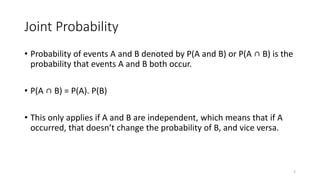
Joint Probability
• Probability of events A and B denoted by P(A and B) or P(A ∩ B) is the
probability that events A and B both occur.
• P(A ∩ B) = P(A). P(B)
• This only applies if A and B are independent, which means that if A
occurred, that doesn’t change the probability of B, and vice versa.
2
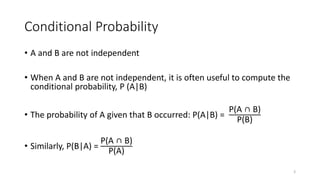
Conditional Probability
• A and B are not independent
• When A and B are not independent, it is often useful to compute the
conditional probability, P (A|B)
• The probability of A given that B occurred: P(A|B) =
P(A ∩ B)
P(B)
• Similarly, P(B|A) =
P(A ∩ B)
P(A)
3
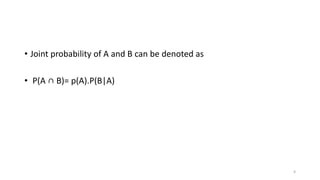
• Joint probability of A and B can be denoted as
• P(A ∩ B)= p(A).P(B|A)
4
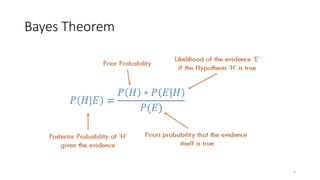
Bayes Theorem
5
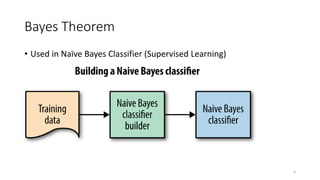
Bayes Theorem
• Used in Naïve Bayes Classifier (Supervised Learning)
6
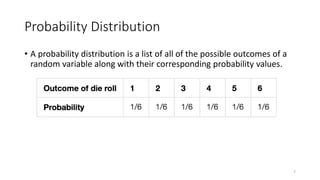
Probability Distribution
• A probability distribution is a list of all of the possible outcomes of a
random variable along with their corresponding probability values.
7
Discrete Probability Distribution
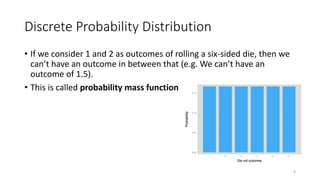
• If we consider 1 and 2 as outcomes of rolling a six-sided die, then we
can’t have an outcome in between that (e.g. We can’t have an
outcome of 1.5).
• This is called probability mass function
8
Mean
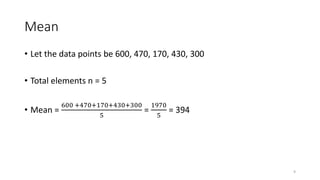
• Let the data points be 600, 470, 170, 430, 300
• Total elements n = 5
• Mean =
600 +470+170+430+300
5
=
1970
5
= 394
9
Variance
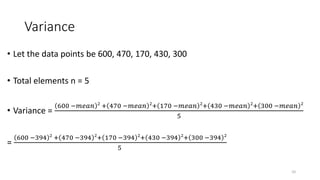
• Let the data points be 600, 470, 170, 430, 300
• Total elements n = 5
• Variance =
600 −𝑚𝑒𝑎𝑛 2
+ 470 −𝑚𝑒𝑎𝑛 2
+ 170 −𝑚𝑒𝑎𝑛 2
+ 430 −𝑚𝑒𝑎𝑛 2
+ 300 −𝑚𝑒𝑎𝑛 2
5
=
600 −394 2
+ 470 −394 2
+ 170 −394 2
+ 430 −394 2
+ 300 −394 2
5
10
Variance σ2
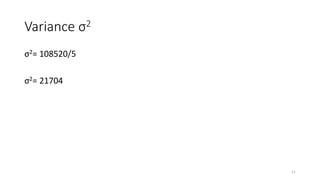
σ2= 108520/5
σ2= 21704
11
Standard Deviation
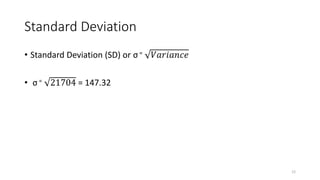
• Standard Deviation (SD) or σ = 𝑉𝑎𝑟𝑖𝑎𝑛𝑐𝑒
• σ = 21704 = 147.32
12
Probability Distribution
13
Example
14
Example
15
Discrete Probability Distributions
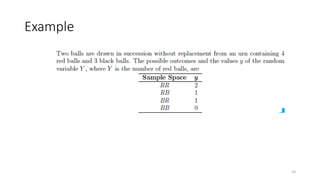
• A discrete random variable assumes each of its values with a certain
probability.
• In the case of tossing a coin three times, the variable X, representing
the number of heads, assumes the value 2 with probability 3/8, since
3 of the 8 equally likely sample points result in two heads and one
tail.
16
Discrete Probability Distribution
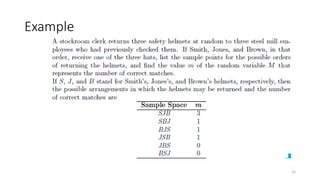
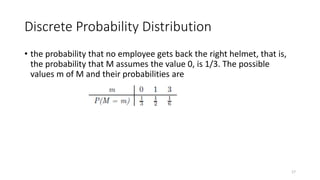
• the probability that no employee gets back the right helmet, that is,
the probability that M assumes the value 0, is 1/3. The possible
values m of M and their probabilities are
17
Discrete Probability Distribution
• Frequently, it is convenient to represent all the probabilities of a
random variable X by a formula. Such a formula would necessarily be
a function of the numerical values x that we shall denote by f(x), g(x),
r(x), and so forth. Therefore, we write f(x) = P(X = x); that is, f(3) = P(X
= 3).
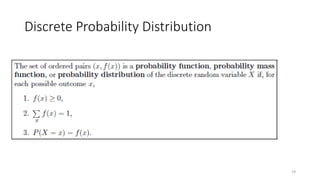
• The set of ordered pairs (x, f(x)) is called the probability function,
probability mass function, or probability distribution of the discrete
random variable X.
18
Discrete Probability Distribution
19
Example
• A shipment of 20 similar laptop computers to a retail outlet contains 3
that are defective. If a school makes a random purchase of 2 of these
computers, find the probability distribution for the number of
defectives.
20
Solution
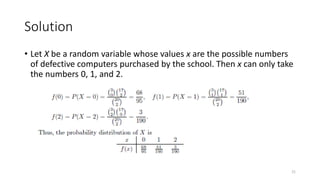
• Let X be a random variable whose values x are the possible numbers
of defective computers purchased by the school. Then x can only take
the numbers 0, 1, and 2.
21
Exercise
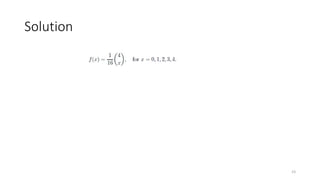
• If a car agency sells 50% of its inventory of a certain foreign car
equipped with side airbags, find a formula for the probability
distribution of the number of cars with side airbags among the next 4
cars sold by the agency.
22
Solution
23
Example
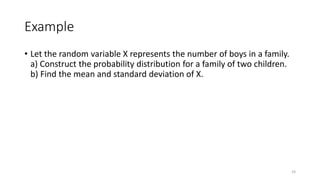
• Let the random variable X represents the number of boys in a family.
a) Construct the probability distribution for a family of two children.
b) Find the mean and standard deviation of X.
24
Solution
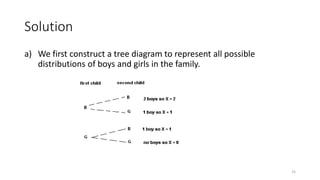
a) We first construct a tree diagram to represent all possible
distributions of boys and girls in the family.
25
Solution
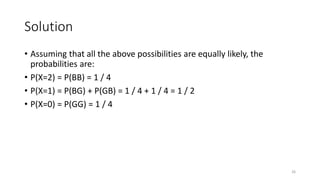
• Assuming that all the above possibilities are equally likely, the
probabilities are:
• P(X=2) = P(BB) = 1 / 4
• P(X=1) = P(BG) + P(GB) = 1 / 4 + 1 / 4 = 1 / 2
• P(X=0) = P(GG) = 1 / 4
26
Solution
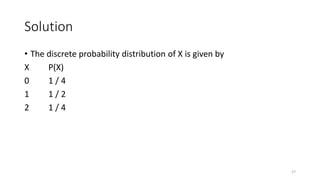
• The discrete probability distribution of X is given by
X P(X)
0 1 / 4
1 1 / 2
2 1 / 4
27
Solution
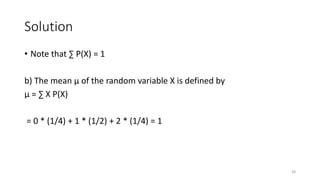
• Note that ∑ P(X) = 1
b) The mean µ of the random variable X is defined by
µ = ∑ X P(X)
= 0 * (1/4) + 1 * (1/2) + 2 * (1/4) = 1
28
Solution
• The standard deviation σ of the random variable X is defined by
SD = Square Root [ ∑ (X- µ) 2 P(X) ]
= (0 − 1) 2 ∗ (1/4) + (1 − 1) 2 ∗ (1/2) + (2 − 1) 2 ∗ (1/4)
= 1 / 2
= 1/1.414
29
Exercise
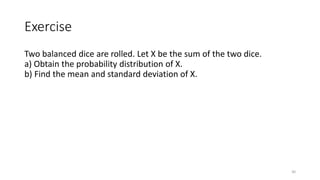
Two balanced dice are rolled. Let X be the sum of the two dice.
a) Obtain the probability distribution of X.
b) Find the mean and standard deviation of X.
30
Solution
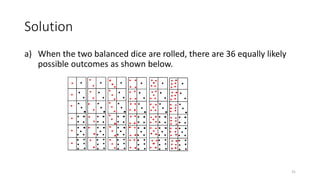
a) When the two balanced dice are rolled, there are 36 equally likely
possible outcomes as shown below.
31
Solution
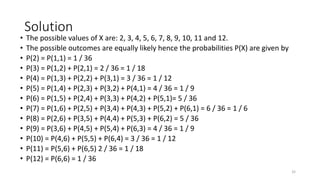
• The possible values of X are: 2, 3, 4, 5, 6, 7, 8, 9, 10, 11 and 12.
• The possible outcomes are equally likely hence the probabilities P(X) are given by
• P(2) = P(1,1) = 1 / 36
• P(3) = P(1,2) + P(2,1) = 2 / 36 = 1 / 18
• P(4) = P(1,3) + P(2,2) + P(3,1) = 3 / 36 = 1 / 12
• P(5) = P(1,4) + P(2,3) + P(3,2) + P(4,1) = 4 / 36 = 1 / 9
• P(6) = P(1,5) + P(2,4) + P(3,3) + P(4,2) + P(5,1)= 5 / 36
• P(7) = P(1,6) + P(2,5) + P(3,4) + P(4,3) + P(5,2) + P(6,1) = 6 / 36 = 1 / 6
• P(8) = P(2,6) + P(3,5) + P(4,4) + P(5,3) + P(6,2) = 5 / 36
• P(9) = P(3,6) + P(4,5) + P(5,4) + P(6,3) = 4 / 36 = 1 / 9
• P(10) = P(4,6) + P(5,5) + P(6,4) = 3 / 36 = 1 / 12
• P(11) = P(5,6) + P(6,5) 2 / 36 = 1 / 18
• P(12) = P(6,6) = 1 / 36
32
Solution
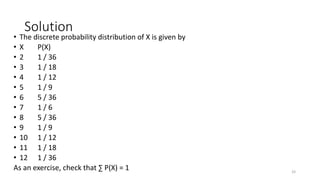
• The discrete probability distribution of X is given by
• X P(X)
• 2 1 / 36
• 3 1 / 18
• 4 1 / 12
• 5 1 / 9
• 6 5 / 36
• 7 1 / 6
• 8 5 / 36
• 9 1 / 9
• 10 1 / 12
• 11 1 / 18
• 12 1 / 36
As an exercise, check that ∑ P(X) = 1 33
Solution
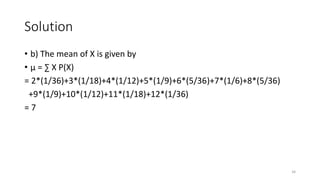
• b) The mean of X is given by
• µ = ∑ X P(X)
= 2*(1/36)+3*(1/18)+4*(1/12)+5*(1/9)+6*(5/36)+7*(1/6)+8*(5/36)
+9*(1/9)+10*(1/12)+11*(1/18)+12*(1/36)
= 7
34
Solution
• The standard deviation of is given by
SD = √ [ ∑ (X- µ) 2 P(X) ]
= √[ (2-7)2*(1/36)+(3-7)2*(1/18)
+(4-7)2*(1/12)+(5-7)2*(1/9)+(6-7)2*(5/36)
+(7-7)2*(1/6)+(8-7)2*(5/36)+(9-7)2*(1/9)
+(10-7)2*(1/12)+(11-7)2*(1/18)+(12-7)2*(1/36) ]
= 2.41
35
Exercise
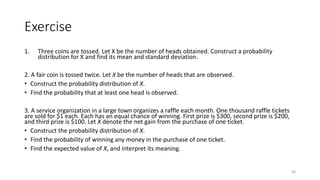
1. Three coins are tossed. Let X be the number of heads obtained. Construct a probability
distribution for X and find its mean and standard deviation.
2. A fair coin is tossed twice. Let X be the number of heads that are observed.
• Construct the probability distribution of X.
• Find the probability that at least one head is observed.
3. A service organization in a large town organizes a raffle each month. One thousand raffle tickets
are sold for $1 each. Each has an equal chance of winning. First prize is $300, second prize is $200,
and third prize is $100. Let X denote the net gain from the purchase of one ticket.
• Construct the probability distribution of X.
• Find the probability of winning any money in the purchase of one ticket.
• Find the expected value of X, and interpret its meaning.
36
Solutions
• Click Here
37
38

Probability and Statistics - Week 2

  • 1.
    Probability and Statistics Week2 – Mean and Standard Deviation, Probability Distribution Dr. Ferdin Joe John Joseph
  • 2.
    Joint Probability • Probabilityof events A and B denoted by P(A and B) or P(A ∩ B) is the probability that events A and B both occur. • P(A ∩ B) = P(A). P(B) • This only applies if A and B are independent, which means that if A occurred, that doesn’t change the probability of B, and vice versa. 2
  • 3.
    Conditional Probability • Aand B are not independent • When A and B are not independent, it is often useful to compute the conditional probability, P (A|B) • The probability of A given that B occurred: P(A|B) = P(A ∩ B) P(B) • Similarly, P(B|A) = P(A ∩ B) P(A) 3
  • 4.
    • Joint probabilityof A and B can be denoted as • P(A ∩ B)= p(A).P(B|A) 4
  • 5.
  • 6.
    Bayes Theorem • Usedin Naïve Bayes Classifier (Supervised Learning) 6
  • 7.
    Probability Distribution • Aprobability distribution is a list of all of the possible outcomes of a random variable along with their corresponding probability values. 7
  • 8.
    Discrete Probability Distribution •If we consider 1 and 2 as outcomes of rolling a six-sided die, then we can’t have an outcome in between that (e.g. We can’t have an outcome of 1.5). • This is called probability mass function 8
  • 9.
    Mean • Let thedata points be 600, 470, 170, 430, 300 • Total elements n = 5 • Mean = 600 +470+170+430+300 5 = 1970 5 = 394 9
  • 10.
    Variance • Let thedata points be 600, 470, 170, 430, 300 • Total elements n = 5 • Variance = 600 −𝑚𝑒𝑎𝑛 2 + 470 −𝑚𝑒𝑎𝑛 2 + 170 −𝑚𝑒𝑎𝑛 2 + 430 −𝑚𝑒𝑎𝑛 2 + 300 −𝑚𝑒𝑎𝑛 2 5 = 600 −394 2 + 470 −394 2 + 170 −394 2 + 430 −394 2 + 300 −394 2 5 10
  • 11.
  • 12.
    Standard Deviation • StandardDeviation (SD) or σ = 𝑉𝑎𝑟𝑖𝑎𝑛𝑐𝑒 • σ = 21704 = 147.32 12
  • 13.
  • 14.
  • 15.
  • 16.
    Discrete Probability Distributions •A discrete random variable assumes each of its values with a certain probability. • In the case of tossing a coin three times, the variable X, representing the number of heads, assumes the value 2 with probability 3/8, since 3 of the 8 equally likely sample points result in two heads and one tail. 16
  • 17.
    Discrete Probability Distribution •the probability that no employee gets back the right helmet, that is, the probability that M assumes the value 0, is 1/3. The possible values m of M and their probabilities are 17
  • 18.
    Discrete Probability Distribution •Frequently, it is convenient to represent all the probabilities of a random variable X by a formula. Such a formula would necessarily be a function of the numerical values x that we shall denote by f(x), g(x), r(x), and so forth. Therefore, we write f(x) = P(X = x); that is, f(3) = P(X = 3). • The set of ordered pairs (x, f(x)) is called the probability function, probability mass function, or probability distribution of the discrete random variable X. 18
  • 19.
  • 20.
    Example • A shipmentof 20 similar laptop computers to a retail outlet contains 3 that are defective. If a school makes a random purchase of 2 of these computers, find the probability distribution for the number of defectives. 20
  • 21.
    Solution • Let Xbe a random variable whose values x are the possible numbers of defective computers purchased by the school. Then x can only take the numbers 0, 1, and 2. 21
  • 22.
    Exercise • If acar agency sells 50% of its inventory of a certain foreign car equipped with side airbags, find a formula for the probability distribution of the number of cars with side airbags among the next 4 cars sold by the agency. 22
  • 23.
  • 24.
    Example • Let therandom variable X represents the number of boys in a family. a) Construct the probability distribution for a family of two children. b) Find the mean and standard deviation of X. 24
  • 25.
    Solution a) We firstconstruct a tree diagram to represent all possible distributions of boys and girls in the family. 25
  • 26.
    Solution • Assuming thatall the above possibilities are equally likely, the probabilities are: • P(X=2) = P(BB) = 1 / 4 • P(X=1) = P(BG) + P(GB) = 1 / 4 + 1 / 4 = 1 / 2 • P(X=0) = P(GG) = 1 / 4 26
  • 27.
    Solution • The discreteprobability distribution of X is given by X P(X) 0 1 / 4 1 1 / 2 2 1 / 4 27
  • 28.
    Solution • Note that∑ P(X) = 1 b) The mean µ of the random variable X is defined by µ = ∑ X P(X) = 0 * (1/4) + 1 * (1/2) + 2 * (1/4) = 1 28
  • 29.
    Solution • The standarddeviation σ of the random variable X is defined by SD = Square Root [ ∑ (X- µ) 2 P(X) ] = (0 − 1) 2 ∗ (1/4) + (1 − 1) 2 ∗ (1/2) + (2 − 1) 2 ∗ (1/4) = 1 / 2 = 1/1.414 29
  • 30.
    Exercise Two balanced diceare rolled. Let X be the sum of the two dice. a) Obtain the probability distribution of X. b) Find the mean and standard deviation of X. 30
  • 31.
    Solution a) When thetwo balanced dice are rolled, there are 36 equally likely possible outcomes as shown below. 31
  • 32.
    Solution • The possiblevalues of X are: 2, 3, 4, 5, 6, 7, 8, 9, 10, 11 and 12. • The possible outcomes are equally likely hence the probabilities P(X) are given by • P(2) = P(1,1) = 1 / 36 • P(3) = P(1,2) + P(2,1) = 2 / 36 = 1 / 18 • P(4) = P(1,3) + P(2,2) + P(3,1) = 3 / 36 = 1 / 12 • P(5) = P(1,4) + P(2,3) + P(3,2) + P(4,1) = 4 / 36 = 1 / 9 • P(6) = P(1,5) + P(2,4) + P(3,3) + P(4,2) + P(5,1)= 5 / 36 • P(7) = P(1,6) + P(2,5) + P(3,4) + P(4,3) + P(5,2) + P(6,1) = 6 / 36 = 1 / 6 • P(8) = P(2,6) + P(3,5) + P(4,4) + P(5,3) + P(6,2) = 5 / 36 • P(9) = P(3,6) + P(4,5) + P(5,4) + P(6,3) = 4 / 36 = 1 / 9 • P(10) = P(4,6) + P(5,5) + P(6,4) = 3 / 36 = 1 / 12 • P(11) = P(5,6) + P(6,5) 2 / 36 = 1 / 18 • P(12) = P(6,6) = 1 / 36 32
  • 33.
    Solution • The discreteprobability distribution of X is given by • X P(X) • 2 1 / 36 • 3 1 / 18 • 4 1 / 12 • 5 1 / 9 • 6 5 / 36 • 7 1 / 6 • 8 5 / 36 • 9 1 / 9 • 10 1 / 12 • 11 1 / 18 • 12 1 / 36 As an exercise, check that ∑ P(X) = 1 33
  • 34.
    Solution • b) Themean of X is given by • µ = ∑ X P(X) = 2*(1/36)+3*(1/18)+4*(1/12)+5*(1/9)+6*(5/36)+7*(1/6)+8*(5/36) +9*(1/9)+10*(1/12)+11*(1/18)+12*(1/36) = 7 34
  • 35.
    Solution • The standarddeviation of is given by SD = √ [ ∑ (X- µ) 2 P(X) ] = √[ (2-7)2*(1/36)+(3-7)2*(1/18) +(4-7)2*(1/12)+(5-7)2*(1/9)+(6-7)2*(5/36) +(7-7)2*(1/6)+(8-7)2*(5/36)+(9-7)2*(1/9) +(10-7)2*(1/12)+(11-7)2*(1/18)+(12-7)2*(1/36) ] = 2.41 35
  • 36.
    Exercise 1. Three coinsare tossed. Let X be the number of heads obtained. Construct a probability distribution for X and find its mean and standard deviation. 2. A fair coin is tossed twice. Let X be the number of heads that are observed. • Construct the probability distribution of X. • Find the probability that at least one head is observed. 3. A service organization in a large town organizes a raffle each month. One thousand raffle tickets are sold for $1 each. Each has an equal chance of winning. First prize is $300, second prize is $200, and third prize is $100. Let X denote the net gain from the purchase of one ticket. • Construct the probability distribution of X. • Find the probability of winning any money in the purchase of one ticket. • Find the expected value of X, and interpret its meaning. 36
  • 37.
  • 38.