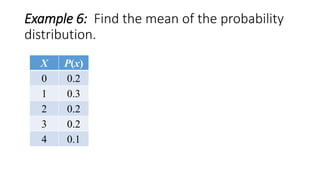
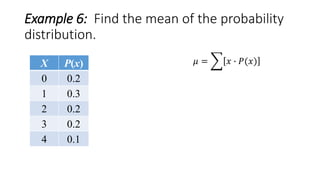
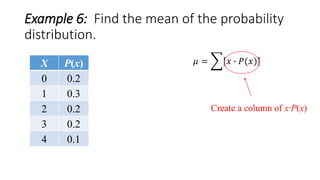
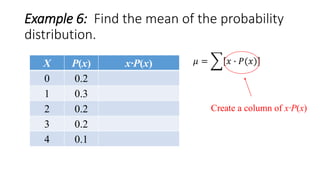
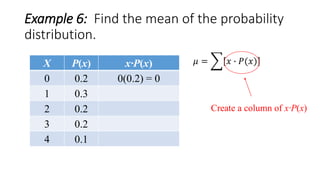
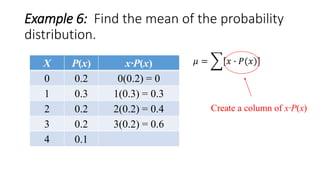
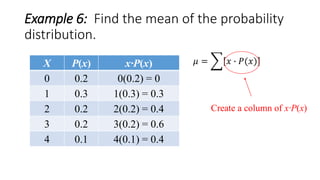
The document shows the steps to calculate the mean of a probability distribution. A table lists the possible values (X) of a random variable, their respective probabilities (P(x)), and the product of each x and P(x). These products are summed to obtain 1.7, which is equal to the mean (μ) of the probability distribution.



![Example 6: Find the mean of the probability
distribution.
X P(x) x∙P(x)
0 0.2 0(0.2) = 0
1 0.3 1(0.3) = 0.3
2 0.2 2(0.2) = 0.4
3 0.2 3(0.2) = 0.6
4 0.1 4(0.1) = 0.4
𝜇 = 𝑥 ∙ 𝑃(𝑥)
Sum the column of x∙P(x)
Σ[x∙P(x)]=1.7](https://image.slidesharecdn.com/meanofadiscreterandomvariable-160626131917/85/Mean-of-a-discrete-random-variable-ppt-11-320.jpg)
![Example 6: Find the mean of the probability
distribution.
X P(x) x∙P(x)
0 0.2 0(0.2) = 0
1 0.3 1(0.3) = 0.3
2 0.2 2(0.2) = 0.4
3 0.2 3(0.2) = 0.6
4 0.1 4(0.1) = 0.4
𝜇 = 𝑥 ∙ 𝑃(𝑥) = 1.7
Σ[x∙P(x)]=1.7](https://image.slidesharecdn.com/meanofadiscreterandomvariable-160626131917/85/Mean-of-a-discrete-random-variable-ppt-12-320.jpg)


